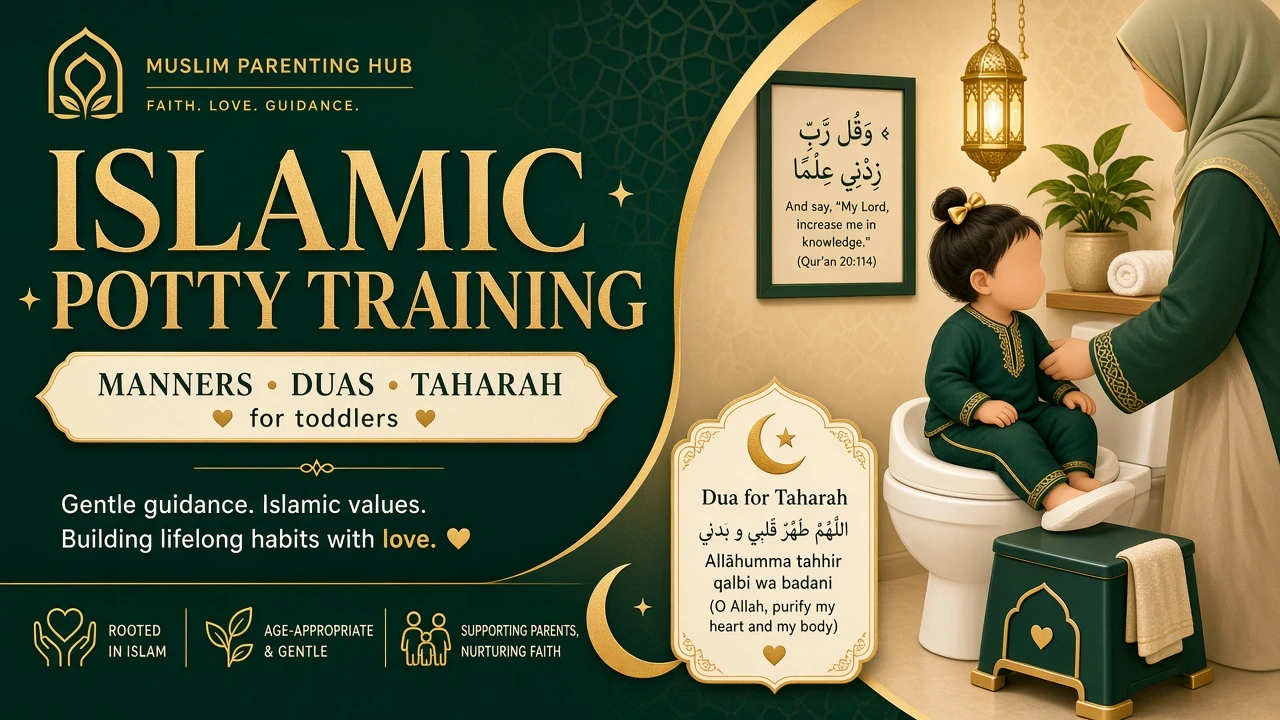
Islamic Potty Training: Toilet Manners, Duas & Taharah Tips for Toddlers
Diapers are full. Your toddler is squirming. Someone says “I need to goooo” — and suddenly you are not only teaching a life skill, you are wondering how Muslim families weave taharah, privacy, and bathroom duas into the messiest season of parenting.
If potty training feels chaotic in your home, you are not behind. You are raising a real child with a real nervous system.
This guide gives you Islamic potty training that fits toddlers and preschoolers: readiness by age, a soft toilet-manners flow, kid-friendly bathroom duas, gentle istinja (water cleaning) habits, bathroom setup tips, tonight scripts, and fridge-style checklists. No perfection. No shame. No fatwa voice — just practical faith at home.
Soft note: This is parenting guidance rooted in widely known Sunnah manners around cleanliness and bathroom etiquette. It is not a fatwa. Follow the scholars and school of thought you trust for rulings on purity, and adapt to your child’s age, sensory needs, and your household’s setup.
Why Islamic Toilet Manners Matter (Even During Potty Training)
Potty training is already about independence. For Muslim families, it is also an early doorway into taharah — the habit of caring about cleanliness because Allah loves those who purify themselves.
You are not trying to turn a two-year-old into a fiqh student. You are planting three seeds:
- The body is an amanah — we treat bathroom time with calm dignity, not jokes that humiliate.
- Cleanliness is part of faith — water, wiping, handwashing, and later wudu all connect.
- Allah is remembered in ordinary places — even a bathroom door can hold a short dua.
Islamic bathroom manners for kids do not require fancy charts or Arabic fluency on day one. They require repeatable cues: enter, privacy, clean, exit, wash, praise.
Related evening rhythm (already on MPH): The After-School Maghrib Routine That Actually Works for Muslim Families — because the same calm coaching voice that works at Maghrib works at the potty door.
Readiness First: Islamic Potty Training by Age Band
Skip the internet race. Readiness beats birthday candles. Use age bands as a map, not a deadline.
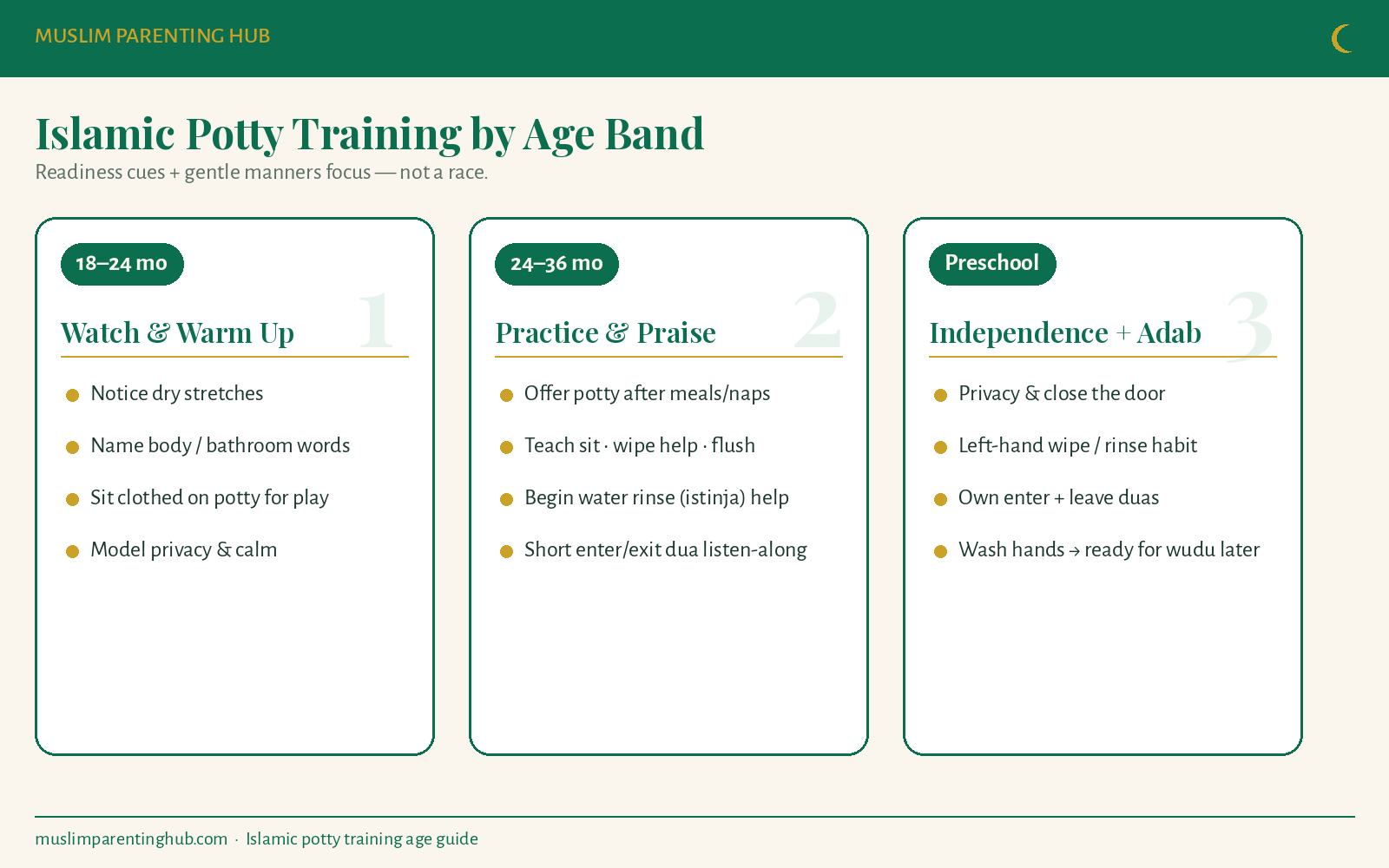
Ages 18–24 months — Watch & Warm Up
Goal: Familiarity, language, and zero pressure.
- Notice longer dry stretches (especially after naps).
- Name body parts and bathroom words without shame.
- Let them sit clothed on a potty for books or songs.
- Model privacy: “Baba/Mama goes in the bathroom and closes the door.”
- Keep diapers as the default; celebrate curiosity, not “success rates.”
Tonight script
“This is the potty. Someday your body will tell you when to sit. Today we just say salam to it.”
Ages 24–36 months — Practice & Praise
Goal: Short practices after natural body cues (meals, wake-ups, play pauses).
- Offer the potty after meals and naps — not every five minutes.
- Teach a simple sequence: sit → wipe help → flush → wash hands.
- Begin water rinse help (istinja lite): you pour/spray; they watch.
- Let them listen along to enter/exit duas while you say them.
- Accidents are information. Change clothes calmly. Reset.
Tonight script
“After snack, we try the potty. If nothing happens, alhamdulillah — we still washed our hands and tried.”
Preschool (about 3–5) — Independence + Adab
Goal: Privacy, ownership of duas, and cleaner habits that later support wudu.
- Close the door; knock before entering someone else’s bathroom.
- Practice left-hand wipe / rinse habits with help as needed.
- Memorize short enter + leave lines (meaning first, wording next).
- Handwashing becomes a bridge to How to Teach Wudu to Preschoolers (Gentle & Fun) ← internal link placeholder: wudu preschool.
- Night dryness may still lag — that is development, not disobedience.
Tonight script
“You’re big enough for privacy. Knock, dua, sit, clean with water, exit dua, wash. I’ll stay nearby if you need help.”
Set Up the Bathroom for Taharah (Not Just “Cute”)
Environment does half the parenting. If the tools are hard to reach, toddlers default to meltdown or avoidance.
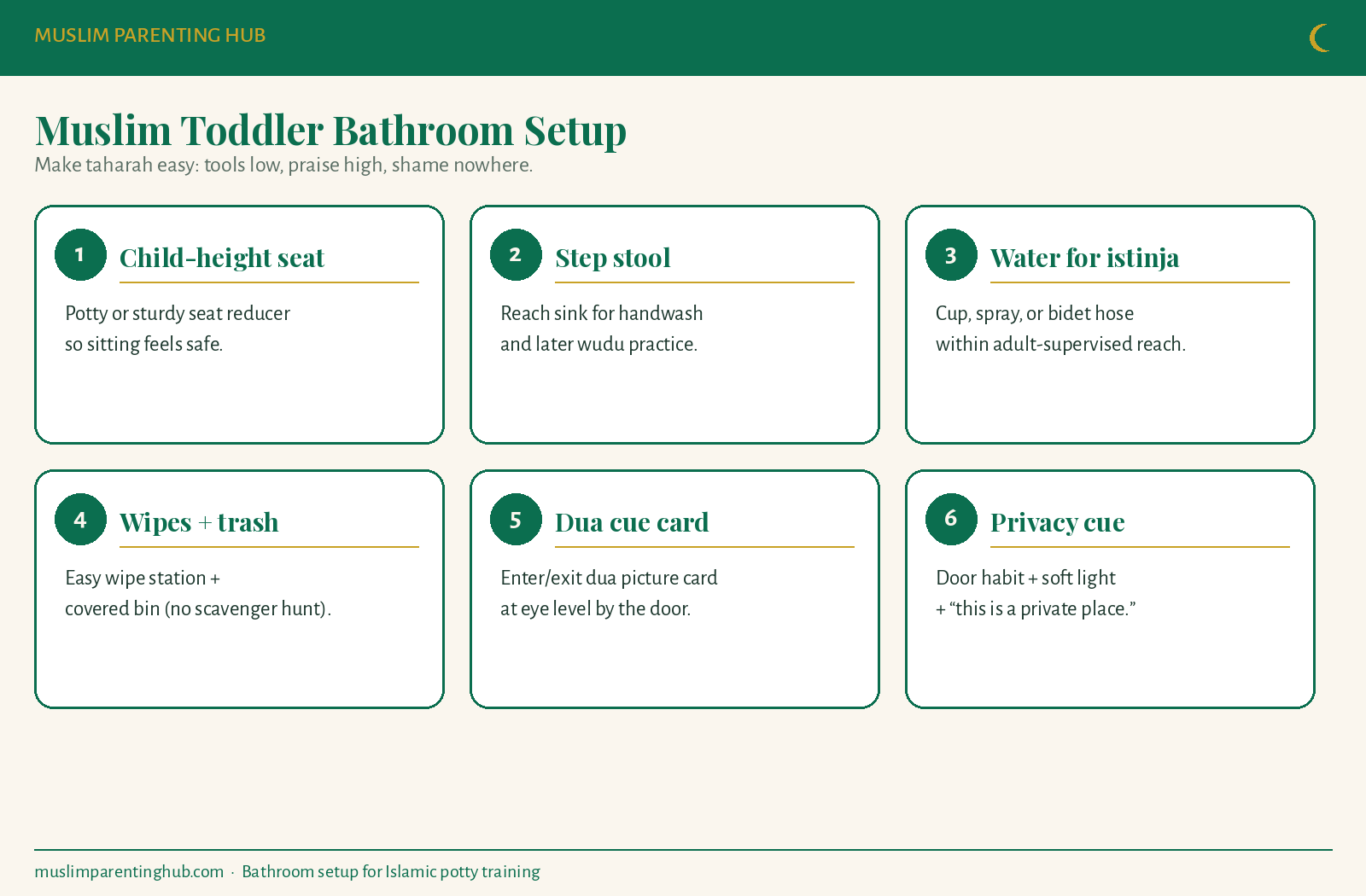
Six setup pieces that lower friction
- Child-height seat — potty chair or sturdy seat reducer so sitting feels safe.
- Step stool — sink access for handwashing (and later wudu practice).
- Water for istinja — small cup, peri bottle, spray, or bidet hose under adult supervision.
- Wipes + covered trash — everything within one calm reach.
- Dua cue card — picture card at child eye-level by the door.
- Privacy cue — door habit, soft light, and language: “This is a private place.”
Optional extras (nice, not required)
- Extra underwear + pants in a basket by the door
- A small “accident towel” (no drama)
- Fragrance-free soap kids can pump themselves
- A timer song for handwashing (20 seconds)
Tonight script
“Look — your stool, your water cup, your dua card. The bathroom is ready for you. I’m ready too.”
The Islamic Toilet Manners Flow (Coach One Step at a Time)
Kids learn sequences from narration, not lectures. Use the same five beats every time so the habit becomes muscle memory.
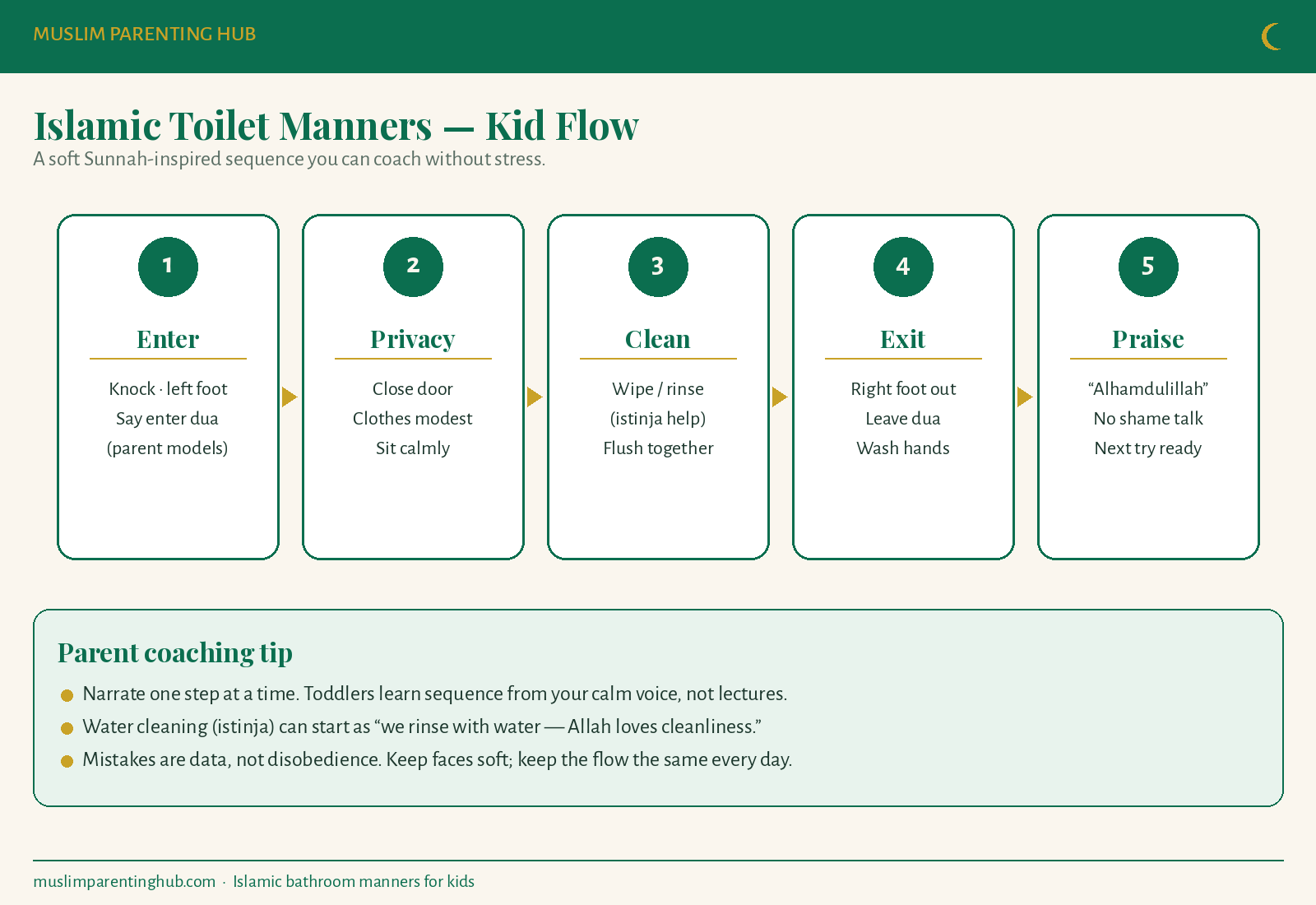
Step 1 — Enter
- Knock if someone might be inside.
- Soft Sunnah cue many families teach: enter with the left foot when possible.
- Say the enter dua (parent models; child echoes one word at a time).
Step 2 — Privacy
- Close the door.
- Keep clothes handling modest and matter-of-fact.
- Sit calmly. For little boys, many parents teach sitting while learning control (follow your trusted guidance).
- No phones in your hand. Your face is the curriculum.
Step 3 — Clean (Istinja help)
- Wipe thoroughly; then rinse with water when you are teaching istinja for toddlers.
- You lead the water at first. Praise the idea: “We clean with water — Allah loves cleanliness.”
- Flush together so the sound isn’t scary.
Step 4 — Exit
- Soft cue many homes use: exit with the right foot when possible.
- Say the leave dua (even a shortened “Ghufraanaka”).
- Wash hands with soap — every time.
Step 5 — Praise
- “Alhamdulillah — you tried / you remembered / you washed.”
- Never use bathroom talk as humiliation, even as a joke.
- If there was an accident, narrate the reset: “Clothes change. Next try soon. I love you.”
Parent coaching tip
Narrate one step at a time. Toddlers cannot hold a five-point lecture. Your calm voice is the adab.
Bathroom Duas for Little Muslims (Meaning First)
Arabic is beautiful. Meaning is what sticks for toddlers. Teach the heart of the dua, then layer wording.
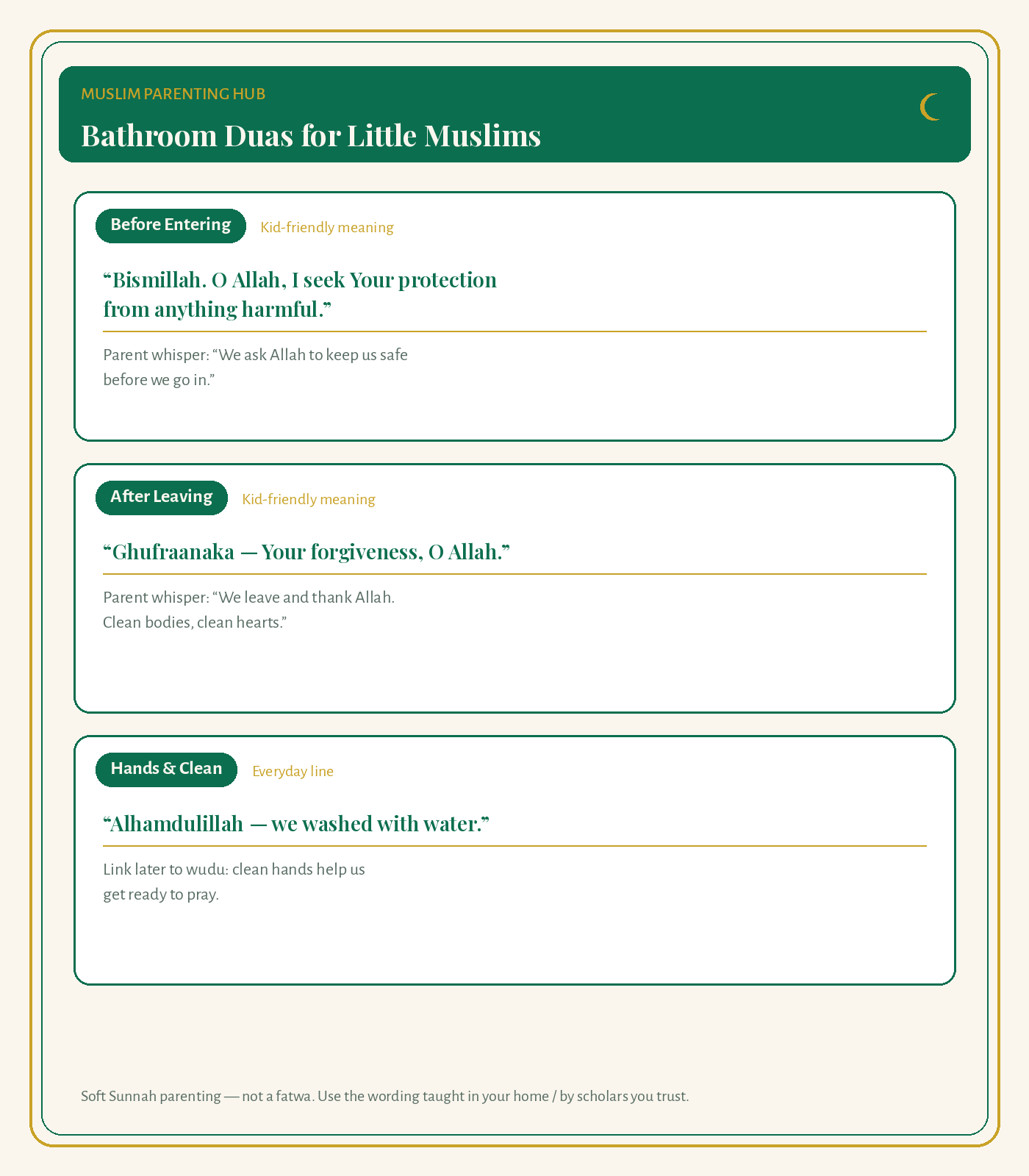
Before entering — kid-friendly meaning
Parent whisper: “We ask Allah to keep us safe before we go in.”
Simple English line to start:
“Bismillah. O Allah, protect us from anything harmful.”
Then, when ready, use the wording taught in your home / by scholars you trust for the bathroom enter dua.
After leaving — kid-friendly meaning
Parent whisper: “We leave and ask Allah’s forgiveness. Clean bodies, clean hearts.”
Simple line many children can hold:
“Ghufraanaka — Your forgiveness, O Allah.”
Hands & clean — everyday bridge
“Alhamdulillah — we washed with water.”
This line becomes a bridge to wudu later, and to heart-duas in other moments. Related later guide: Teach Your Child to Make Dua From the Heart ← internal link placeholder: dua from heart.
How to practice without pressure
| Stage | What to do |
|---|---|
| Listen-along | You say the full line; child hears it daily at the door. |
| Echo | Child repeats the last word or “Ameen.” |
| Own line | Child says a shortened version independently. |
| Full wording | Add the complete dua when language is ready. |
Tonight script
“Door time. Bismillah — we ask Allah to protect us. Ready? Left foot with me.”
Istinja & Taharah Tips for Toddlers (Gentle, Practical)
Istinja means cleaning the private parts after using the toilet — commonly with water (and tissue as needed). For toddlers, think coaching, not ritual anxiety.
A toddler-safe approach
- Wipe first (parent help as needed) so dirt lifts.
- Rinse with water — cup pour, gentle spray, or hose on low, always supervised.
- Pat dry so underwear stays comfortable.
- Wash hands — soap, twenty seconds, celebration.
Sensory-sensitive kids
Some children hate spray sounds or cold water.
- Warm the water slightly.
- Let them pour from a small cup (control reduces fear).
- Offer choices: “Cup or wipe-first today?”
- Keep sessions short; stop before panic.
What not to do
- Do not scold for imperfect wiping — teach, then re-check quietly.
- Do not shame wet underwear.
- Do not turn taharah into fear of “being najis forever.” Children need hope and help.
- Do not compare siblings’ timelines out loud.
Link to salah life (without rushing)
Clean bathroom habits make later wudu feel familiar: water, sequence, calm. When Maghrib comes, the same gentle coaching applies — see the Maghrib routine guide linked above.
If bedtime accidents spike during training, keep nights compassionate. Related later guide: When Your Muslim Toddler Fights Bedtime ← internal link placeholder: bedtime struggles.
Tonight Scripts Library (Copy-Paste Calm)
Use the same words for a week. Predictability lowers power struggles.
On resistance
“You don’t have to love the potty. You just try sitting for one song. I’ll stay.”
On fear of the flush
“Flush is loud, not dangerous. You can cover ears. I’ll press the button.”
On an accident
“Accident. Not a naughty. We clean, we change, we try again later. I am still your calm parent.”
On sibling teasing
“Bathroom talk stays kind. In this house we protect dignity — that’s Islamic manners.”
On success
“MashaAllah — you remembered water and hands. That is real taharah practice.”
On rushed mornings
“Quick version: potty, wipe, splash of water, hands, dua at the door. Done. Good try.”
On public bathrooms
“Same manners everywhere: privacy, clean as we can, wash hands, short dua in our hearts.”
Common Problems (And Calm Fixes)
“They only go in a diaper.”
Offer potty at high-probability times, then return to diaper without a speech. Shrink the drama. Many kids need weeks of “both available.”
“They pee standing everywhere.”
Reset location: “Pee belongs in the potty.” Supervise play zones. For teaching control, sitting is often easier — choose what your household guidance supports and stay consistent.
“They refuse water cleaning.”
Start with a damp wipe + one symbolic cup rinse on the parent’s hand demonstration. Build tolerance slowly. The goal is a lifelong comfort with water, not a battle tonight.
“Constipation is making everything worse.”
Pause aggressive training. Focus on fluids, fiber, movement, and pediatric advice. Pain teaches bathroom avoidance faster than any chart.
“Grandparents undermine our method.”
Share one sentence: “We’re teaching potty + water clean + short duas — please use our calm words.” Give them the fridge checklist so everyone coaches the same playbook.
“Night training isn’t happening.”
Night dryness is often hormonal, not moral. Use protective bedding, skip shame, keep daytime skills growing. Protect sleep.
“I’m exhausted and snapping.”
Protect a minimum: one calm sit + handwash + one dua word. Rebuild warmth tomorrow. Shame is not a Sunnah strategy.
A 7-Day Starter Plan (Low Friction)
- Day 1–2: Setup only — stool, seat, water cup, dua card. Practice enter/exit words with clothes on.
- Day 3–4: Offer potty after meals/naps. Celebrate sits, not only pees.
- Day 5: Add wipe help + a tiny water rinse with heavy praise.
- Day 6: Child echoes one dua word at the door.
- Day 7: Full flow once: enter → privacy → clean → exit → wash → “Alhamdulillah.”
Do not launch underwear-only week on a travel day. Stack wins at home first.
Printable Mentality Checklists (Fridge Version)
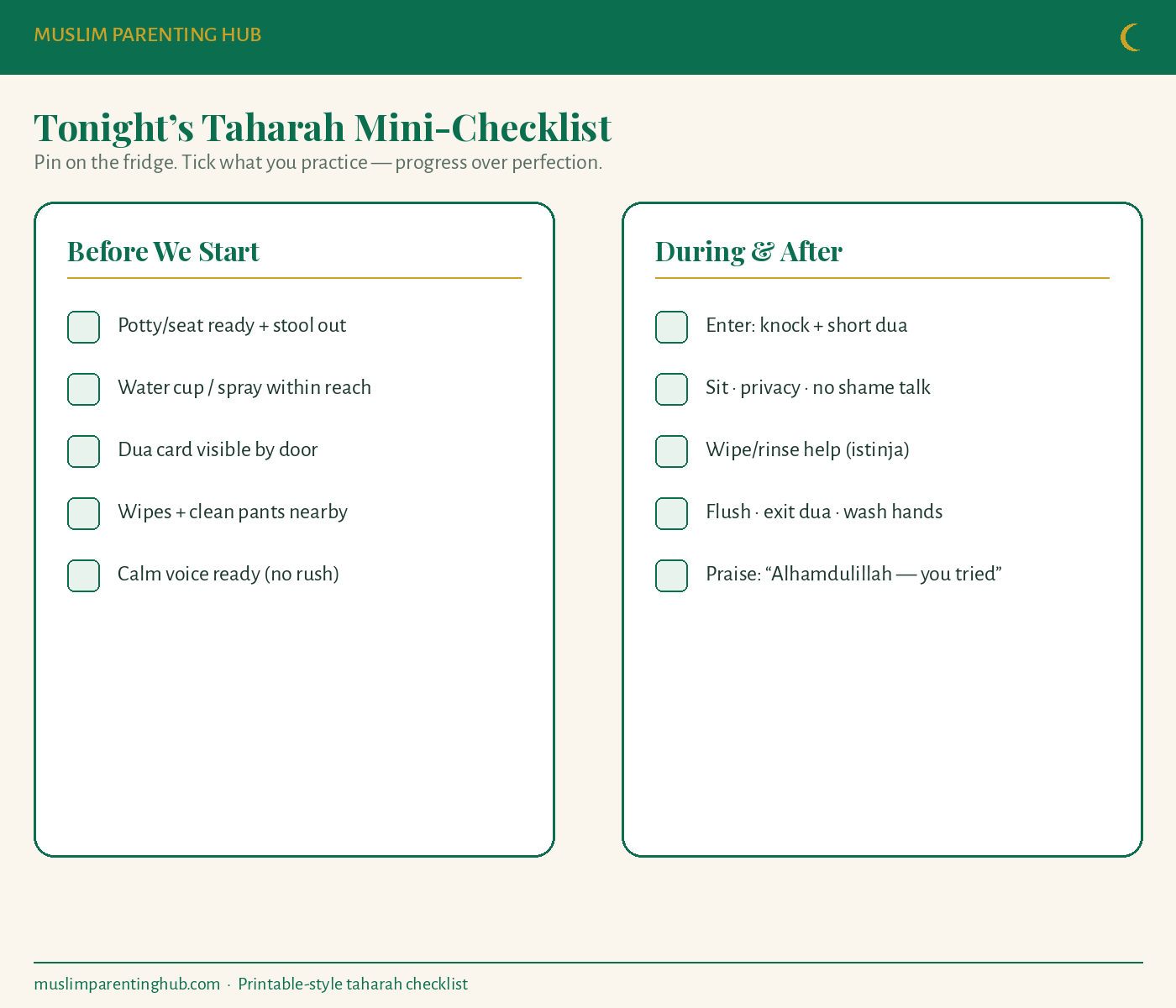
Before we start
- [ ] Potty/seat ready + stool out
- [ ] Water cup / spray within reach
- [ ] Dua card visible by door
- [ ] Wipes + clean pants nearby
- [ ] Calm voice ready (no rush)
During & after
- [ ] Enter: knock + short dua
- [ ] Sit · privacy · no shame talk
- [ ] Wipe/rinse help (istinja)
- [ ] Flush · exit dua · wash hands
- [ ] Praise: “Alhamdulillah — you tried”
Weekly dignity check (parents)
- [ ] No teasing about bathroom skills
- [ ] Same words used by all caregivers
- [ ] Accidents handled as logistics
- [ ] One dua practiced without pressure
- [ ] Hands washed every time
Sample Day Schedules (Steal One)
Version A — Home day, 24–36 months
| Cue | Action |
|---|---|
| Wake-up | Potty offer → water rinse help → hands → exit dua |
| After breakfast | Potty offer (high chance) |
| Mid-morning | Watch for pee dance; invite once |
| After lunch / nap | Potty offer + praise for trying |
| Before Maghrib / outing | Quick try so the trip is easier |
| Bedtime | Diaper or pull-up if nights are wet — no shame |
Version B — Preschooler with some independence
- Morning: child leads door dua; parent spot-checks cleaning.
- School/daycare: pack spare clothes + note your water preference if relevant.
- Evening: one “full manners flow” practice when nobody is rushed.
- Connect handwashing to tomorrow’s wudu learning.
Version C — Sensory-sensitive / anxious child
- Keep sessions under two minutes.
- Use the same song and the same cup.
- Allow diaper for bowel movements longer if needed.
- Celebrate proximity to the bathroom as progress.
Soft Sunnah Anchors (Keep Them Soft)
These are common manners many Muslim homes teach. Present them as loved habits, not scare tactics:
- Remembering Allah when entering and leaving the bathroom
- Caring about cleanliness and removing impurities carefully
- Preferring water for cleaning when reasonably possible
- Guarding privacy and modesty
- Avoiding unnecessary conversation inside (model quietly; don’t police toddlers harshly)
- Washing hands as a bridge to purity habits
Again: parenting tone, not courtroom fiqh. If you are unsure about a ruling, ask a trusted local teacher — and keep your child’s dignity intact while you learn.
Internal Links (MPH Cluster)
- The After-School Maghrib Routine That Actually Works for Muslim Families — calm coaching voice for evening worship
- How to Teach Wudu to Preschoolers (Gentle & Fun) — next step after handwashing habits (placeholder: wudu preschool)
- Teach Your Child to Make Dua From the Heart — deepen dua beyond bathroom lines (placeholder: dua from heart)
- When Your Muslim Toddler Fights Bedtime — for night wetting / bedtime battles (placeholder: bedtime struggles)
FAQ: Islamic Potty Training & Toilet Manners for Muslim Toddlers
What is Islamic potty training?
Islamic potty training is regular potty learning plus gentle Muslim manners: privacy, cleanliness (including water cleaning/istinja when suitable), short bathroom duas, and shame-free coaching that treats the child’s body with dignity.
When should I start potty training my Muslim toddler?
Start when readiness signs appear — often between about 18 and 36 months — not because of social pressure. Watch for dry stretches, interest in the bathroom, and ability to follow a simple two-step instruction.
How do I teach Islamic bathroom manners to kids?
Use a repeatable flow: knock/enter with dua, privacy, clean (wipe + water help), exit with dua, wash hands, praise. Keep language short and consistent across caregivers.
How do I teach istinja to a toddler?
Parent-led at first: wipe, then a gentle rinse with a cup or spray, pat dry, wash hands. Narrate “we clean with water.” Increase independence slowly. Never force a terrified child; desensitize kindly.
What dua should my child say before entering the bathroom?
Begin with meaning: asking Allah for protection. Then teach the wording used in your home or by scholars you trust. Toddlers can start with “Bismillah” and grow into the full enter dua.
What if my child has constant accidents?
Expect accidents during learning. Respond with logistics (clean, change, reset), not lectures. Check for constipation, overtiredness, or starting too early. Protect dignity every time.
Should boys sit or stand while learning?
Many families find sitting easier for aim and cleanliness while learning. Follow what your trusted guidance recommends and what keeps the bathroom clean and the child calm. Consistency matters more than internet debates.
How does potty training connect to wudu later?
Handwashing, water comfort, sequences, and calm coaching all transfer. Preschoolers who already know “water + steps + dua” often find wudu less foreign. See the future MPH preschool wudu guide linked above.
How do I handle potty training during Maghrib or bedtime routines?
Keep a mini version: quick potty offer before Maghrib leave-the-house moments, and compassionate nighttime protections. Don’t let training wars destroy evening salah or sleep — those anchors matter too.
Closing: Start Tonight, Keep Dignity Intact
You do not need a perfect Arabic poster wall to raise a child who loves taharah.
You need a stool, a water cup, a soft voice, one door dua, and a promise that accidents will never cost them their dignity.
Tonight is enough:
- Put the dua card by the bathroom door
- Place a water cup within reach
- Practice enter → sit → clean → exit → wash once
- End with “Alhamdulillah — you tried”
May Allah make cleanliness beloved to your children, make your coaching gentle, and make these small bathroom moments a seed of lifelong taharah and adab. Ameen.
Published for Muslim Parenting Hub · Practical faith at home · English guide for parents of toddlers and preschoolers
FAQs
What is Islamic potty training?
Islamic potty training is regular potty learning plus gentle Muslim manners: privacy, cleanliness (including water cleaning/istinja when suitable), short bathroom duas, and shame-free coaching that treats the child’s body with dignity.
When should I start potty training my Muslim toddler?
Start when readiness signs appear—often between about 18 and 36 months—not because of social pressure. Watch for dry stretches, interest in the bathroom, and ability to follow a simple two-step instruction.
How do I teach Islamic bathroom manners to kids?
Use a repeatable flow: knock/enter with dua, privacy, clean (wipe + water help), exit with dua, wash hands, praise. Keep language short and consistent across caregivers.
How do I teach istinja to a toddler?
Parent-led at first: wipe, then a gentle rinse with a cup or spray, pat dry, wash hands. Narrate that we clean with water. Increase independence slowly and never force a terrified child.
What dua should my child say before entering the bathroom?
Begin with meaning: asking Allah for protection. Then teach the wording used in your home or by scholars you trust. Toddlers can start with Bismillah and grow into the full enter dua.
What if my child has constant accidents?
Expect accidents during learning. Respond with logistics (clean, change, reset), not lectures. Check for constipation, overtiredness, or starting too early. Protect dignity every time.
Should boys sit or stand while learning?
Many families find sitting easier for aim and cleanliness while learning. Follow what your trusted guidance recommends and what keeps the bathroom clean and the child calm.
How does potty training connect to wudu later?
Handwashing, water comfort, sequences, and calm coaching all transfer. Preschoolers who already know water, steps, and dua often find wudu less foreign.
How do I handle potty training during Maghrib or bedtime routines?
Keep a mini version: quick potty offer before outings or Maghrib transitions, and compassionate nighttime protections. Don’t let training wars destroy evening salah or sleep.