

Bathroom Accidents at School: A Calm Islamic Response for Muslim Parents (Taharah Without Shame)
The school number pops up on your phone at 11:20 a.m. “Hi, this is the front office. Everything’s okay, but Yusuf had a little accident. He’s in the nurse’s office. Could you bring a change of clothes?”
Your stomach drops. Maybe he has been fully potty trained for two years. Maybe it’s the second time this month. Maybe you’re at work, forty minutes away, and your first thought is, Why didn’t he just ask to go?
Take a breath. Bathroom accidents at school are very common in kindergarten through second grade, and they still happen to plenty of eight- and nine-year-olds. In most cases the child is not being lazy or careless. They are a small person in a big, loud building with rules about when you can leave the room.
This guide gives you a calm, Islamic way to respond: what to say at pickup, how to handle taharah (purity) at home without drama, what to pack, how to talk to the teacher, and how to prevent the next one. It pairs well with our guide to Islamic bathroom manners at school, which covers the everyday routine in public restrooms.
Why Accidents Happen at School (Even After Potty Training)
Before you think about consequences, think about causes. The most common ones are ordinary:
- Holding it too long. Kids get absorbed in centers, recess, or a game and ignore the signal until it’s too late.
- Not wanting to ask. Some children are shy about raising a hand and saying “bathroom” in front of 24 classmates. Others were told “wait until after the lesson” once and now assume they always have to wait.
- The bathroom itself. Automatic flushes that roar, stalls without locks, no water for istinja, older kids hanging around. A Muslim child who is used to a lota or bidet at home may avoid the school bathroom completely.
- Constipation. This is one of the biggest hidden causes. A full bowel presses on the bladder and leads to both wetting and soiling. Kids who avoid school bathrooms often hold in poop, too.
- Stress and change. A new school year, a new sibling, a move, a hard friendship, a substitute teacher. Accidents are often the body’s way of saying, “Something is a lot right now.”
- Medical issues. Urinary tract infections, sudden thirst, or pain can show up first as accidents.
Notice that almost none of these are “bad behavior.” That shapes everything about how we respond.
The Islamic Lens: No Shame, No Sin, Just Care
Children are not held accountable
The Prophet ﷺ said the pen is lifted from three people, including “the child until he reaches puberty” (Abu Dawud). A five-year-old who wets his pants has not done anything sinful. There is nothing to repent from, nothing to feel guilty about in front of Allah. That truth alone can lower the temperature in your house.
The Prophet ﷺ responded to accidents with calm
A baby boy was brought to the Prophet ﷺ and urinated on his lap. He did not scold anyone or hand the baby back in disgust. He simply asked for water and poured it over the spot (Bukhari). On another occasion, a Bedouin man urinated inside the masjid itself. The companions jumped up to stop him, and the Prophet ﷺ told them to leave him alone, then had a bucket of water poured over the place. He explained that the masjid is not a place for that, but gently, after the fact (Bukhari and Muslim).
If the best of creation could stay calm about urine in the masjid, we can stay calm about wet jeans in the nurse’s office.
Taharah is a skill, not a test of worth
Cleanliness matters in Islam, and we want our children to grow up loving purity. But taharah is learned step by step, the same way reading is. A child who has an accident needs to learn what to do next, not that they are dirty. Keep those two messages separate.
At Pickup: The First Five Minutes Matter Most
Your child will read your face before they hear your words. Many kids spend the whole afternoon dreading the moment you find out. Make it the moment they feel safe again.
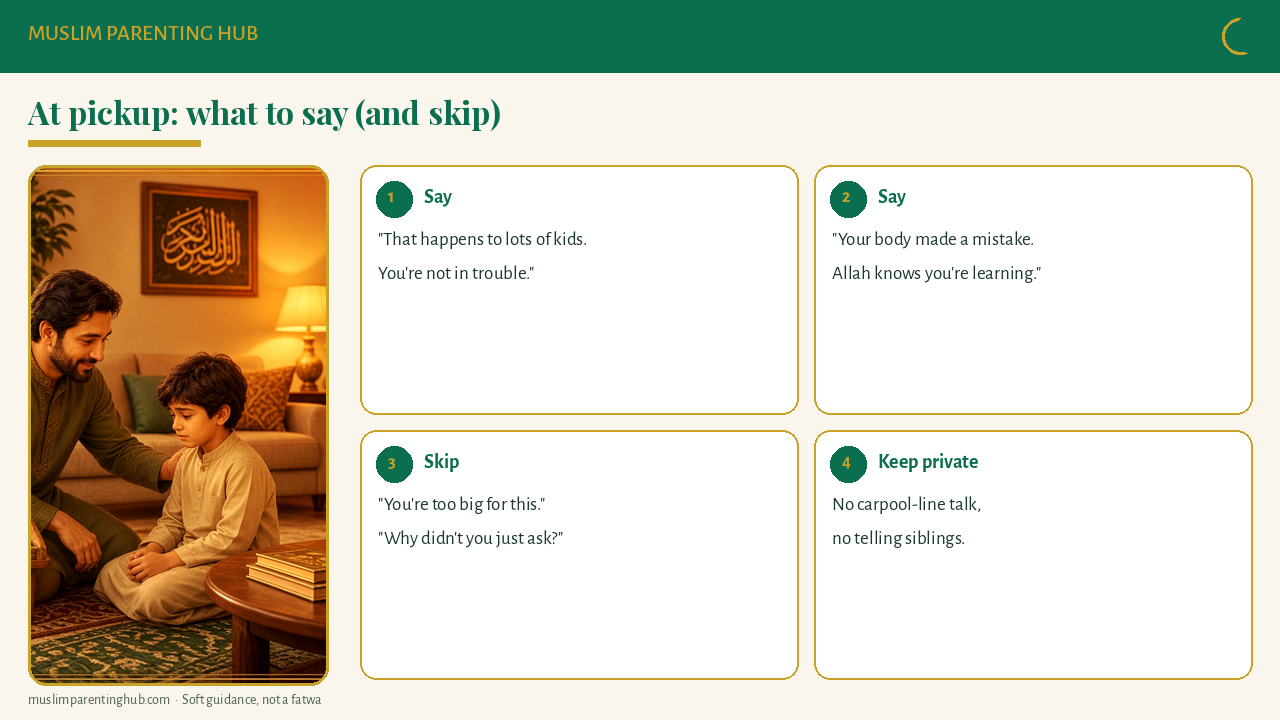
Do: - Kneel down, smile, and give a hug if they want one. - Use a light, matter-of-fact tone. - Keep the conversation private. Not in front of the office staff, not in the carpool line, not on speakerphone with Grandma.
Say something like:
“Assalamu alaikum, habibi. I heard you had an accident. That happens to lots of kids. You’re not in trouble. Let’s go home and get clean.”
“Your body made a mistake. Bodies do that sometimes. Allah made bodies, and He knows kids are still learning.”
“I’m proud of you for going to the nurse and telling a grown-up.”
Avoid: - “You’re too big for this.” - “Why didn’t you just ask?” (Save the problem-solving for later.) - “Everyone is going to laugh at you.” - Telling siblings or relatives. - Taking away recess, screens, or a treat as punishment.
If your child is crying, let them cry. You can say, “You felt embarrassed. That’s a hard feeling. It’s over now.” Embarrassment shrinks when it is named and met with love.
At Home: Taharah Step by Step (Without a Lecture)
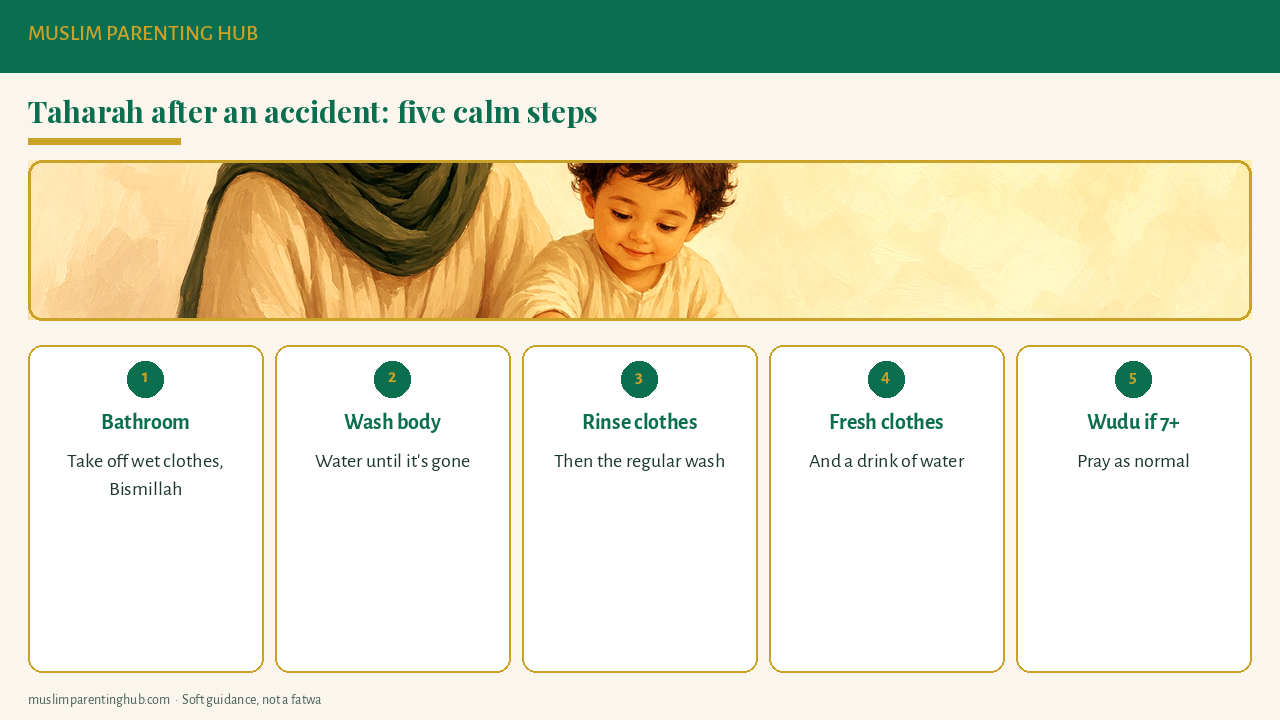
Once you’re home, turn clean-up into a calm routine rather than an emergency. If your child is old enough, let them do most of it with you nearby, so they learn they can handle it.
- Bathroom first. Remove wet or soiled clothes. Say Bismillah quietly as you go, and the bathroom dua if you usually do.
- Wash the body. Use water to clean the private area and any skin the urine or stool touched. For urine, washing with water until it’s gone is enough. For stool, remove it first, then wash. A quick shower is often easiest.
- Clean clothes. Rinse the soiled clothes with water until no trace of the impurity remains, then put them in the regular wash. You don’t need special soap or prayers.
- Fresh clothes and a drink of water.
- Wudu if it’s prayer time. If your child is seven or older and praying, they make wudu and pray as normal. If the accident happened before Dhuhr at school, older kids can pray it at home once they’re clean, within its time.
Keep the language neutral: “Now we wash with water, now your body is clean, now your clothes go in the wash.” You are teaching that impurity has a simple fix. That’s the heart of taharah.
A note on waswasa (over-worry): Some anxious kids, especially sensitive ones around eight to ten, start to worry constantly that they are “not clean.” Don’t feed that worry. Teach the simple rule (wash with water until it’s gone) and then say, “It’s clean now. Allah made it easy.” If the worry grows, talk to a knowledgeable teacher and your pediatrician.
If your child also has nighttime accidents, our guide to bedwetting with no-shame taharah tips covers mattress protectors, night washing, and Fajr.
Pack a “Just in Case” Kit
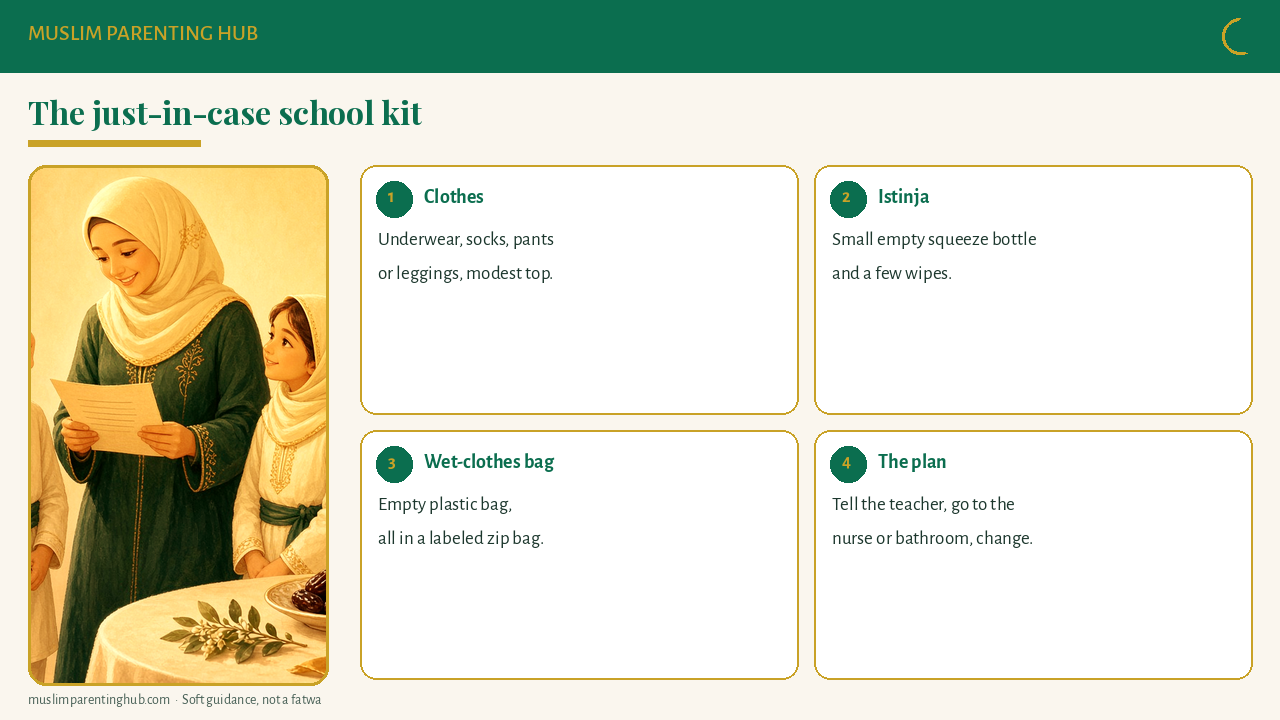
Most elementary schools in the US keep some spare clothes in the nurse’s office, but they may not fit, and they may not be modest enough for your family. Pack your own and tell your child exactly where it is.
Backpack kit (in a gallon zip bag labeled with their name): - Underwear and socks - Pants or leggings (and a long top for girls if your family prefers) - A small travel squeeze bottle for istinja (empty, to fill at the sink) - A few unscented wipes - An empty plastic bag for wet clothes
Some families keep a second kit with the teacher or in the nurse’s office. Refresh sizes when the season changes, especially from shorts weather to winter.
Show your child the kit and practice once at home: “If you have an accident, you can tell your teacher, take this bag to the nurse or the bathroom, change, and put the wet clothes in this bag.” Knowing there’s a plan makes kids less anxious, and less anxiety often means fewer accidents.
Talk to the Teacher (Kindly and Briefly)
Teachers handle accidents every year, and most will gladly help if they know what’s going on. A short, warm email is usually enough. Here’s a template you can adapt:
Hi Ms. Carter,
Thank you for helping Yusuf today. He’s doing well at home and we think he may be waiting too long to go, or feeling shy about asking in front of the class.
Would it be possible for him to use a quiet signal (like crossing his fingers) or a bathroom pass, so he can go without having to ask out loud? We’ve also put a change of clothes in his backpack.
We appreciate you keeping this private. Please let us know if you notice a pattern, like a certain time of day.
Thank you, Mariam (Yusuf’s mom)
If accidents keep happening, ask for a quick meeting with the teacher and school nurse. You can also ask about scheduled bathroom breaks before recess and lunch. If your child has a medical reason, a 504 plan can formally include bathroom access. Our list of questions to ask at a parent-teacher conference has more wording for faith-related needs like wudu and prayer space.
Preventing the Next Accident
You can’t control what happens at school, but you can stack the odds in your child’s favor.
Build a “go before you go” habit
Bathroom before leaving the house, before recess, before lunch, and before the bus home. Make it a rule, not a question: “Everybody tries before we leave,” whether or not they “need to.”
Practice asking at home
Role-play the classroom. You’re the teacher, they raise their hand: “May I please use the restroom?” Practice the quiet signal, too. Silly voices help. Shy kids need rehearsal, not reminders.
Make the school bathroom less scary
Many Muslim kids avoid school bathrooms because of the water issue. Teach a simple school routine: tissue first, then water from a small bottle if possible, or wipes if not. If your child knows exactly what to do, they’re far less likely to hold it all day. If the automatic flush scares younger kids, a sticky note over the sensor (some parents send one in the kit) solves the problem.
Watch water and fiber
Kids who drink very little at school to avoid the bathroom often get constipated, which makes accidents worse. Send a water bottle, offer fruits, vegetables, beans, and whole grains, and notice if your child is going for poop less than every couple of days.
Notice the pattern
Keep a simple note for two weeks: time of accident, what was happening (recess, specials, after lunch), what they drank. Patterns often jump out. “Every accident is right after recess” usually means they need a bathroom stop on the way in.
Lower the pressure at home
If you’ve been nagging about the bathroom, step back. The more attention accidents get, the more anxious some kids feel. Our guide for when Islamic potty training stalls has patience scripts that work just as well for school-age setbacks.
If Classmates Notice or Tease
Sometimes other kids see. Give your child short, confident lines to use:
- “It was an accident. It happens.”
- “I’m fine now, thanks.”
- “Please stop. That’s not kind.”
Then tell them: “If someone keeps teasing you, tell your teacher and tell me. That’s not tattling; that’s getting help.” If teasing continues, contact the school. Persistent mocking about something private can be bullying.
At home, you might remind them of the Muslim way to treat others’ mistakes: “Allah covers our mistakes, and we cover other people’s.” The Prophet ﷺ said that whoever covers a Muslim’s faults, Allah will cover his faults on the Day of Judgment (Muslim). This also teaches your child how to treat a classmate who has an accident someday.
When to Call the Pediatrician
Most school accidents are about habits and stress, but check with your child’s doctor if:
- Accidents start suddenly after a long dry stretch
- Your child complains of burning, pain, or needing to go very often
- You notice unusual thirst or weight loss
- There’s stool in the underwear regularly (often a sign of constipation)
- Daytime accidents continue past age 6 despite routines
- Your child seems very anxious, withdrawn, or has other big changes
There’s no shame in getting help. Seeking treatment is part of taking care of the trust (amanah) of our children’s bodies.
What Your Child Should Remember
When it’s all over, sum it up in one sentence your child can carry: “Accidents happen, I know what to do, and my family loves me no matter what.”
That’s the message you want stuck in their heart, far more than any memory of wet pants. If you’d like to strengthen the basics at home, our Islamic potty training plan with toilet manners and duas is a gentle refresher for younger siblings, too.
FAQ
Is my child sinning if they have a bathroom accident?
No. Children are not held accountable before puberty, and an accident is not a choice. Simply wash the body and clothes with water and move on calmly.
How do I clean clothes after a urine accident Islamically?
Rinse the affected area with water until no trace of the urine remains, then wash as normal. For stool, remove the solid first, then rinse with water and launder.
Should I punish my child for an accident at school?
No. Punishment usually increases anxiety and holding, which makes accidents more likely. Focus on causes, a spare-clothes kit, and a quiet bathroom plan with the teacher.
What should I put in a spare-clothes kit for school?
Underwear, socks, pants or leggings, a modest top if needed, a small squeeze bottle for istinja, a few wipes, and an empty bag for wet clothes, all labeled in a zip bag.
Can my child pray after an accident at school?
Yes. Once they wash the impurity off their body and change into clean clothes, they make wudu and pray as normal. Children under seven are still practicing, so keep it gentle.
When should I worry about daytime accidents?
Call your pediatrician if accidents start suddenly, come with pain or frequent urination, involve regular soiling, or continue past about age 6 despite good routines.
Related guides
Related articles
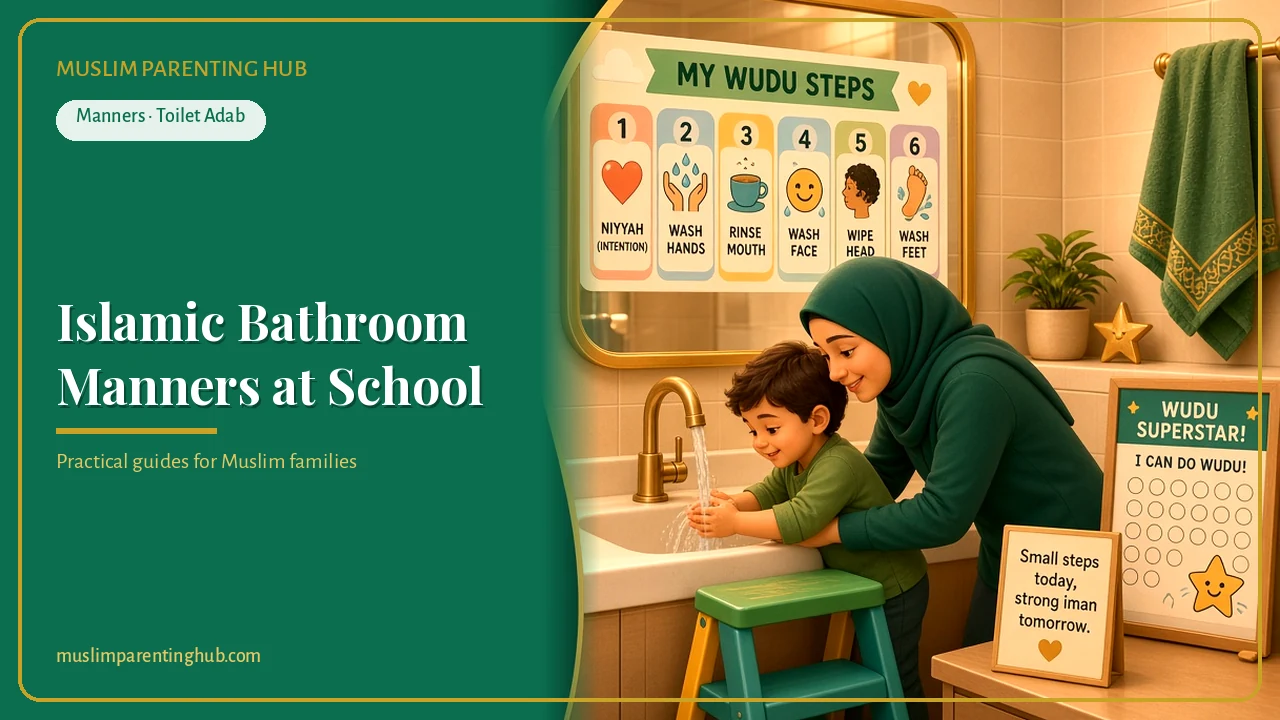
Islamic Bathroom Manners at School: A Kid-Friendly Guide to Public Restrooms
Help your child keep Islamic toilet manners at school and in public restrooms: duas, privacy, istinja without a lota, and calm scripts for teachers.
Read guide →
When Islamic Potty Training Stalls: Soft Patience Scripts & Taharah Without Pressure
Islamic potty training stalled? Soft scripts, taharah habits without pressure, regressing toddlers, and calm US-family tips that keep dignity intact.
Read guide →
Bedwetting in Muslim Kids: Calm Nighttime Tips, Taharah Basics and No-Shame Scripts
Is bedwetting normal? Calm tips for Muslim parents: what's typical by age, taharah for sheets and Fajr, no-shame scripts, and when to call the doctor.
Read guide →
Islamic Potty Training: A Calm 7-Day Plan, Bathroom Duas & Toilet Manners for Toddlers
Potty training a Muslim toddler? Get a calm 7-day plan, easy bathroom duas with meaning, simple istinja steps, and fridge checklists—no shame, no battles.
Read guide →