Bathroom Duas for Kids: What to Say Before and After the Toilet (Easy Words + a 5-Day Plan)
Your toddler has just learned to use the potty. Now comes the part many Muslim parents look forward to: teaching the little words that turn an ordinary bathroom trip into a moment of remembering Allah.
The bathroom duas are among the first duas most Muslim children learn, and for good reason. They are short, they are used several times a day, and they teach a child that Allah protects us everywhere, even in the most private places.
This guide gives US Muslim families the exact words, simple meanings kids understand, a picture-free way to remember them, and a calm five-day plan for ages 2–8. It is gentle home guidance, not a fatwa. If your family follows a specific teacher or madhhab detail, follow that.
If you are just starting potty training, begin with our full guide to Islamic potty training without shame. The duas fit right into that routine.
The Two Bathroom Duas (Words + Meanings)
Before Entering: Bismillah + the Protection Dua
Say these before stepping into the bathroom, at the door:
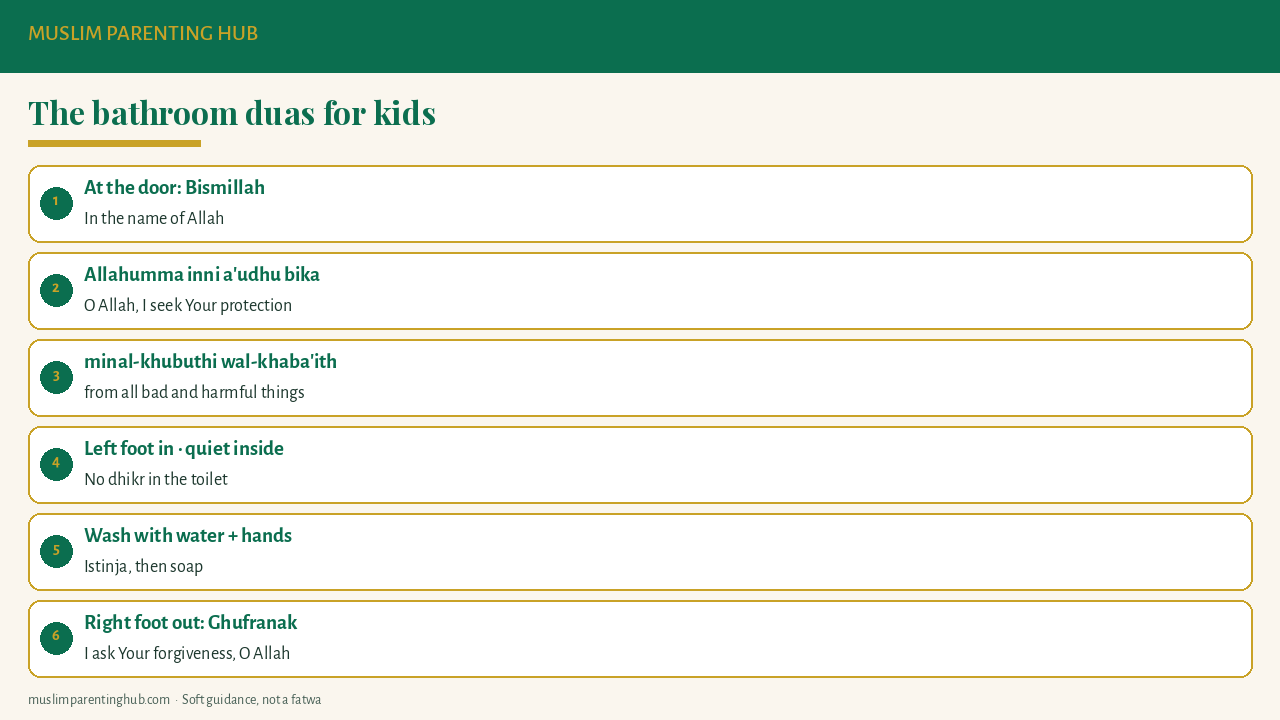
Bismillah. Allahumma inni a’udhu bika minal-khubuthi wal-khaba’ith. “In the name of Allah. O Allah, I seek Your protection from all bad and harmful things.”
The Prophet ﷺ taught this dua when entering the toilet (Bukhari, Muslim). He also taught that saying Bismillah when entering the toilet is a screen that protects a person’s privacy from the jinn (Tirmidhi). Scholars translate al-khubuth wal-khaba’ith as evil ones among the jinn, male and female, or as all filth and harmful things.
For kids: “We ask Allah to keep us safe from anything bad.” That is enough. Small children don’t need details about jinn to say this dua. (If your child asks, our article on talking about the unseen without fear can help later.)
After Leaving: Ghufranak
Say this right after stepping out:
Ghufranak. “I ask for Your forgiveness, O Allah.”
This one word comes from the Prophet ﷺ, who said it when leaving the toilet (Abu Dawud, Tirmidhi).
For kids: “It means, Allah, please forgive me. It’s a little thank-you-and-sorry word to Allah.” Some scholars explain that we ask forgiveness because we paused our dhikr while inside, or to thank Allah for the relief He gave us, which we can never thank Him enough for.
Some families also say Alhamdulillahil-ladhi adhhaba ‘annil-adha wa ‘afani (“Praise be to Allah who removed the harm from me and gave me well-being”). Its chain is considered weak by many scholars, so Ghufranak is the main one to teach first.
The Little Manners That Go With the Duas
Kids learn the duas faster when they come with a simple body routine.
- Dua at the door. Say Bismillah and the protection dua before going in.
- Left foot in. Scholars recommend entering a bathroom with the left foot.
- No dhikr inside. We don’t say Allah’s name, recite Quran, or chat on the toilet. Quiet inside is part of the adab.
- Clean with water. Teach gentle istinja. Our step-by-step istinja guide for kids shows how in a US bathroom without a bidet.
- Wash hands. With soap, every time.
- Right foot out. Step out with the right foot.
- Ghufranak. Say it right after leaving.
Turn it into a chant: “Bismillah, left foot in. Wash with water, right foot out, Ghufranak!”
What About American Bathrooms?
Most US homes have the toilet, sink and bathtub in one room, and the door opens straight from a hallway or bedroom. That raises some common questions.
Where do we say the dua? Say it at the bathroom door, before entering the room, even if you are going in to brush teeth or bathe. Many families simply make that the rule for any bathroom trip, which is easier for kids to remember.
What if my child forgets and is already inside? Don’t make it a big deal. Many scholars say a person who forgets can say it quietly in their heart, without speaking Allah’s name aloud inside. Next time, say it together at the door.
What about school and public restrooms? The same duas work everywhere. Kids can whisper them before going through the restroom door. For privacy, washing and teacher scripts, see our guide to Islamic bathroom manners at school.
Things with Allah’s name on them. Teach kids to leave a necklace with Allah’s name or a Quran app open on a phone outside, or at least tucked away and covered.
A 5-Day Plan to Teach the Bathroom Duas
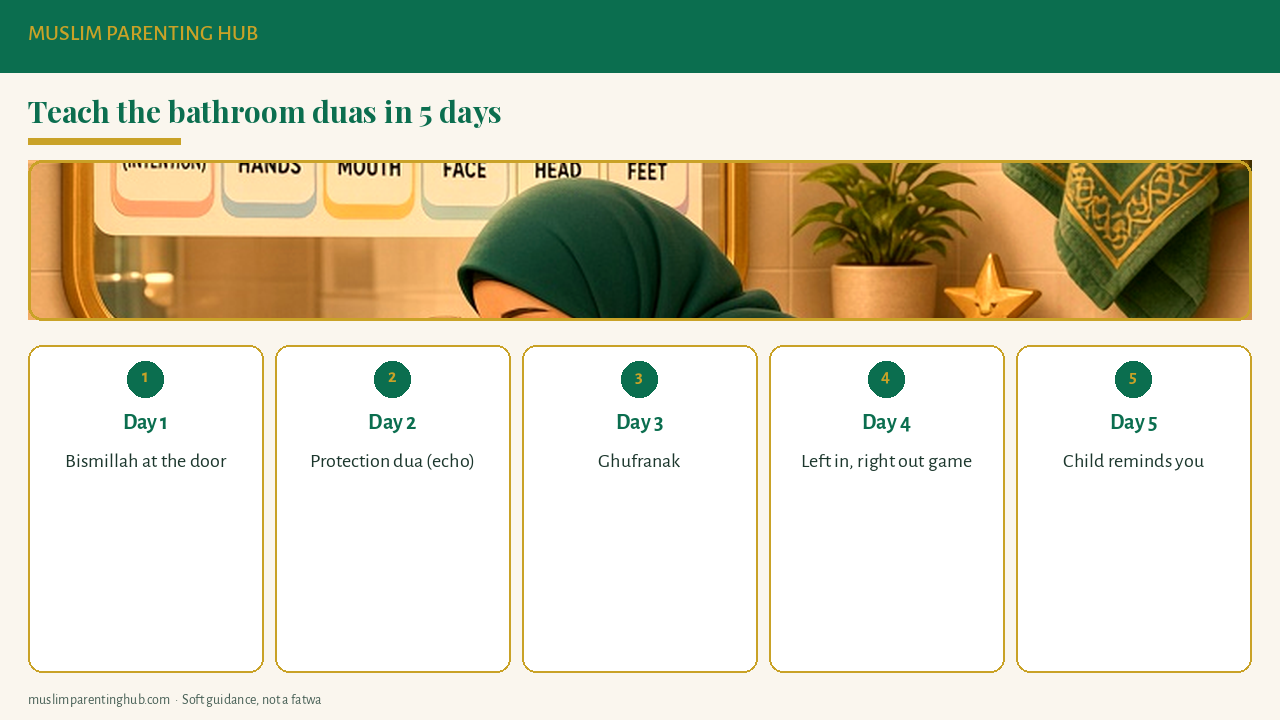
Ten seconds per bathroom trip, five days. That is all.
Day 1: Bismillah only. Before every bathroom trip, say Bismillah together at the door. High-five afterward.
Day 2: Add the protection dua. You say it slowly, your child echoes each part: Allahumma… inni a’udhu bika… minal-khubuthi… wal-khaba’ith. Most toddlers manage the first half; that’s fine.
Day 3: Add Ghufranak. After washing hands, step out with the right foot and say Ghufranak together. Kids love this one because it’s one fun word.
Day 4: Feet game. Stand at the door: “Which foot goes in first?” Let them get it wrong sometimes and laugh. Then switch for coming out.
Day 5: Teach-back. Your child reminds you at the door. “Mama, you forgot Bismillah!” Let them catch you on purpose. Children remember what they teach.
Then keep it going for about two weeks. Most children have both duas memorized by then because they use them so often.
By Age
- Ages 2–3: Bismillah and Ghufranak only. Say the long dua yourself out loud while they listen.
- Ages 4–5: Echo the full entering dua. Add the feet rule.
- Ages 6–8: Say both duas alone and learn the meanings. Add the “no Allah’s name inside” rule and the school-restroom whisper.
Making It Stick Without Pressure
- Model it out loud. Your child hears you say the dua every time you go in. That alone does most of the teaching.
- A small card by the door. Tape a card at child height with “Bismillah” on the outside of the bathroom door and “Ghufranak” at eye level as they leave. No pictures of people needed, just words and maybe a star.
- Praise effort, not perfection. “You remembered Bismillah all by yourself!”
- Never shame. If they forget, simply say it together next time. Bathroom time should never feel tense, especially during potty training.
- Link to other duas. Once these are easy, your child is ready for more. Our list of duas for kids to learn and our short duas for kids by age chart are natural next steps.
On the Road and at Grandma’s
New bathrooms can make kids forget routines. Before a trip, practice at home: “At the gas station, we still say Bismillah at the door.” Pack a small water bottle for istinja too. Our guide to potty training while traveling covers road trips, flights and holiday visits.
FAQ
What is the dua for entering the bathroom for kids?
Before entering, say “Bismillah, Allahumma inni a’udhu bika minal-khubuthi wal-khaba’ith,” meaning “In the name of Allah. O Allah, I seek Your protection from all bad and harmful things” (Bukhari, Muslim). Young kids can start with just “Bismillah.”
What do you say when leaving the bathroom?
Say “Ghufranak,” which means “I ask for Your forgiveness, O Allah.” The Prophet ﷺ said it when he came out of the toilet (Abu Dawud, Tirmidhi). Step out with the right foot first.
Should kids say the bathroom dua inside or outside?
Outside, before entering. We avoid saying Allah’s name inside the toilet. If a child forgets and is already inside, many scholars say they can say it quietly in the heart.
Which foot do you enter the bathroom with in Islam?
Scholars recommend entering the bathroom with the left foot and leaving with the right foot, the opposite of entering the masjid. Turn it into a simple game so kids remember.
At what age should kids learn the bathroom duas?
Start with “Bismillah” and “Ghufranak” around ages 2–3, often during potty training. Most kids can echo the full entering dua by 4–5 and say both duas with meanings by 6–8.
What if my child keeps forgetting the bathroom dua?
That’s normal. Say it out loud yourself every time, put a small word card on the bathroom door, and let your child remind you. Gentle repetition works far better than correction.
Related guides
- Islamic potty training without shame
- How to teach kids istinja
- Potty training boys in Islam
- Potty training girls in Islam
Closing
Two tiny duas, said a few times a day, teach a child something huge: Allah is with us and protects us everywhere. Bismillah at the door, Ghufranak on the way out, and a parent who says it every single time. That is how a Muslim child grows up remembering Allah without even trying.
Quick steps
5-day plan to teach kids the bathroom duas. Ten seconds per bathroom trip: say the duas together at the door and add one small step each day.
- Day 1 — Bismillah — Say Bismillah together at the bathroom door before every trip.
- Day 2 — Protection dua — Echo Allahumma inni a’udhu bika minal-khubuthi wal-khaba’ith in small parts before entering.
- Day 3 — Ghufranak — After washing hands, step out with the right foot and say Ghufranak together.
- Day 4 — Feet game — Practice left foot in, right foot out at the door as a game.
- Day 5 — Teach-back — Let your child remind you of the duas at the door.
Related articles
Islamic Potty Training Without Shame: Readiness, Bathroom Duas & Taharah
Ready for Islamic potty training? Spot readiness signs, teach bathroom duas and gentle istinja, and coach toilet manners with zero shame—start tonight.
Read guide →
How to Teach Kids Istinja: Simple Washing Steps for US Bathrooms
Teach your child istinja without shame: easy wiping and washing steps, left-hand rules, peri bottle and bidet tips for US bathrooms, and a 7-day practice plan.
Read guide →
Islamic Bathroom Manners at School: A Kid-Friendly Guide to Public Restrooms
How Muslim kids keep Islamic bathroom manners at school: the duas, istinja with a squeeze bottle, privacy in stalls, urinals, and calm scripts for teachers.
Read guide →
25 Short Duas for Kids to Learn (By Age, With Meaning and Transliteration)
Short, easy duas for kids by age (2–4, 5–7, 8–10) with transliteration and meaning—plus a gentle 10-minute daily practice for US Muslim families.
Read guide →