

When Your Muslim Toddler Fights Bedtime: Calm Sunnah-Based Fixes
Teeth are brushed. Pajamas are on. Then the classic toddler plot twist: one more drink… one more story… I need you to lie down… there’s a shadow…
Muslim toddler bedtime struggles are rarely about “defiance against Islam.” They are about a small nervous system that doesn’t want the day to end—plus fear, FOMO, and a brain still learning how to switch off. You can honor Sunnah calm (adhkar, cleanliness, gentle winds-down) and hold boundaries without harshness.
This guide separates stalling from fear from separation needs, then gives you a calm plan, scripts, and age notes. Soft parenting guidance—not a fatwa. For medical sleep issues, talk to your child’s clinician.
First: Diagnose the Bedtime Battle
Not every delay is the same problem.
| Pattern | What it often is | What helps most |
|---|---|---|
| “One more…” loops | Stalling / boundary testing | Predictable sequence + kind finality |
| Crying when you leave | Separation need | Gradual presence plan + short check-ins |
| Fear of dark, sounds, “someone there” | Fear | Safety cues + soft dua + night light |
| Wired after screens | Overstimulation | Earlier screen cutoff + Maghrib-first evenings |
| Late second wind | Schedule mismatch | Slightly earlier wind-down; watch naps |
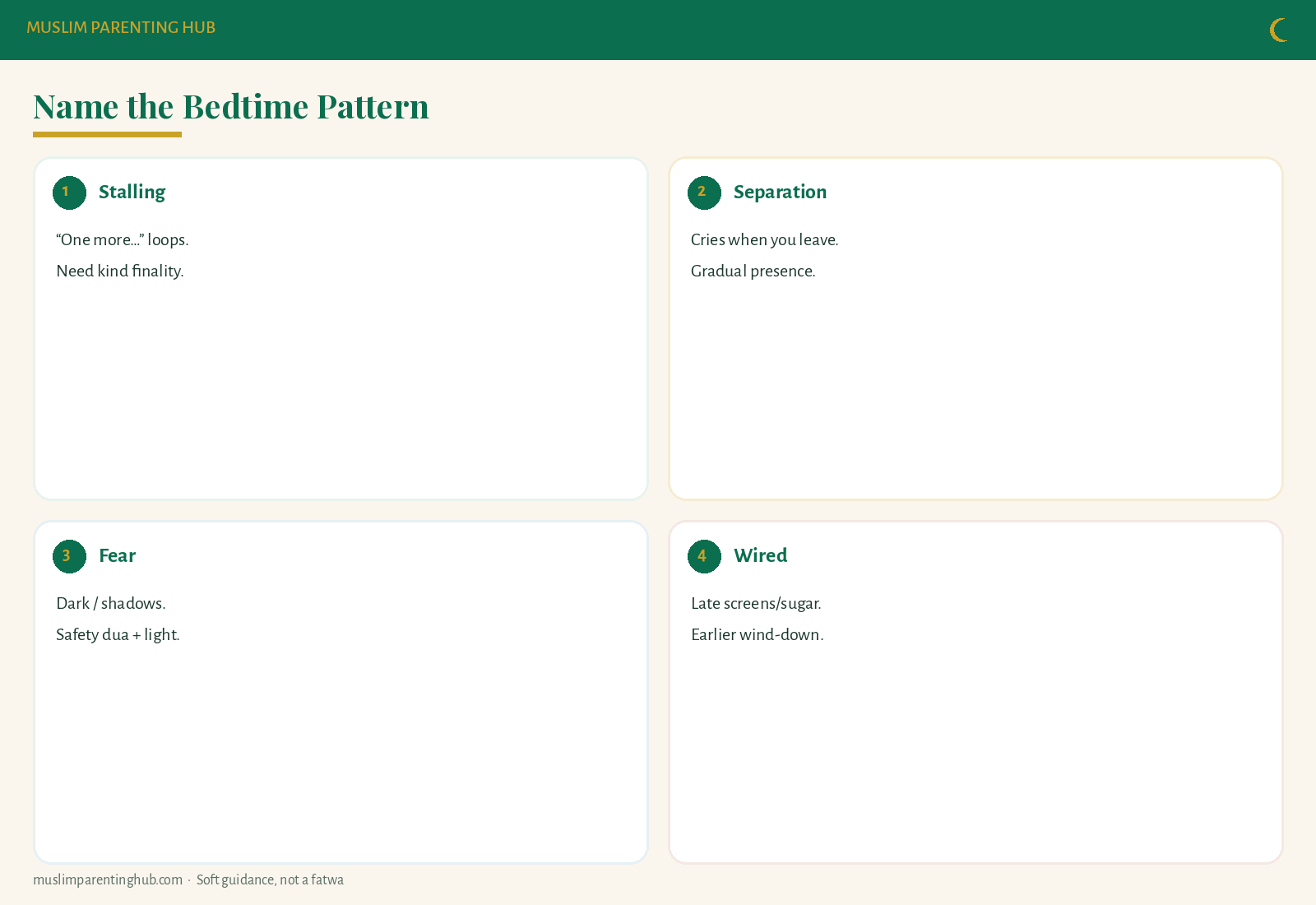
If you treat fear like stalling (or stalling like fear), everyone loses. Start by naming the pattern out loud to yourself: Tonight is stalling. Or: Tonight is fear.
The Big Idea: A Calm Chain, Not a Perfect Night
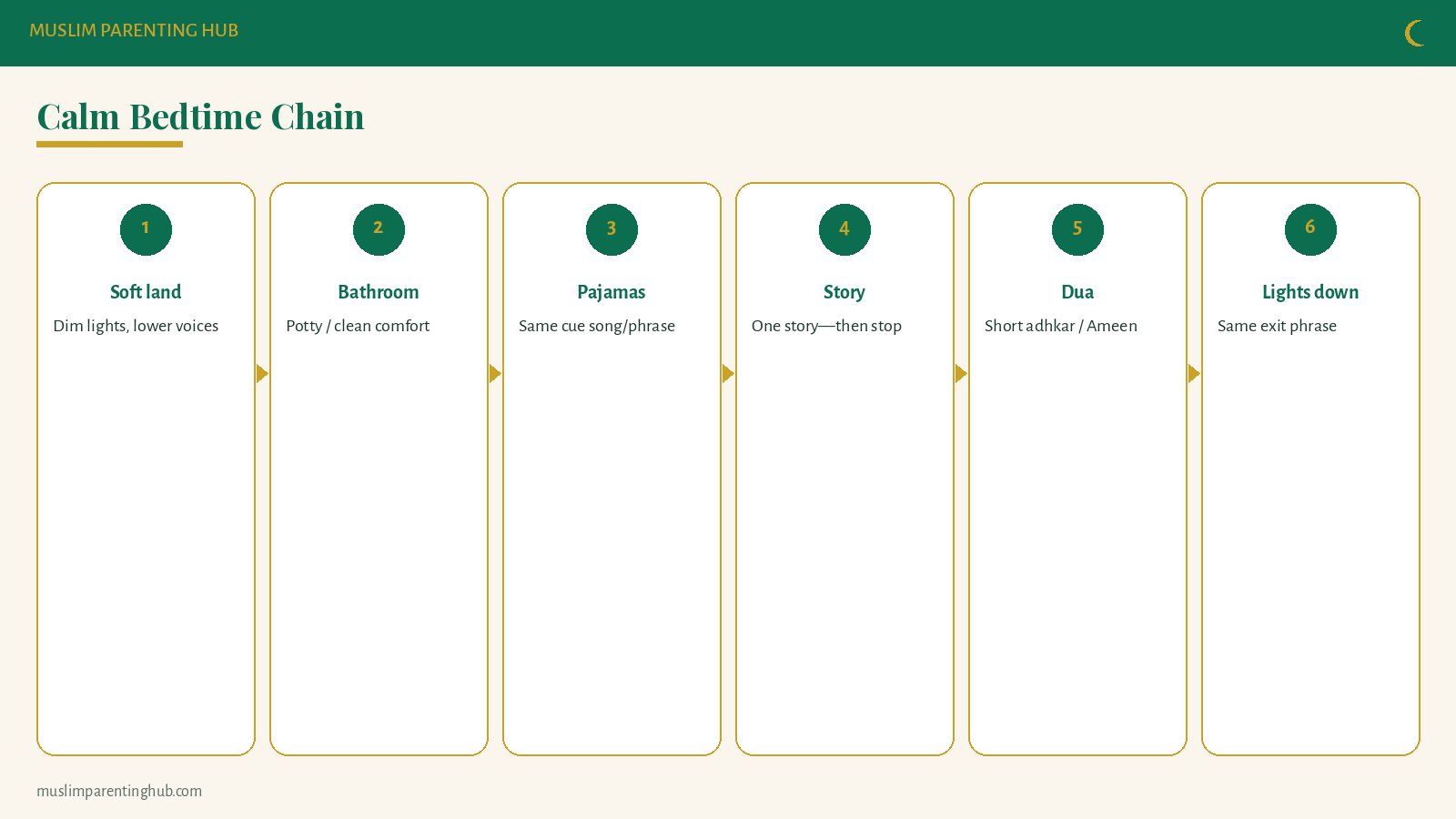
Sunnah-inspired evenings for little kids work best as a short, boring, repeatable chain:
- Soft landing (dim lights, lower voices)
- Bathroom / wudu-ish clean (as fits age)
- Pajamas
- Brief story or quiet cuddle
- Short bedtime dua / adhkar
- Lights down, parent exit plan
Boring is a feature. Novelty invites negotiation.
Anchor the whole house earlier with your After-School Maghrib Routine—toddlers who still have tablets humming at Isha often “fight bedtime” because their brains never downshifted.
Sunnah Soft Anchors (Without Turning Bedtime into a Class)
Keep markers light and loving:
- Cleanliness & comfort — clean teeth/body as your family practices; cozy pajamas.
- Remembrance — a few bedtime adhkar or a tiny own-words dua.
- Right side / gentle sleep manners — model without forcing a wrestling match.
- Avoid scary talk — no “angels will be mad if you get up” (see our angels guide for fear-free framing).
If dua becomes a power struggle, shorten it. One line + Ameen is enough on hard nights. Grow heart-dua skills with Teach Kids Dua From the Heart.
Fix Pack A — Stalling (“One More…”)
What to do
- Announce the chain once at the start: “Drink → potty → story → dua → sleep.”
- Offer two choices that both end in bed: “Blue pajamas or green?” not “Do you want to sleep?”
- Use a visual — three pictures on the wall. Move a clothespin down each step.
- Kind final phrase: “This is the last one. I love you. It’s sleep time.”
- Do not add new entertainment after the final phrase—no new cartoons “just to calm down.”
Script
“I hear you want another story. We already chose one. I’ll sing two lines, then lights down. I’m right in the next room.”
What not to do
Endless debates. Threatening “no Eid gifts.” Shame. Starting a second Maghrib lecture at 9:40 p.m.
Fix Pack B — Separation Distress
Toddlers often need you more than they need a speech about independence.
Gradual presence plan
- Night 1–3: sit near the mattress until breathing slows; leave with a consistent phrase.
- Next nights: move the chair closer to the door.
- Then: check-ins every few minutes with the same calm line—no long chats.
Script
“You’re safe. Mama/Baba is here in the home. I’ll check on you after I count slowly to twenty. Ya Allah, keep us safe. Ameen.”
Consistency beats intensity. Random long cuddles some nights and sudden hard exits other nights confuse the nervous system.
Fix Pack C — Fear (Dark, Shadows, “What’s there?”)
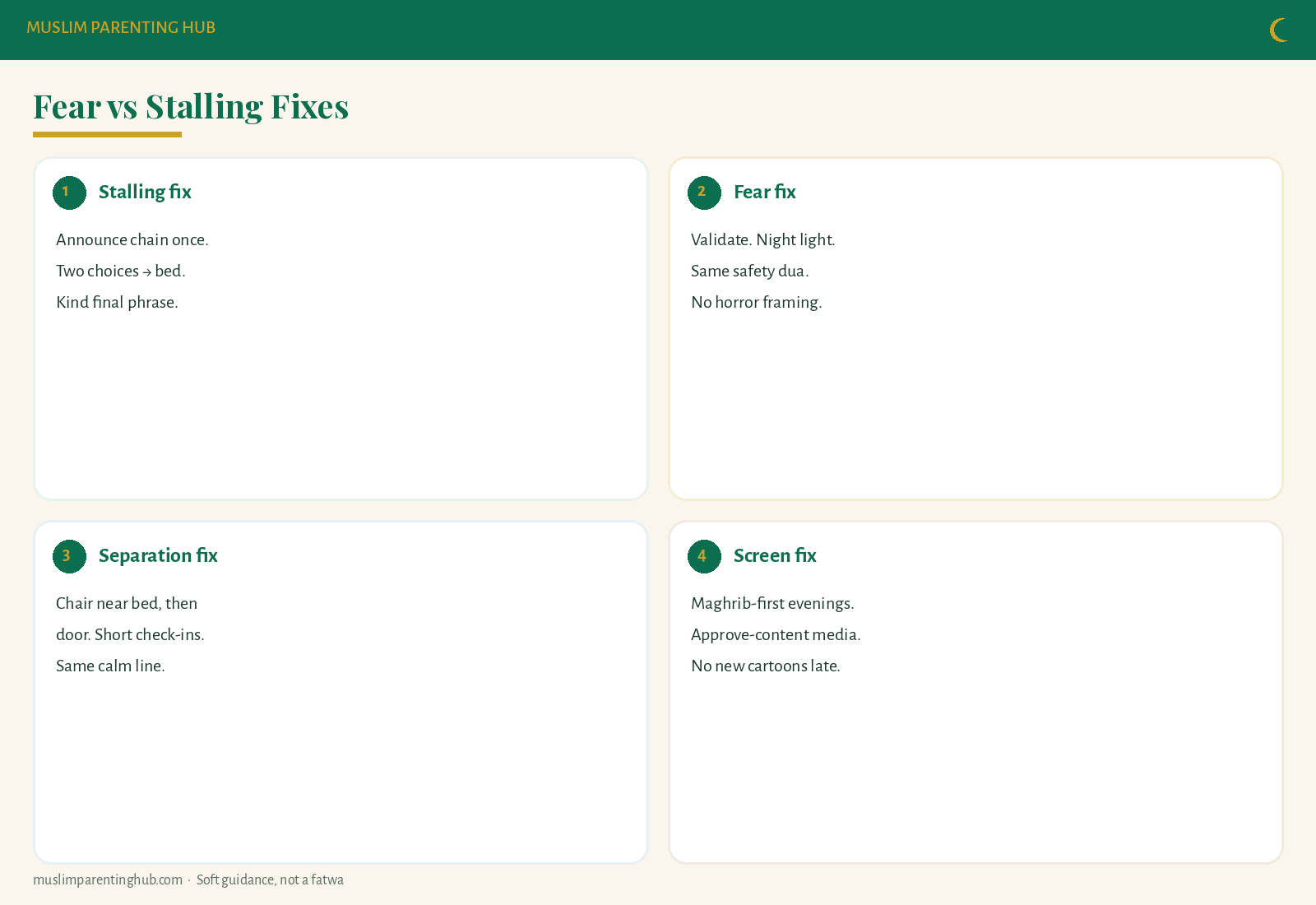
- Validate: “Dark can feel tricky.”
- Reality-check gently: night light, show the room is ordinary.
- Safety dua: short, same words nightly.
- Avoid horror framing of jinn/angels at lights-out. Wonder belongs in daytime lessons; bedtime needs safety.
- Limit scary media—preview kids’ videos; use Approve Content habits from YouTube Kids setup.
Script
“You’re safe in our home. Allah is our Protector. We’ll say our small dua, keep the little light on, and I’ll be nearby.”
If fears explode after a new “Islamic” video with intense imagery, pause that content. Soft aqidah never requires nightmares.
Screens, Sugar, and the Evening Cliff
Many “bedtime problems” start at 5 p.m.
- Pause stimulating screens well before bed; prefer Maghrib-first.
- Watch late caffeine/sugar (chocolate, soda).
- Protect a wind-down buffer after Friday joy, too—Friday Night Family Routine should still end gently.
A toddler who “won’t sleep” after a loud family night may simply be overstimulated. Plan a longer quiet landing on high-joy evenings.
Age Notes Inside the Toddler Years
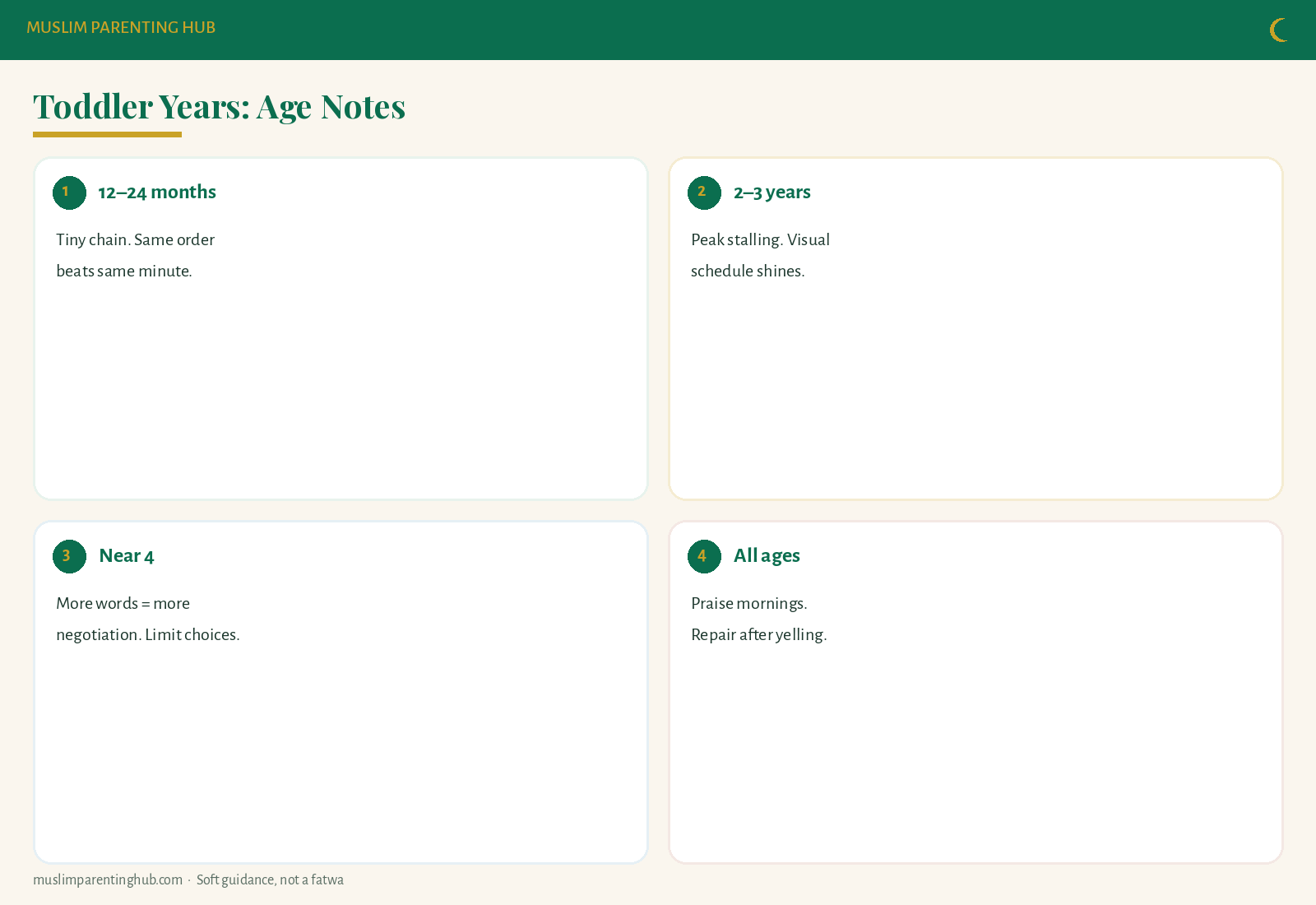
~12–24 months
- Keep the chain tiny.
- Expect protest when routines change (travel, guests, teething).
- Prioritize same order over same clock minute.
~2–3 years
- Peak stalling creativity. Visual schedules shine.
- Potty requests may be real or delay—do one last potty, then close the loop. Link bathroom manners without shame using calm habits from Islamic potty training.
- Offer a lovey / approved comfort object if it helps.
Approaching 4
- More words = more negotiation. Keep choices limited.
- Fear stories may appear; answer briefly, then return to the chain.
- Praise mornings: “You slept in your bed—mashaAllah. That helped your body.”
Tonight Plan (Print in Your Head)
- Dim lights 20–30 minutes before bed.
- Run the same 6-step chain.
- One short dua.
- Kind final phrase.
- Exit / check-in plan you can repeat tomorrow.
Track for seven nights before declaring failure. Toddlers test new boundaries to see if they are real.
When to Get Extra Help
Talk to a professional if you see severe night terrors, breathing concerns, extreme daytime sleepiness, or bedtime battles that include ongoing aggression or parental burnout that feels unsafe. Seeking help is part of amanah—not a lack of tawakkul.
Sample 25-Minute Wind-Down (Adjust to Your Clock)
Use this as a template, not a stopwatch to worship.
- Minutes 0–5 — Soft landing: lights dim, voices down, water offered once.
- Minutes 5–10 — Bathroom & clean: potty, wipe, wash hands/face as your routine allows; keep it playful, not a lecture.
- Minutes 10–15 — Pajamas & room cue: same song or phrase each night while changing.
- Minutes 15–20 — One story or quiet talk: set a timer if stories multiply; when it rings, stop mid-page if needed and bookmark calmly.
- Minutes 20–23 — Dua / adhkar: parent models; child may only say Ameen.
- Minutes 23–25 — Lights down + exit phrase: same words nightly.
If Maghrib falls inside this window in winter, pray first with the family, then resume the chain. Salah is not “extra homework”—it is the evening’s spine. On long summer days, keep the same order even if clock times shift.
Two-Home and Travel Nights
Bedtime battles spike when the environment changes—grandparents’ house, hotel rooms, late walimahs.
- Pack the lovey, the visual chain cards, and the same dua.
- Accept a slightly later clock; protect the order.
- Preview: “Tonight bed is at Grandma’s. Same steps: potty, pajamas, dua, sleep.”
- After travel, expect two to three nights of re-teaching at home without panic.
Consistency is a mercy you carry in a bag—not only a bedroom color scheme.
Parent Regulation: Your Nervous System Leads
Toddlers borrow your calm. Before the final boundary, try:
- One glass of water for you
- Shoulders down, jaw unclenched
- A silent dua: “Ya Allah, help me be gentle and clear.”
If you already yelled, repair: “I used a loud voice. I’m sorry. The rule is still sleep time. I love you.” Repair + boundary teaches more than perfect nights.
Burnout is real. Trade nights with a spouse when you can. A short break after Isha for the on-duty parent (tea, two messages max) can prevent the harsh spiral.
FAQ: Muslim Toddler Bedtime Struggles
What helps when a Muslim toddler fights bedtime?
Use a short repeatable chain (bathroom, pajamas, story, dua, lights), kind finality for stalling, gradual presence for separation, and safety-focused dua for fear. Cut late screens. Stay calm and consistent for at least a week.
How do I use Sunnah at bedtime without pressure?
Keep adhkar and manners light—modeling over forcing. One sincere line of dua beats a long stressed recitation. Comfort and remembrance can live together.
Is stalling the same as disobedience?
Not exactly. Stalling is often a toddler strategy to keep connection and delay the dark. Hold the boundary without labeling them “bad.” Teach with routines, not shame.
What dua should we say if our toddler is scared?
Keep it identical most nights, for example: “Ya Allah, keep us safe and calm while we sleep. Ameen.” Add Arabic your family knows. Hold a hand. Use a small light if needed.
Should we let our toddler cry it out?
Families differ. Many Muslim parents prefer responsive settling with clear limits—short check-ins, calm voice, no new play. Choose a plan you can hold consistently and that protects everyone’s safety. If unsure, ask a pediatric professional aligned with your values.
How do Maghrib routines help bedtime?
An earlier calm—snack, wudu, Maghrib, connection—downshifts the evening so bedtime isn’t the first quiet moment of the day. Fewer battles start when the house already practiced stillness.
What if one parent works late?
The available parent runs the chain. Keep the same phrases. When the second parent arrives, offer a short hello-cuddle before the final lights-down when possible—or a morning special time so late arrivals don’t restart negotiations nightly.
Closing: Calm Is a Mercy
You do not need a perfect sleeper to be a good Muslim parent. You need a repeatable mercy: soft voice, clear end, small dua, tomorrow we try again.
May Allah grant your children peaceful sleep, protect them from fear, and put barakah in your nights. Ameen.
FAQs
What helps when a Muslim toddler fights bedtime?
Use a short repeatable chain, kind finality for stalling, gradual presence for separation, and safety-focused dua for fear. Cut late screens and stay consistent for a week.
How do I use Sunnah at bedtime without pressure?
Keep adhkar and manners light—modeling over forcing. One sincere line of dua beats a long stressed recitation.
Is stalling the same as disobedience?
Not exactly. Stalling often seeks connection and delay. Hold the boundary without labeling the child bad.
What dua should we say if our toddler is scared?
Keep the same short line most nights asking Allah for safety and calm, add Arabic your family knows, and use a small light if needed.
Should we let our toddler cry it out?
Families differ. Many prefer responsive settling with clear limits and short check-ins. Choose a consistent plan that protects safety and ask a pediatric professional if unsure.
How do Maghrib routines help bedtime?
An earlier calm downshifts the evening so bedtime isn’t the first quiet moment of the day.