
Sibling Jealousy in a Muslim Home: Fairness, Scripts & What Not to Say
One child gets a sticker. The other melts down: “You love him more!”
Or two kids collide over the same toy, and somehow you become the villain for “not being fair.” Sibling jealousy is not proof you failed as a Muslim parent. It is a normal human signal—belonging, attention, and fairness—loud in small bodies with big feelings.
Islam calls us to justice and mercy at home. That does not mean identical gifts, identical minutes, or identical consequences for different ages. It means children feel safely loved, conflicts get coached, and we refuse shame scripts that plant lifelong resentment.
This guide gives you a fairness framework, copy-paste scripts, what not to say, and age-banded expectations. Soft parenting guidance—not a fatwa. Adapt to your family, and seek counseling if jealousy turns into ongoing aggression or deep distress.
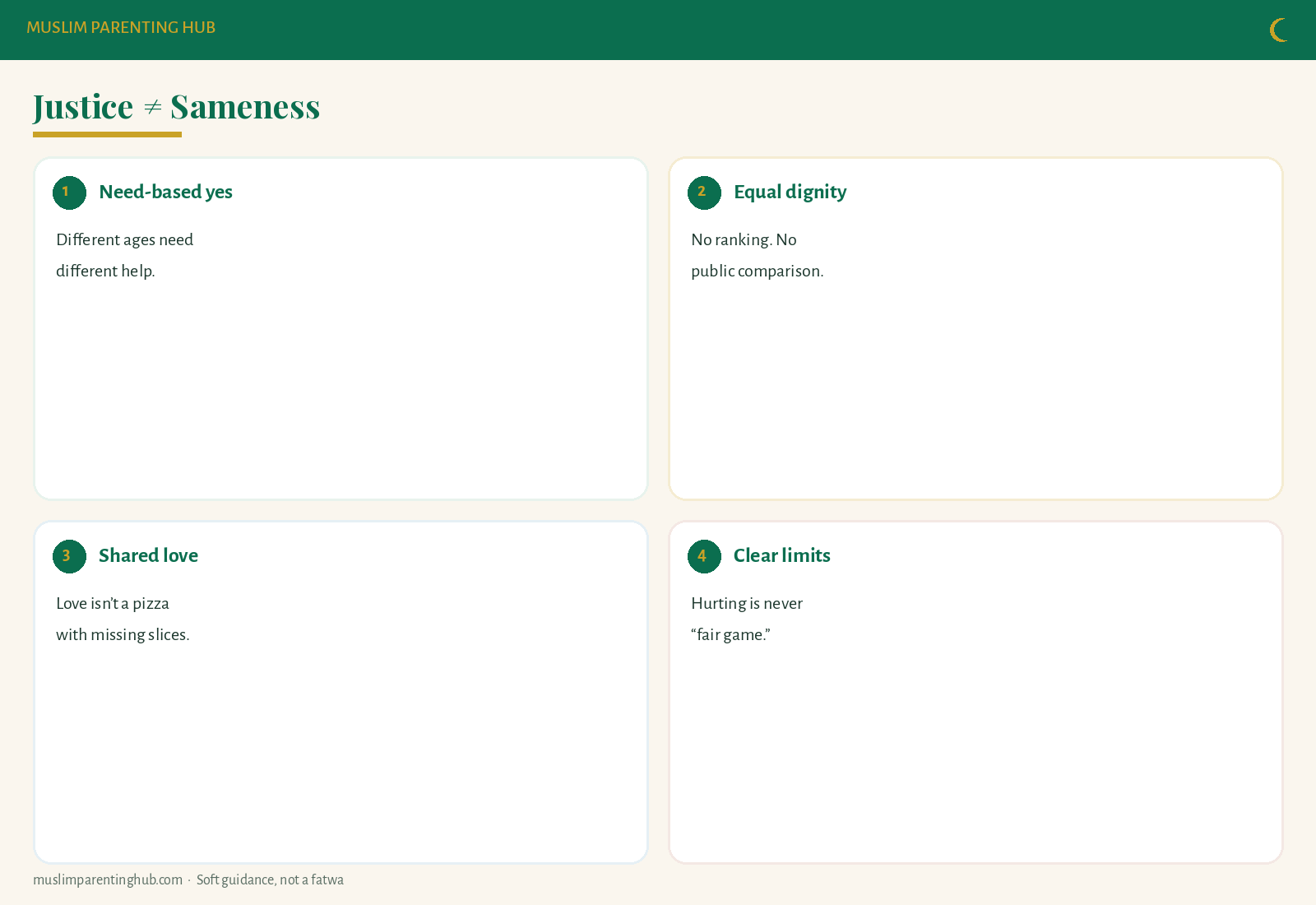
The Big Idea: Justice ≠ Sameness
In many homes, “fair” gets confused with “exact same.” But siblings are not clones.
- A toddler needs more hands-on help than a nine-year-old.
- A child with homework may get quiet time another child doesn’t need tonight.
- One child may receive a gift for a milestone the other hasn’t reached.
Islamic fairness in parenting leans toward: each child gets what they need, everyone gets dignity, and no one is mocked or permanently ranked as “the good one.”
When jealousy flares, your job is not to erase the feeling. Your job is to:
- Name it without drama.
- Reassure belonging.
- Coach a next step (share, wait, take turns, repair).
- Protect the relationship—yours with each child, and theirs with each other.
Why Sibling Jealousy Shows Up
Common sparks in Muslim (and all) homes:
- New baby attention
- One child “easier” in public (masjid, guests)
- Different school or Quran progress
- Screens, snacks, or seats in the car
- Praising one child’s salah or manners in front of the other
Jealousy often means: “Is there still enough love for me?” Answer that question with presence more than speeches.
What Not to Say (Even When You’re Exhausted)
| Harmful line | Why it backfires | Better direction |
|---|---|---|
| “Stop being jealous—Muslims aren’t like that.” | Shames the feeling; faith becomes a stick | “Jealous feelings happen. Let’s handle them with adab.” |
| “You’re the older one—always give in.” | Builds quiet resentment | “You’re older, so I’ll coach you in leadership—and your sibling still takes turns.” |
| “Why can’t you be like your brother/sister?” | Comparison wounds identity | Praise specific effort privately; avoid ranking |
| “Allah loves the quiet child more.” | Distorts aqidah + attachment | “Allah loves you. Quiet and loud kids both belong.” |
| “Fine—nobody gets it!” (every time) | Teaches that jealousy controls the house | Hold a fair boundary; coach the feeling separately |
Feelings are not sins to crush. Actions (hitting, name-calling, destroying) still get clear limits.
Soft Scripts You Can Use Today
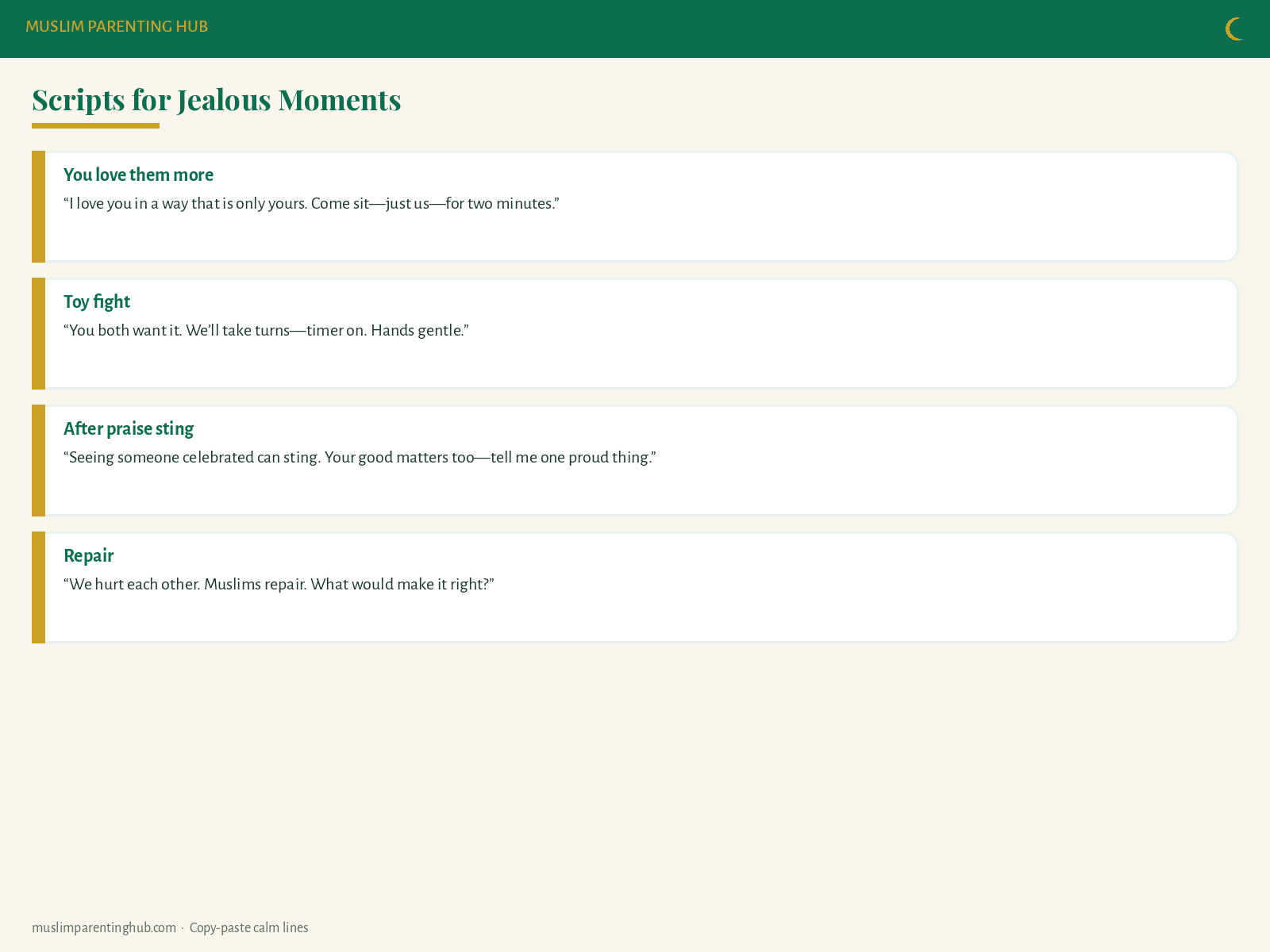
When they say “You love them more”
“I love you in a way that is only yours. Love isn’t a pizza with one missing slice. Come sit with me for two minutes—just us.”
Then actually give two minutes. Belonging repairs faster than lectures.
When they explode over a toy
“You both want it. The toy is not more important than our adab. We’ll take turns—timer on. First, hands gentle.”
When one is praised and the other wilts
(To the jealous child, privately) “Seeing someone celebrated can sting. Your good matters too. Tonight tell me one thing you’re proud of—I’ll listen fully.”
When guests praise only one child
Redirect warmly: “Alhamdulillah for both of them—different gifts, same family.” Later, give the quieter child a private highlight.
Repair after a fight
“We hurt each other. Muslims repair. Say what happened without insults… now what would make it right?”
Keep repair short. Forced long apologies become theater.
Dua in the middle (optional, calm)
“Ya Allah, soften our hearts toward each other and help us be fair. Ameen.”
Own-words dua—see Teach Kids Dua From the Heart—turns rivalry into a shared turn toward Allah without a sermon.
A Simple Fairness Toolkit for Muslim Homes
1) One-on-one minutes
Ten focused minutes with each child a few times a week reduces “love scarcity.” Call it special time. Phones away. Let the child lead play.
2) Turn-taking systems
Timers, “you then me” cards, or “today’s chooser” rotations beat nightly negotiations—especially for screens. Pair with house rules from YouTube Kids for Muslim Parents so jealousy isn’t only about who holds the tablet.
3) Private praise, public dignity
Praise effort privately when comparison is hot. In public, protect both children’s honor—no roasting, no ranking.
4) Need-based yes
It’s okay to say: “Your sister needs help with wudu right now; I’ll check your LEGO in five minutes.” Narrate the need, not the favorite.
5) Maghrib reset as family glue
Shared salah and a short connection circle after Maghrib remind siblings they are a team. Use your After-School Maghrib Routine as the daily glue—not only a conflict tool.
Age Bands: What to Expect
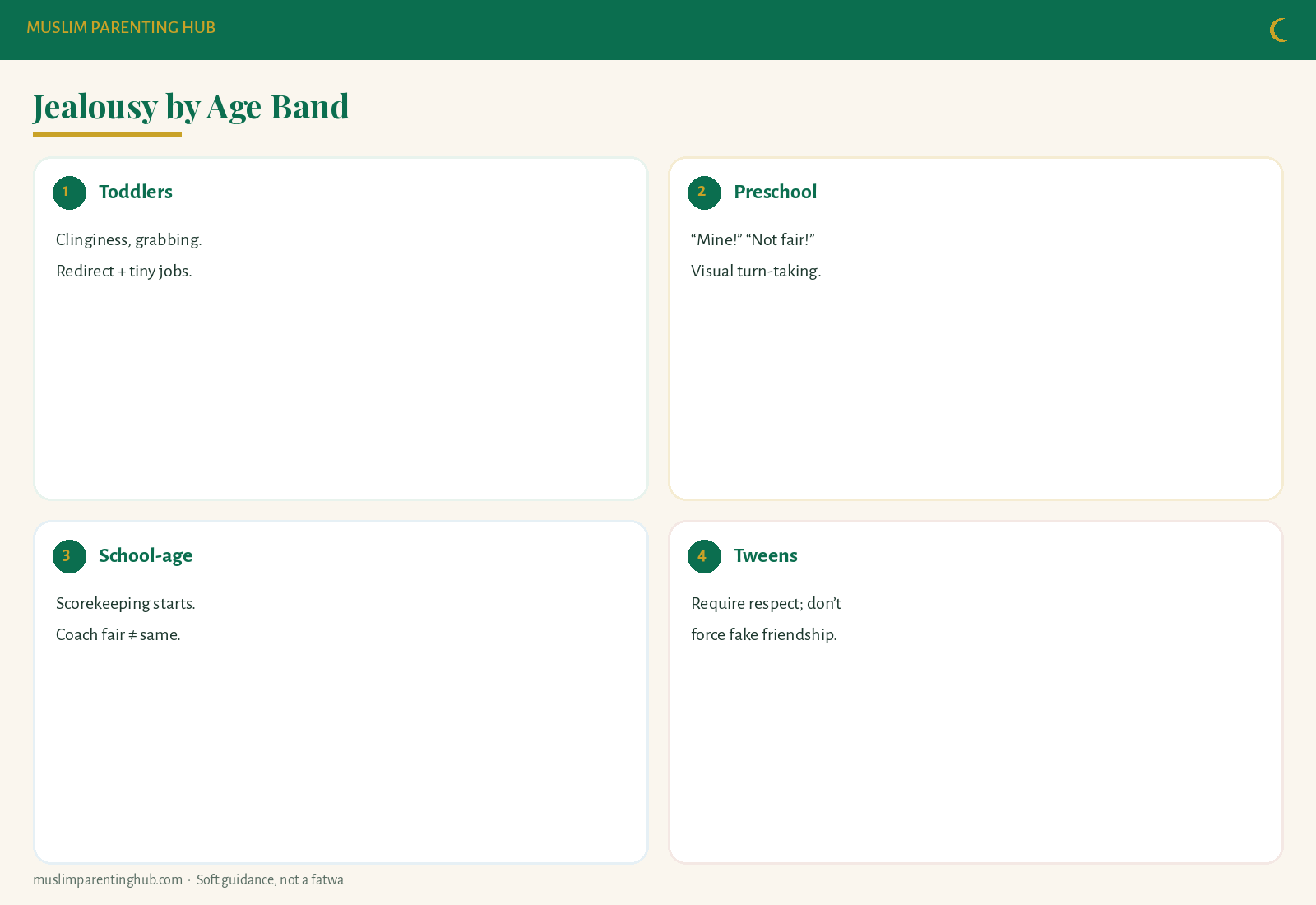
Toddlers (1–3) with an older sibling
- Jealousy looks like clinginess, regression, or toy grabbing.
- Narrate: “You want Mama too.” Offer a job: bring the diaper, hold the cream.
- Do not expect sharing sermons to stick. Supervise and redirect.
Preschool (3–5)
- Words appear: “Mine!” “Not fair!”
- Teach turn-taking with visuals.
- Keep explanations under two sentences.
- Celebrate any gentle hands loudly.
School-age (6–10)
- Scorekeeping begins (“He got more!”).
- Explain justice ≠ sameness with real examples (different bedtimes, different homework).
- Coach conflict: each speaks, each suggests a fix.
- Watch for sarcasm and exclusion—name it as hurting adab.
Tweens
- Jealousy may hide as eye-rolls or silent treatment.
- Don’t force fake friendship; require basic respect.
- Private check-ins matter more than group lectures.
- Avoid using Islamic language as humiliation.
Sibling Fighting: A 4-Step Coaching Flow
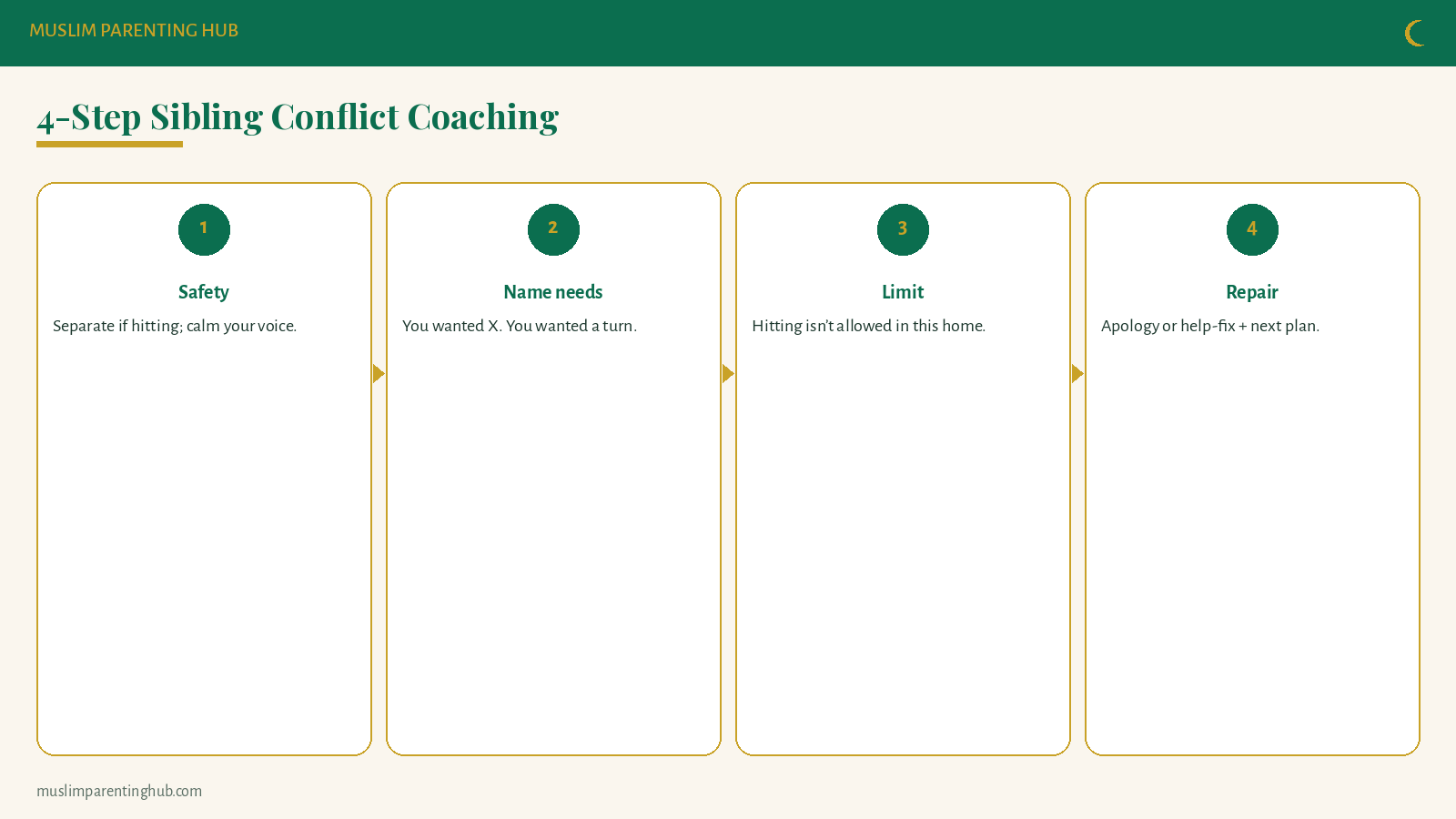
- Safety first — separate bodies if hitting; calm your own voice.
- Name needs — “You wanted the car. You wanted a turn.”
- Limit — “Hitting is not allowed in this Muslim home.”
- Repair + plan — apology or help-fix; then a clear next rule (timer, trade, or put-away).
Skip courtroom mode where you hunt for “who started it” for twenty minutes. Patterns matter more than one verdict.
If fights cluster at bedtime, the real fuel may be fatigue—see When Your Muslim Toddler Fights Bedtime for wind-down fixes that lower evening sparks.
Fairness and Gifts, Food, and Milestones
- Gifts: Equal price is less important than equal dignity. A milestone gift can be explained: “This is for her Quran completion. Your moment will be celebrated too.”
- Food: Avoid using dessert as a public ranking system.
- Milestones: Photograph and celebrate each child’s wins without forcing the sibling to clap on command—invite, don’t demand.
- Chores: Different ages, different jobs. Fairness is contribution matched to ability.
Prophetic homes valued justice and kindness. Your consistency—more than perfect equality—teaches children what Muslim family feels like.
When Jealousy Needs Extra Support
Seek extra help if you see frequent physical aggression, cruelty to animals, deep withdrawal, or jealousy that never eases despite calm routines. A counselor who respects your faith can help. There is no shame in support—mercy includes wise means.
A Weekly “Belonging” Rhythm (Prevents Many Blowups)
Jealousy shrinks when each child can predict when they matter one-on-one.
Try this light weekly rhythm:
- Two micro-dates — 10 minutes each child, twice a week (after Maghrib or weekend morning).
- One shared sibling joy — a game where nobody is ranked (cooperative puzzle, picnic blanket fort, walking to the masjid together).
- One family repair night — if the week was rough, name it: “We had hard voices. Tonight we practice soft salaam and one kind sentence each.”
Keep it imperfect. The point is a pattern children can trust: love returns on a schedule, not only when I explode.
Script for launching a micro-date
“This is Yusuf time—just us. Phones away. You choose the game for ten minutes.”
If the other sibling protests, validate and point to their slot on a simple fridge chart. Visibility reduces panic.
Guests, Masjid Moments, and Public Comparison
Public spaces amplify jealousy because attention becomes a spotlight.
At the masjid: If one child sits calmly and another wiggles, avoid announcing scores in the car. Whisper privately later: “I saw you trying. Next time we’ll bring a quiet book.” To the calmer child: “Thank you for helping the family khushu—without putting your sibling down.”
With relatives: Prepare a line before visits: “Please don’t compare them out loud—each has different gifts.” If a comment still lands, repair in the car: “Uncle didn’t mean to hurt. In our home we don’t rank children.”
On social media: Think twice before posting only one child’s wins. Children notice who becomes content.
Teaching “Hasad” Softly (Without Heavy Labels)
Older children may hear about envy in Islamic lessons. Translate carefully:
“Hasad is when we wish someone’s blessing would go away. Feeling jealous is a signal. What we do next matters—we ask Allah for good for them and us, and we work on our lane.”
Invite a counter-dua:
“Ya Allah, bless my sister and bless me. Make us helpers, not rivals. Ameen.”
This keeps aqidah practical and merciful—especially after a fight over marks, Quran memorization, or a new bike.
FAQ: Sibling Jealousy in a Muslim Home
How do I handle sibling jealousy in Islamic parenting?
Reassure belonging, avoid shame and comparison, coach turn-taking, and keep justice need-based rather than identical. Use short scripts, one-on-one time, and clear limits on hurting. Faith language should comfort and guide—not humiliate.
Is it unfair if siblings get different rules?
Not always. Different ages and needs often require different bedtimes, chores, and privileges. Explain the why briefly. What must stay equal is dignity, safety, and love—not every detail of the schedule.
What should I not say when siblings fight?
Avoid “Why can’t you be like…,” “Muslims don’t get jealous,” and “You’re older so always give in.” Don’t label a child “the problem.” Do set limits on hitting and insults, then coach repair.
How can I teach fairness without buying two of everything?
Use timers, rotations, and “you choose next time.” Narrate needs. Give micro one-on-one attention so love doesn’t feel scarce. Sameness of stuff rarely heals jealousy; secure connection does.
What if one child is easier and gets more praise?
Notice your pattern without self-hate. Schedule private time with the harder-to-parent child. Praise specific efforts. Ask guests to speak kindly to both. Ease is not worthiness.
Can dua help with sibling jealousy?
Yes—as connection, not magic erasure of feelings. Model a short dua for soft hearts, then invite one sentence from each child. Pair dua with practical coaching and fair systems.
How do we stop fights before Maghrib?
Lower blood sugar and chaos: snack, screens paused, wudu together, short salah focus. A predictable Maghrib reset reduces the “witching hour” fuel that turns jealousy into war.
Closing: Room Enough for Every Heart
Sibling jealousy asks a holy question: Is there room for me? Your calm answer—through minutes, scripts, and justice—teaches more aqidah than a lecture on envy.
You will not perfect every evening. You can practice: name the feeling, protect adab, repair the bond, return to Allah together.
May Allah put barakah in your home, soften hearts between siblings, and make you a parent of justice and rahma. Ameen.
FAQs
How do I handle sibling jealousy in Islamic parenting?
Reassure belonging, avoid shame and comparison, coach turn-taking, and keep justice need-based rather than identical. Use short scripts and clear limits on hurting.
Is it unfair if siblings get different rules?
Not always. Different ages and needs often require different bedtimes and chores. What must stay equal is dignity, safety, and love.
What should I not say when siblings fight?
Avoid comparisons, ‘Muslims don’t get jealous,’ and always forcing the older child to give in. Set limits on hitting and insults, then coach repair.
How can I teach fairness without buying two of everything?
Use timers, rotations, and micro one-on-one attention. Sameness of stuff rarely heals jealousy; secure connection does.
What if one child is easier and gets more praise?
Schedule private time with the harder-to-parent child, praise specific efforts, and ask guests to speak kindly to both.
Can dua help with sibling jealousy?
Yes as connection—not magic erasure. Model a short dua for soft hearts, then invite one sentence from each child alongside practical coaching.