Potty Training Muslim Boys: Sitting vs Standing, Splash Control and Taharah Tips
Your two-and-a-half-year-old son has just discovered that his cousin “pees like Baba, standing up.” Now he refuses to sit, there’s a puddle around the toilet base, and you’re wondering whether you’re doing something wrong Islamically or just having a very normal toddler week.
Good news: it is mostly a very normal toddler week.
Potty training boys comes with its own set of questions for Muslim parents. Should he sit or stand? How much does a splash matter? How do you teach washing (istinja) to a wiggly boy who wants to be done in three seconds? What happens at Target, the masjid, or the soccer field porta-potty?
This guide answers those questions with a calm, practical plan. It builds on our main Islamic potty training plan with bathroom duas and toilet manners, so if you haven’t started yet, read that first. Here we zoom in on what’s different for boys.
Why Boys Often Need a Slightly Different Plan
Every child is different, but many pediatricians note that boys, on average, finish potty training a few months later than girls. If your daughter trained at 2 and your son is still in pull-ups at 3, he isn’t “behind” in any way that matters.
A few things tend to come up more often with boys:
- Aiming is a new motor skill. Little boys have to learn to point down, and they forget in the middle.
- Splashing is common. Standing, bouncing, and “watching the bubbles” all lead to drips on legs, clothes, and floors.
- They copy older males. Brothers, cousins, and Baba are fascinating role models, sometimes in ways you didn’t plan.
- They rush. Many want to get back to their trucks, so washing and waiting are the hardest part.
Islam’s interest here is taharah: staying clean from urine so body and clothes are ready for worship later. For a toddler there is no sin and no accountability, just a skill you build slowly.
Sitting vs Standing: What the Sunnah Shows
This is the question most Muslim parents of boys ask first, so let’s be clear and gentle.
The Prophet’s usual practice was to sit. Aisha (may Allah be pleased with her) said that the Prophet ﷺ only urinated sitting, in the narration reported by at-Tirmidhi and an-Nasa’i. Sitting made privacy easier and kept splashes away.
Standing is not forbidden. Hudhayfah reported that the Prophet ﷺ once urinated standing at a place where people threw their trash (Sahih al-Bukhari 224, Sahih Muslim 273). Many scholars explain that Aisha described what she saw at home, while Hudhayfah described a particular situation outside. The common conclusion is that sitting is preferred, and standing is allowed when a person can protect themselves from splashes and keep their privacy.
For a toddler, sitting first just makes sense. You don’t need a fiqh debate in the bathroom. Sitting is:
- Closer to the Sunnah you most want to model.
- Easier for splash control while aiming is still clumsy.
- The same position he needs for bowel movements, so he learns one routine instead of two.
- Simpler for washing afterward.
Many families teach boys to sit for everything through the preschool years. Standing carefully, for example when a public seat is filthy, is a conversation for age 5 to 7, not week one.
A simple line for your son: “In our house, boys and girls sit. The Prophet ﷺ usually sat, and it keeps us clean for salah.”
Splash Control: Small Tricks That Save Your Floors
Splashes matter because they land on clothes and skin, and they make the bathroom unpleasant for everyone. Here’s how to keep them small without nagging.
Use a seat with a built-in splash guard. Many toddler potty seats in US stores have a raised front lip. It does most of the work for you.
Teach “point down, then sit back.” Show him how to gently push down with one finger and lean slightly forward. Say it the same way every time so it becomes a little chant.
Feet flat on a stool. A wobbly boy aims poorly. A step stool under his feet keeps him steady and relaxed, which also helps with bowel movements.
Keep a “drip check” step. After he finishes, he waits a few seconds before standing up. Islamic scholars call making sure you are finished istibra’. For a toddler, you can simply call it “the wait-and-check.” No harsh shaking or squeezing is needed; a calm pause is enough.
Make clean-up boring and quick. Keep water and paper towels near the toilet and wipe splashes with him, without commentary.
Quick-change pants. Choose easy elastic pants and keep spares nearby. A drop on clothing is simply washed with water.
Istinja for Boys: A Gentle Step-by-Step
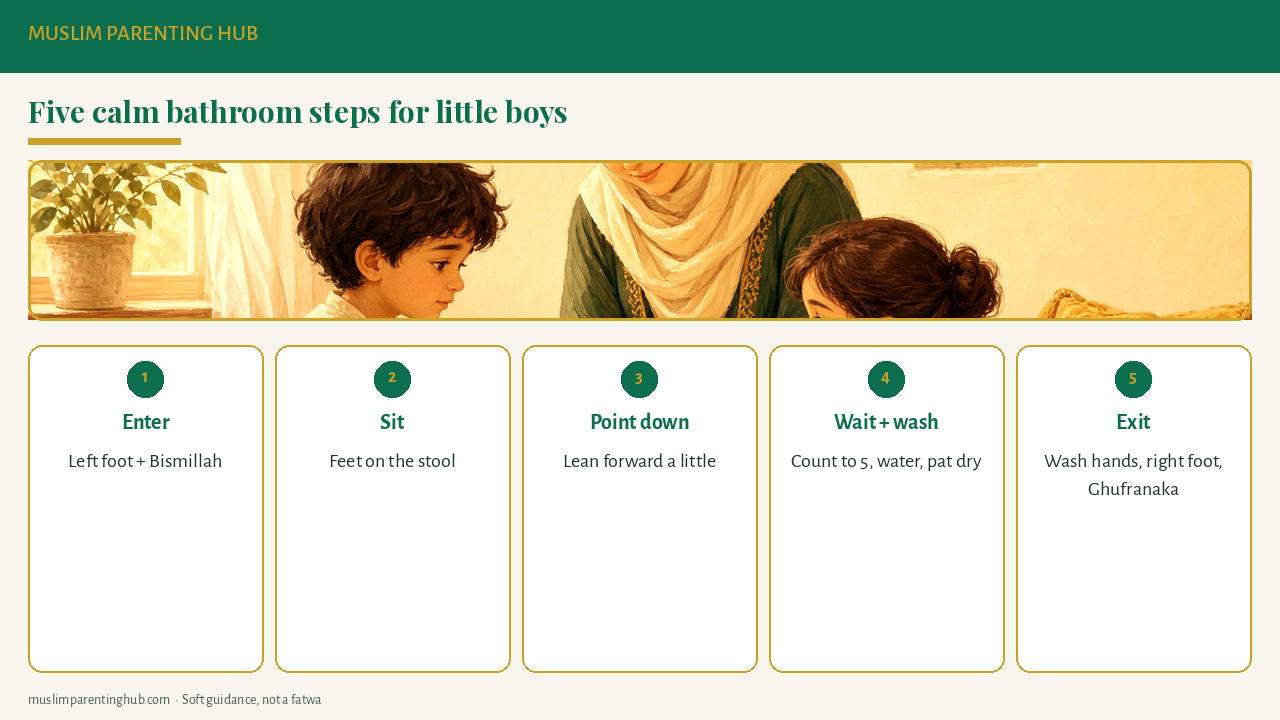
Istinja means cleaning the private area with water (or tissue when water isn’t available) after using the toilet. It’s the heart of taharah. Boys often resist it because they want to be done fast, so make it short and predictable.
- Enter with the left foot. Say “Bismillah” and, if he knows it, the short entering dua. You can say it for him while he’s little.
- Sit and point down. Feet on the stool, finger pointing down, relaxed.
- Wait and check. Count slowly to five together before standing up.
- Wash with the left hand. Use a peri bottle, a lota, a bidet sprayer, or a cup. Water first, then pat dry with tissue. You can guide his hand at first.
- Wash hands, exit with the right foot. Soap, rinse, then say “Ghufranaka” (“I ask Your forgiveness”) as he steps out.
For toddlers who hate the feeling of water, try lukewarm water in the bottle, let him squeeze it himself, or start with a damp, unscented wipe and move to water over a few weeks. Sensory-sensitive boys may need a much slower path. That’s okay.
The bathroom duas, the left-foot/right-foot habit, and washing all connect to wudu later. If your son is already curious about the prayer, our playful steps for teaching wudu to a preschooler can show him that “clean in the bathroom” leads to “clean for salah.”
Modeling Without Losing Modesty
Boys love to copy their fathers and older brothers, and many parenting books suggest dads “demonstrate.” In a Muslim home, we keep awrah (private parts) covered, even with small children watching. Modeling does not require showing anything.
What Baba can do instead:
- Talk through his routine: “I go in with my left foot, I say Bismillah, I sit down, I wash with water, I wash my hands, and I come out with my right foot.”
- Let your son see the parts that are public: washing hands, saying the dua at the door, wiping the seat for the next person.
- Use a picture chart on the bathroom wall with the five steps above.
- Cheer him on: “You sat and washed. MashaAllah! That’s exactly what I do.”
If an older cousin is teaching him to stand, keep it light: “Everyone has their own way. In our house, we sit.” Then praise him every time he sits.
When He Refuses to Sit (Or Suddenly Wants to Stand)
This is the most common struggle. Some ideas:
Offer choices inside the rule. “Frog seat or blue seat?” He gets control over something small.
Make sitting the fun part. Keep two or three board books in a basket by the toilet, or sing a short song.
Don’t fight in the moment. If he stands and pees, help him clean up calmly and say, “Next time we sit.” Then move on. Turning every trip into a battle can stall the whole process.
Watch for constipation. Sometimes a boy refuses to sit because he associates sitting with a painful bowel movement. More water, fruit, and fiber, plus a call to your pediatrician if it continues, can solve what looks like a “behavior” problem.
If the whole process has gone sideways, with regression, refusal, or tears on both sides, our guide on what to do when Islamic potty training stalls has a 5-day soft reset that works for boys and girls alike. And if refusals come with big meltdowns, these calm Islamic responses to toddler tantrums can help you stay steady.
Public Restrooms: Target, the Masjid and the Soccer Field
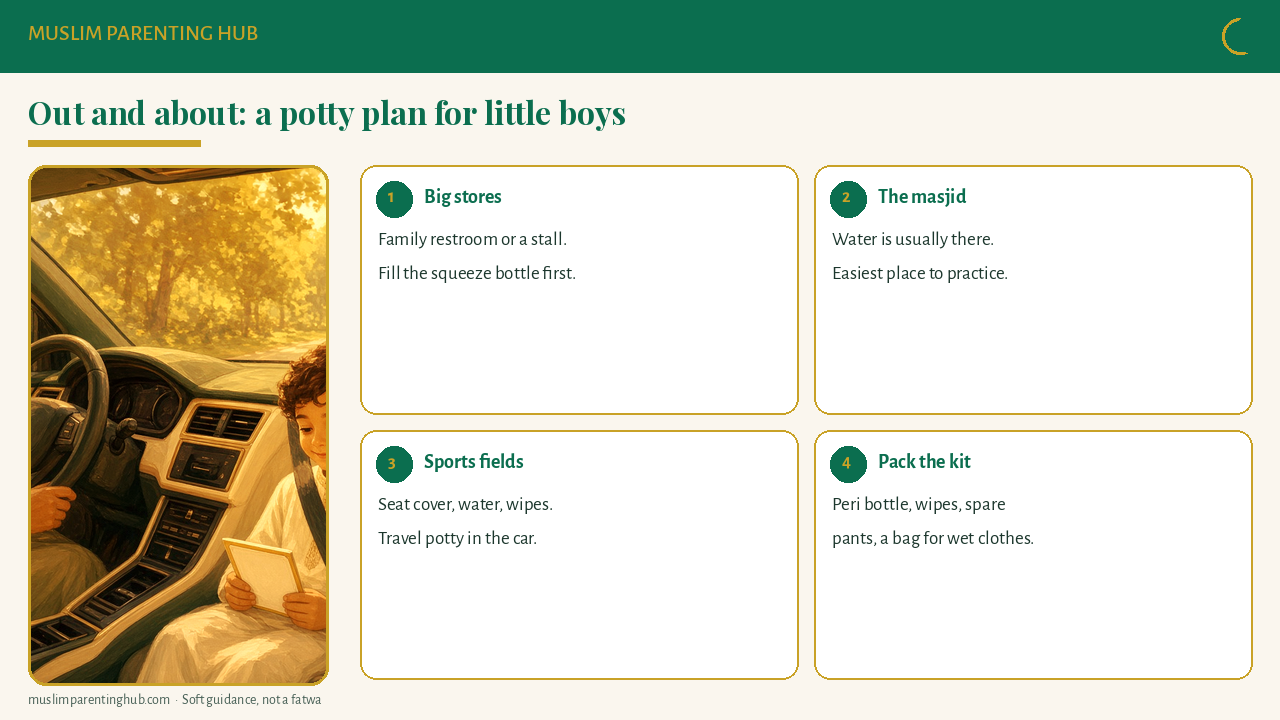
Outings are where many families lose confidence. A little planning helps.
Pack a small kit. A travel peri bottle or a small squeeze bottle, a pack of unscented wipes, a foldable potty seat cover, spare pants and underwear, and a plastic bag for wet clothes.
Choose the family restroom or a stall. At big stores like Target or Costco, family restrooms are often easier. With a toddler, a stall with a seat is the default, even for boys. Urinals can wait until he’s older and you’ve talked about splash control and privacy.
Fill the bottle at the sink. Before you go into the stall, fill his squeeze bottle with water. After he finishes, you help him wash, then wipe dry.
At the masjid. Masjid restrooms usually have water for istinja, which makes this the easiest place to practice. Remind him to step in with the left foot and to keep quiet voices.
Sports fields and porta-potties. Use the seat cover, a squeeze of water and wipes, or keep a travel potty in the car as backup.
Once he starts preschool or kindergarten, the routine shifts again. Our kid-friendly guide to Islamic bathroom manners at school covers backpack kits, scripts for curious classmates, and what to tell the teacher.
Accidents, Nighttime and Preschool Deadlines
Accidents will happen. Wet pants at the playground or on the classroom carpet are part of learning, not a sign of failure. Keep your tone neutral, change him, wash the area with water, and move on. If it happens at school, our article on handling bathroom accidents at school calmly has scripts for pickup and for the teacher.
Nighttime dryness comes later. Many boys stay dry during the day long before they’re dry at night. Night training depends a lot on body development, not willpower. For calm tips and simple taharah steps for sheets and mattresses, see our guide to bedwetting without shame.
Preschool “fully trained” rules. Many US preschools ask that children be potty trained by age 3 or the first day of class. If a deadline is looming, talk to the director early; many programs are more flexible than the paperwork suggests. Don’t let a deadline push you into harsh methods.
Gentle Reminders for Parents
- It’s fine if this takes months. Toilet manners are a lifelong habit, not a weekend project.
- Never use fear, sin or scary stories with a toddler. Children aren’t accountable, and fear tends to cause holding and accidents.
- Keep the five steps the same every time, and praise effort: “You told me you needed to go!” is a win.
- Make dua for both of you: “Ya Allah, make this easy for us.”
FAQ
Should Muslim boys pee sitting or standing?
The Prophet ﷺ usually urinated sitting, as Aisha reported, and he once urinated standing in a specific situation (Bukhari 224, Muslim 273). Most scholars say sitting is preferred and standing is allowed if you avoid splashes and keep privacy. For toddlers, sitting is the easiest and cleanest way to start.
At what age should I start potty training my son?
Most boys show readiness between about 2 and 3 years old, such as staying dry for two hours, telling you when they’re wet, and showing interest in the toilet. Many boys finish a few months later than girls, which is normal.
How do I teach my toddler boy istinja?
Keep it to a short routine: sit, wait a few seconds, wash with water using the left hand (a peri bottle or lota works well), pat dry, then wash hands. Guide his hand at first and let him squeeze the bottle himself to build independence.
What if a few drops get on his clothes?
Wash the spot with water. That’s all that’s needed for taharah. Don’t make a big deal of it; small splashes are part of learning, and toddlers are not accountable.
Can my son use urinals at school or in public restrooms?
With toddlers and preschoolers, a stall is easier and cleaner. Older boys may use urinals if they can avoid splashes, keep their privacy, and clean with water or tissue afterward. Many families still prefer a stall so their son can wash properly.
Should his father show him how to use the toilet?
Fathers are great role models, but they don’t need to uncover anything. Dad can talk through the steps, wash hands together, say the duas at the door, and praise his son. A picture chart on the wall fills in the rest.
Related guides
- Islamic potty training: a calm 7-day plan with bathroom duas
- When Islamic potty training stalls
- Islamic bathroom manners at school
- Bathroom accidents at school: a calm response
Soft guidance, not a fatwa. For detailed fiqh questions, please ask a trusted local scholar or your masjid’s imam. For medical concerns such as pain, constipation or frequent accidents, talk to your pediatrician.
Related articles
When Islamic Potty Training Stalls: Soft Patience Scripts & Taharah Without Pressure
Islamic potty training stalled? Soft scripts, taharah habits without pressure, regressing toddlers, and calm US-family tips that keep dignity intact.
Read guide →
Islamic Potty Training: A Calm 7-Day Plan, Bathroom Duas & Toilet Manners for Toddlers
Potty training a Muslim toddler? Get a calm 7-day plan, easy bathroom duas with meaning, simple istinja steps, and fridge checklists—no shame, no battles.
Read guide →
Islamic Bathroom Manners at School: A Kid-Friendly Guide to Public Restrooms
Help your child keep Islamic toilet manners at school and in public restrooms: duas, privacy, istinja without a lota, and calm scripts for teachers.
Read guide →
Bathroom Accidents at School: A Calm Islamic Response for Muslim Parents (Taharah Without Shame)
Your child had a bathroom accident at school. What to say at pickup, how to handle taharah at home, a spare-clothes kit, and a kind note for the teacher.
Read guide →