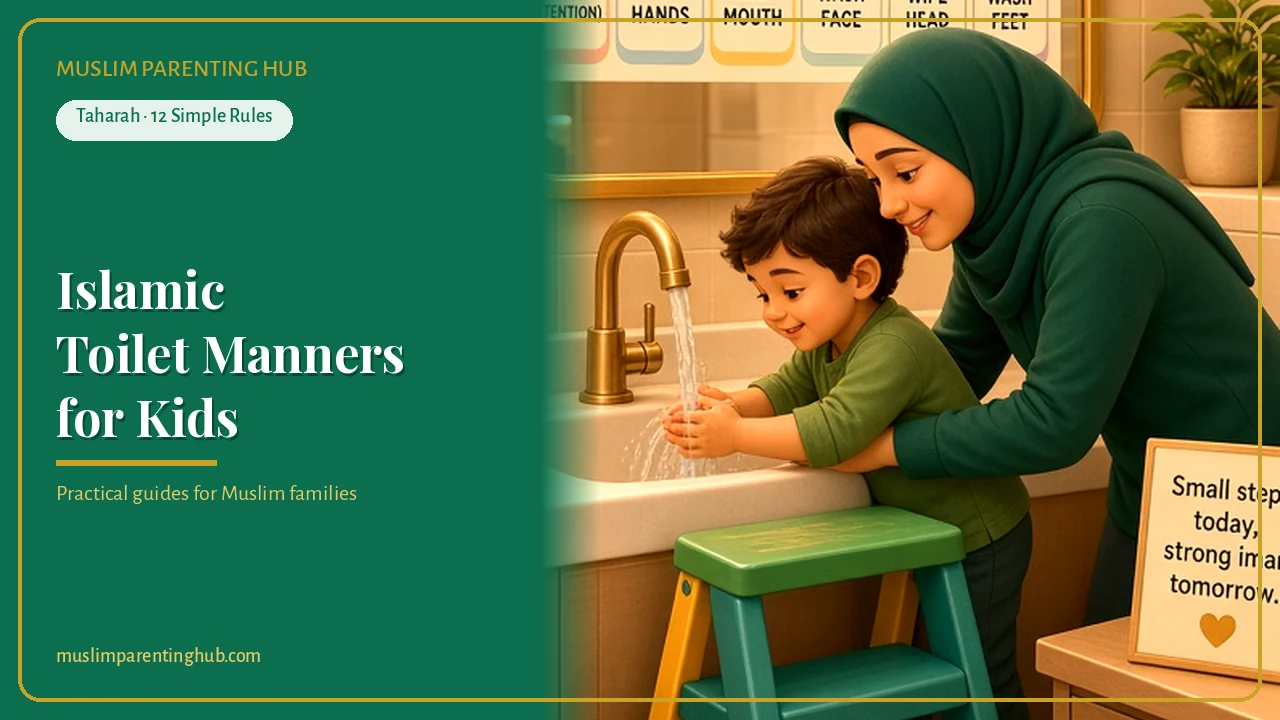
Islamic Toilet Manners for Kids: 12 Simple Rules (With the Reason Behind Each)
Your child is out of diapers. They can wipe, flush and wash their hands. Now comes the part that makes a Muslim bathroom routine different: the manners. Which foot goes in first? Can they talk in there? What about facing the qibla, splashes and the left hand?
Islam has a full set of toilet manners (adab al-khala), and children can learn all of them by about age seven if you teach one or two at a time and always explain why. Kids follow rules much better when the reason makes sense to them.
This guide lists 12 simple Islamic toilet manners with the reason behind each, how to teach them by age, a bathroom routine kids can follow on their own, and what to do when they forget. It is gentle home guidance, not a fatwa; where scholars differ, we note it, and you can follow the view of your local imam.
If your child is still in the middle of potty training, start with our main guide to Islamic potty training without shame. This page is the “next step” once they are using the toilet.
The 12 Rules at a Glance
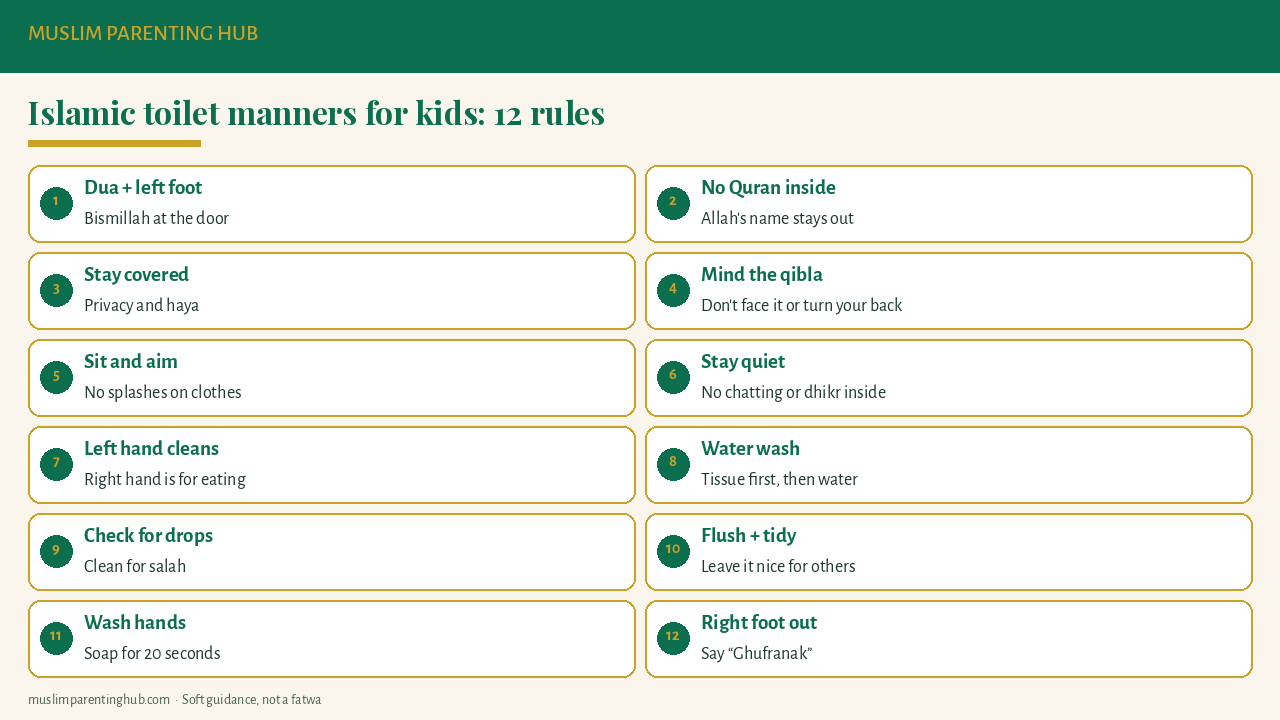
- Say the dua and go in with the left foot.
- Don’t take a Quran or anything with Allah’s name inside.
- Keep your private parts covered until you are ready.
- Don’t face or turn your back to the qibla while using the toilet (see note).
- Sit down when you can, and aim carefully so you don’t splash.
- Don’t talk in the bathroom unless you need to.
- Use your left hand for wiping and washing.
- Clean with water (istinja), or tissue and then water.
- Make sure no drops are left on your body or clothes.
- Flush and leave the toilet clean for the next person.
- Wash your hands well with soap.
- Leave with the right foot and say “Ghufranak.”
Print it, tape it at child height near the bathroom door, and work on two rules a week.
The Rules With Their Reasons
1. The dua and the left foot
Before entering, say: “Bismillah. Allahumma inni a’udhu bika minal-khubuthi wal-khaba’ith”: “In the name of Allah. O Allah, I seek refuge in You from all evil and evil things” (Bukhari, Muslim; Bismillah from Tirmidhi). Step in with the left foot.
The reason for kids: “We use our right side for good and clean things, like eating and entering the masjid. The bathroom is for dirty things, so the left foot goes first. The dua asks Allah to keep us safe.” Our bathroom duas for kids guide has a five-day plan for learning both duas.
2. No Quran or Allah’s name inside
Leave a mushaf, a necklace with Allah’s name, or a page with ayat outside the bathroom.
The reason: “We keep Allah’s words in clean, respectful places.” Phones with a Quran app are fine in a pocket, but don’t open it in there.
3. Privacy and covering
Close the door, and don’t undress more than needed. At school, use the stall.
The reason: “Our private parts are private. Allah loves modesty (haya).”
4. The qibla
The Prophet ﷺ taught not to face the qibla or turn your back to it while relieving yourself (Bukhari, Muslim). Many scholars say this is strict outdoors and more relaxed inside buildings, but it is best to avoid it if your toilet allows.
The reason: “The qibla is the direction of the Kaaba, the direction we pray. We show it respect.” If your toilet already faces the qibla, don’t stress; ask your imam, and teach kids to angle slightly where possible.
5. Sit, aim, no splashes
Sitting is the usual way and the easiest for keeping clean. Boys can stand where there is no splashing, but sitting at home is simpler. Our potty training boys in Islam guide covers the details.
The reason: “Urine is najis (not clean for prayer). If it splashes on us, our clothes need washing before salah.” Keep this calm. There is a well-known hadith about care with urine, but for young children, the simple message “we keep ourselves clean for salah” is enough.
6. Quiet in the bathroom
Avoid chatting, singing or calling out conversations from the bathroom. If they need help, they can call you.
The reason: “The bathroom isn’t a place for talking or dhikr out loud. We say our dua outside.”
7. Left hand for cleaning
The Prophet ﷺ taught not to wipe with the right hand (Muslim).
The reason: “Your right hand is for eating and shaking hands. Your left hand does the cleaning.” A sticker on the left wrist helps preschoolers remember.
8. Water for istinja
Wash with water using a bidet, squeeze bottle or lota. Tissue first and then water is best. If there’s no water, wiping well with tissue an odd number of times is allowed. Our step-by-step guide on how to teach kids istinja in US bathrooms shows exactly how.
The reason: “Water makes us really clean, and Allah loves people who keep clean” (Quran 9:108).
9. Check for drops
Teach older kids to wait a moment, then wash, and check their underwear.
The reason: “Tiny drops can make clothes unclean for salah.” No shame if it happens; just change and wash.
10. Flush and leave it clean
Wipe the seat, flush, put the bottle back and dry any water on the floor.
The reason: “Removing harm is part of faith” (Muslim). Leaving the bathroom nice is kindness to the next person, especially at Grandma’s or a friend’s house.
11. Wash hands with soap
Twenty seconds, front, back and between fingers. Our Sunnah handwashing guide for kids turns this into a quick song.
12. Right foot out and “Ghufranak”
Step out with the right foot and say “Ghufranak”: “I ask Your forgiveness” (Abu Dawud, Tirmidhi).
The reason: “We thank Allah for the easy body He gave us, and we ask His forgiveness for the time we couldn’t remember Him.”
Teaching by Age
- Ages 2–4: Focus on three things: “Bismillah” at the door, left foot in, wash hands. Do it with them every time.
- Ages 4–6: Add the full entering dua, “Ghufranak,” left-hand cleaning and sitting to avoid splashes.
- Ages 6–8: Add independent istinja with water, privacy, the qibla rule and leaving it clean.
- Ages 8+: Add checking for drops, school and public restrooms. Our guide to Islamic bathroom manners at school has scripts for teachers and a school kit.
A Bathroom Routine Kids Can Follow Alone
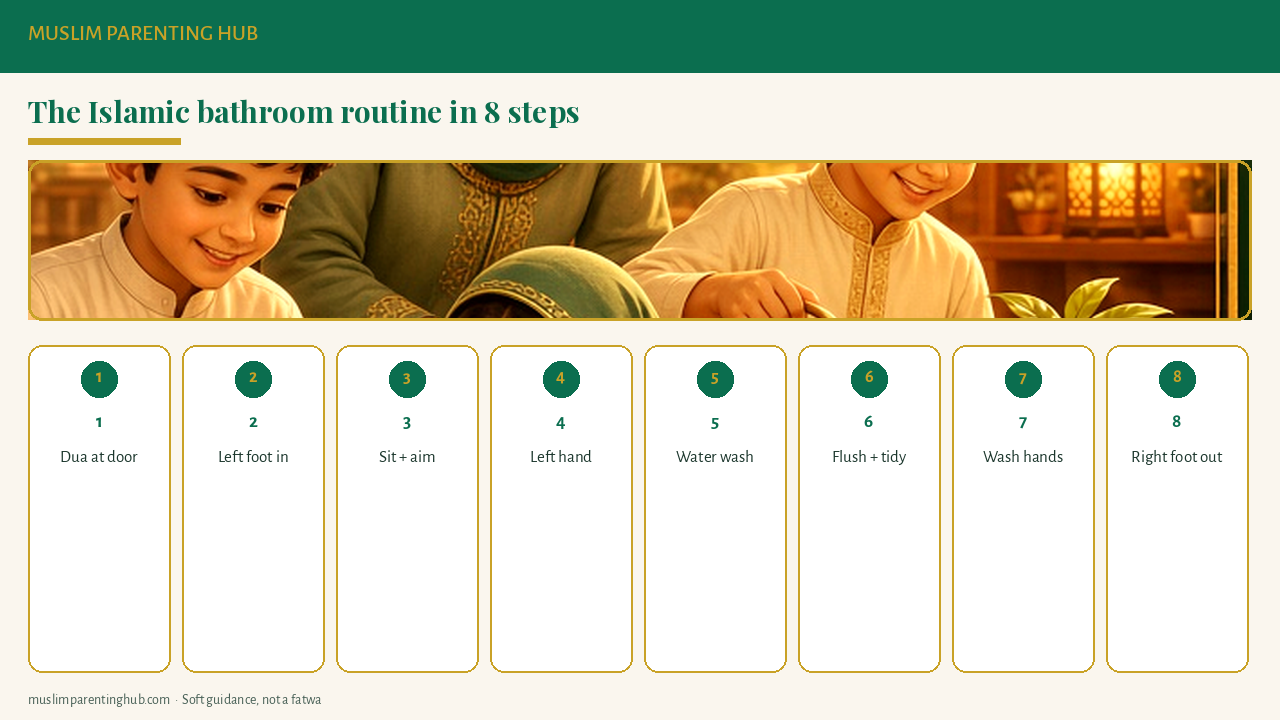
Once the rules are familiar, combine them into one routine. Practice it together for a week, then let your child do it alone and check in afterward.
- Stop at the door. Say Bismillah and the entering dua.
- Left foot in. Close the door.
- Sit and aim. Feet flat, take your time.
- Left hand cleans. Tissue first if needed.
- Water wash. Bidet, bottle or lota.
- Flush and tidy. Wipe the seat and put things back.
- Wash hands with soap.
- Right foot out. Say “Ghufranak.”
When Kids Forget (They Will)
Forgetting is normal. Correct with a whisper, not a lecture:
“Oops, which foot? Let’s step back out and try the left. Great.”
Never punish or shame toilet mistakes. Children who feel ashamed start hiding accidents, rushing and skipping istinja. Praise the effort: “MashaAllah, you remembered the dua all by yourself!”
If your child is still having accidents, see when Islamic potty training stalls for patience scripts.
FAQ
What are the Islamic toilet manners for kids?
Say Bismillah and the dua, enter with the left foot, keep covered, avoid facing the qibla, sit and avoid splashes, don’t talk, clean with the left hand and water, flush and leave it clean, wash hands, then leave with the right foot saying “Ghufranak.”
Which foot do you enter the bathroom with in Islam?
The left foot. Leave with the right foot. Muslims use the right side for clean and honorable things like eating and entering the masjid, and the left for the bathroom. For kids, a sticker on the left shoe helps them remember.
What dua do kids say before entering the toilet?
“Bismillah. Allahumma inni a’udhu bika minal-khubuthi wal-khaba’ith,” meaning “In the name of Allah. O Allah, I seek refuge in You from evil and evil things” (Bukhari, Muslim). Little ones can start with just “Bismillah.”
Is it haram to face the qibla in the toilet?
The Prophet ﷺ taught not to face or turn your back to the qibla while relieving yourself. Many scholars apply this strictly outdoors and are more lenient inside buildings. Avoid it if your toilet allows, and ask your local imam if your bathroom already faces the qibla.
Can kids talk in the bathroom in Islam?
Muslims avoid unnecessary talking in the bathroom and don’t say dhikr out loud there. A child can still call a parent for help. Teach them to say their duas just before and after, at the door.
Do kids need to use water after the toilet in Islam?
Using water (istinja) is the Sunnah and cleanest way, often after tissue. If water isn’t available, wiping well with tissue is allowed. Kids can use a squeeze bottle at school or travel and should wash hands with soap afterward.
Related guides
- Islamic potty training without shame
- Bathroom duas for kids: before and after the toilet
- How to teach kids istinja
- Islamic bathroom manners at school
- Islamic manners for kids: 30-habit adab checklist
Closing
Islamic toilet manners look like a long list, but they come down to three ideas kids understand: keep clean for Allah, keep private, and remember Allah at the door. Teach two rules a week, explain the reason, and praise every small win. In a month or two, the routine will be as automatic as brushing their teeth.
Quick steps
Islamic bathroom routine for kids in 8 steps. A simple routine that puts the Islamic toilet manners in order so children can follow them alone.
- Stop at the door — Say Bismillah and the entering dua before going in.
- Left foot in — Step in with the left foot and close the door.
- Sit and aim — Sit with feet flat and take your time so nothing splashes.
- Left hand cleans — Use the left hand for wiping, tissue first if needed.
- Water wash — Wash with water using a bidet, squeeze bottle or lota.
- Flush and tidy — Flush, wipe the seat and put things back.
- Wash hands — Wash hands with soap for about 20 seconds.
- Right foot out — Leave with the right foot and say “Ghufranak.”
Related articles
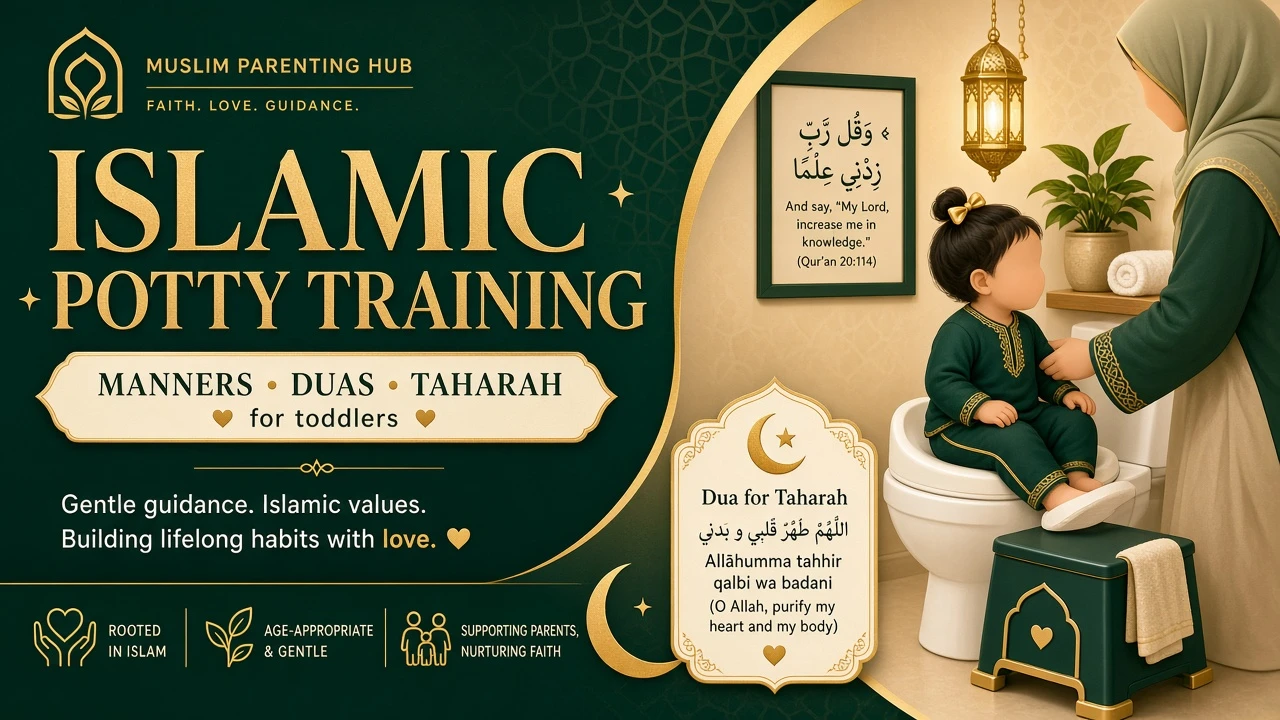
Islamic Potty Training Without Shame: Readiness, Bathroom Duas & Taharah
Ready for Islamic potty training? Spot readiness signs, teach bathroom duas and gentle istinja, and coach toilet manners with zero shame—start tonight.
Read guide →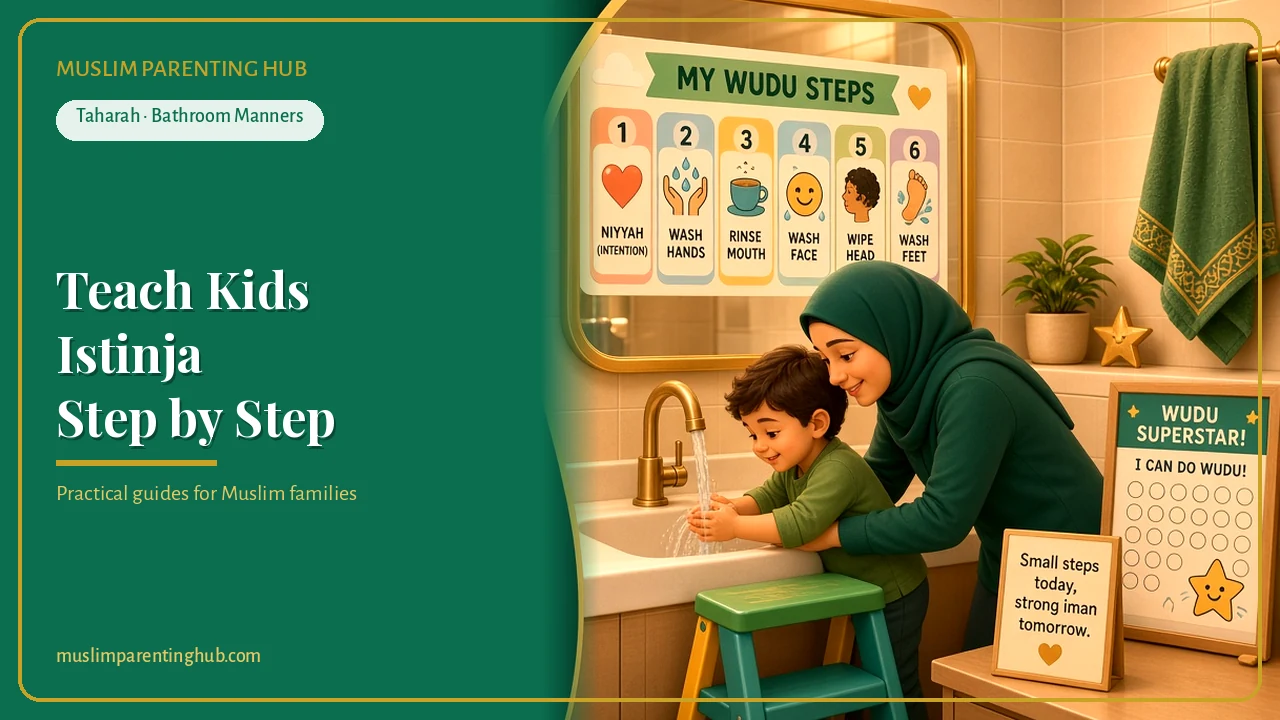
How to Teach Kids Istinja: Simple Washing Steps for US Bathrooms
Teach your child istinja without shame: easy wiping and washing steps, left-hand rules, peri bottle and bidet tips for US bathrooms, and a 7-day practice plan.
Read guide →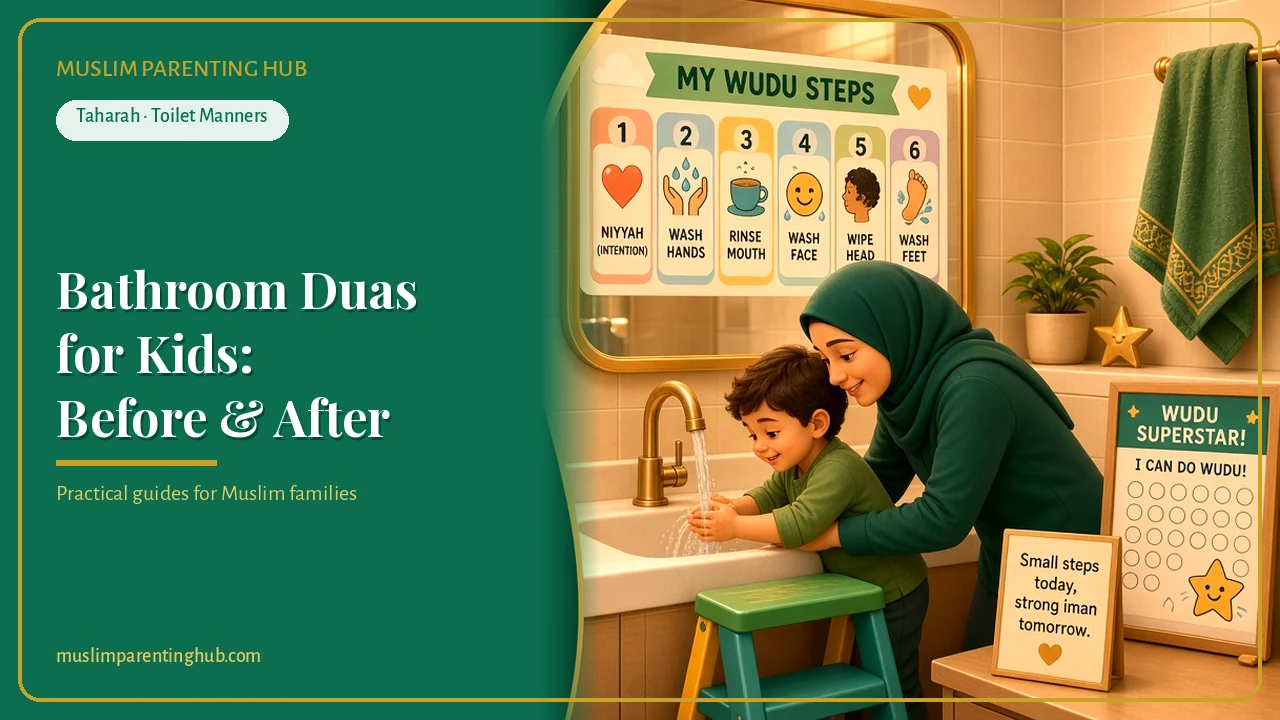
Bathroom Duas for Kids: What to Say Before and After the Toilet (Easy Words + a 5-Day Plan)
Teach kids the bathroom duas in easy steps: Bismillah and the entering dua, Ghufranak when leaving, left foot in, right foot out, and a 5-day plan (ages 2–8).
Read guide →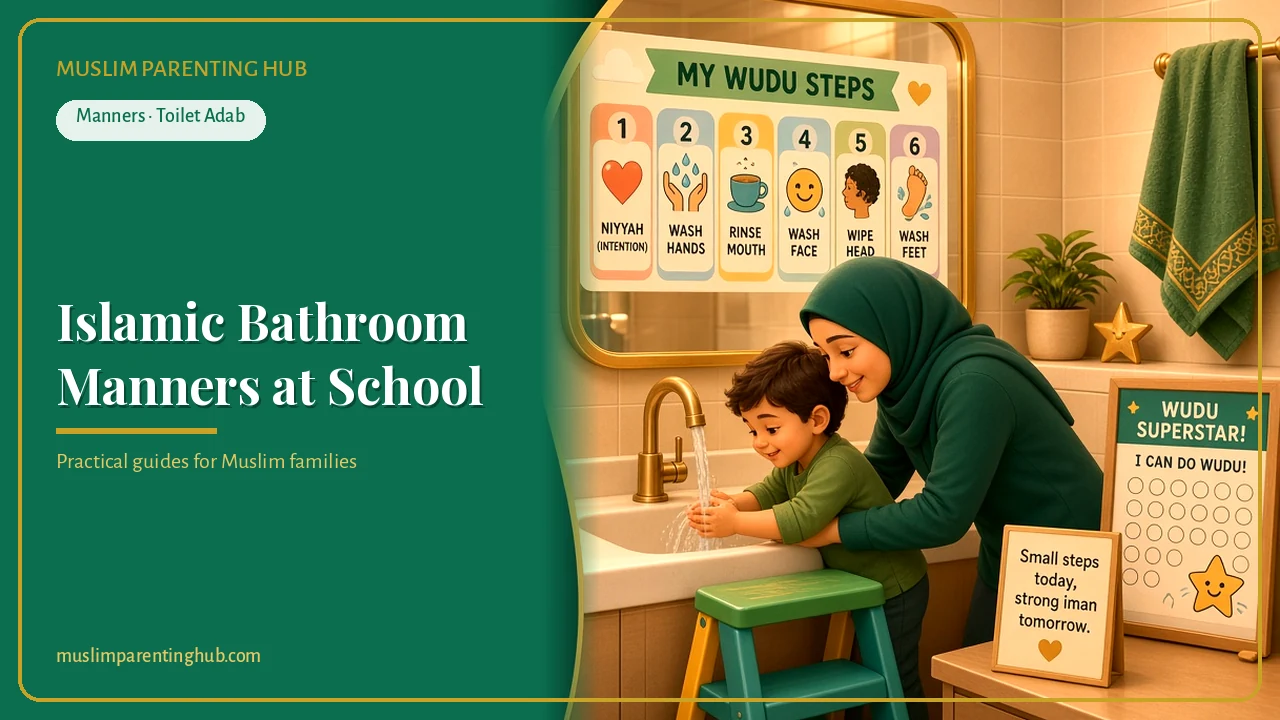
Islamic Bathroom Manners at School: A Kid-Friendly Guide to Public Restrooms
How Muslim kids keep Islamic bathroom manners at school: the duas, istinja with a squeeze bottle, privacy in stalls, urinals, and calm scripts for teachers.
Read guide →