

Islamic Chores for Kids: Age-by-Age Responsibility Chart for Muslim Homes
Children who only receive service can grow entitled. Children who only hear lectures about “hard work” can grow resentful. Islamic homes aim for a third path: helping as love, service, and shared amanah—without turning kids into unpaid staff or using chores as punishment theater.
This guide gives you an age-by-age chore chart, faith framing rooted in the Prophet ﷺ helping at home, scripts for pushback, and troubleshooting for perfectionism, sibling scorekeeping, and busy weeknights. Soft guidance—not a fatwa. Adapt for disability, trauma history, and your madhhab’s manners teachings.
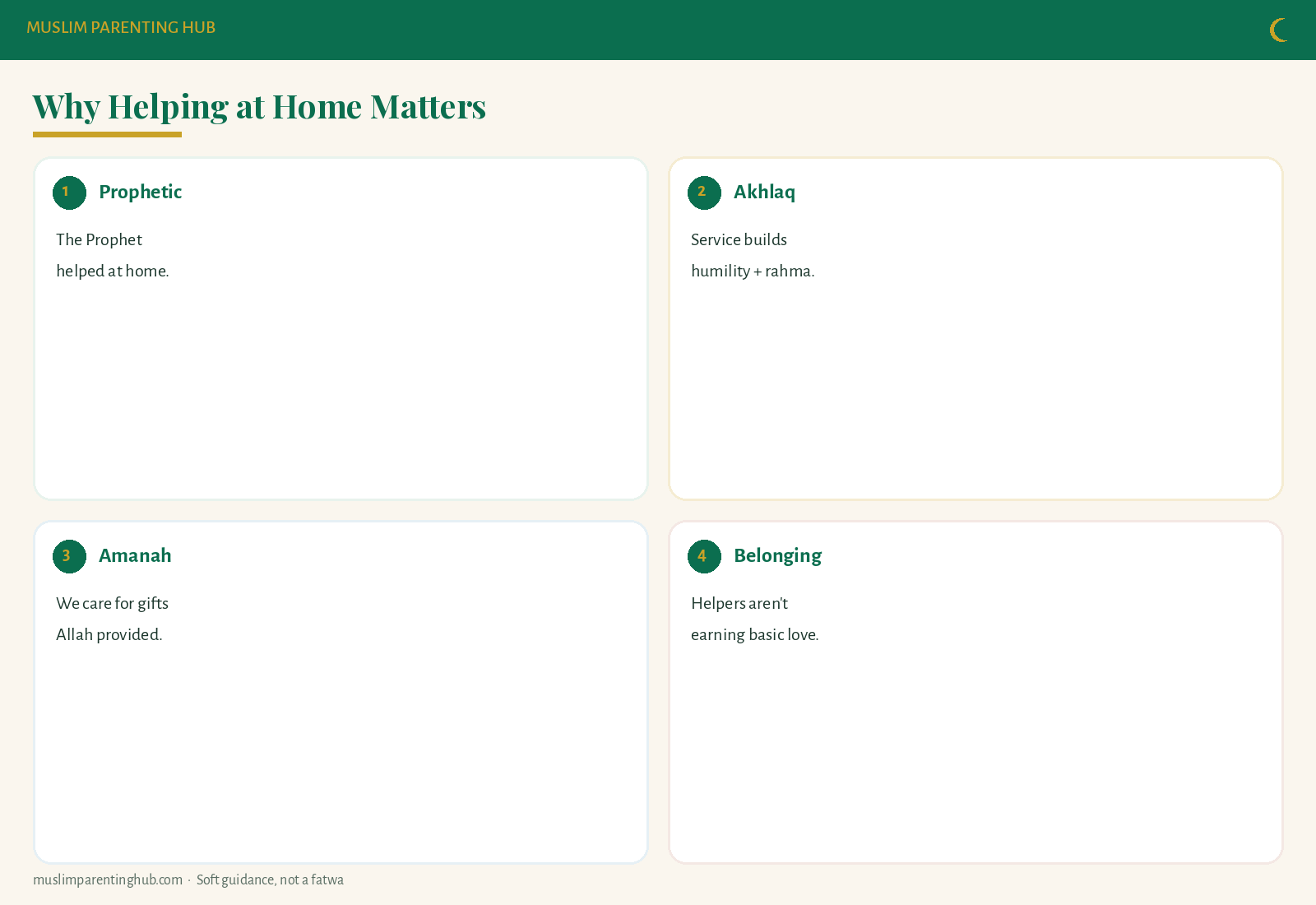
The Big Idea: Helping Is Worshipful Character
In many narrations cherished by Muslims, the Prophet ﷺ took part in household work. You do not need a debate club at the dinner table. One line is enough:
Script: “Our Prophet ﷺ helped at home. In this family, we help because we love Allah and each other.”
Chores teach:
- Responsibility (someone depends on my small effort)
- Humility (no job is “below” us)
- Rahma (we lighten each other’s load)
- Gratitude (we care for gifts—home, food, clothes)
Frame chores as sadaqah of effort and service—not as earning basic love.
Age-by-Age Islamic Chores Chart
Use this as a menu, not a mandatory checklist. Start with one or two jobs. Mastery beats a laminated fantasy chart you never follow.
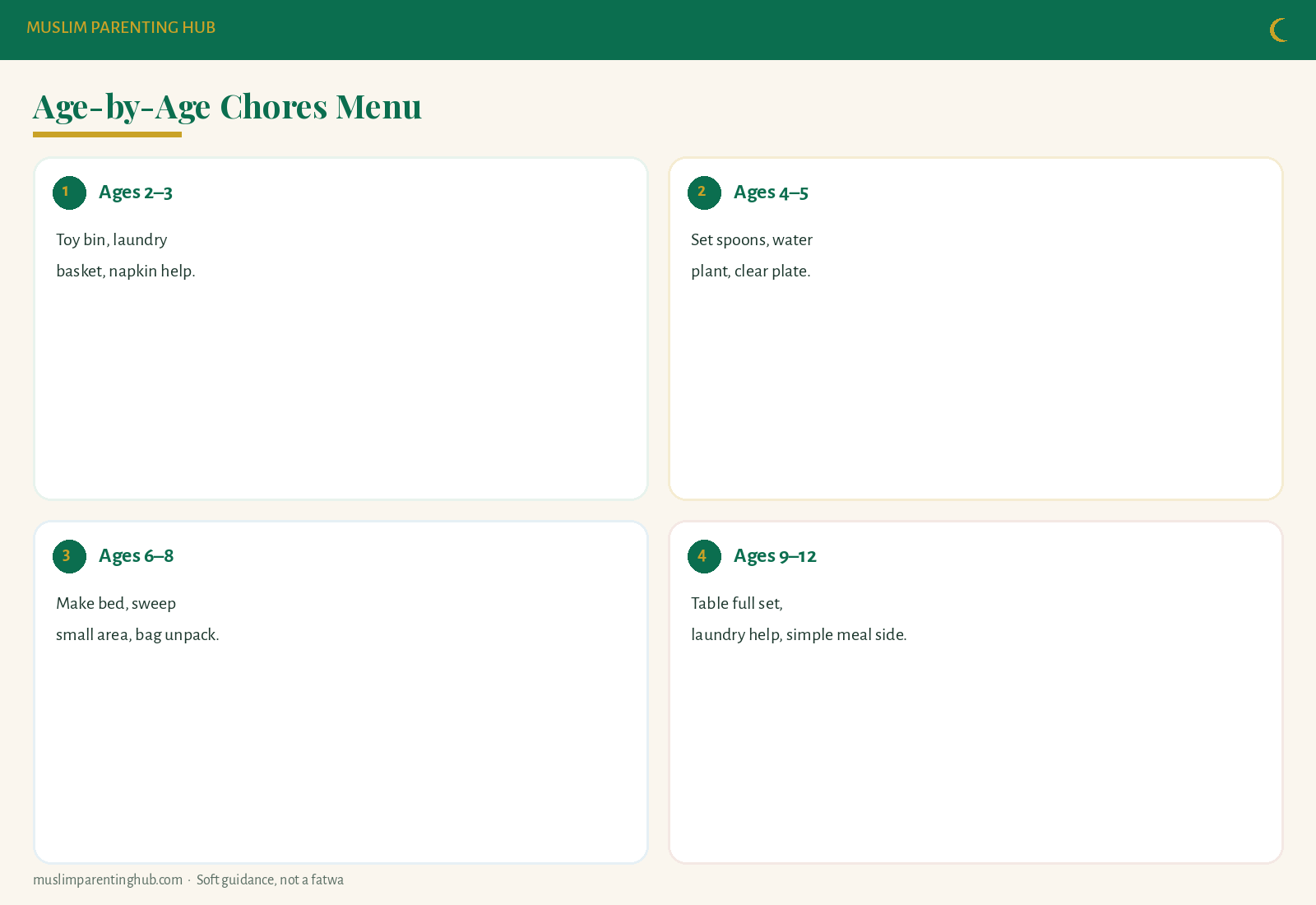
Ages 2–3 (toddlers)
- Put dirty clothes in a basket (you may finish)
- Wipe a low table with a damp cloth (expect streaks)
- Put toys in a bin with a song
- Carry a plastic cup to the sink
- Hand you clothespins / napkins
Faith line: “You’re a helper. Allah loves helpers.”
Ages 4–5 (preschool)
- Set napkins and spoons
- Water a plant with a small cup
- Match socks (imperfect pairs OK)
- Clear their plate to a safe station
- Wipe bathroom sink exterior with guidance
- Feed pet with you watching
Faith line: “We take care of what Allah gave us.”
Ages 6–8 (early school)
- Make bed simply (pull duvet)
- Unpack bag / lunch box rinse
- Sweep a small area
- Help prep iftar snacks or weekend salad
- Take out light trash bag with supervision
- Wipe baseboards on Friday reset (10 minutes)
Faith line: “This is our shared amanah—the home we borrow from Allah’s blessings.”
Ages 9–12
- Full table set / clear
- Laundry transfer (fold with playlist-free calm or Quran soft audio)
- Simple meal side (eggs, sandwiches) with safety rules
- Bathroom wipe-down checklist
- Younger sibling toy reset (coach, don’t dump parenting on them)
- Garden / balcony care
Faith line: “Strength is service. We don’t outgrow helping.”
Teens (brief note)
Negotiate real contribution: grocery list section, cooking one meal weekly, deep-clean zone. Avoid sarcasm. Respect growing privacy while keeping shared spaces dignified.
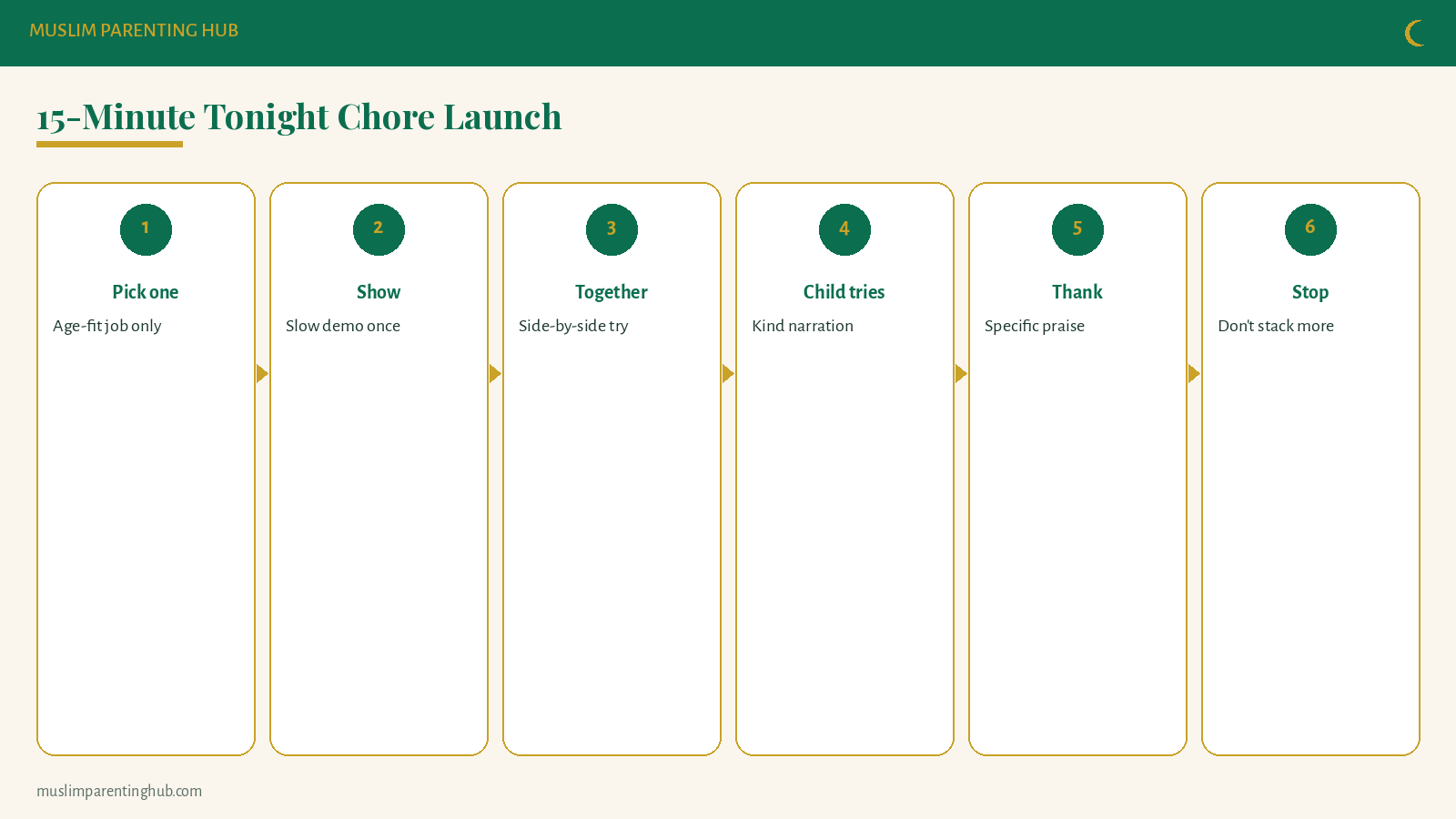
How to Introduce Chores Tonight (15-Minute Launch)
- Pick one job matched to age (not five).
- Show once slowly (“watch my hands”).
- Do together once.
- Child tries while you narrate kindly.
- Thank specifically: “You put three books on the shelf—that helped our Maghrib calm.”
- Stop. Don’t add a second chore in the same pep talk.
Script for resistance: “I hear you don’t feel like it. Helpers still help for five minutes. Timer on—then play.”
Connect after-school energy to your Maghrib rhythm: chores before screens often works—see After-School Maghrib Routine and Deen Before Screen.
Fairness Without Identical Jobs
Siblings will shout “Not fair!” if one folds laundry while another only puts shoes away. Teach early: fair ≠ same.
Script: “Different ages, different jobs. Both are real help. Both matter to Allah.”
For jealousy spike patterns, borrow calm language from Sibling Jealousy Scripts.
Rotate “special” jobs weekly so no one forever owns only the soggy trash duty.
Sticker Charts: Use Lightly or Skip
Charts can motivate—or create reward addiction and meltdowns when stickers run out.
Better patterns:
- Family “helper jar” with notes of thanks (read Fridays)
- Natural privilege after contribution (“When bags are hung, we start story”)
- Quiet pride: end day naming one help each child gave
If you use stickers, keep them short-term for a new skill (two weeks), then fade to intrinsic + thanks.
Home Edge Cases
Perfectionist parent: Accept toddler wipe marks. Redoing angrily teaches “my help is worthless.” Fix after they’re gone if needed.
Messy special needs / sensory profiles: Shrink jobs to one step. Success builds identity; overload builds shutdown.
You work late: Morning micro-chores (make bed) + weekend shared reset. Quality over daily theater.
Grandparents spoil / undo chores: Privately align: “We’re training helpers. Please thank their effort even if imperfect.”
Chores as punishment: Avoid “Because you lied, scrub the floor.” That wires service to shame. Repair and accountability can include restorative help chosen carefully—never humiliation.
Friday glow: Make a joyful 20-minute family tidy before Friday night fun—pairs with Friday Night Family Routine.
Scripts Board (Copy-Paste)
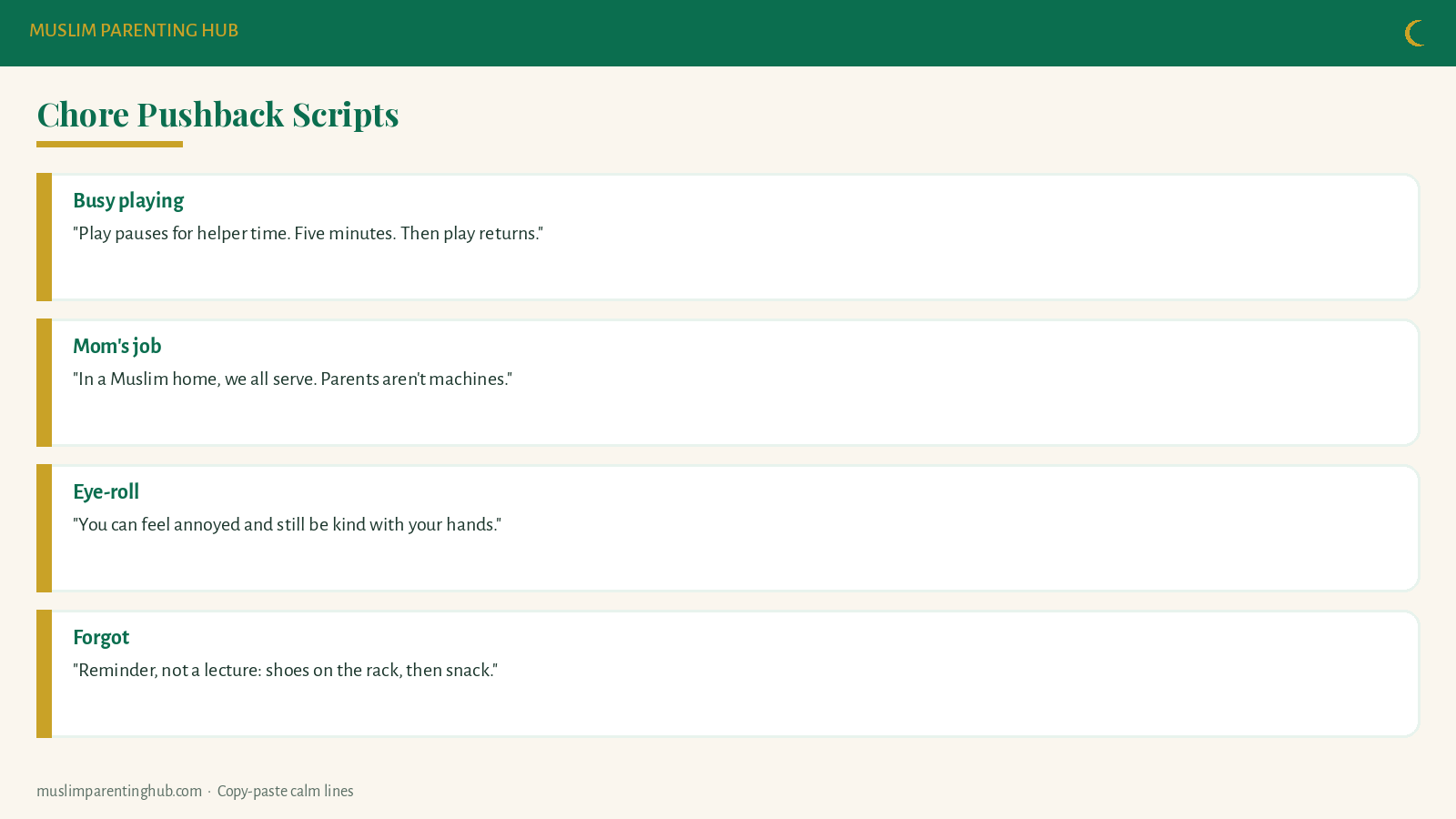
| Moment | Say this |
|---|---|
| “I’m busy playing” | “Play pauses for helper time. Five minutes. Then play returns.” |
| “That’s Mom’s job” | “In a Muslim home, we all serve. Mom/Dad aren’t machines.” |
| Eye-roll / sigh | “You can feel annoyed and still be kind with your hands.” |
| Sibling mocks effort | “We protect dignity. Helpers get respect.” |
| Job forgotten | “Reminder, not a lecture: shoes on the rack, then snack.” |
| Beautiful effort | “Allah sees your trying. I see it too. Thank you.” |
Linking Chores to Manners and Faith
- Toilet / bathroom wipe habits grow from dignity lessons in Islamic Potty Training.
- Greeting guests after tidying entryway pairs with Teach Toddlers Salam.
- After helping, a short own-words thanks dua grows from Dua From the Heart.
Weekly Rhythm Suggestion
| Day | Focus |
|---|---|
| Sat | Family reset (20–40 min music-free or soft Quran) |
| Sun | Plan week’s helper jobs on fridge |
| School nights | One micro-chore before screens |
| Thu | Clear Maghrib path (shoes, prayer space) |
| Fri | Short tidy + gratitude for helpers |
What Success Looks Like in Six Weeks
Not a spotless house. Success is:
- Less arguing about the idea of helping
- Kids who know where things belong
- Language of service in the home
- You snapping less because systems carry load
If you only installed “put plates near sink” and “toys in bin,” you already won a phase.
Prophetic Work Ethic in Kid Language (Keep It Soft)
You do not need a full seerah unit. Three family lines are enough for months:
- “The Prophet ﷺ helped at home.”
- “Helping is part of good character (akhlaq).”
- “We don’t mock helpers—including parents.”
If older kids ask for proof stories, read a short kid-friendly seerah moment later—not during a trash-bag standoff.
Room-by-Room Starter Jobs
Entryway: Shoes on rack; bag on hook. (Prevents Maghrib trip hazards.)
Kitchen: Napkins; wipe low spills with parent; sort recyclables with gloves if needed.
Living room: Five-item pickup race (timer, not shame).
Bedroom: Pillow straighten; books to shelf; laundry to basket.
Bathroom: After potty habits mature—pump soap, towel on hook, wipe faucet exterior. Pair dignity with Islamic potty training.
Post a photo chart of your rooms (not a Pinterest mansion) so kids see the real target.
The “Two-Minute Helper” Rule for Exhausted Nights
School night. Everyone is fried. Skip the ambitious laundry fold.
Say: “Two-minute helper: plates to counter, then we’re done.”
Tiny consistency preserves identity (“I am a helper”) when perfect routines fail. Resume fuller charts on weekends.
Chores and Screens: A Clean Bargain
Many homes succeed with: helper job → then agreed screen—or no screen on school nights after Maghrib anyway.
Bargain must be honest. If you promise a game after chores and revoke randomly, trust drops—and chore wars worsen. Align with your video games checklist and morning gate.
Celebrating Without Bribing Forever
Rotate celebrations:
- Verbal specific praise
- Extra story choice
- Choose Friday dessert flavor
- “Helper of the day” announces dua intention for someone
Avoid escalating payouts (toys for every sock match). Service should taste like belonging.
Photo Chart DIY (Tonight Project)
- Take photos of your child doing each approved job (or of the finished state: shoes on rack).
- Print small; tape to cardstock.
- Title: “Helpers in our Muslim home.”
- Place at kid eye level.
- Review after Maghrib twice a week—not every failure moment.
Photos of their hands beat generic clipart. Update as skills grow so the chart doesn’t insult a nine-year-old with toddler jobs forever.
Masjid / Guest-Ready Reset (10 Minutes)
Before guests or Jummah departure: assign each child one zone. Parent does bathrooms/stove safety. End with salam practice at the door—Teach toddlers salam. Tidying becomes hospitality adab, not nagging for its own sake.
FAQ: Islamic Chores for Kids
What chores are appropriate for Muslim toddlers?
Simple, supervised tasks: toy bin, clothes in basket, napkin to table, wipe a low surface. Praise effort. Keep it playful and short.
How do I teach kids responsibility in an Islamic way?
Link helping to Prophetic character and service to family, not to earning love. Use age-fit jobs, model yourself, thank specifically, and avoid shame-based punishment chores.
Should I pay kids for chores?
Families differ. Many keep core family contributions unpaid (we all serve) and use occasional paid extras for bigger optional jobs. Stay consistent and explain your house rule calmly.
What if my child refuses all chores?
Shrink the ask to two minutes, offer two job choices, use a timer, and follow through kindly. Check sleep, screens, and whether the job is too hard. Repair your own yelling separately.
How do I stop sibling fights about who does more?
Teach fair ≠ same, rotate less-loved tasks, and stop public scorekeeping. Private one-on-one thanks reduces competition.
At what age should kids clean their own room?
Many preschoolers can reset toys with help; school-age kids can own a simple weekly reset. Standards should match age—guide, don’t expect hotel perfection.
FAQs
What chores are appropriate for Muslim toddlers?
Simple supervised tasks like toy bin, clothes in basket, napkin to table, and wiping a low surface. Praise effort and keep it short.
How do I teach kids responsibility in an Islamic way?
Link helping to Prophetic character and family service, use age-fit jobs, model yourself, thank specifically, and avoid shame-based punishment chores.
Should I pay kids for chores?
Many families keep core family contributions unpaid and sometimes pay for bigger optional extras. Stay consistent and explain your house rule calmly.
What if my child refuses all chores?
Shrink the ask to two minutes, offer two job choices, use a timer, and follow through kindly while checking sleep, screens, and job difficulty.
How do I stop sibling fights about who does more?
Teach that fair is not the same as identical, rotate less-loved tasks, and thank each child privately to reduce scorekeeping.
At what age should kids clean their own room?
Preschoolers can reset toys with help; school-age kids can own a simple weekly reset. Match standards to age without hotel perfection.