
My Child Lied: An Islamic, Trust-Building Response Guide for Parents
Your stomach drops. The story doesn’t add up. Maybe the cookie crumbs, the broken vase, the “I already prayed,” or the secret game download.
Before you escalate into a courtroom, pause. How you respond to a lie trains the next ten lies—toward honesty or toward better hiding.
This guide helps you sort fear-based lies, imaginative stretch, and manipulative patterns, with age-banded scripts, a repair plan, and soft taqwa framing that does not terrorize. Parenting guidance—not a fatwa.
The Big Idea: Protect Truth + Relationship
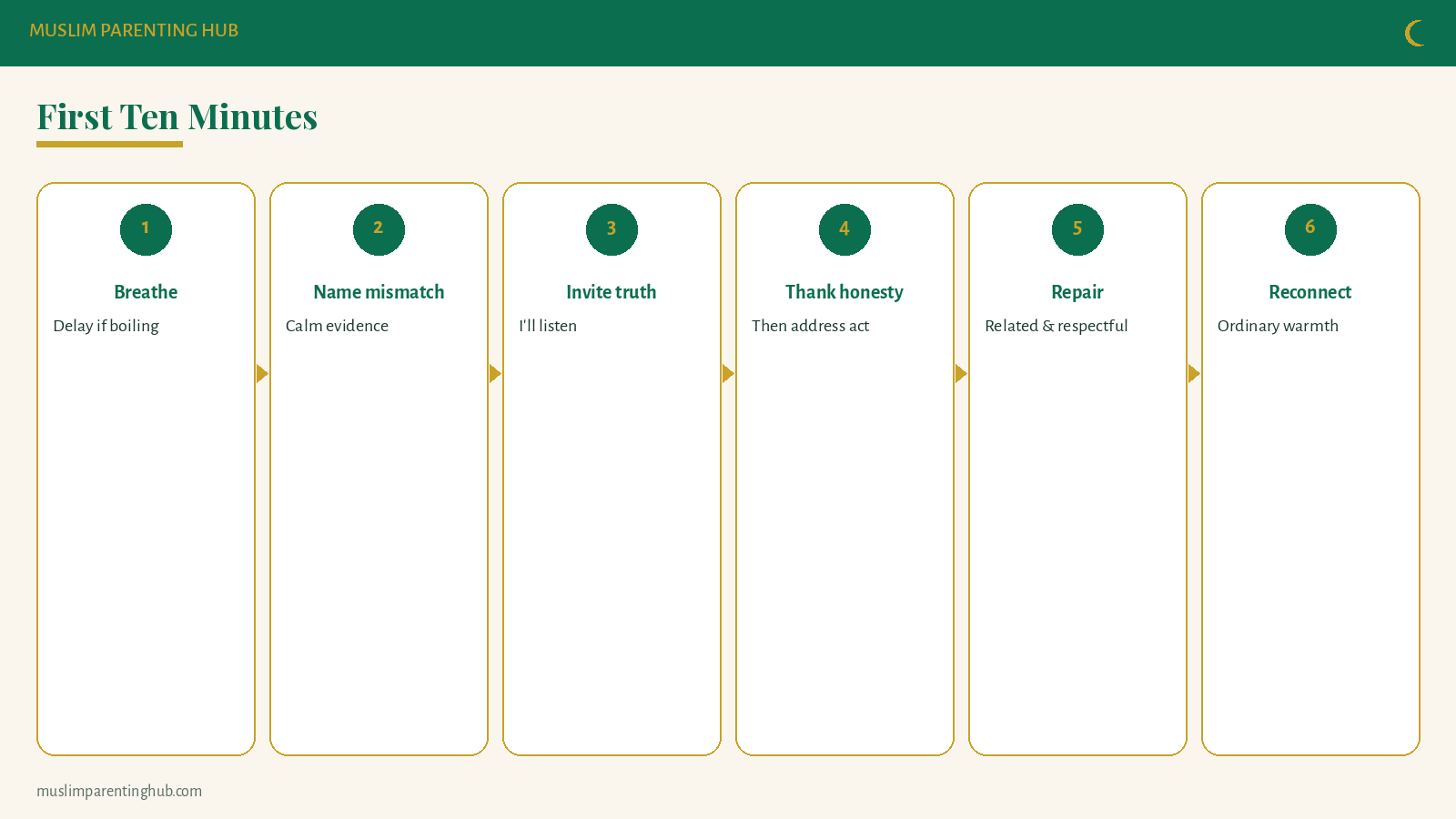
Goals in order:
- Safety (if the lie hid danger)
- Truth recovered without humiliation
- Repair of harm
- Skill for next time (words for hard truths)
- Hope — Allah loves tawbah; parents love return to honesty
Avoid the identity stamp: “You are a liar.” Prefer: “That wasn’t true. In our family we practice coming back to truth.”
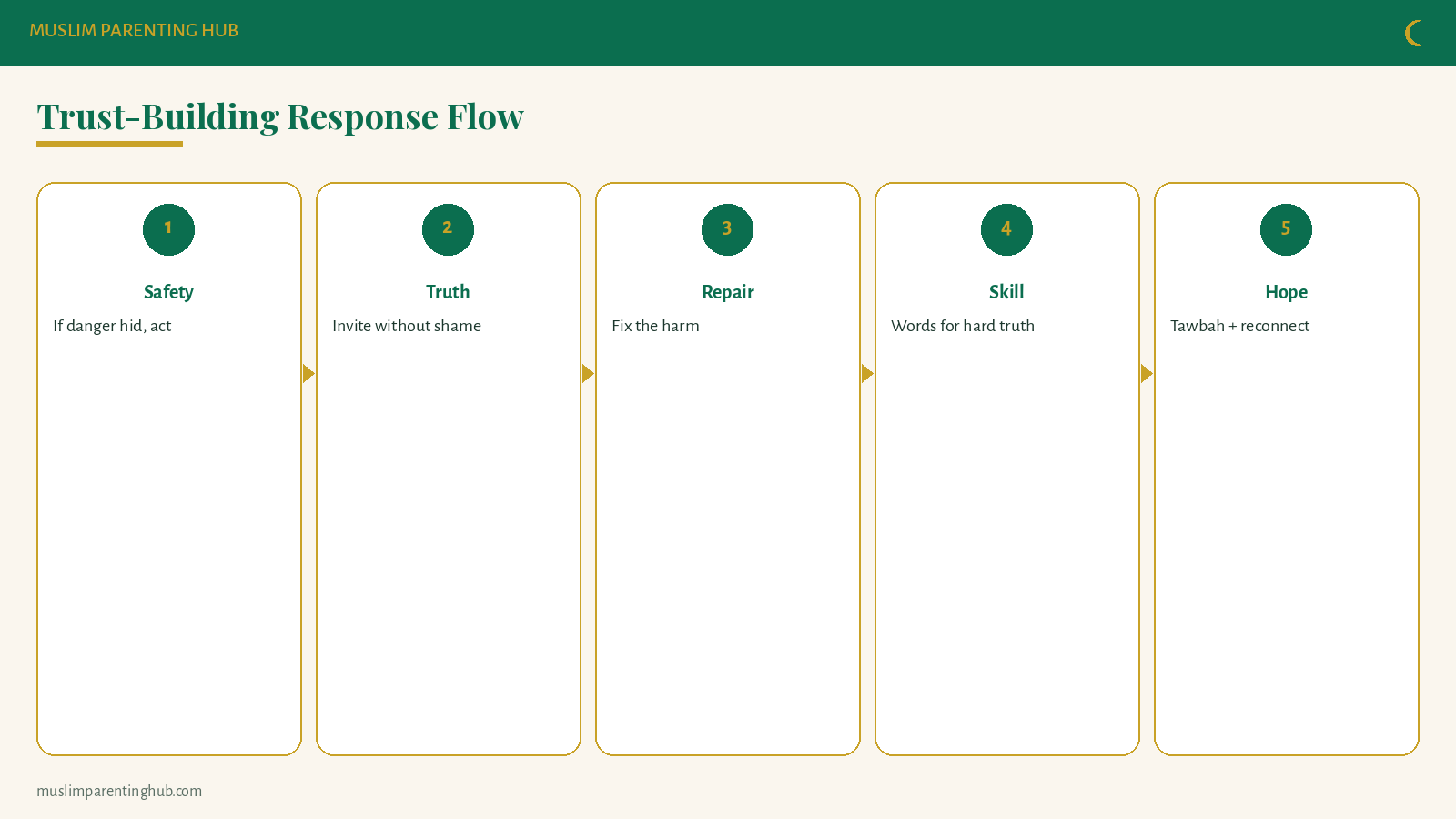
First: What Kind of “Lie” Is This?
1) Imaginative / wishful (common under 5)
“I have a pet dragon.” “I scored ten goals.” Often not moral corruption—developmental.
Response: Softly label reality without shame. “That sounds like pretend. Pretend is fun. For real life we say what’s true.”
2) Fear-based lie
Child expects rage, shame, or withdrawal. Lying is a shield.
Response: Lower your voice. “You can tell me hard things. I may be upset about the choice—and I will still help you.”
3) Avoidance / laziness
“I already made wudu / did homework.”
Response: Check gently, require redo without sarcasm marathon.
4) Status / peer image
Exaggeration to impress friends; teen image management.
Response: Private talk about integrity as strength.
5) Patterned deception with harm
Repeated stealing + lying, secret accounts, cruelty covered up.
Response: Stronger boundaries, possible counseling, device limits—still without degrading labels.
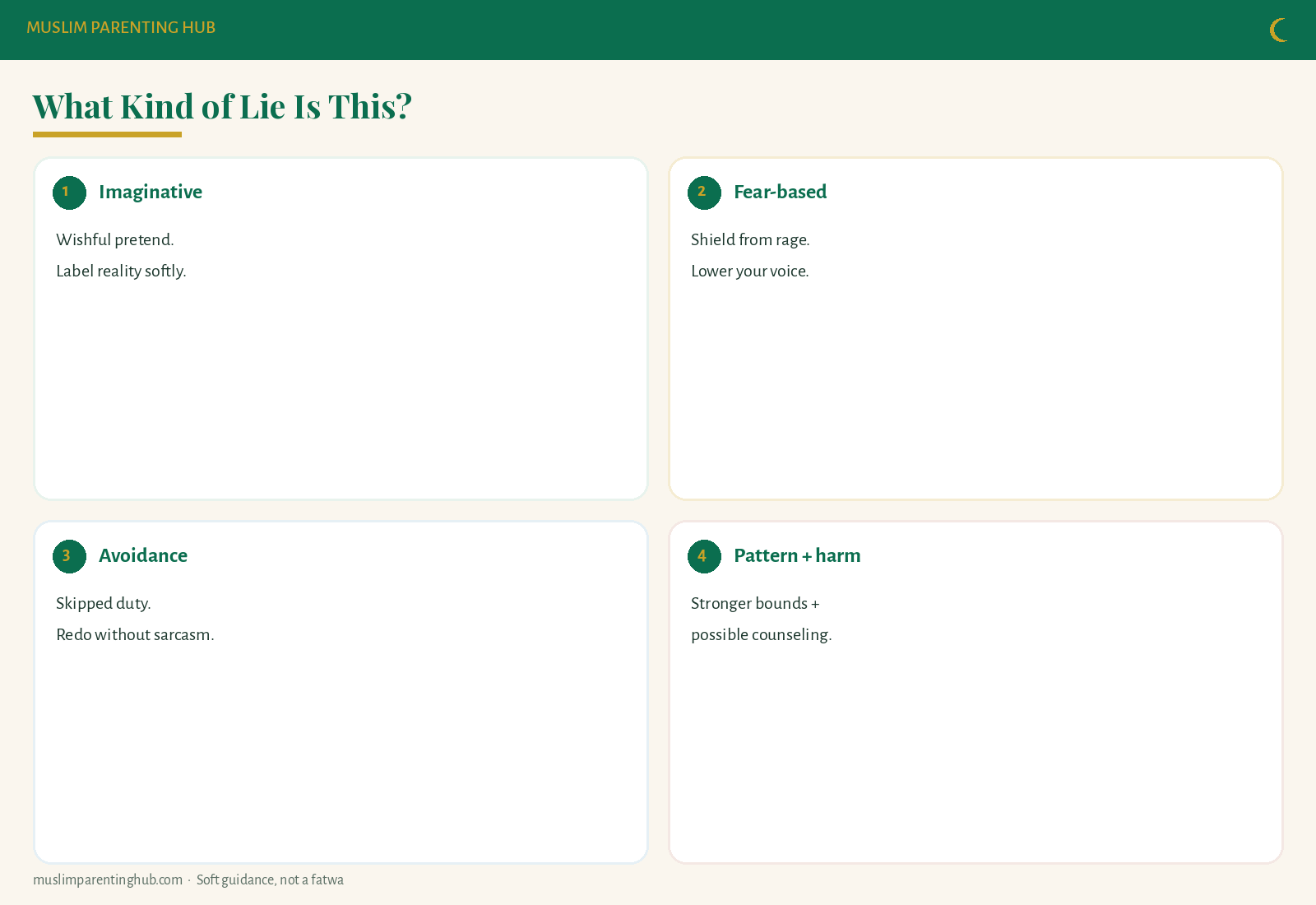
The First Ten Minutes After You Catch a Lie
- Breathe. Delay big consequences if you are boiling.
- State the mismatch calmly. “I see crumbs and you said you didn’t eat any.”
- Invite truth once. “Tell me what happened. I’ll listen.”
- If truth comes: thank honesty before addressing the original mistake.
- If denial continues: hold the boundary on the evidence; avoid hours of interrogation.
- Repair plan (clean, apologize, replace, redo prayer practice, etc.).
- Reconnect later with ordinary warmth so honesty feels survivable.
Tonight script: “Truth keeps our hearts light. Even when the truth is messy, we can clean it together. Lying makes a bigger mess.”
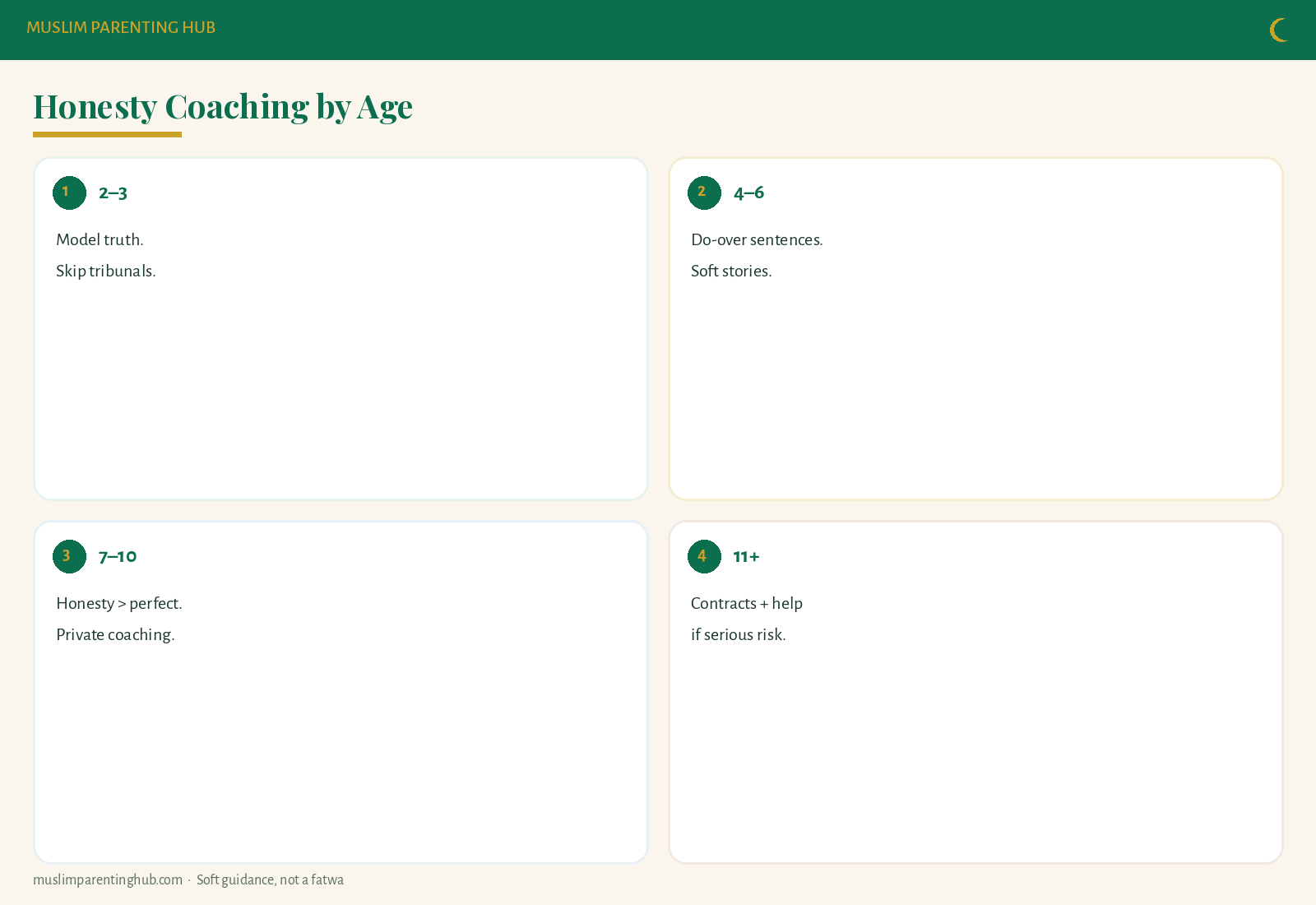
Age Bands: What Honesty Coaching Looks Like
Ages 2–3
- Mix of pretend and early experiments with “no” reality.
- Don’t hold moral tribunals.
- Model: “Oops—I spilled. I’ll tell Baba the truth.”
- Simple: “We say what really happened.”
Ages 4–6
- Peak magical thinking + growing awareness that words can change outcomes.
- Use stories of honesty without graphic punishment tales.
- Practice “do-over sentences”: “I knocked it. I need help.”
Ages 7–10
- Clearer moral understanding; fear of disappointing parents spikes.
- Written family value: honesty > looking perfect.
- Logical repairs; remove audience (no sibling shame show).
Ages 11+
- Privacy expands; so does capacity for secret life.
- Contracts for devices; natural consequences.
- Discuss hypocrisy gently—living two lives is heavy.
- If lies hide serious risk (self-harm, predation, substances), get professional + trusted Islamic counsel.
Islamic Framing Without Terror
You can teach that Allah knows what is hidden as comfort for the honest and a wake-up for secrecy—not as a horror movie.
Soft lines:
- “Allah already knows. Telling me lets us fix it together.”
- “Allah loves those who turn back. Honesty is a door.”
- “We don’t need perfect kids. We need truthful ones who repair.”
Avoid with young children: graphic hellfire lectures for cookie theft. That can create scrupulosity or secret atheism of the heart (“Allah is only scary”).
Pair conscience growth with mercy stories and own-words istighfar—see Dua From the Heart. For sibling blame games (“He did it!”), see Sibling Jealousy.
Scripts for Common Moments
| Situation | Script |
|---|---|
| Cookie / snack denial | “I’m not asking to trap you. I want truth. Then we plan sweets rules.” |
| “I prayed” (but didn’t) | “Salah is for Allah, not for my smile. Let’s pray now. Truth next time even if late.” |
| Broken item | “Accidents happen. Hiding breaks trust more than glass.” |
| Homework lie | “Struggle is allowed. Lying about work blocks help.” |
| Game / screen secret | “Hidden games pause all games. Honesty restarts the path.” Link Video games checklist. |
| Blaming sibling | “Each person owns their piece. No dumping.” |

Repair Plans That Teach (Not Humiliate)
Good repairs are related, respectful, reasonable:
- Clean the mess together
- Apologize to the person harmed (coached, not forced robotic theater if dysregulated—return later)
- Replace from allowance if appropriate
- Redo the skipped obligation
- Temporary privilege pause tied to the domain (screens if screen-lie)
Bad repairs: public shaming, insults about character, endless lectures while hungry/tired, comparing to “cousin who never lies.”
When You Model Dishonesty
Kids hear “Tell them I’m not home,” fake ages for tickets, or empty threats (“I’ll never take you again”) that you don’t mean. Honesty culture starts with adult integrity plus apology when we slip.
Script to child after you lied/exaggerated: “I said something untrue. I’m fixing it. Muslims practice truth—including parents.”
Home Edge Cases
One parent harsh, one soft: Align privately. Child will lie to the scary parent and charm the soft one. Shared calm script matters.
School accusations: Listen first; verify; advocate if biased; still coach honesty if true.
Anxiety / ADHD / autism: Processing and fear differ. Lies may be shutdown language. Use visual supports and fewer words.
Chronic lying: Track triggers (hunger, screens, peer status). Consider counselor. Keep dignity.
Maghrib reset after a hard honesty talk: Pray together; don’t let the fight erase worship rhythm—Maghrib routine.
A 7-Day Honesty Reset (After a Trust Crack)
- Day 1: Name the value at dinner without naming the crime show-style.
- Day 2: Practice “hard truth” role-play with stuffed animals / scenarios.
- Day 3: Parent shares a childhood honesty story (age-fit).
- Day 4: Thank any micro-honesty loudly.
- Day 5: Review device / pocket money systems that reduce temptation.
- Day 6: Short dua together for truthful hearts.
- Day 7: Family fun unrelated to the incident—joy rebuilds attachment.
Taqwa Without Terror: A Mini Lesson Plan (10 Minutes)
- Sit side-by-side (not across like an interrogation).
- Define taqwa in kid words: “Caring about what Allah thinks—even when no person sees.”
- Give a positive example: returning extra change; admitting spill.
- Contrast hiding vs. returning to truth.
- End with a short istighfar together and a hug if welcome.
Stop before they glaze over. Repeat monthly—not only in crisis.
Classroom & Masjid Lies
Children sometimes lie to teachers about homework or to aunties about “already prayed.” Coordinate with adults: shared calm scripts beat good-cop/bad-cop. Protect your child’s dignity in public; coach in private.
If a teacher humiliates, advocate. Shame from outsiders often increases secretiveness.
Rebuilding Trust Timeline (Realistic)
Trust returns in deposits: small honest moments stacked over weeks—not one tearful apology. Parents also owe consistency: if you say “you can tell me anything,” don’t explode beyond what you promised you could handle. If you need a pause, say: “I need five minutes to calm so I can listen well.” That models regulation, not rejection.
When the Lie Protected Someone Else
Kids may lie to shield a sibling or friend. Acknowledge loyalty, then teach: “Protecting people from harm is good. Covering harm so it continues is not. Tell a trusted adult.” Nuance matters for bullying situations.
Dua and Remembrance After Hard Truths
After repair, keep ibadah hopeful. A one-line dua—“Ya Allah, make us people of sidq (truthfulness)”—beats a forty-minute scold. Grow own-words skill with Dua from the heart.
“Truth Practice” Games (Ages 4–8)
Two doors: Parent tells a true story and a silly false one; child spots which is true—then switch roles. Keep silly, not scary.
Repair theater: Stuffed animal breaks a cup and hides; kids coach the animal to tell truth + clean.
Compliment honesty: Catch them telling an inconvenient truth (“I didn’t brush”) and thank the courage before the brushing redo.
Play lowers shame. Shame raises hiding.
Parent Script When You Were About to Explode
If you already yelled “You liar!”—repair:
“I called you a hurtful name. That was wrong. You are my child who made a dishonest choice. We will practice truth. I’m sorry for the name.”
Children learn tawbah from our tawbah.
Connecting Honesty to Evening Calm
After a hard truth conversation, do not skip the soothing chain: water, Maghrib if due, short connection, bedtime dua. Dysregulated nights breed tomorrow’s fear-lies. Use Toddler bedtime fixes when little ones spiral after conflict.
Remember: a single lie does not define a child’s akhirah path. Your consistent mercy-plus-boundary response is itself an act of tarbiyah that can last decades.
FAQ: When Your Child Lies
What should a Muslim parent do when a child lies?
Stay calm, name the untruth, invite honesty, thank truth when it comes, repair the original harm, and teach that Allah loves returning to truth—without labeling the child “a liar.”
Is lying normal for toddlers?
Imaginative talk and early denial are common. Coach reality gently. Focus more on fear-based and harmful deception as they grow.
How do I teach honesty in Islam without scaring my child?
Emphasize Allah’s knowledge as a reason to be free and truthful, highlight tawbah and repair, and avoid graphic punishment stories for small mistakes.
Should I punish lying or the original mistake?
Address both: the act and the cover-up—usually with clearer weight on rebuilding trust. Avoid double explosions that make truth feel impossible.
What if my child keeps lying even after talks?
Inspect fear, peer pressure, and unclear rules. Tighten systems (supervision, devices), keep relationship warm, and seek counseling if the pattern is deep.
FAQs
What should a Muslim parent do when a child lies?
Stay calm, name the untruth, invite honesty, thank truth when it comes, repair the original harm, and teach that Allah loves returning to truth—without labeling the child a liar.
Is lying normal for toddlers?
Imaginative talk and early denial are common. Coach reality gently and focus more on fear-based and harmful deception as they grow.
How do I teach honesty in Islam without scaring my child?
Emphasize Allah’s knowledge as a reason to be free and truthful, highlight tawbah and repair, and avoid graphic punishment stories for small mistakes.
Should I punish lying or the original mistake?
Address both the act and the cover-up, usually with clearer weight on rebuilding trust, and avoid double explosions that make truth feel impossible.
What if my child keeps lying even after talks?
Inspect fear, peer pressure, and unclear rules; tighten supervision systems; keep the relationship warm; and seek counseling if the pattern is deep.
Should I call my child a liar?
No. Name the behavior—“that wasn’t true”—and protect identity so change feels possible.