
How to Teach Kids Not to Interrupt: Islamic Manners, the Hand-on-Arm Trick and a 7-Day Plan
You pick up the phone, and within ten seconds: “Mama. Mama. MAMA. Can I have a snack?” Or Grandma is telling a story at dinner, and your eight-year-old jumps in halfway through with a story of their own. Or you’re talking to the imam after Jumu’ah, and a small hand tugs your sleeve over and over.
Interrupting is one of the most common manners struggles in any home. Young children genuinely find it hard to hold a thought, and their need always feels urgent. The good news is that listening without interrupting is a skill, not a personality, and it can be taught in a few weeks with a simple signal, the right words and a lot of practice.
This guide gives US Muslim parents the Islamic “why” in kid-sized words, the famous hand-on-arm trick, scripts by age, what to do when you are the interrupter, and a seven-day plan. It fits right alongside the other habits in our Islamic manners for kids checklist.
Why Listening Is an Islamic Manner
Kids follow a rule better when they know why it matters. Keep it short:
“When someone is talking, we listen until they finish. It shows we respect them, and the Prophet ﷺ was the best listener. Allah loves good manners.”
Three examples to share:
- The Prophet ﷺ finished before answering. Once, while he was teaching, a man interrupted to ask, “When is the Hour?” The Prophet ﷺ continued what he was saying, and when he finished, he asked, “Where is the one who asked?” and answered him kindly (Bukhari). He didn’t ignore the man, and he didn’t stop mid-sentence.
- Speak good or stay quiet. The Prophet ﷺ said, “Whoever believes in Allah and the Last Day, let him say something good or remain silent” (Bukhari, Muslim).
- Luqman’s advice to his son. “And lower your voice” (Quran 31:19). Calm, gentle voices are part of good adab.
Waiting your turn is a close cousin of knocking and asking permission: both teach kids that other people’s time and space matter. Respect for elders is a big part of this too. If your child talks over grandparents, our guide to teaching kids to respect elders in Islam pairs well with this one.
The Hand-on-Arm Trick (The Signal That Changes Everything)
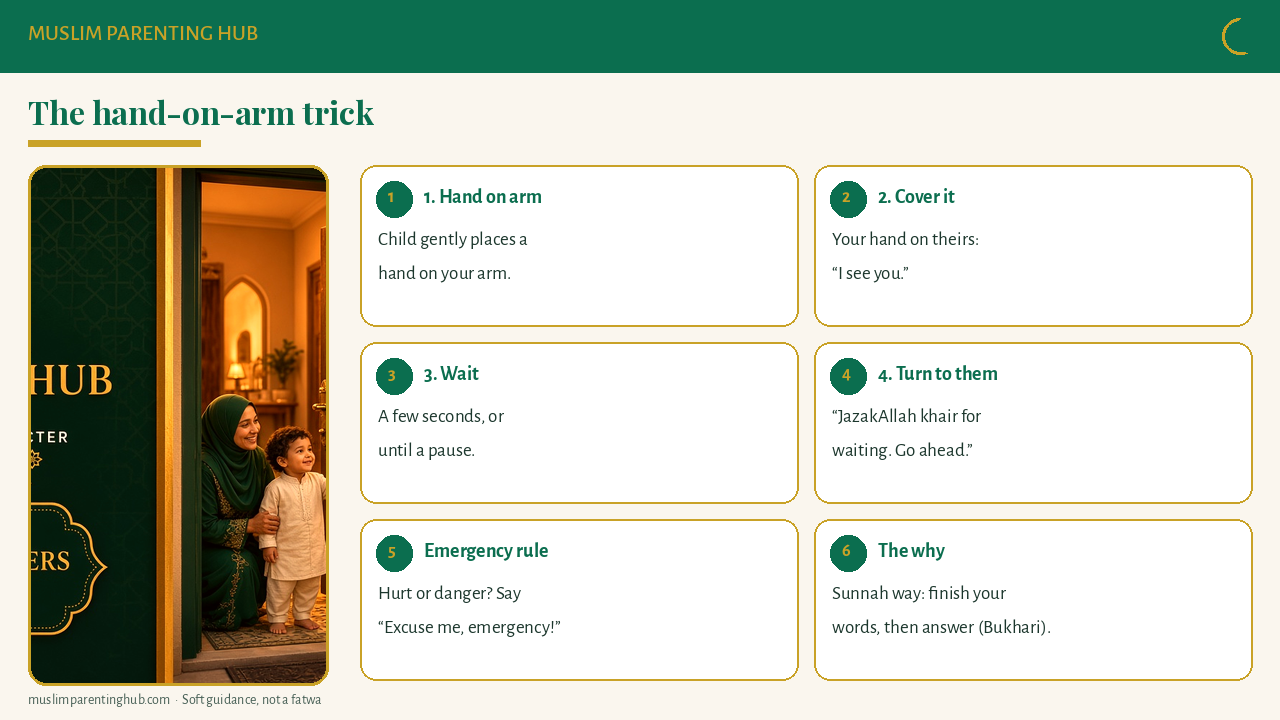
This simple, widely used method replaces nagging with a quiet signal:
- Your child wants to talk while you’re busy. Instead of saying your name, they gently put a hand on your arm or shoulder.
- You place your hand on top of theirs. This means “I know you’re here, and I’ll come to you soon.”
- They wait quietly. For little ones, a few seconds. For older kids, until a natural pause.
- At the pause, you turn to them. “JazakAllah khair for waiting. What did you want to say?” (If “JazakAllah khair” is new in your home, see teaching kids to say JazakAllah khair.)
Why it works: the child gets an immediate sign they’ve been seen, which takes away the panic of “Mama will forget me.” And you get to finish your sentence.
Emergency rule: Teach clearly that if someone is hurt, something is broken or there’s danger, they should interrupt right away and say “Excuse me, it’s an emergency.” Practice what counts as an emergency (a cut that’s bleeding: yes; wanting juice: no).
Scripts by Age
Ages 3–5: The Hand and the Wait
Little ones can’t wait long. Keep waits short and praise every success.
“When Mama is talking, put your hand on my arm. I’ll put my hand on yours. That means I see you. Then count to five on your fingers, and I’ll turn to you.”
Make it a game: practice at lunch with a pretend phone call. If you are already working on greetings, the hand signal fits right after the salam habit in our 7-day plan to teach toddlers salam: greet first, then wait your turn.
Ages 6–9: “Excuse Me” and the Pause
Add words and teach them to look for pauses.
“When people are talking, watch for the little stop at the end of a sentence. Then you can say, ‘Excuse me, may I say something?’ If it’s not urgent, you can keep your idea in your ‘thought pocket’ until it’s your turn.”
The “thought pocket” helps kids who worry they’ll forget what they wanted to say. They tap their pocket and hold the thought.
Ages 10–12: Conversations and Gatherings
Older kids need help with group conversations, dinners with guests and the masjid.
“At dinner with guests, it’s adab to let the elders speak first and to wait until someone finishes. If you’re bursting to say something, catch the eye of the person talking, or wait for a question. And if you interrupt by accident, just say ‘Sorry, go ahead.’”
For dinner-table manners in general, see our guest manners for Muslim kids.
The Phone Call Problem
Phone and video calls are the top interruption trigger. Some practical fixes:
- Prepare before the call. “I’m going to call Khala now. Do you need anything first? Water? Bathroom?”
- A “call box.” A small box of quiet activities that comes out only during calls: stickers, a puzzle, a coloring book.
- Use the hand signal on calls too. Cover their hand, finish your sentence, then say to the caller, “One second,” and answer your child.
- Keep calls short when kids are small, and praise them after: “You waited for my whole call, mashaAllah!”
When the Grown-Ups Interrupt
Children learn far more from what they see than from what they hear. A few honest questions for us as parents:
- Do we interrupt our kids when they’re telling a long story?
- Do we talk over each other at the dinner table?
- Do we finish their sentences for them?
Try this week to let your child finish every story, even the long, winding ones about recess. Say, “Let me finish listening, then I’ll answer.” When you slip, model the fix: “Sorry, I interrupted you. Please go on.” This is exactly the kind of quiet example that builds the habit of saying everyday Islamic phrases naturally too.
Gentle Fixes When They Forget
- Don’t answer the interruption. Calmly put your hand on theirs, finish your sentence, then turn to them. If you answer the interruption, it works, and it’ll happen again.
- Re-do, not lecture. “Let’s try that again. Hand on arm.” Then respond warmly when they do it right.
- Name what went well. “You waited so patiently while Dada talked. That’s beautiful adab.”
- Expect setbacks. Tired, hungry or excited kids interrupt more. That’s normal, not failure.
The Seven-Day “Wait for Your Turn” Plan
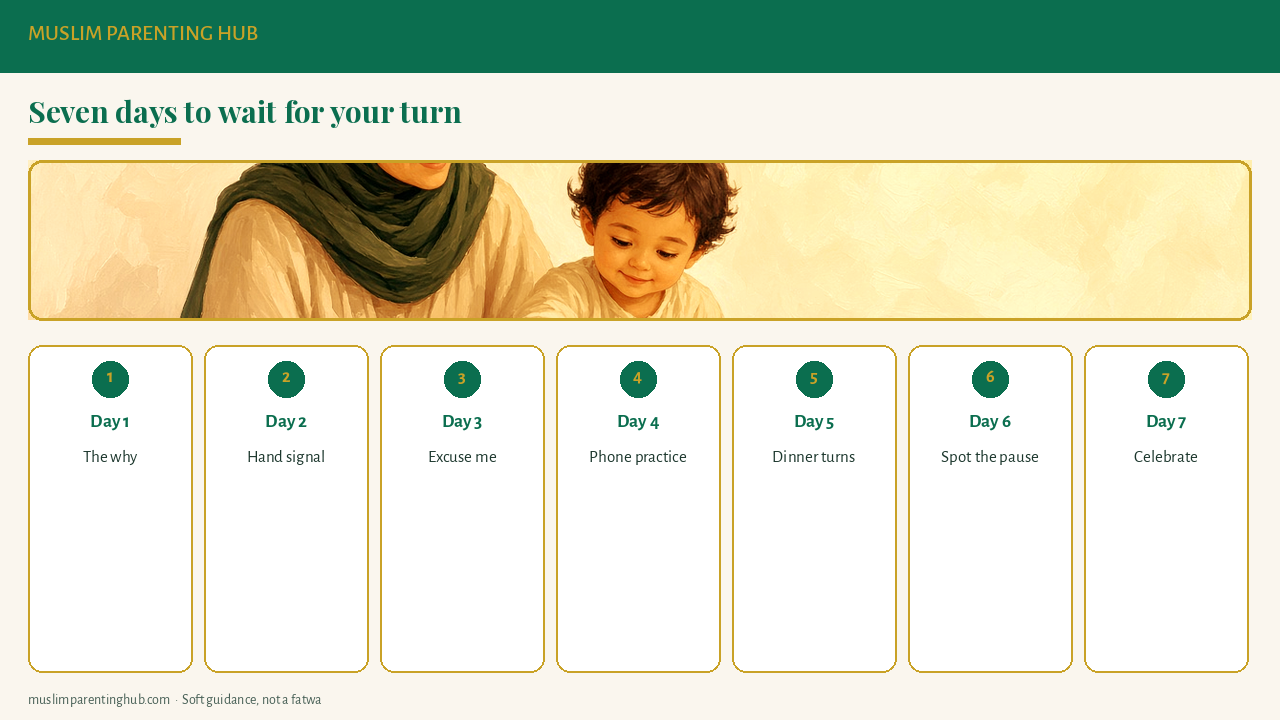
- Day 1 — The why. Share the story of the Prophet ﷺ finishing his talk before answering the man’s question.
- Day 2 — The hand signal. Teach and practice the hand-on-arm trick with a pretend phone call.
- Day 3 — “Excuse me.” Practice the words “Excuse me, may I say something?” at lunch.
- Day 4 — Phone practice. Make a short real call and use the call box and hand signal.
- Day 5 — Dinner turns. Each person shares one thing about their day while everyone else listens. No interrupting, even the parents.
- Day 6 — The pause. Play “spot the pause”: listen to a short story and raise a finger at each natural stop.
- Day 7 — Celebrate. Notice every success from the week out loud and give a small “Good Listener” certificate.
After the week, keep the hand signal going. Most families find interrupting drops dramatically within a few weeks.
FAQ
How do I teach my child not to interrupt?
Use the hand-on-arm signal: your child puts a hand on your arm, you cover it to show you’ve noticed, they wait, and you turn to them at the next pause. Practice it daily, praise waiting and don’t respond to interruptions.
What does Islam say about interrupting?
Islam teaches respectful listening. The Prophet ﷺ finished speaking before answering a man who interrupted (Bukhari), and he taught us to say good or stay silent (Bukhari, Muslim). Lowering the voice is also Quranic advice (31:19).
At what age can kids stop interrupting?
Most 3–4-year-olds can learn the hand signal and wait a few seconds. By 6–7, kids can wait for a pause and say “excuse me.” Older kids can learn group-conversation manners with practice.
What if it’s an emergency?
Teach kids that real emergencies, like someone hurt or danger, mean they should interrupt right away and say “Excuse me, it’s an emergency.” Practice which situations count so they feel confident.
How do I stop my child interrupting phone calls?
Prepare before the call, keep a special quiet-activity box only for call time, use the hand signal, keep early calls short, and praise your child afterwards for waiting.
Is interrupting a sign of bad manners or just age?
Usually age. Young children have strong impulses and worry they’ll forget their idea. Treat it as a skill to teach with patience, not a character flaw, and model good listening yourself.
Related guides
- Islamic manners for kids: 30-habit adab checklist
- How to teach toddlers salam: 7 playful days
- Teach kids to respect elders in Islam
- Guest manners for Muslim kids at home
- Teach kids to knock and ask permission
Closing
A child who can wait for their turn to speak is learning patience, respect and self-control, three things the Prophet ﷺ modeled every day. Start with a hand on your arm and a hand on top of theirs. Before long, you’ll find yourself finishing whole sentences again, and your child will be the one others love talking to.
Quick steps
Seven-day plan to teach kids not to interrupt. One small listening skill a day, built around the hand-on-arm signal.
- Day 1 — The why — Share how the Prophet ﷺ finished his talk before answering a man who interrupted.
- Day 2 — Hand signal — Teach and practice the hand-on-arm trick with a pretend phone call.
- Day 3 — Excuse me — Practice “Excuse me, may I say something?” at lunch.
- Day 4 — Phone practice — Make a short real call using the call box and the hand signal.
- Day 5 — Dinner turns — Each person shares one thing while everyone else listens.
- Day 6 — Spot the pause — Listen to a story and raise a finger at each natural pause.
- Day 7 — Celebrate — Name every success and give a small Good Listener certificate.
Related articles
Islamic Manners for Kids: A Daily Adab Checklist for Home, School and the Masjid (Ages 3–10)
Islamic manners for kids in one checklist: 30 daily adab habits for home, school and the masjid, with hadith, age guides, gentle scripts and a 10-week plan.
Read guide →
How to Teach Toddlers to Say Salam: A Playful 7-Day Plan
Teach your toddler to say Assalamu alaikum in 7 playful days: mirror games, doorway role-play, shy-child scripts and age tips. Start today, no forcing.
Read guide →
How to Teach Kids to Respect Elders in Islam: Greetings, Words and 10 Daily Habits
Teach Muslim kids to respect elders with 10 simple habits: salam first, letting elders speak, offering a seat and kind words to grandparents, with hadith.
Read guide →
Guest Manners for Muslim Kids: Hosting at Home with Islamic Adab
Teach Muslim kids guest manners for hosting at home—shoes, greetings, serving, privacy, and soft scripts. Islamic adab parents can practice tonight.
Read guide →