
The Weekly Family Meeting: A 15-Minute Family Shura Muslim Kids Actually Enjoy
It’s Sunday evening. Someone forgot their soccer cleats were still muddy in the trunk. Nobody remembers that the field trip form is due Tuesday. Two siblings are arguing about whose turn it is to unload the dishwasher, again. And you’re realizing that your family only talks about logistics in the five frantic minutes before the bus.
A weekly family meeting fixes more of this than you’d expect. Fifteen minutes, once a week, everyone at the table. You look at the week ahead, check in on chores, thank each other, and solve one problem together.
For Muslim families, it’s also a chance to practice something Allah praises directly in the Quran: shura, or mutual consultation. Kids learn that their voices matter, parents stay in charge, and the house runs a little more smoothly.
This guide gives you a simple 15-minute agenda, roles for kids of every age, scripts for tricky moments, and ideas to keep it from turning into a lecture.
Why Shura Belongs at the Kitchen Table
Allah describes the believers as those “whose affairs are decided by consultation among themselves” (Ash-Shura 42:38). He told the Prophet ﷺ to “consult them in the matter” (Al Imran 3:159), even though he received revelation.
The Prophet ﷺ practiced this at home, too. At Hudaybiyah, when the companions were upset and slow to follow his instruction, he went to his wife Umm Salamah and asked her advice. She suggested he go out and do it himself without saying a word. He took her advice, and the companions followed (Sahih al-Bukhari 2731–2732).
That’s the heart of a family meeting: the leader listens, considers ideas, and then decides. Shura doesn’t mean kids vote on bedtime. It means they’re heard.
The Prophet ﷺ also said, “Each of you is a shepherd, and each of you is responsible for his flock” (Sahih al-Bukhari 893). A weekly meeting is one practical way to shepherd a family: noticing what’s working, what isn’t, and who needs a little extra care.
The 15-Minute Family Meeting Agenda
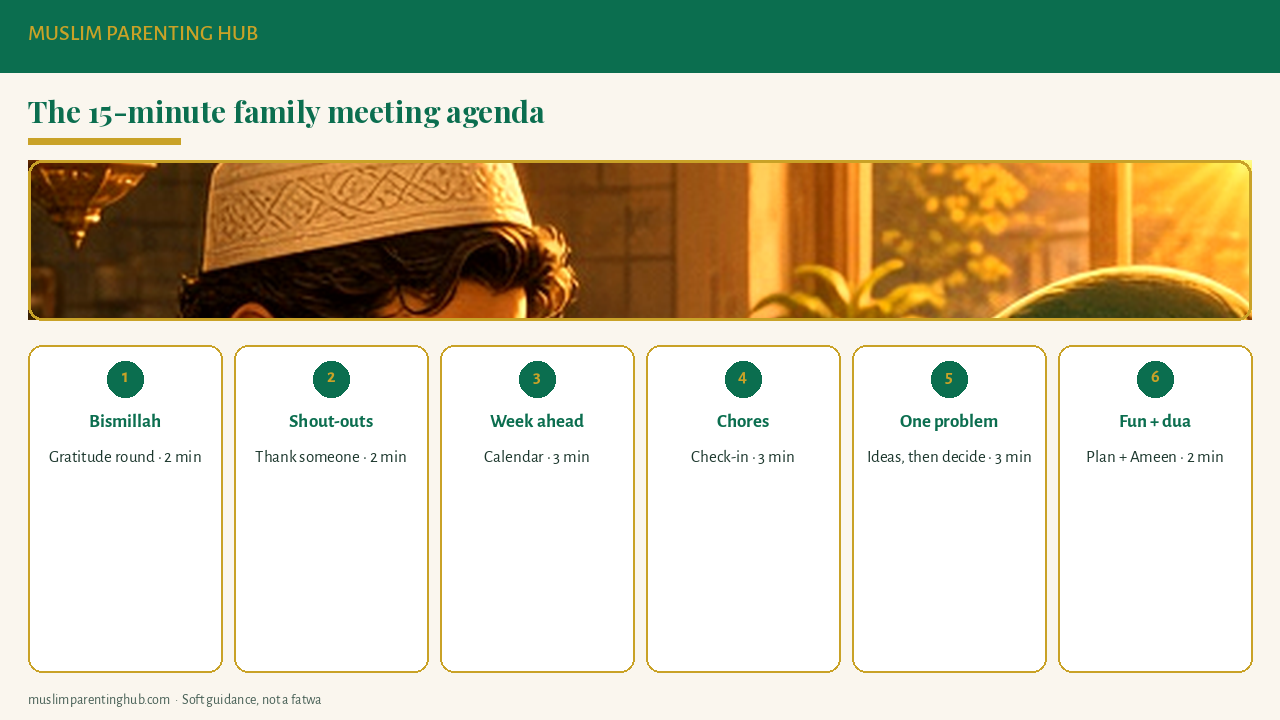
Keep the same order every week. Predictability is what makes kids relax and participate.
1. Bismillah and a gratitude round (2 minutes)
Open with “Bismillah.” Then each person shares one thing they’re grateful for from the past week, starting with “Alhamdulillah for…” Little kids might say “Alhamdulillah for pizza.” That counts.
2. Shout-outs (2 minutes)
Each person thanks or praises someone else in the family for something specific. “JazakAllah khair, Yusuf, for helping me find my shoe.” This one segment can shift the whole mood of a home. Siblings who fought all week suddenly have to look for good in each other.
3. The week ahead (3 minutes)
Look at the calendar together: games, practices, school events, appointments, masjid classes, who’s driving the carpool. A big wall calendar or a shared family calendar works. Kids love being the one to read it out loud.
Fall weeks get busy fast. This year, Halloween falls on a Saturday (October 31), clocks fall back on Sunday, November 1, many schools hold parent-teacher conferences in November, and Thanksgiving is November 26. Talking about these ahead of time means fewer surprises and less stress.
4. Chore check-in (3 minutes)
Review the chore chart. Who did their jobs? What needs to change? Is it time to rotate? If you don’t have a chore system yet, our Islamic chores age chart for Muslim homes is a great place to start. Keep this upbeat; it’s not the moment for blame.
5. One problem to solve (3 minutes)
Pick one issue: morning chaos, fighting over the iPad, the backpack pile by the door. Everyone suggests ideas, even silly ones. Then parents choose a plan to try for one week. Next week, check in on how it went.
6. Fun plan and closing dua (2 minutes)
End on something to look forward to: a Friday night movie, a park trip, baking cookies. Then close with a short dua: “Ya Allah, bless our family this week, make it easy, and keep us kind to each other. Ameen.”
Total: about 15 minutes. Set a timer. Ending on time is part of what makes kids willing to come back next week.
Your First Meeting: What to Say
The first meeting sets the tone, so keep it light and short. Bring a snack, sit somewhere comfortable, and try something like this:
“Starting tonight, we’re going to have a family meeting every Sunday. It’s only 15 minutes. The Prophet ﷺ used to ask the people around him for their ideas, and we want to hear yours too. We’ll say what we’re thankful for, look at the week, check our jobs, and solve one problem together. Then we plan something fun.”
Then make the ground rules together (see below), do a gratitude round, and pick a fun plan for the week. Skip the problem-solving step entirely the first time. You want kids to leave thinking, “That was nice,” not “That was a lecture.”
After a few weeks, ask them: “What should we change about our meetings?” Letting kids shape the meeting itself is shura in action.
Roles That Give Kids Ownership
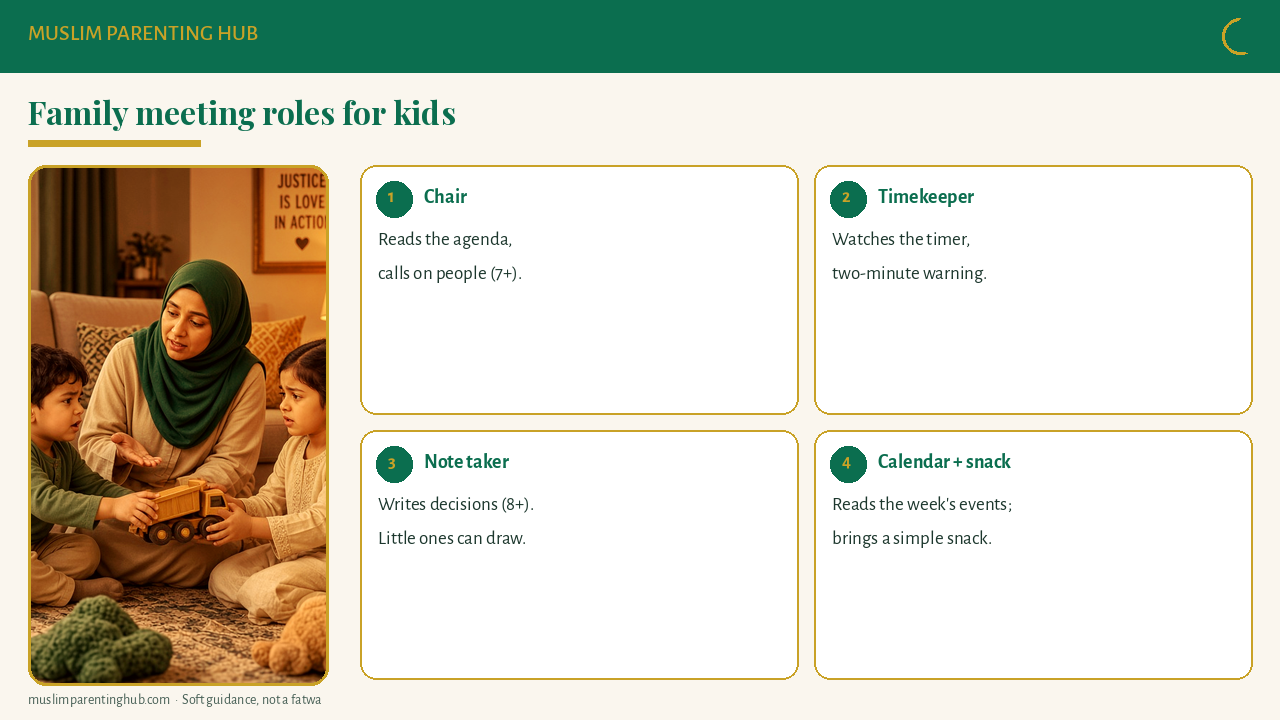
Rotate these roles each week so everyone gets a turn:
- Chair: reads the agenda and calls on people (ages 7+ do great with a printed card).
- Timekeeper: watches the timer and gives a two-minute warning.
- Note taker: writes down decisions and next week’s plan (ages 8+; younger kids can draw).
- Calendar reader: reads out the week’s events.
- Snack captain: prepares a simple snack. A treat makes everything easier.
Even a 4-year-old can be the “Bismillah starter” or the one who passes around the talking object.
Ground Rules for a Respectful Meeting
Set three or four simple rules together in the first meeting, then post them on the fridge.
- One voice at a time. Use a talking object, like a small cushion, a ball, or a tasbih. Whoever holds it talks.
- No interrupting, no eye-rolling. Listen fully before responding.
- Solve problems, don’t shame people. Talk about the issue (“toys left on the stairs”), not the person (“Ali is so messy”).
- Private problems stay private. Some things should be talked about one-on-one, not in front of siblings.
That last rule matters. The Prophet ﷺ said that whoever covers the fault of a Muslim, Allah will cover his faults (Sahih Muslim 2699). If one child is struggling with lying, grades, or something embarrassing, handle it privately, not at the family table.
Topics That Work Well
Not sure what to talk about? Here are ideas that fit many families:
- Chores and fairness. Rotations, swaps, extra jobs. If siblings argue about fairness, our guide on sibling jealousy and fairness in a Muslim home has scripts that help.
- Allowance and money. For families who use allowance, the meeting is a natural time for payday and savings goals. See our guide to allowance, chores and sadaqah for Muslim kids.
- Room and house tidiness. Agree on a daily reset time. Our 10-minute tidy routine for kids’ rooms gives everyone the same simple steps.
- Screen rules. Discuss limits and weekend screen time together. Kids follow rules they helped shape far better than rules handed down.
- After-school flow. If afternoons are chaotic, talk through snack, Asr, homework, and Maghrib. Our guide to the after-school order for Muslim kids can be a starting template.
- Family goals. A sadaqah project, a surah to learn together, or a kindness goal for the neighbors.
- Upcoming changes. A new baby, a move, a new school, Ramadan coming up.
When to Hold It
Pick a time when everyone is usually home and fed.
Sunday evening works well for many families. It sets up the school week, and everyone’s calendar is fresh.
Friday night works if you already have a family routine. Some families add a short meeting before their family joy time. If you don’t have a Friday rhythm yet, our Friday night Muslim family routine shows how to build one, and a 15-minute meeting fits right before the fun part.
After Maghrib on any regular evening works if everyone’s together for prayer.
Whatever you choose, keep it consistent. A weekly meeting that happens four weeks out of five is far better than a “perfect” meeting that happens once.
Age-by-Age Tips
Toddlers (2–3). They won’t sit for 15 minutes. Let them join for the gratitude round and the snack, then play nearby.
Preschoolers (4–5). They love simple jobs: passing the talking object, holding the calendar, saying “Bismillah.” Ask them one question: “What made you happy this week?”
Early elementary (6–8). Great at shout-outs and suggesting solutions (some wildly creative). Give them real roles like chair or calendar reader.
Upper elementary (9–12). Capable note takers and problem-solvers. Let them propose a topic for the agenda.
Teens. They may resist at first. Give them real influence, such as planning the family outing or proposing a rule change, and they’re more likely to show up. Keep it short and don’t use the meeting to lecture.
Common Problems (and Calm Fixes)
“It turned into a complaint session.” Bring back the structure: gratitude and shout-outs first, one problem only, and ideas instead of blame.
“The kids think it’s boring.” Add a snack, let them run it, and end with the fun plan. Keep it to 15 minutes, even if you didn’t cover everything.
“Parents disagree in front of the kids.” Talk privately beforehand about any topic you might disagree on. Present a united front at the table.
“We keep skipping it.” Attach it to something that already happens, like Sunday dinner or Friday Maghrib. Missed weeks are normal; just pick it back up.
“Our kids are too young.” Start with just the gratitude round, the week ahead, and a dua. Five minutes is still a family meeting.
What Kids Learn From This
Beyond a smoother week, family meetings quietly teach:
- Listening and respect. Waiting your turn and hearing others out is real adab.
- Gratitude. Saying “Alhamdulillah for…” every week trains the heart to notice blessings.
- Responsibility. Kids see that the household depends on everyone.
- Problem-solving. They learn to suggest ideas, try them, and adjust.
- Leadership with humility. They see parents listen before deciding, just as the Prophet ﷺ consulted the people around him.
Years from now, your children may run their own homes, workplaces, or masjid committees the same way they learned at your kitchen table.
FAQ
What is a family meeting in Islam?
A family meeting is a short, regular time when the family sits together to plan, thank each other, and solve problems. It reflects shura (consultation), which Allah praises in the Quran (42:38). Parents listen to everyone’s ideas and then make the final decision.
How long should a family meeting with kids be?
About 15 minutes is ideal for most families with school-age children. With toddlers and preschoolers, five to ten minutes is plenty. Use a timer and end on time.
What should be on a family meeting agenda?
A simple agenda: Bismillah and a gratitude round, shout-outs, the week’s calendar, a chore check-in, one problem to solve together, and a fun plan with a closing dua.
Do kids get a vote in a family shura?
Kids give ideas and opinions, and parents take them seriously, but parents make the final decision. Shura means consultation, not a vote. Explaining your decision helps kids feel respected even when the answer is no.
What age can kids join a family meeting?
Even 2- and 3-year-olds can join for the gratitude round and snack. By ages 6 to 8, most children can take a real role like chair or calendar reader, and by 9 to 12 they can take notes and help solve problems.
What if one child has a problem that shouldn’t be shared?
Handle it privately. The Prophet ﷺ taught that covering others’ faults is beloved to Allah (Muslim 2699). Keep the family meeting for shared topics and talk to individual children one-on-one about personal struggles.
Related guides
- Islamic chores for kids: age-by-age chart
- Friday night Muslim family routine
- Allowance, chores and sadaqah for Muslim kids
- How to get kids to clean their room without yelling
Soft guidance, not a fatwa. For detailed questions, please ask a trusted local scholar or your masjid’s imam.
Quick steps
15-minute weekly family meeting agenda. The same six short segments every week, with a timer, so the meeting stays positive and ends on time.
- Bismillah and a gratitude round (2 minutes) — Open with Bismillah; each person shares one thing they're grateful for, starting with "Alhamdulillah for..."
- Shout-outs (2 minutes) — Each person thanks or praises someone else in the family for something specific.
- The week ahead (3 minutes) — Look at the calendar together: games, practices, school events, appointments, masjid classes and carpools.
- Chore check-in (3 minutes) — Review the chore chart, decide what needs to change and whether it's time to rotate, without blame.
- One problem to solve (3 minutes) — Pick one issue, let everyone suggest ideas, then parents choose a plan to try for one week.
- Fun plan and closing dua (2 minutes) — Plan something to look forward to, then close with a short dua for the family.
Related articles

Friday Night Muslim Family Routine: 5 Simple Steps Kids Look Forward To
Make Jumuah special at home: a 60–90 minute Friday night routine with Maghrib, kid-sized Surah Al-Kahf, a family joy block and dua. Try it this week.
Read guide →
How to Get Kids to Clean Their Room Without Yelling: A 10-Minute Tidy Routine for Muslim Families
A calm, Sunnah-inspired way to get kids to clean their room: a 10-minute tidy routine, age-by-age expectations, scripts that work and a simple room setup.
Read guide →
Islamic Chores for Kids: Age-by-Age Responsibility Chart for Muslim Homes
Age-by-age Islamic chores chart for Muslim kids—Prophetic helping-at-home framing, tonight scripts, sticker-free tips, and responsibility without shame.
Read guide →
Should Muslim Kids Get an Allowance for Chores? Allowance, Sadaqah and Saving Explained
Should Muslim kids get an allowance for chores? US guide to khidmah vs paid extras, three jars (spend, save, sadaqah), and what never to pay for.
Read guide →