

Should Muslim Kids Get an Allowance for Chores? Allowance, Sadaqah and Saving Explained
US Muslim parents hear two loud messages. One says: Never pay kids for chores—family work is a duty. The other says: Pay for everything so they learn money. Islam’s spirit of helping the home (khidmah), honesty with wealth, and sadaqah sits in a wiser middle: some work is simply how a family loves each other; some extra jobs can earn money; and every dollar can train the heart.
This guide explains a practical allowance approach for US homes, a three-jar system (spend, save, sadaqah), age-band amounts as soft starting points, and what you should never pay for—salah, basic manners, and cruelty prevention. Pair it with your Islamic chores age chart and sadaqah habits by age.
Soft guidance for homes—not a fatwa. Money rulings and zakat details for adults belong with qualified teachers; here we focus on parenting habits.
Helping the Family Is Character—Not Always a Payroll
In many Muslim homes, kids learn that contributing is part of being in the ummah of the household: clearing plates, sorting laundry, taking out trash, watching a toddler sibling for ten supervised minutes. That spirit matches teaching responsibility and keeping promises as amanah.
Family baseline chores = unpaid membership in the home.
Optional extra jobs = may earn allowance or one-off pay (washing the car, deep-cleaning the garage, helping a parent with a paid side task that is safe and age-appropriate).
When kids ask “What’s in it for me?” for baseline chores, answer with belonging, not shame:
“We take care of our home because we live here and Allah loves excellence. Allowance is for learning money—not a bribe for every sock.”
The Three-Jar System (Spend, Save, Sadaqah)
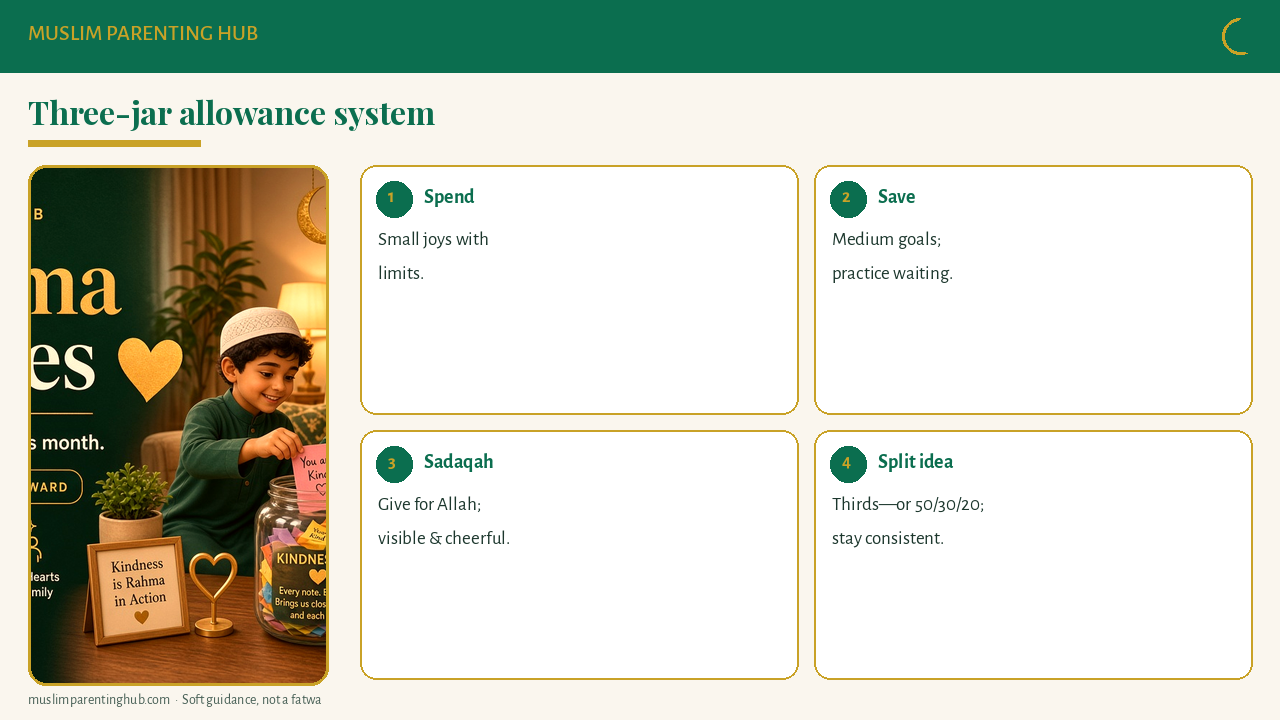
Label three clear jars, envelopes, or kid bank accounts:
- Spend — small joys they choose (stickers, a used book, a treat out). Teaches decision-making and living with limits.
- Save — medium goals (toy, bike accessory, gift fund). Teaches delay and planning.
- Sadaqah — money given for Allah’s sake (masjid box, relief fund, helping a classmate’s fundraiser you approve). Teaches that wealth is a trust.
Starter split many families like: 50% save / 30% spend / 20% sadaqah—or equal thirds for younger kids who need simpler math. Adjust without dogma. The point is a visible sadaqah lane so giving is not an afterthought when parents “just donate for them” invisibly.
Let kids place cash or track digital allowance on a card weekly. Touching money teaches faster than lectures.
Allowance Amounts by Age (US Soft Starting Points)
These are conversation starters, not Islamic amounts and not a cost-of-living claim for every city:
| Age | Soft weekly range (USD) | Notes |
|---|---|---|
| 5–6 | $2–$5 | Mostly coins + jar practice |
| 7–8 | $5–$8 | Introduce save vs spend clearly |
| 9–11 | $8–$15 | Link to extra jobs list |
| 12–14 | $15–$25 | Phone/app tracking; more save goals |
| 15+ | Family-specific | May shift toward job income + contribution talks |
Inflation, local costs, and siblings’ fairness matter. Equal does not always mean identical—explain differences kindly (older kids may pay bus fare; younger kids do not).
Some families prefer commission for extras only (no base allowance). Others prefer a small base allowance plus extras. Both can work if baseline chores stay unpaid family duty.
What Never to Pay For
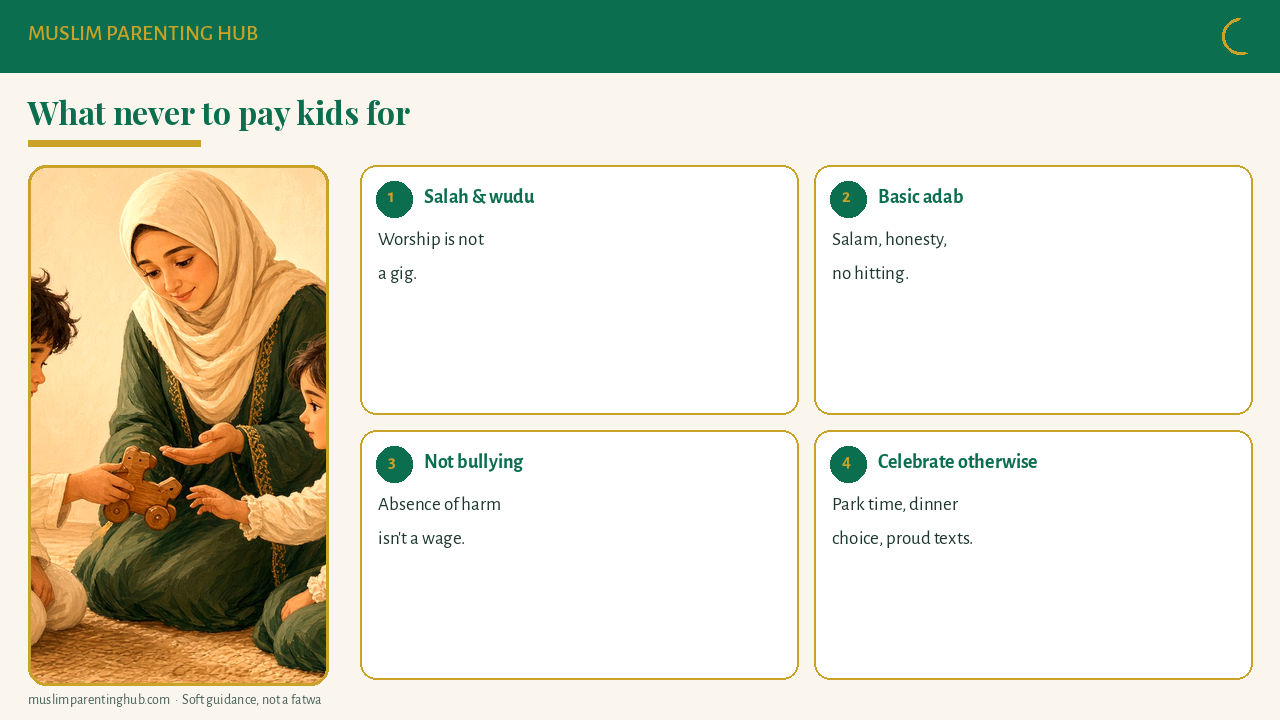
Do not turn these into wages:
- Salah and wudu — worship is not a gig economy
- Basic adab — saying salam, not hitting, truth-telling
- Not bullying siblings — “I’ll pay you to be nice” trains the wrong muscle
- Homework completion as a bribe forever — occasional celebration differs from a permanent paycheck for school duty
- Acts of cruelty avoided — absence of harm is not a paid service
You can still celebrate growth with non-money joy: extra park time, choosing dinner, a proud text to Grandma. See also teaching shukr so gratitude does not depend on purchases.
Khidmah vs Paid Extra Jobs — A Clear List
Usually unpaid (family khidmah): make bed, put dirty clothes in hamper, clear own plate, feed pet with reminder, tidy toys, set table, simple wipe-downs.
Often paid extras (when you choose): wash family car, organize pantry with a checklist, rake leaves for a set fee, help prepare freezer meals for a busy week, safe tech help for a grandparent if skilled.
Write the list on the fridge so arguments shrink.
Teaching Sadaqah and Early Zakat Awareness
Kids are not usually calculating adult zakat, but they can learn:
- Money is a trust from Allah
- Giving should be cheerful, not showy
- Even small amounts count
- We give from what we love a little—not only broken toys
Once a month, let them choose a sadaqah cause from two parent-approved options. When they resist emptying the sadaqah jar, stay calm:
“This jar is how we thank Allah for enough. We’ll start with one dollar today if five feels big.”
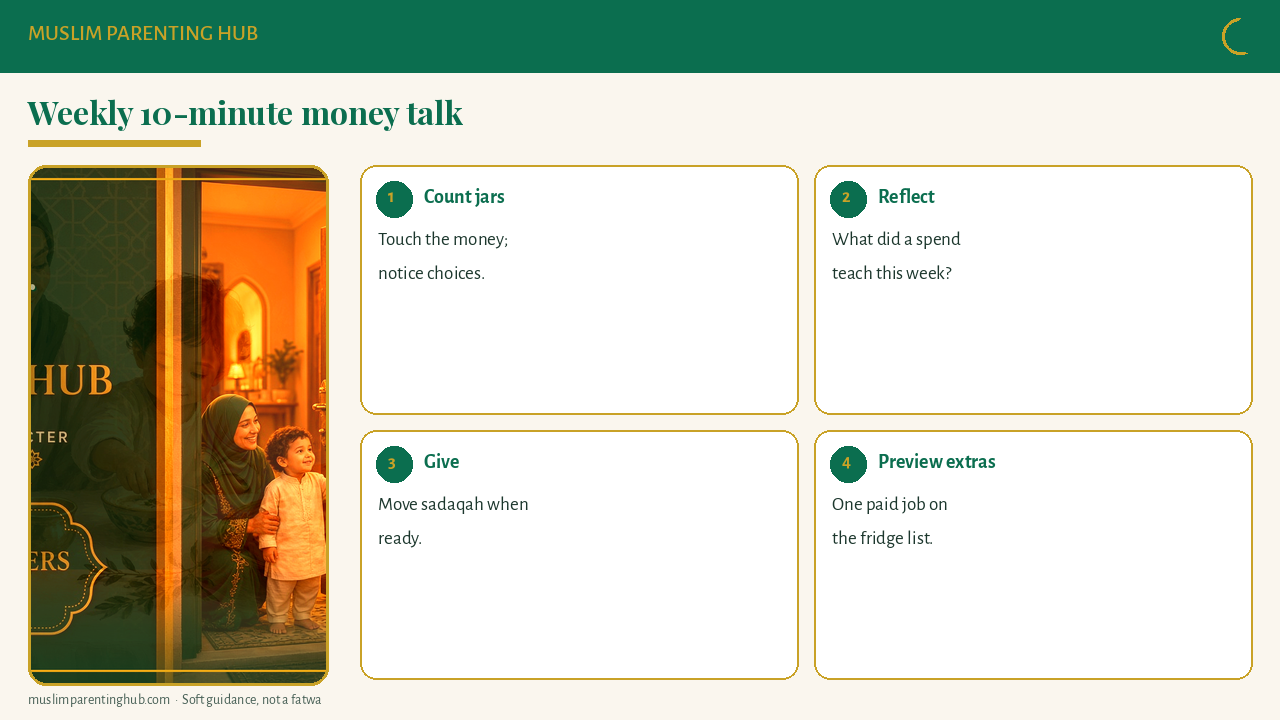
Weekly Money Talk Script (10 Minutes)
Pick a calm Sunday or weekend morning vibe—even if you discuss money after Maghrib on a weeknight.
- Count jars together.
- Ask: “What did you learn from a spend choice this week?”
- Move planned sadaqah if ready.
- Preview one extra job available next week.
- End with dua: “Ya Allah, put barakah in our money and make us generous.”
Keep adults’ marital money stress out of this meeting. Kids need a training ground, not a courtroom.
Sibling Fairness Without Identical Jobs
Older kids often do harder chores and may earn more from extras. Younger kids need real contribution too. Explain:
“Fair means everyone helps at their strength—not that every job and dollar matches.”
If jealousy spikes, revisit emotional tools from your character articles and keep allowance transparent so rumors do not grow.
Digital Allowance and Online Spending
US kids meet money through apps, gift cards, and in-game purchases. Rules that help:
- Parent-visible accounts until maturity you choose
- No password sharing with friends
- Sadaqah still happens offline sometimes so giving stays tangible
- “Cool-down day” before nonessential buys over a set amount
Scripts for Sticky Moments
“Pay me to clean my room.”
“Your room is your amanah. Allowance is separate. Want an extra job on the fridge list after your room is done?”
“He got more than me.”
“He finished two paid extras. You can pick one tomorrow. Your base jars stay on our plan.”
“I spent it all and I’m sad.”
“That feeling is a teacher. Next week we protect save and sadaqah first.”
Relative: “We never got paid; you’re spoiling them.”
“We’re training money manners and giving—not paying for salah. Thanks for caring.”
Common Mistakes
- Paying for every household breath
- Never letting kids make a small foolish spend (learning needs a safe budget mistake)
- Hiding all charity so kids think only parents are generous
- Using allowance removal as the only discipline tool
- Comparing your amounts publicly with cousins in a way that shames either family
Bank Accounts, Cash, and Masjid Boxes
Younger kids learn faster with cash jars they can hear jingle. Older kids may use a youth account with parent oversight. Keep at least occasional cash sadaqah so giving stays physical—dropping coins in a masjid box hits the heart differently than a parent tapping “donate” on a phone while kids play Roblox in the next room.
If your masjid has a kids’ sadaqah program, visit once a month as a family field trip—not a guilt trip.
When Allowance Becomes a Power Struggle
If every chore turns into a negotiation, freeze new paid extras for two weeks. Return to unpaid baseline only. Reset the fridge list. Say:
“We’re pausing the store. Membership chores continue. Paid extras reopen when the arguing cools.”
Consistency teaches more than a raise.
Gratitude When Money Is Tight
Not every US Muslim family can fund weekly allowance. Alternatives: time-allowance (choose the Saturday activity), privilege tokens, or sadaqah-only jars funded by recycling cans. Honesty helps:
“Our family is budgeting carefully. We still practice giving and saving with what we have.”
Shukr grows in lean seasons when parents narrate enough-ness without shame.
Connecting Money to Amanah Stories
Tell short stories of trustworthy keepers of wealth—without turning kids into mini accountants for adult bills. Emphasize: we do not steal, we return change, we do not mock people who have less. Allowance is character class wearing a dollar costume.
FAQ
Is paying kids for chores allowed in Islam?
Many families treat baseline family help as unpaid duty and may pay for extra jobs. For specific rulings, ask a trusted teacher—this is parenting structure, not a fatwa.
How much allowance by age?
Use soft US ranges as starters (for example a few dollars weekly for early elementary, rising with age and extras). Adjust for your city and values.
What percent should go to sadaqah?
There is no single kid percentage required here. Equal thirds or about 20% sadaqah are common training wheels—consistency matters more than a magic number.
Should allowance be tied to chore checklists?
Some parents tie base allowance to completing baseline chores; others keep allowance as money education and chores as duty. Pick one philosophy and stay consistent.
What if my child refuses sadaqah?
Lower the amount, let them choose the cause, and model your own giving visibly. Avoid forcing with humiliation.
Can teens keep all job income?
Families differ. Many ask for a contribution to phone plans or savings while respecting teen effort. Discuss openly.
Related guides
Closing
Allowance is not a bribe for being Muslim. It is a classroom for barakah-minded money: work, wait, spend wisely, and give. Keep worship and basic manners off the price list. Put sadaqah on the kitchen counter where kids can see it.
Tonight, tape three jar labels. Tomorrow, name two unpaid family chores and one optional paid extra. That small clarity prevents years of “What’s in it for me?” battles—and grows kids who can hold a dollar without the dollar holding them.
Related articles

Islamic Chores for Kids: Age-by-Age Responsibility Chart for Muslim Homes
Age-by-age Islamic chores chart for Muslim kids—Prophetic helping-at-home framing, tonight scripts, sticker-free tips, and responsibility without shame.
Read guide →
Sadaqah Habits for Kids: An Age Chart for Charity at Home
Build sadaqah habits with kids using an age chart—charity jar, giving scripts, weekly rhythms, and soft Islamic charity practice at home. Practical & gentle.
Read guide →
How to Teach Shukr to Kids: A 14-Day Muslim Family Gratitude Plan
Teach shukr to Muslim kids with a 14-day family plan—Alhamdulillah habits, dinner and bedtime scripts, gratitude jar, age tips, and edge cases. Soft, practical.
Read guide →
Teach Kids to Keep Promises: An Amanah Habit Plan for Muslim Families
Teach Muslim kids to keep promises with an amanah habit plan—parent modeling, age scripts, trust deposits, and what not to promise. Soft & practical.
Read guide →