
A Simple Friday Night Family Routine for Muslim Parents (That Kids Will Look Forward To)
Jummah is over. Shoes are kicked off. Someone wants pizza. Someone wants a screen. Someone is already half-asleep on the couch.
Friday night can feel like the leftover hours after a long week—or it can become the sweetest Islamic memory your children keep.
This guide gives you a simple Friday night Muslim family routine: short, joyful, and doable after Jummah. Think Surah Al-Kahf with kids (in an age-fit way), one shared meal moment, one connection game, and a calm close—without turning your living room into a seminar.
No perfection. No fatwa. Just a Jummah evening at home with kids that they will actually look forward to.
Soft note: This is parenting guidance rooted in love for the Sunnah spirit of Friday, not a legal ruling. Follow the scholars and practices you trust for prayer times, Surah Al-Kahf etiquette, and family rulings. Adapt everything to your home.
Why Friday Night Matters for Muslim Kids
Friday already carries barakah in the hearts of believers. Children do not need a lecture to feel that—they need a repeatable family night that says:
- Today is different from Monday.
- Our faith has joy, not only rules.
- We belong to each other and to Allah.
A Friday family night Islam rhythm does three quiet jobs:
- Identity — “In our home, Friday evenings are for Allah and us.”
- Connection — after a busy Jummah, kids get undivided warmth.
- Anticipation — when kids look forward to Friday night, obedience stops feeling like a chore and starts feeling like belonging.
Pair this with your weekday anchor. If Maghrib after school is your daily reset, Friday night is your weekly celebration. See: The After-School Maghrib Routine That Actually Works for Muslim Families.
The Big Idea: A 60–90 Minute “Friday Glow” (Not a Marathon)
Forget a four-hour program. Aim for a warm pocket after Maghrib (or after your family’s Jummah evening settles):
- Arrive & soft reset (5–10 min)
- Maghrib together (as usual)
- Surah Al-Kahf — kid version (10–20 min)
- Family joy block (20–40 min)
- Gratitude + dua close (5–10 min)
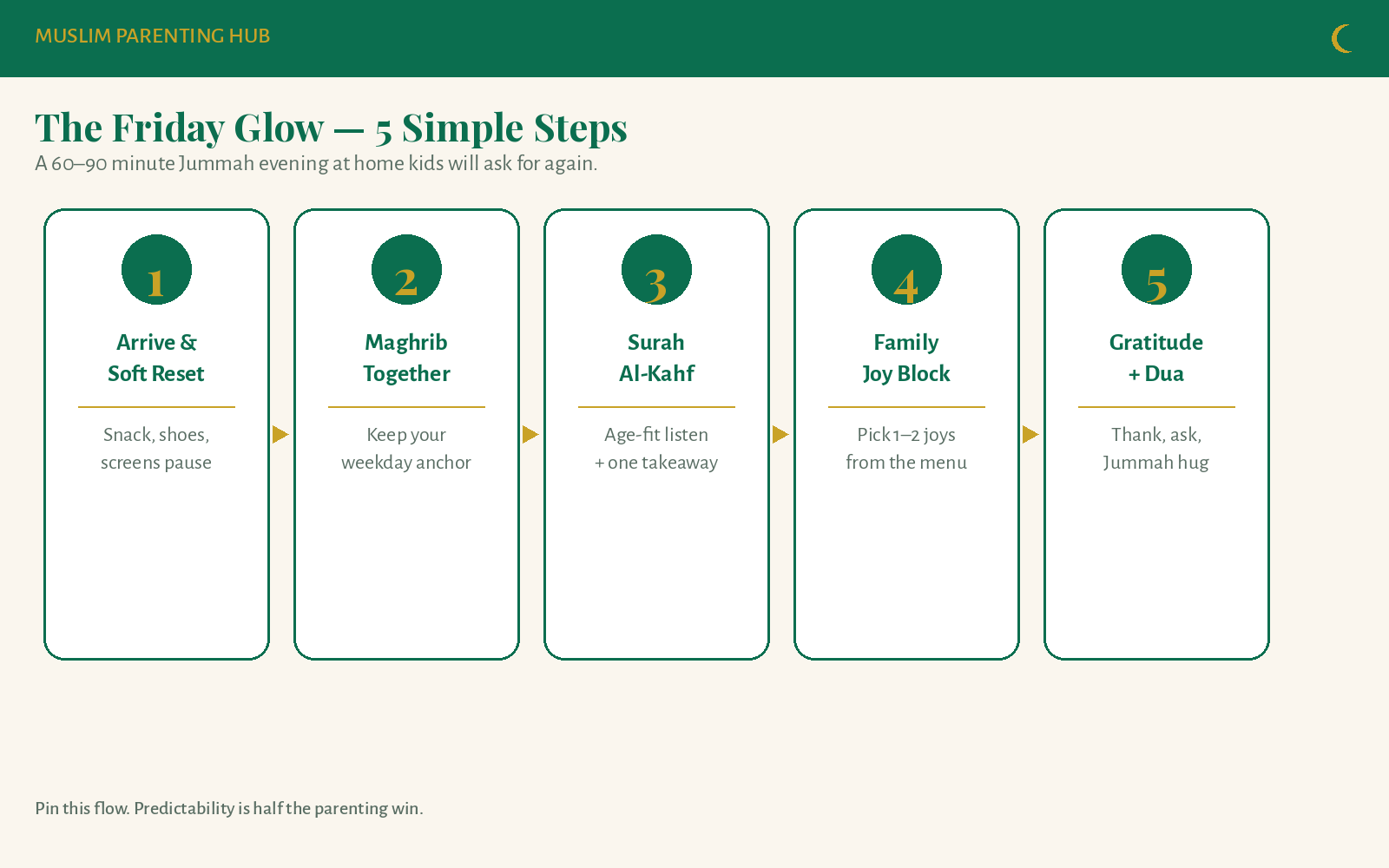
Pin the flow on the fridge. Kids love knowing what comes next. Parents love fewer debates when everyone is tired.
Step 1 — Arrive & Soft Reset (Make Friday Feel Different)
Open Friday night with relief, not a syllabus.
The Friday landing
- Shoes & bags parked (same spot as weekdays)
- Light snack or start dinner prep together
- Screens into the charging basket until after Maghrib + Al-Kahf
- One sensory cue that says “Friday”: a special candle (safe), a playlist of nasheed/Qur’an, or a gold “Friday Glow” card on the table
Tonight you can say
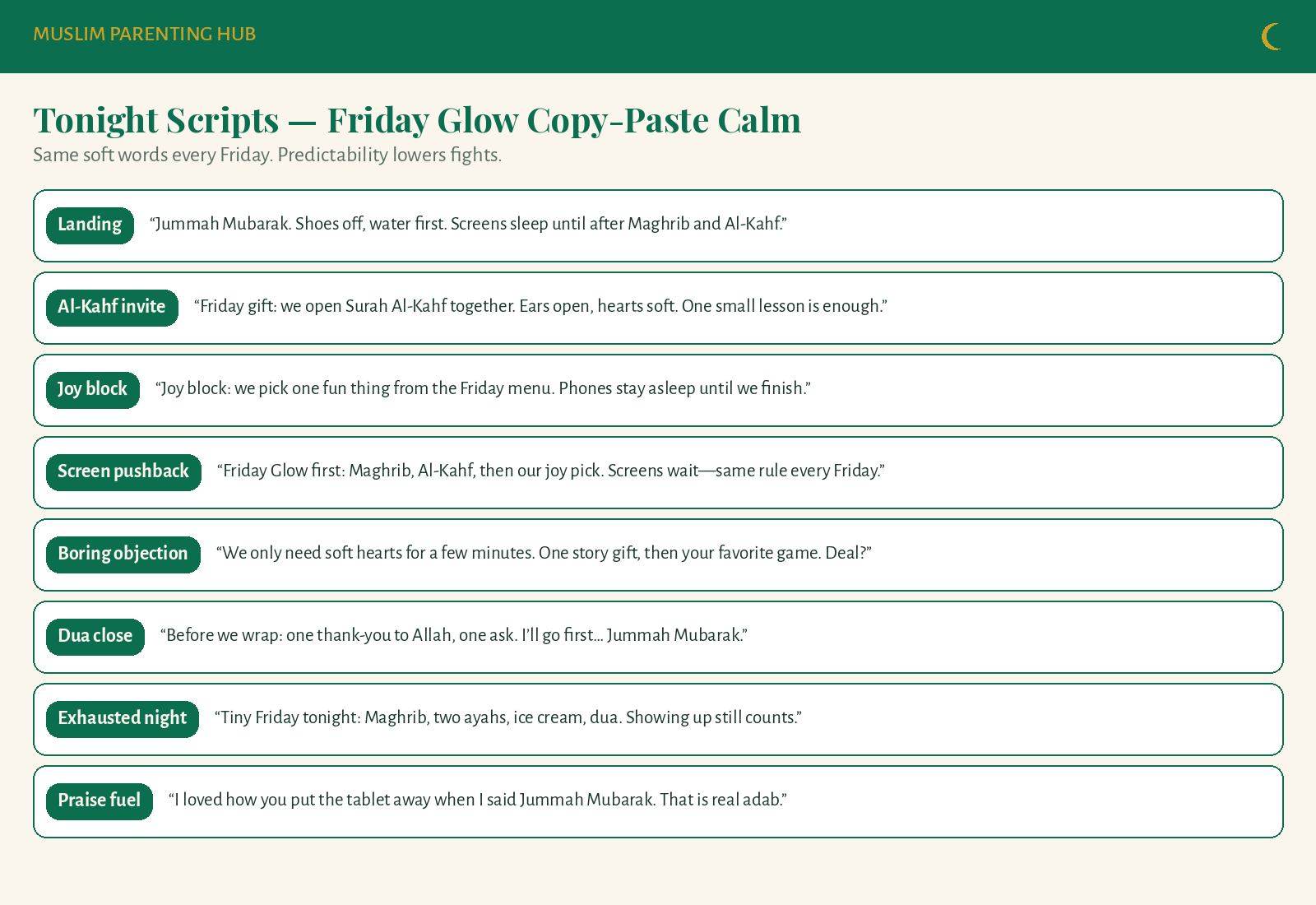
“Assalamu alaykum—Jummah Mubarak. Shoes off, water first. Screens sleep until after Maghrib and our Al-Kahf moment. Tonight is our Friday Glow.”
Age tweaks
| Age | What helps |
|---|---|
| Toddler (2–3) | Let them place the “Friday Glow” card. Hand them water. Expect short attention; praise presence. |
| Preschool (4–5) | Give a job: napkin captain or “adhan helper” (play button). Offer two snack choices max. |
| School-age (6–12) | They run the landing checklist. Optionally lead the Jummah Mubarak greeting to siblings. |
If potty timing collides with the landing (common with little ones), keep manners calm and shame-free—Islamic Potty Training: Toilet Manners, Duas & Taharah Tips—then rejoin the Friday flow without drama.
Step 2 — Maghrib Together (Keep the Weekday Anchor)
Do not reinvent Maghrib on Fridays. Protect it.
Your weekday Maghrib routine still applies: snack → wudu → pray together → short connect. Friday simply adds sparkle after that anchor, not instead of it.
Tonight you can say
“Same Maghrib love as every day—then our Friday special starts.”
If Maghrib fell during commute or Jummah travel, pray on time as you can, then gather whoever is home for a shared Maghrib or a later family dua so the evening meaning still sticks.
Step 3 — Surah Al-Kahf with Kids (Age-Fit, Not Academic)
Many families love reading or listening to Surah Al-Kahf on Fridays. With children, the win is warmth + a tiny takeaway, not a full tafsir class.
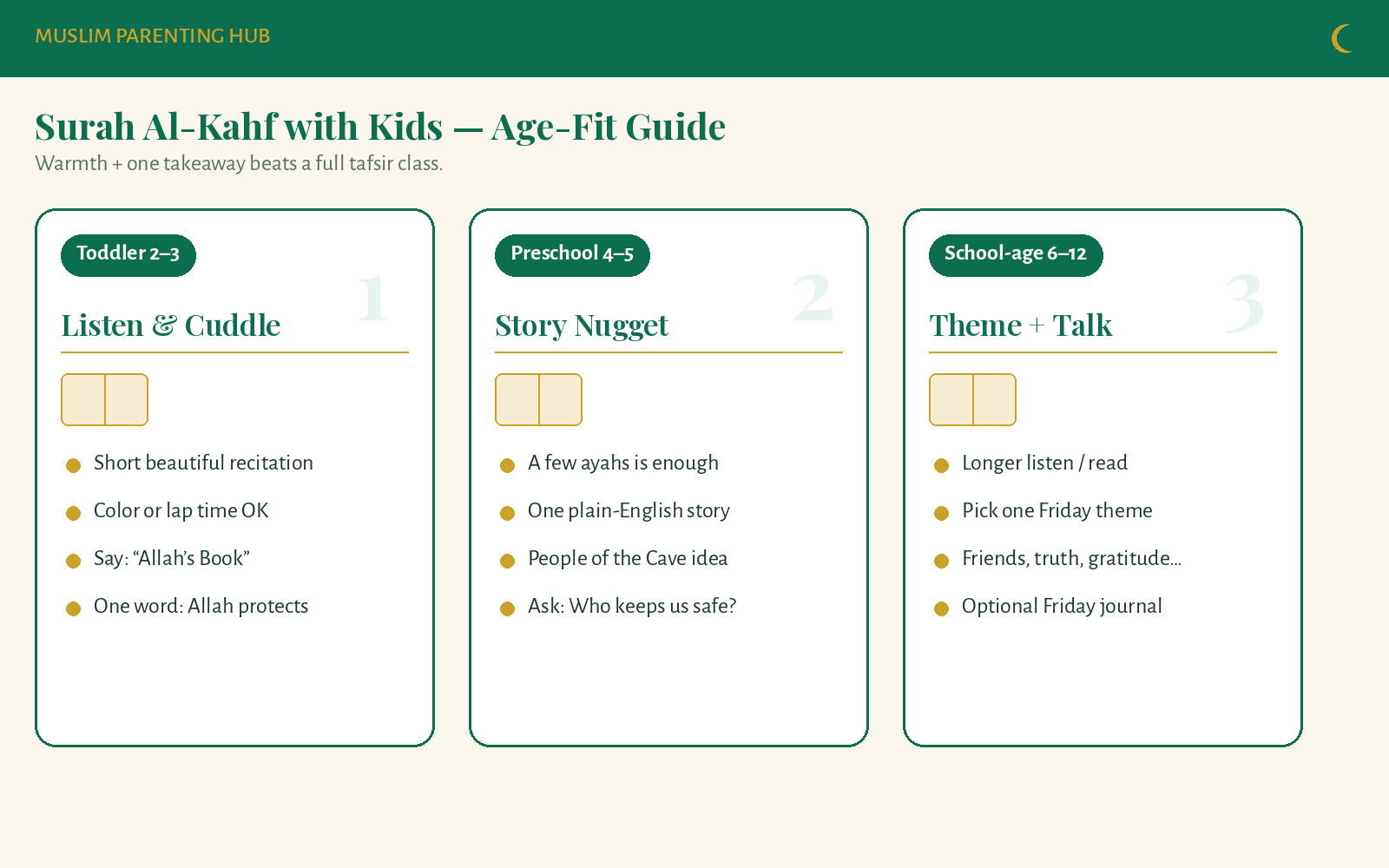
Age-band Al-Kahf guide
Toddler (2–3)
- Play a beautiful short recitation while they color or cuddle.
- Point: “This is Allah’s Book. Friday is special.”
- One word to remember: Allah protects.
Preschool (4–5)
- Listen to a short portion (even a few ayahs).
- Tell one story nugget in plain English—e.g., the People of the Cave trusted Allah; He kept them safe.
- Ask: “Who keeps us safe?” → “Allah.”
School-age (6–12)
- Read or listen to a longer portion together (your family’s pace).
- Pick one theme for the night: protection, truth vs. flashy dunya, good friends, or gratitude for guidance.
- Optional: kids underline / note one ayah meaning in a “Friday journal.”
Keep it soft
- You do not need to finish the whole surah with young kids in one sitting. Consistency beats volume.
- Use a reliable mushaf / app / reciter your family trusts.
- If attention crashes, switch to one story highlight + dua. That still counts as a Friday family night win.
Tonight you can say
“Friday gift: we open Surah Al-Kahf together. Ears open, hearts soft. One small lesson is enough.”
Step 4 — Family Joy Block (The Part Kids Will Beg For)
This is why they look forward to Friday night. Choose one or two joys—not twelve.
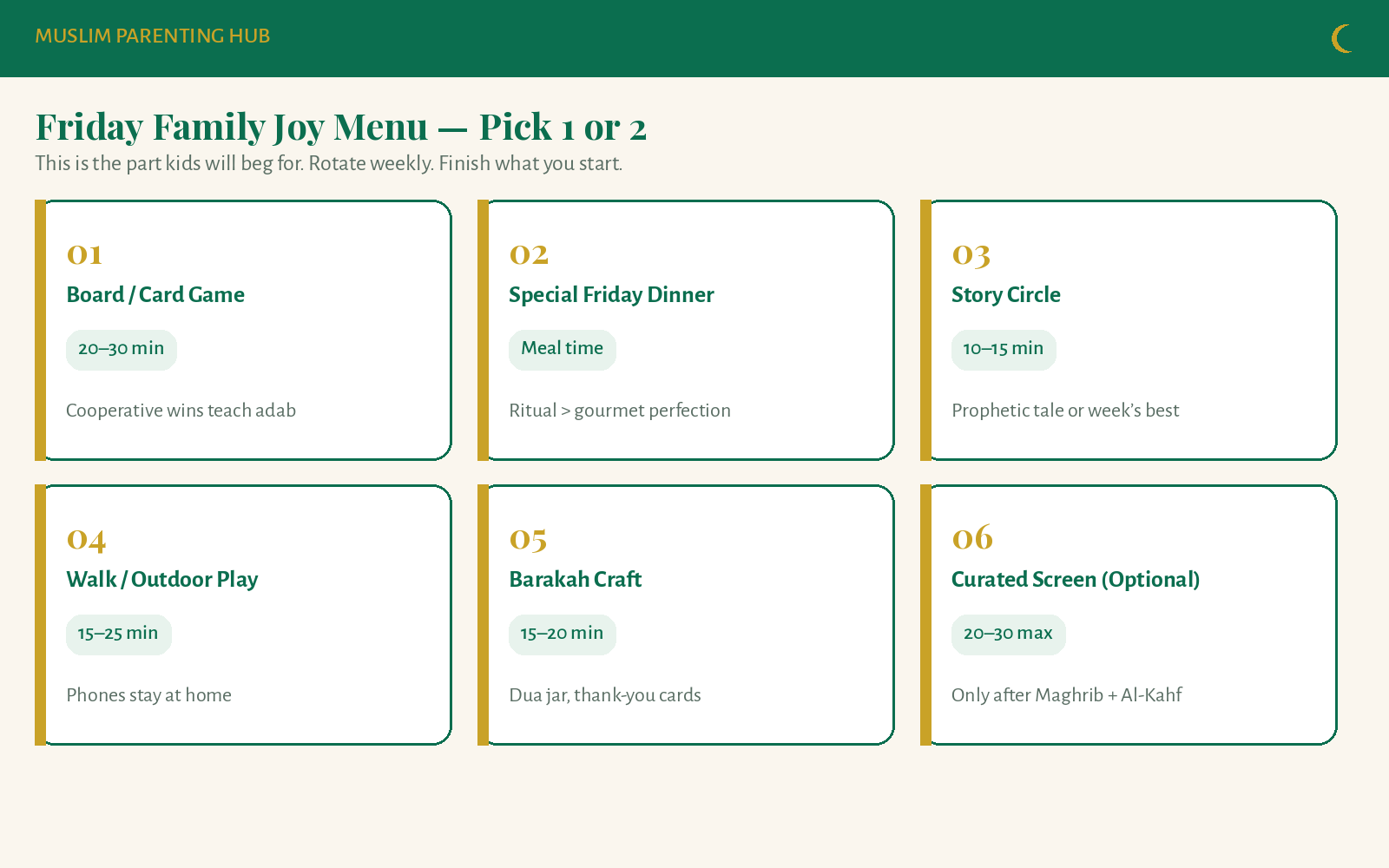
Friday Joy Menu (rotate weekly)
| Joy | Time | Notes |
|---|---|---|
| Family board game / card game | 20–30 min | Keep it cooperative when possible |
| Special Friday dinner | meal length | Pizza night, biryani, “kids choose sides”—ritual > gourmet |
| Story circle | 10–15 min | Prophetic story or family “best moment this week” |
| Walk or backyard play | 15–25 min | Phones stay home |
| Creative barakah craft | 15–20 min | Thank-you cards, dua jar notes, simple calligraphy |
| Limited approved screen | 20–30 min max | Only after Maghrib + Al-Kahf + connection plan; curated, not open-ended |
For screens: treat YouTube Kids as a library you stock, not a babysitter. Approve Content mode + your whitelist criteria still apply—see YouTube Kids for Muslim Parents: A Practical Setup Guide. On Friday, many homes do better with zero screens during the joy block, then a short approved clip only if energy is flat.
Tonight you can say
“Joy block: we pick one fun thing from the Friday menu. Phones stay asleep until we finish. Ready?”
Age tweaks for the joy block
| Age | What helps |
|---|---|
| Toddler | Short play rotations; sensory bins; dancing to a nasheed; expect early exit to bed prep |
| Preschool | Simple games with clear turns; let them “host” snack plates |
| School-age | Let them choose next week’s menu item; teach fair play as adab |
Step 5 — Gratitude + Dua Close (Seal the Night)
End before Isha/wind-down chaos. Five minutes is enough.
The 3-breath close
- One gratitude each — “Alhamdulillah for…”
- One dua from the heart — thank Allah + ask for help (parents model first)
- Jummah Mubarak hug / high-five — physical warmth seals memory
Teach kids that dua does not need fancy Arabic to be sincere. Whispered English from the heart is welcome while you grow their Arabic duas over time—Teach Your Child to Make Dua From the Heart.
Tonight you can say
“Before we wrap: one thank-you to Allah, one ask. I’ll go first… Jummah Mubarak—I love praying and playing with you.”
Age Bands at a Glance (Friday Night Edition)
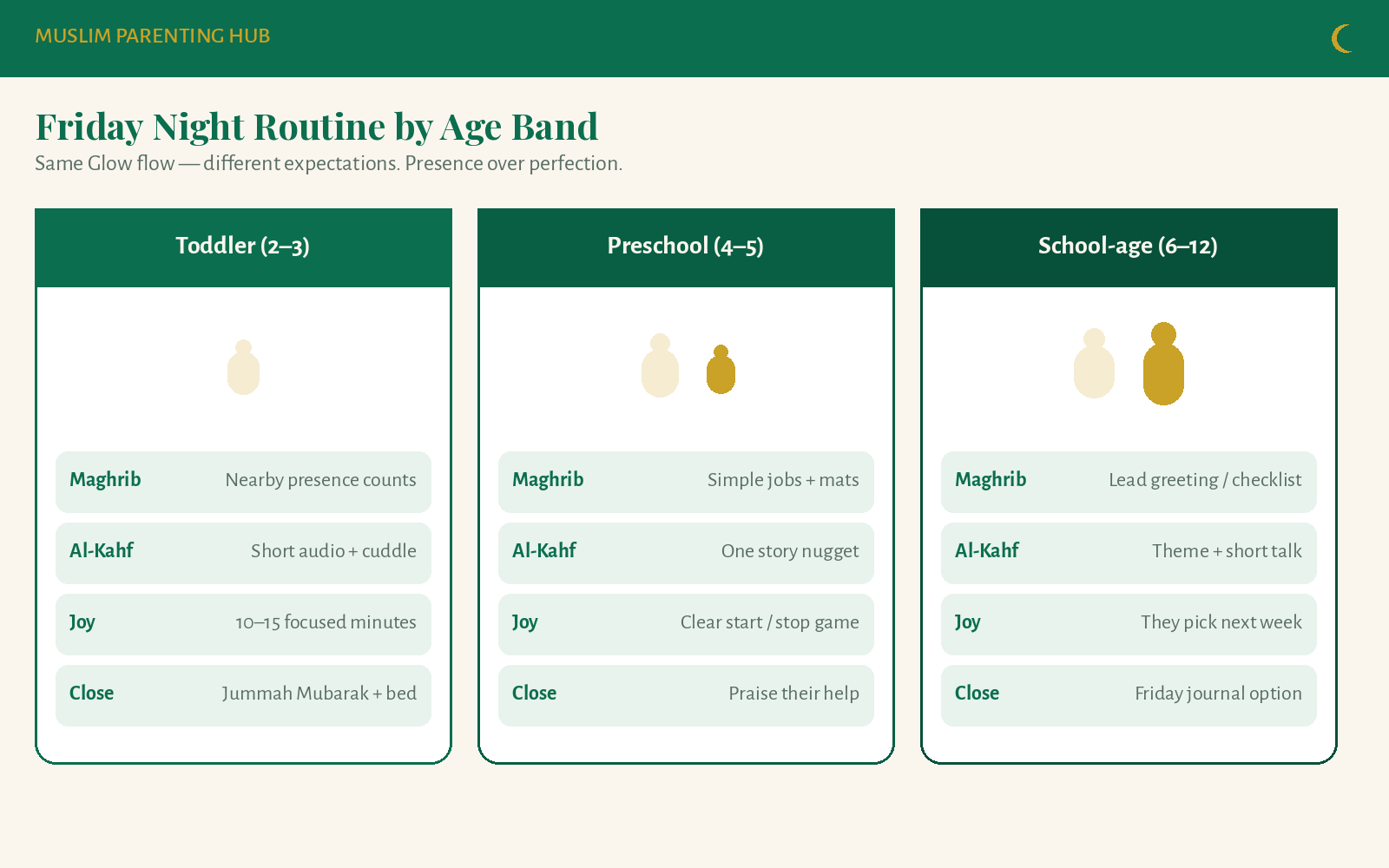
Toddler (2–3): Presence over performance
- Maghrib nearby counts.
- Al-Kahf = short audio + cuddle.
- Joy = 10–15 focused minutes.
- Bedtime may cut the night short—still say Jummah Mubarak.
Preschool (4–5): Jobs + one story
- Give them a Friday job every week.
- One Al-Kahf story nugget.
- One joy activity with clear start/stop.
- Praise: “You helped our Friday Glow—mashaAllah.”
School-age (6–12): Ownership + meaning
- Let them lead greeting, ayah pick, or game choice.
- Longer Al-Kahf listen/read with one discussion question.
- Optional Friday journal: “What protected me this week?”
- Screens only after the spiritual + connection pieces—if at all.
Sample Friday Night Schedules (Steal One)
Version A — Classic post-Jummah at home
| Time | Action |
|---|---|
| Arrive home | Salam, Jummah Mubarak, shoes, water |
| Soft reset | Snack / start dinner; screens in basket |
| Maghrib | Wudu + pray together |
| +10–20 min | Surah Al-Kahf kid version |
| +20–40 min | One joy from the menu + special dinner |
| +5–10 min | Gratitude + dua close |
| Then | Isha / wind-down as usual |
Version B — Late Jummah / tired parents
- Protect Maghrib (even brief).
- Do a 10-minute Al-Kahf highlight (audio + one sentence meaning).
- One short joy (dessert picnic on the floor / 15-minute game).
- Dua close. Sleep. Full menu returns next Friday.
Version C — Guests or extended family
- Keep Maghrib + a public-friendly Al-Kahf listen.
- Joy = inclusive game or shared dessert.
- Skip private journals; keep the vibe warm and light.
- Kids still get the message: Friday gathers hearts.
Version D — One parent working late
- Available parent runs Steps 1–5.
- Late parent gets a “Friday replay”: kids retell the Al-Kahf nugget + give a Jummah Mubarak hug.
- Identity stays family-shaped even when clocks differ.
Scripts Library (Copy-Paste Calm)
On “I want YouTube now”
“Friday Glow first: Maghrib, Al-Kahf, then our joy pick. Screens wait—same rule every Friday.”
On sibling fighting
“Fight pause. Mats out for Maghrib. We can solve it after we stand for Allah.”
On “Al-Kahf is boring”
“We only need soft hearts for a few minutes. One story gift, then your favorite game. Deal?”
On exhaustion
“Tiny Friday tonight: Maghrib, two ayahs, ice cream, dua. Showing up still counts.”
On praise
“I loved how you put the tablet away when I said Jummah Mubarak. That is real adab.”
On guests changing the plan
“Our Friday still has Maghrib and kindness. Joy might look different—and that’s okay.”
Common Problems (And Calm Fixes)
“They only care about the pizza.”
Lead with joy after Maghrib and a micro Al-Kahf moment—not before. Food becomes the celebration of worship, not the replacement.
“We skip Al-Kahf because nobody listens.”
Shrink it. Three minutes of beautiful recitation + one English sentence beats a frustrated half-hour. Consistency grows capacity.
“Friday becomes a screen free-for-all.”
Use a visible rule card: Screens after Maghrib + Al-Kahf + joy plan. Curate with Approve Content if you allow any YouTube Kids time—don’t reopen the open feed.
“We’re too tired after Jummah.”
Pre-decide Version B every Thursday night. Tiny Friday still plants identity. Shame is not a strategy.
“Older kids roll their eyes.”
Give ownership: they pick next week’s joy, lead the dua close, or choose the Al-Kahf theme. Autonomy softens resistance.
“Toddlers melt down during Quran time.”
Parallel play is allowed—coloring, quiet toys, lap cuddles. Your calm recitation is still their Friday soundtrack.
A 4-Week Starter Plan (Low Friction)
- Week 1: Maghrib together + special dinner + Jummah Mubarak dua only
- Week 2: Add 5 minutes of Al-Kahf audio
- Week 3: Add one joy-menu game after Al-Kahf
- Week 4: Full Glow (reset → Maghrib → Al-Kahf → joy → dua) + kids help plan next Friday
Do not launch the “perfect Islamic Friday” after a chaotic week. Stack wins.
Fridge Checklist — Friday Glow
- [ ] Jummah Mubarak greeting
- [ ] Shoes / bags parked; water or light snack
- [ ] Screens in basket
- [ ] Maghrib together
- [ ] Surah Al-Kahf kid version (any length that fits)
- [ ] One joy from the menu
- [ ] Special-feeling dinner or dessert
- [ ] Gratitude + heartfelt dua
- [ ] Isha / wind-down plan spoken out loud
FAQ: Friday Night Muslim Family Routine
What is a simple Friday night Muslim family routine?
A simple routine is: soft reset after Jummah, Maghrib together, a kid-friendly Surah Al-Kahf moment, one shared joy (game, special meal, or story), and a short gratitude-and-dua close. Aim for 60–90 minutes, not an all-evening program.
How do I do Surah Al-Kahf with kids who won’t sit still?
Match the age band. Toddlers need short audio and cuddles. Preschoolers need one story nugget. School-age kids can listen longer and discuss one theme. Presence and warmth matter more than finishing the whole surah in one sitting.
Should we allow screens on Friday family night?
Many families keep screens paused until after Maghrib, Al-Kahf, and the planned joy block. If you allow any YouTube Kids time, use Approve Content mode and a timer—and prefer zero screens during the core Friday Glow when you can.
What if Jummah runs late and everyone is exhausted?
Run a “tiny Friday”: Maghrib, a few minutes of Al-Kahf audio, one small treat, and dua. Showing up lightly still builds the habit. Expand again next week.
How is Friday night different from the Maghrib evening routine?
Your Maghrib routine is the daily anchor. Friday night keeps that anchor and adds weekly joy—Al-Kahf, a special meal, and a celebration feeling kids anticipate. Link them; don’t replace one with the other.
What if only one parent is home on Friday evening?
The available parent runs the Glow. When the other arrives, kids share one Al-Kahf takeaway and a Jummah Mubarak hug so the night still feels shared.
Can we invite friends or cousins into Friday family night?
Yes—keep Maghrib and a short Al-Kahf listen, then choose an inclusive joy (game or dessert). Adjust privacy-heavy activities for guests, but keep the Friday identity clear.
How do we teach dua without making Friday feel heavy?
Model first. Ask each person for one thank-you and one ask in simple words. Heartfelt dua in a child’s language is a beautiful start while Arabic duas grow over time.
Closing: Make Friday the Night They Ask For
You do not need a Pinterest-perfect Islamic living room to give your children a Friday they love.
You need a greeting that feels special, mats that still come out for Maghrib, a few ayahs of Al-Kahf with soft voices, one joy you actually finish, and a dua that sounds like your real family.
Tonight is enough:
- Put the “Friday Glow” card on the table
- Park the screens
- Pray Maghrib with whoever will stand with you
- Play two minutes of Surah Al-Kahf
- Pick one joy and one heartfelt ameen
May Allah make your Fridays light, your children’s hearts attached to His Book, and your home a place where Jummah evening feels like belonging. Ameen.
Published for Muslim Parenting Hub · Practical faith at home · English guide for parents of toddlers, preschoolers, and school-age kids
FAQs
What is a simple Friday night Muslim family routine?
A simple routine is: soft reset after Jummah, Maghrib together, a kid-friendly Surah Al-Kahf moment, one shared joy (game, special meal, or story), and a short gratitude-and-dua close. Aim for 60–90 minutes, not an all-evening program.
How do I do Surah Al-Kahf with kids who won’t sit still?
Match the age band. Toddlers need short audio and cuddles. Preschoolers need one story nugget. School-age kids can listen longer and discuss one theme. Presence and warmth matter more than finishing the whole surah in one sitting.
Should we allow screens on Friday family night?
Many families keep screens paused until after Maghrib, Al-Kahf, and the planned joy block. If you allow any YouTube Kids time, use Approve Content mode and a timer—and prefer zero screens during the core Friday Glow when you can.
What if Jummah runs late and everyone is exhausted?
Run a tiny Friday: Maghrib, a few minutes of Al-Kahf audio, one small treat, and dua. Showing up lightly still builds the habit. Expand again next week.
How is Friday night different from the Maghrib evening routine?
Your Maghrib routine is the daily anchor. Friday night keeps that anchor and adds weekly joy—Al-Kahf, a special meal, and a celebration feeling kids anticipate. Link them; don’t replace one with the other.
What if only one parent is home on Friday evening?
The available parent runs the Glow. When the other arrives, kids share one Al-Kahf takeaway and a Jummah Mubarak hug so the night still feels shared.
Can we invite friends or cousins into Friday family night?
Yes—keep Maghrib and a short Al-Kahf listen, then choose an inclusive joy (game or dessert). Adjust privacy-heavy activities for guests, but keep the Friday identity clear.
How do we teach dua without making Friday feel heavy?
Model first. Ask each person for one thank-you and one ask in simple words. Heartfelt dua in a child’s language is a beautiful start while Arabic duas grow over time.