

How to Get Kids to Clean Their Room Without Yelling: A 10-Minute Tidy Routine for Muslim Families
It’s Saturday morning. You open your nine-year-old’s door and see the usual: a soccer cleat on the bed, the other one under the desk, three hoodies on the floor, a half-built Lego set, school papers from September, and something sticky that used to be Halloween candy.
“Clean your room!” you say, for the fourth time this week. Your child stares at the chaos, looks overwhelmed, and quietly starts building Lego again.
Here’s the thing: most kids don’t refuse to clean their room because they’re lazy or defiant. They refuse because “clean your room” is too big. They don’t know where to start, what “clean” looks like, or when they’re done.
This guide gives you a different approach: a 10-minute tidy routine with clear steps, age-by-age expectations, a simple room setup that makes tidying easier, and Islamic reasons that turn a chore into something meaningful. No yelling required.
If you’re still figuring out which chores fit which age in general, start with our Islamic chores for kids age-by-age chart. This article zooms in on the one chore every parent fights about: the bedroom.
Why a Tidy Room Matters in Islam (Kid Version)
You don’t need a lecture. A few short ideas go a long way.
Allah loves beauty. The Prophet ﷺ said, “Allah is beautiful and loves beauty” (Muslim 91). Kid version: “When we keep our room clean and nice, we’re doing something Allah loves.”
The Prophet ﷺ helped at home. When Aisha was asked what the Prophet ﷺ did at home, she said he used to serve his family (Bukhari 676). Other narrations mention that he mended his own clothes and repaired his own sandals (Ahmad). Kid version: “Even the Prophet ﷺ took care of his own things.”
Start with the right. The Prophet ﷺ liked to start with the right side in his affairs (Bukhari 168). Kids love this as a rule for tidying: “Start with the right side of your room.”
Dust off your bed. The Prophet ﷺ taught that when we go to bed, we should brush off the bed first, because we don’t know what landed on it while we were away (Bukhari 6320). That makes “make your bed” part of a Sunnah bedtime habit.
Thank Allah for your things. A room full of toys and clothes is a blessing. Taking care of them is a way of saying “Alhamdulillah” with our hands.
Keep these as gentle reminders, not threats. “Allah will be angry if your room is messy” is not true and not helpful. “Allah loves it when we take care of His gifts” is both.
The 10-Minute Tidy Routine
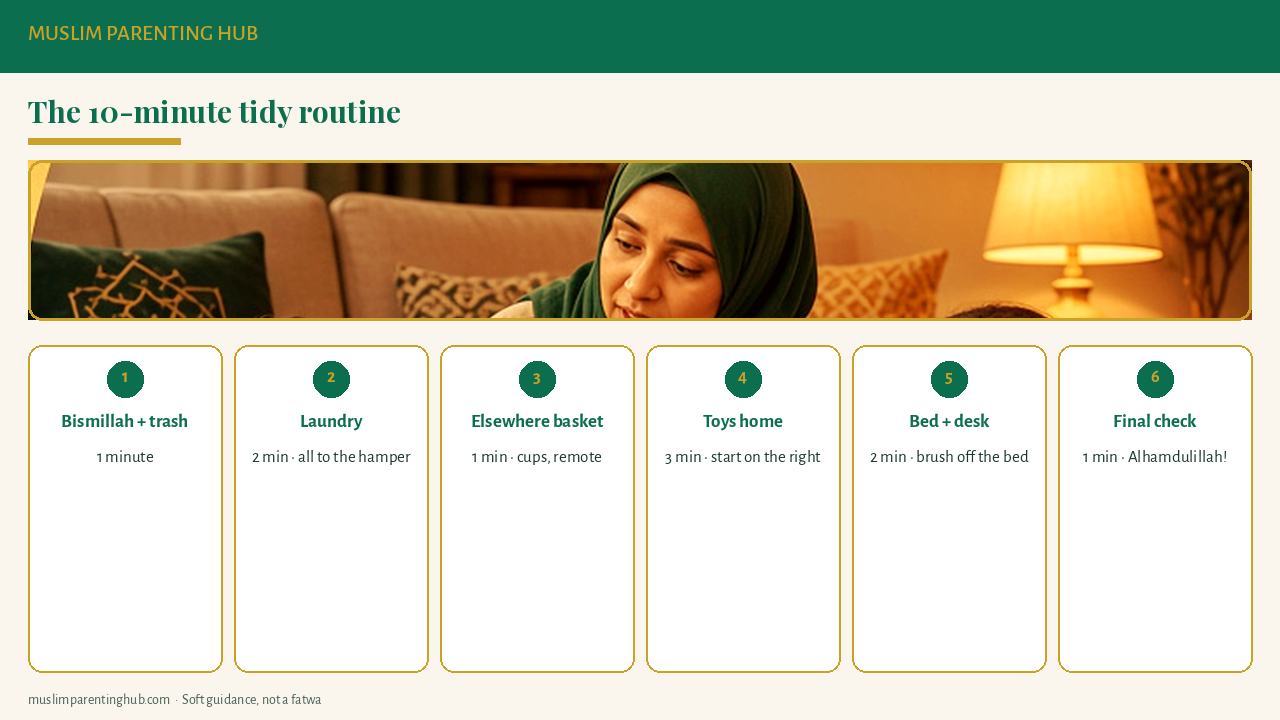
The power of this routine is that it’s the same every time, it’s short, and it has a finish line. Set a timer (kids love timers) and go in this order:
Step 1 — Bismillah and trash (1 minute)
Say “Bismillah,” grab a small bag, and pick up anything that’s trash: wrappers, broken crayons, old papers. Trash first, because it’s fast and makes a visible difference.
Step 2 — Laundry to the hamper (2 minutes)
Every piece of clothing on the floor goes into the hamper or, if clean, back in the drawer. Tip: don’t make kids decide “clean or dirty?” when they’re little. Everything on the floor goes in the hamper.
Step 3 — Things that belong elsewhere (1 minute)
Cups, plates, the TV remote, a sibling’s toy. Put them all in one “outside basket” by the door and take it out at the end.
Step 4 — Toys and books home (3 minutes)
Every toy goes to its “home”: a labeled bin, a shelf, a book basket. Start with the right side of the room, move to the left.
Step 5 — Bed and desk reset (2 minutes)
Pull up the comforter, put the pillow at the top, brush off the bed (Sunnah!), and clear the desk surface. A “made” bed for a 6-year-old is just “covers pulled up.” That counts.
Step 6 — Final check and Alhamdulillah (1 minute)
Look around together: “Floor clear? Bed made? Desk clear? Alhamdulillah!” Take out the outside basket. Done.
That’s it. Ten minutes, six steps, one clear finish line.
When to Do It
The routine works best attached to something that already happens:
- After school, before screens. Add it to your afternoon flow. Our after-school order: snack, salah, homework, then Maghrib shows where a quick tidy fits.
- Before Maghrib. A “Maghrib reset” means the house is calm when the family prays.
- Saturday morning. A slightly longer version (20 minutes) with a deeper clean: under the bed, the closet floor, the backpack.
- Before guests. When cousins come over for Thanksgiving break or a weekend visit, the routine makes the room guest-ready fast.
Pick one daily time and stick with it for a month. Consistency matters more than the exact time.
Age-by-Age: What “Clean” Looks Like
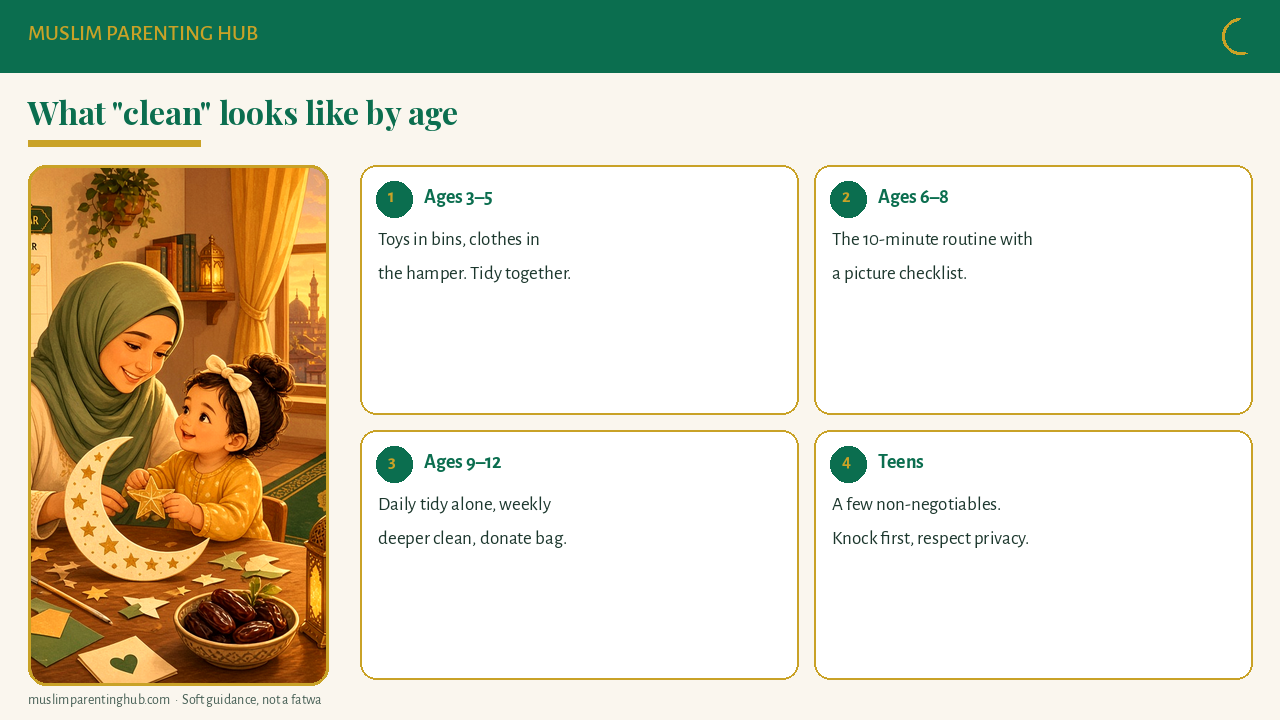
Many fights happen because parents expect an adult standard. Match the expectation to the age.
Ages 3–5
- Toys in bins (no sorting by type needed).
- Clothes in the hamper.
- Covers pulled up.
- You do it with them. At this age, tidying is a team activity. Sing, count, race the timer. A preschooler cannot clean a room alone, and that’s normal.
Ages 6–8
- The full 10-minute routine with a picture checklist.
- Can sort toys into labeled bins.
- Can put clean clothes in drawers (folding optional).
- You check in once or twice, but they do most of the work.
Ages 9–12
- The 10-minute routine alone, daily.
- Weekly deeper tidy: under the bed, closet floor, backpack clean-out.
- Can strip and remake their bed with help on laundry day.
- Can decide what to donate.
Teens
- Their room is mostly their responsibility. Agree on a few non-negotiables (no food left out, laundry in the hamper, floor clear enough to walk) and let the rest go.
- Respect their privacy. Knock before entering, as the Quran teaches about asking permission (An-Nur 24:58–59). Our guide to teaching kids to knock and ask permission covers this adab in both directions.
Set Up the Room So Tidying Is Easy
Sometimes the problem isn’t the child. It’s the room. A few small changes make a huge difference.
- Fewer toys out. Rotate toys: keep a third in the closet, swap every few weeks. Fewer items means less mess.
- Every item has a home. Labeled bins (pictures for non-readers) for Legos, cars, dolls, art supplies.
- Low hooks. For hoodies, backpacks and the jacket they’ll need as the weather cools. Kids hang things when hooks are at their height.
- Open hamper. No lids. If it’s hard to use, clothes end up on the floor.
- A “sports spot.” A bin by the door for cleats, shin guards and the water bottle. Saves the Saturday morning search.
- A prayer corner. If your child has space, a folded prayer rug on a small shelf or in a basket gives the room a special corner. Kids tend to keep that area tidier.
The fall clothes swap
October is a natural time for a reset: summer clothes out, warm clothes in. Make it a family project. Kids try things on, outgrown clothes go to a donation bag, and you talk about giving: “Someone else’s child will be warm in this jacket this winter. That’s sadaqah.” The Prophet ﷺ taught us to look at those who have less than us so we don’t look down on Allah’s blessings (Muslim 2963).
Scripts That Work Better Than “Clean Your Room!”
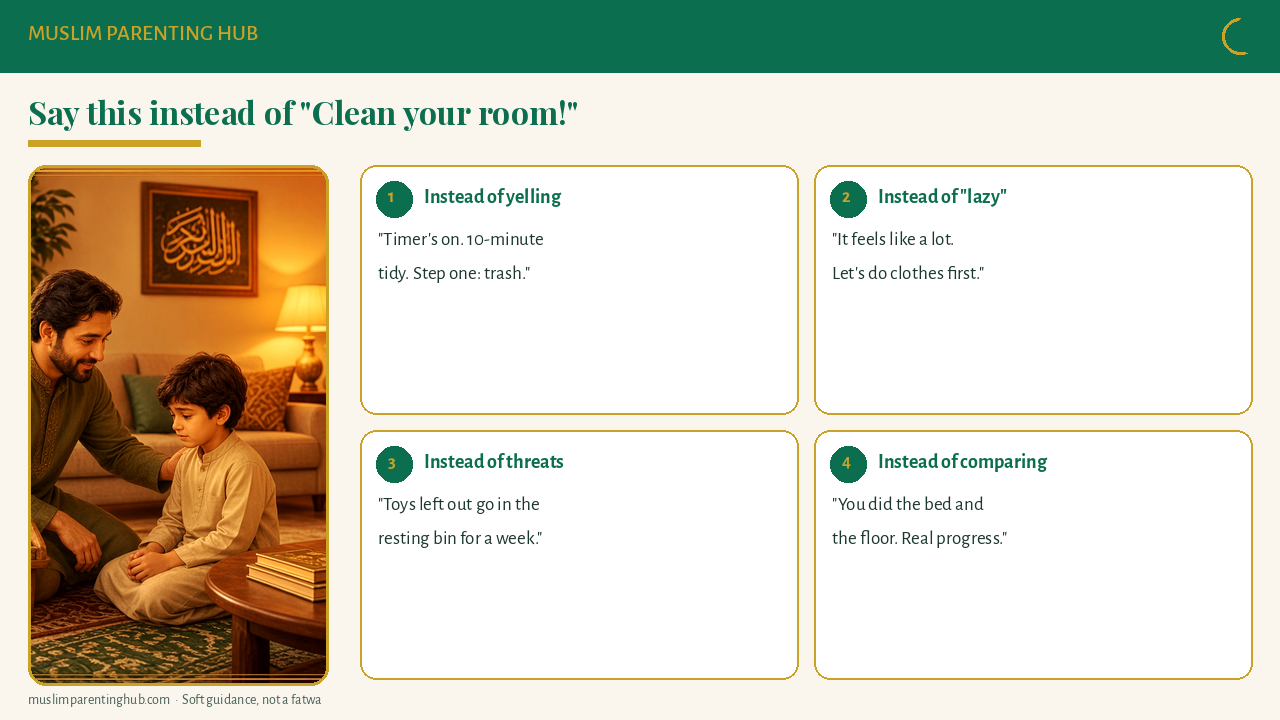
Swap vague commands for clear, calm, specific ones.
Instead of: “Clean your room!” Try: “Timer’s on. Let’s do the 10-minute tidy. Step one: trash.”
Instead of: “Why is it always such a mess?” Try: “Rooms get messy when we live in them. Let’s reset it.”
Instead of: “You’re so lazy.” Try: “I know it feels like a lot. Let’s just do the clothes first.”
Instead of: “If you don’t clean up, I’m throwing all your toys away.” Try: “Toys that don’t go back in their home go in the ‘resting bin’ for a week.”
Instead of: “Look at your brother’s room, it’s always clean.” Try: “You did the bed and the floor today. That’s real progress.”
That last one matters. Comparing siblings creates resentment, not tidiness. If you have kids sharing a room, our guide to sibling jealousy, fairness and what not to say has more on keeping it fair.
Shared Rooms: Keeping the Peace
Many Muslim families have siblings sharing a room. That doubles the mess and the arguments.
- Divide by zones, not by items. “Your side, your shelf, your bin.” Shared areas (the floor, the rug) are a team job.
- Same timer, same routine. Both kids do the 10-minute tidy at the same time. Nobody watches while the other works.
- No blame game. If it’s on your side, you tidy it, no matter whose it is. Sort out ownership later.
- Older helps younger, briefly. A 10-year-old can help a 5-year-old for the last two minutes, and that’s a beautiful act of rahma, not a punishment.
Rewards, Allowance and Motivation
Should you pay kids to clean their room? Many families keep basic self-care chores (your room, your clothes, your dishes) unpaid, because they’re part of living in a family. Extra jobs beyond that can earn money. Our guide on allowance for chores in a Muslim home explains different approaches, including saving and sadaqah.
What motivates kids more than money:
- Your company. Tidying with a parent is far more appealing than tidying alone.
- Music or a nasheed. A short playlist that ends when the timer does.
- A visible finish line. The final check and “Alhamdulillah” moment.
- Real praise. Specific and honest: “You put every book back. Your shelf looks great.”
- Niyyah. For older kids: “Let’s make the intention that this is for Allah, because He loves beauty and we’re taking care of His gifts.” Intention turns a chore into worship.
When It Still Doesn’t Work
Some kids genuinely struggle with tidying more than others. If you’ve tried a consistent routine for several weeks and your child still freezes, it might help to:
- Break the routine into even smaller pieces: just one step per day for a week.
- Use a picture checklist taped to the door.
- Work side by side for longer than you think is “age appropriate.”
- Notice patterns. If your child also struggles with organization at school (lost homework, messy backpack), it may be worth mentioning to their teacher or pediatrician. Some kids need extra support with executive function, and that’s nothing to be ashamed of.
And on hard days, when everyone is sick or tired or it’s a busy week of fall sports, let it go. A messy room for a few days is not a moral failure. Restart the routine when you can.
FAQ
How do I get my kids to clean their room without yelling?
Replace “clean your room” with a short, predictable routine: a 10-minute timer and the same six steps every time (trash, laundry, things that belong elsewhere, toys, bed and desk, final check). Clear steps and a finish line remove most of the arguing.
At what age should a child clean their own room?
Kids ages 3–5 can help tidy alongside a parent. By 6–8, most children can do a simple routine with a picture checklist and some check-ins. By 9–12, many can do a daily 10-minute tidy alone and a weekly deeper clean.
What does Islam say about keeping your room clean?
Islam loves cleanliness and beauty. The Prophet ﷺ said, “Allah is beautiful and loves beauty” (Muslim), he helped with work at home, and he taught us to brush off our beds before sleeping. A tidy room is a simple way to care for Allah’s gifts.
Should I pay my kids to clean their room?
Many Muslim families keep room cleaning unpaid because it’s part of being in a family, and offer allowance for extra jobs. What matters most is consistency and a calm routine, not the reward.
How can siblings who share a room keep it clean?
Divide the room into personal zones with their own bins and shelves, and treat shared areas like the floor as a team job. Have both children do the same 10-minute routine at the same time and avoid comparing them.
How long should it take a child to clean their room?
For daily upkeep, about 10 minutes is enough if the room has simple storage and fewer toys out. A weekly deeper clean, like under the bed and in the closet, can take 20–30 minutes.
Related guides
- Islamic chores for kids: age-by-age chart
- Should Muslim kids get an allowance for chores?
- Kids in the kitchen: age-by-age cooking jobs
- The after-school order: snack, salah, homework, then Maghrib
Soft guidance, not a fatwa. For detailed fiqh questions, please ask a trusted local scholar or your masjid’s imam.
Quick steps
10-minute tidy routine for a kid's bedroom. The same six short steps every time, with a timer and a clear finish line, so kids know where to start and when they're done.
- Bismillah and trash (1 minute) — Say Bismillah, grab a small bag and pick up anything that's trash: wrappers, broken crayons and old papers.
- Laundry to the hamper (2 minutes) — Every piece of clothing on the floor goes into the hamper or, if clean, back in the drawer.
- Things that belong elsewhere (1 minute) — Put cups, plates, the remote and siblings' things in one outside basket by the door.
- Toys and books home (3 minutes) — Return every toy and book to its labeled bin or shelf, starting with the right side of the room.
- Bed and desk reset (2 minutes) — Pull up the covers, put the pillow at the top, brush off the bed as the Sunnah teaches, and clear the desk.
- Final check and Alhamdulillah (1 minute) — Look around together (floor clear, bed made, desk clear), say Alhamdulillah and take the outside basket out.
Related articles

Islamic Chores for Kids: Age-by-Age Responsibility Chart for Muslim Homes
Age-by-age Islamic chores chart for Muslim kids—Prophetic helping-at-home framing, tonight scripts, sticker-free tips, and responsibility without shame.
Read guide →
Should Muslim Kids Get an Allowance for Chores? Allowance, Sadaqah and Saving Explained
Should Muslim kids get an allowance for chores? US guide to khidmah vs paid extras, three jars (spend, save, sadaqah), and what never to pay for.
Read guide →
Kids in the Kitchen: Age-by-Age Cooking Jobs for Muslim Kids (Ages 2–12)
Age-by-age kitchen jobs for Muslim kids 2–12: safe tasks, Bismillah and clean-hands habits, a weekly cooking night, and Thanksgiving-week prep ideas.
Read guide →
The After-School Order for Muslim Kids: Snack, Salah, Homework, Then Maghrib
A simple after-school order for Muslim kids: snack, wudu and Asr, homework, play, then Maghrib together. Sample fall schedules for school days and sports nights.
Read guide →