
Laundry Chores for Muslim Kids by Age: Folding, Sorting and a Weekly Habit
Sunday evening in a US Muslim home often looks like this: sports uniforms in a heap, jumuah thobes or dresses waiting on a chair, backpacks half-zipped for Monday, and a parent staring at a mountain of laundry wondering when childhood became a textile management job.
Laundry is one of the most practical ways to teach responsibility, taharah awareness, and amanah—without a lecture. Clean clothes matter for dignity, for school, and for standing in salah with care. Kids can help long before they can run a full household.
This guide gives you an age chart (2–4, 5–7, 8–10, 11+), scripts for sorting and folding, and a 15-minute Sunday laundry reset you can actually keep between soccer and meal prep. It sits beside our popular Islamic chores age chart with a deeper dive on the washer-and-fold path.
Why Laundry Is an Islamic Character Workout
- Amanah: Clothes are a trust. We care for what Allah gave us.
- Taharah mindset: We notice clean vs dirty; we don’t pray in something we know is najis if we can change (age-fit teaching, not panic).
- Ihsan: Folding neatly is excellence in small things.
- Family service: Helping the household is worshipful character when done with the right intention—softly taught, never weaponized.
You don’t need to narrate all four points every Sunday. One line is enough: “We take care of our clothes so we’re ready for school and for salah.”
Age Chart: Laundry Jobs That Fit Real Kids
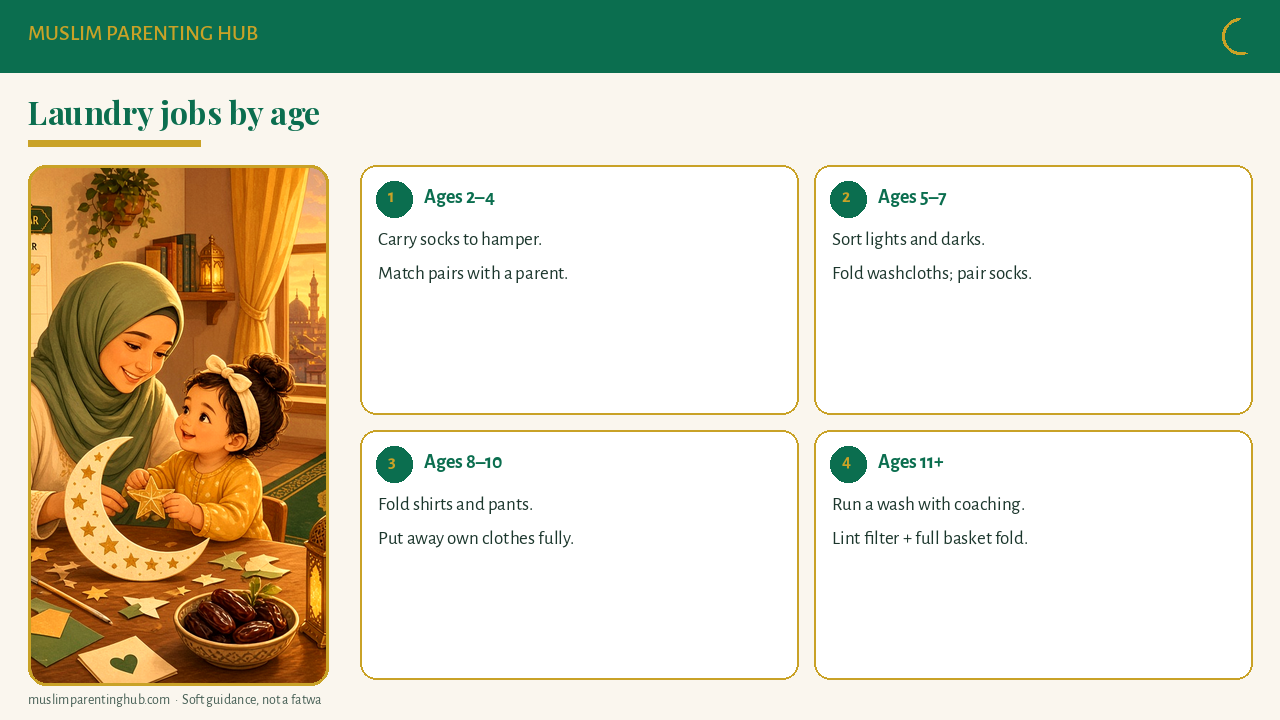
Ages 2–4 — Helper hands
- Carry a pair of socks to the basket (make it a race).
- Put dirty clothes in the hamper (celebrate the aim).
- Match baby socks with a parent (color game).
- Press the washer’s start button after you load (supervised thrill).
Avoid detergent measuring. Avoid hot machines unsupervised. Toddlers “help” through presence and tiny carries.
Ages 5–7 — Sort and start folding
- Sort lights and darks into two piles (teach “mostly white/light” vs “bright/dark”).
- Sort towels vs clothes if you wash separately.
- Fold washcloths and square tea towels.
- Pair socks.
- Put pajamas away in the right drawer with a photo label.
Script: “Lights here, darks here. If you’re not sure, make a ‘maybe’ pile and ask me.”
Ages 8–10 — Fold, put away, own a load
- Fold shirts (parent finishes collars if needed).
- Fold pants into halves.
- Carry a basket to bedrooms.
- Put away own clothes completely.
- Remind the family when the dryer buzzes (phone timer backup).
- Separate “prayer clothes” onto a hook or shelf.
This age can start reading simple care labels with you (“cold” vs “hand wash”). Keep bleach and stain chemicals as adult-only.
Ages 11+ — Near-independent laundry
- Start a wash cycle with correct level and cold/warm choice you approve.
- Move load to dryer; clean lint filter every time.
- Fold a full family basket in 15 focused minutes.
- Iron simple items if your family irons (optional).
- Pack sports bags the night before with clean gear.
- Help younger siblings put away—leadership without bossiness.
Tweens ready for more household trust may also connect laundry effort to allowance conversations if that’s your family system—payment optional, character not optional.
Teach Sorting Lights and Darks (Without a Fight)
Lay a light towel and a dark towel on the floor as targets. Race two songs’ worth of sorting. Mistakes are data, not drama.
Special cases to name once:
- Jeans → darks
- School polos with logos → follow the main fabric color
- New red items → alone the first wash (you handle)
- Prayer caps / scarves → gentle pile
If your child also helps in the kitchen, use the same calm coaching tone you use for kids’ kitchen jobs by age: short instructions, then step back.
Folding That Kids Can Master
Washcloths: flat, fold in half, fold in half. Socks: match, fold or clip. T-shirts: kids fold in half vertically; you square shoulders later if you care. Pants: legs together, fold at knees.
Put on Quran or a short nasheed during fold time so the chore feels like family atmosphere, not punishment. Ten minutes of folding together beats an hour of nagging from the couch.
Connect put-away to your room routine: clean laundry belongs in drawers, not on the chair mountain—see getting kids to clean their room.
Clean Clothes as Salah Prep (Keep It Soft)
You can say:
“We like to stand for prayer in clean clothes when we can. That’s part of caring for our salah.”
Avoid shaming a child who only has the shirt on their back after a spill five minutes before Maghrib. Offer a quick change if possible; if not, pray and wash later. Fiqh nuances belong with a local teacher; your job at home is dignity and effort.
Hang a child-height hook near the prayer corner for a clean thobe, abaya, or scarf. Laundry habits feed worship spaces.
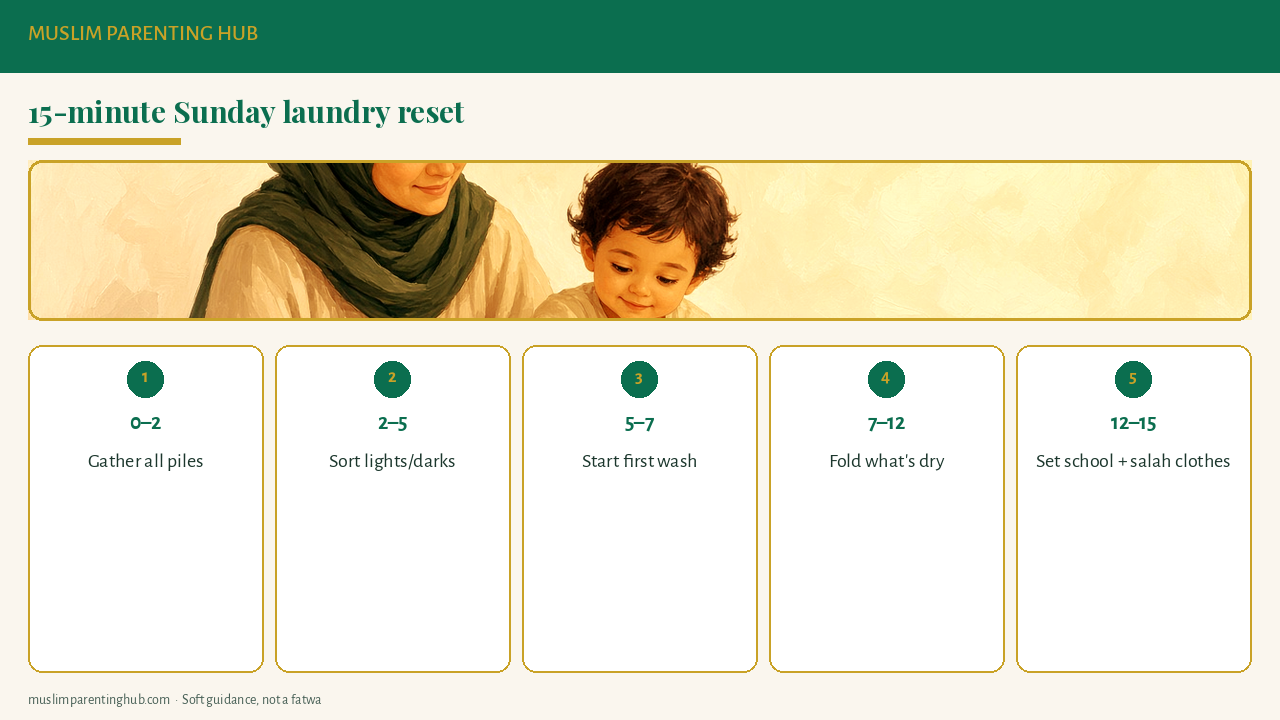
HowTo: The 15-Minute Sunday Laundry Reset
Use this when the week exploded—fall sports, rainy recesses, extra towels, visiting cousins.
Minute 0–2: Everyone brings bedroom piles to the laundry area. No arguing about whose sock is whose yet.
Minute 2–5: Sort lights/darks/towels into three zones. Ages 5+ lead sorting; parent handles mystery stains.
Minute 5–7: Start washer with the first load. Set a phone timer for the cycle end.
Minute 7–12: Fold whatever is already clean and dry from yesterday. Put away in baskets labeled by name.
Minute 12–15: Spot-check prayer clothes and Monday school outfits on hooks. Done. Imperfect is fine.
Run this after your weekly family meeting or before Sunday night wind-down. Same time each week → less decision fatigue.
Scripts for Real Laundry Drama
“I don’t want to fold!”
“Five songs. You fold, I fold. Then free play. We take care of our amanah first.”
“This is Mom’s job.”
“In our family, laundry is a team sport. Allah loves helpers. Pick socks or towels—your choice.”
Sibling dumps a clean basket on the floor
“Pause. We don’t dump clean clothes. Help pick up, then your turn with the timer for tablet.”
Stain panic before school photos
Adult treats the stain. Child brings the shirt quickly next time. No shame spiral.
Travel / hotel week
Pack two mesh bags: dirty and clean. Kids can sort into the bags even in a hotel room after a road trip or Thanksgiving travel.
Weekly Rhythm Suggestion
| Day | Tiny laundry habit |
|---|---|
| Sun | 15-minute reset + first wash |
| Mon–Thu | Kids put pajamas in hamper nightly |
| Wed | Midweek towel wash if needed |
| Fri | Clean jumuah / Maghrib clothes check |
| Sat | Sports gear wash after games |
Keep it lighter than a military schedule. The point is rhythm, not perfection.
Safety Notes Parents Should Own
- Detergent pods: locked up; look like candy.
- Dryer lint: tween job only after you teach fire-safety why.
- Irons and steamers: adult or carefully trained teen.
- Hot water cycles: parent decision for now.
Responsibility grows inside safety fences.
Linking Laundry to the Wider Chore Map
Laundry sits beside kitchen help, room reset, and guest-ready tidying. If you’re building a full chart, start with our Islamic chores age guide, then specialize with this laundry article so kids aren’t drowning in twenty new jobs at once. One laundry skill per month is plenty.
Praise effort in front of family: “Maryam sorted the whole lights pile today—jazakillahu khairan.” Public gratitude, private correction.
Parent Heart Check
You will re-fold some shirts. That is okay. The goal is a child who sees household care as normal Muslim life—not a punishment for being young. Progress looks like fewer mystery piles under the bed by December, not magazine-perfect drawers in week one.
Stain Station: A Kid Job Inside an Adult Skill
Create a small “oops tray” on a low shelf: a cloth, a spray bottle of water, and a parent-approved gentle soap for fresh food spots. Ages 7+ can blot (not rub) and call you. Ages 11+ can learn your family’s stain basics for grass and ketchup. Keep chemical removers locked.
Script after recess mud: “Shoes off, pants in the stain zone, tell me before it dries.” Speed beats perfection. Dried stains are adult problems; fresh stains are teamwork.
Boarding School Uniforms, Sports Kits, and Masjid Clothes
US Muslim kids often rotate three clothing worlds: school dress code, team colors, and masjid or jumuah outfits. Color-code hampers or mesh bags:
- Black bag: school
- Green bag: sports
- White/cream bag: prayer and jumuah
Kids 8+ can learn which bag gets washed more often (sports) and which needs gentler care (scarves, thobes). Friday afternoon becomes a five-minute “jumuah check” instead of a morning panic.
If your child wears a hijab to school, teach a nightly hook habit: clean scarf for tomorrow, worn scarf to the gentle pile. Same for kufis and clean socks dedicated to salah.
Teaching Boys and Girls the Same Dignity
Avoid “laundry is only for girls.” Rotate who sorts and who carries. Fathers folding beside sons is a powerful adab lesson. Mothers teaching daughters and sons machine basics builds future adults who don’t outsource basic life skills by gender myth.
When relatives joke that boys shouldn’t fold, smile and keep your house rule: “In this family helpers are everyone.”
What If the Washer Is in a Basement or Shared Laundry Room?
Apartment and condo life needs extra safety: kids don’t ride elevators alone with detergent. Assign hallway carries only with a parent. Use a rolling cart kids can push. Put-away still happens in the bedroom—laundry skill isn’t only the machine; it’s finishing the loop.
For shared paid machines, let tweens carry the card or coins with you and learn the cost of forgotten wet loads. Real-life math meets amanah.
Seasonal Surges: Fall Sports and Winter Layers
October through March multiplies laundry: jerseys, muddy cleat socks, hoodies, and raincoats. Preview the surge at your Sunday reset: “Sports week = extra towel pile.” Assign the athlete to empty the sports mesh bag into the hamper within ten minutes of getting home—before snacks if that is your house rule, or right after, but same every day.
Winter layers also trick kids into chair piles (“I’ll wear it again tomorrow”). Teach a middle hamper: “Wear again” hook for one hoodie max, everything else washes. Amanah includes not growing science experiments in bedroom corners.
FAQ
What laundry chores can a 5-year-old do?
Sort lights and darks into piles, match socks, fold washcloths, and put pajamas in a labeled drawer. Keep detergent and machine settings as adult jobs. Praise sorting accuracy more than speed.
How do I teach kids to fold laundry without frustration?
Start with square items (washcloths), fold side-by-side for five to ten minutes with audio on, and accept “good enough” folds. Save crisp adult standards for your own stack. Short, shared sessions beat solo exile to the laundry room.
Why connect laundry to salah for kids?
Clean, dignified clothes help kids feel ready to stand before Allah. Teach it as care, not anxiety. If a spill happens right before Maghrib, change if you can; otherwise pray and wash after—keep hearts calm.
What is a Sunday laundry reset?
A fifteen-minute family sprint: gather piles, sort, start one wash, fold what’s dry, and set out Monday/prayer clothes. It prevents weekday overwhelm during school and sports seasons.
Should kids get paid for laundry chores?
That’s a family choice. Some homes use allowance tied to chores; others keep laundry as unpaid family contribution. Either way, teach amanah first. If you use money, keep character language louder than dollar language.
How do I stop clean clothes from living on the chair?
Give each child a put-away basket, a five-minute timer after dryer buzzes, and a hook for tomorrow’s outfit. Tie it to the room-cleaning habit so laundry has a clear home.
Related guides
- Islamic chores for kids: age chart
- Kids kitchen jobs by age
- Get kids to clean their room
- Allowance for chores in Muslim homes
Soft guidance, not a fatwa. For detailed questions, please ask a trusted local scholar or your masjid’s imam.
Quick steps
15-minute Sunday laundry reset. Gather piles, sort lights and darks, start one wash, fold what's dry, and set out school and prayer clothes in fifteen minutes.
- Gather (0–2 min) — Everyone brings bedroom and bathroom piles to the laundry area without sorting arguments yet.
- Sort (2–5 min) — Make lights, darks, and towels zones; ages 5+ lead sorting while a parent pulls stained items aside.
- Start washer (5–7 min) — Load the first sorted pile and start the cycle; set a phone timer for when it ends.
- Fold what's ready (7–12 min) — Fold dry clean clothes into name baskets while the new load runs.
- Set out clothes (12–15 min) — Hang or lay Monday school outfits and clean prayer clothes on hooks; stop when the timer hits fifteen.
Related articles

Islamic Chores for Kids: Age-by-Age Responsibility Chart for Muslim Homes
Age-by-age Islamic chores chart for Muslim kids—Prophetic helping-at-home framing, tonight scripts, sticker-free tips, and responsibility without shame.
Read guide →
How to Get Kids to Clean Their Room Without Yelling: A 10-Minute Tidy Routine for Muslim Families
A calm, Sunnah-inspired way to get kids to clean their room: a 10-minute tidy routine, age-by-age expectations, scripts that work and a simple room setup.
Read guide →
Should Muslim Kids Get an Allowance for Chores? Allowance, Sadaqah and Saving Explained
Should Muslim kids get an allowance for chores? US guide to khidmah vs paid extras, three jars (spend, save, sadaqah), and what never to pay for.
Read guide →
Kids in the Kitchen: Age-by-Age Cooking Jobs for Muslim Kids (Ages 2–12)
Age-by-age kitchen jobs for Muslim kids 2–12: safe tasks, Bismillah and clean-hands habits, a weekly cooking night, and Thanksgiving-week prep ideas.
Read guide →