
How to Teach Toddlers to Say Salam (A 7-Day Practice Plan)
You open the front door. Your toddler hides in your leg. Grandma leans down with a huge smile: “Where’s my salam?”—and suddenly manners feel like a spotlight.
Teaching the Islamic greeting is one of the sweetest early adab skills. Assalamu alaikum is not just politeness; it is a prayer of peace. Toddlers will not deliver a perfect, confident salam on command for guests. They will copy what they see, hear, and practice in tiny, playful reps.
This guide gives you a 7-day practice plan, door role-plays, smile-and-eye-contact coaching, and scripts that protect dignity. Soft parenting guidance—not a fatwa. Go at your child’s pace.
Why Salam Matters for Little Muslims
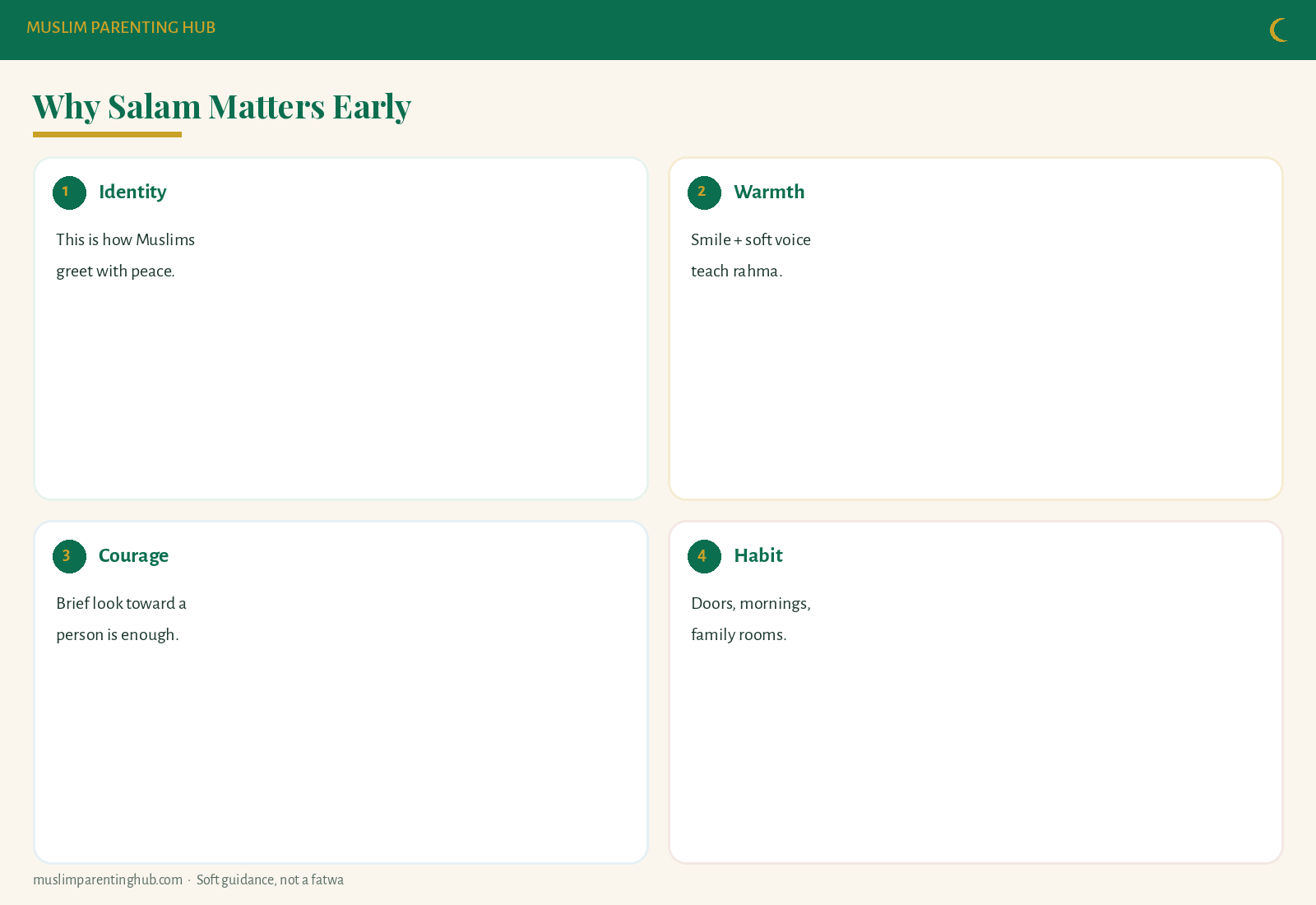
The Prophet ﷺ encouraged spreading salam. For toddlers, the goal is not robotic performance. The goals are:
- Identity — “This is how Muslims greet.”
- Warmth — peace, smile, soft voice.
- Social courage — looking toward a person (even briefly).
- Habit — doorways, waking family, entering rooms.
If we scold—“Say it! Say it louder!”—children learn that salam equals pressure. If we model and celebrate attempts, salam becomes belonging.
What “Good Enough” Looks Like by Age
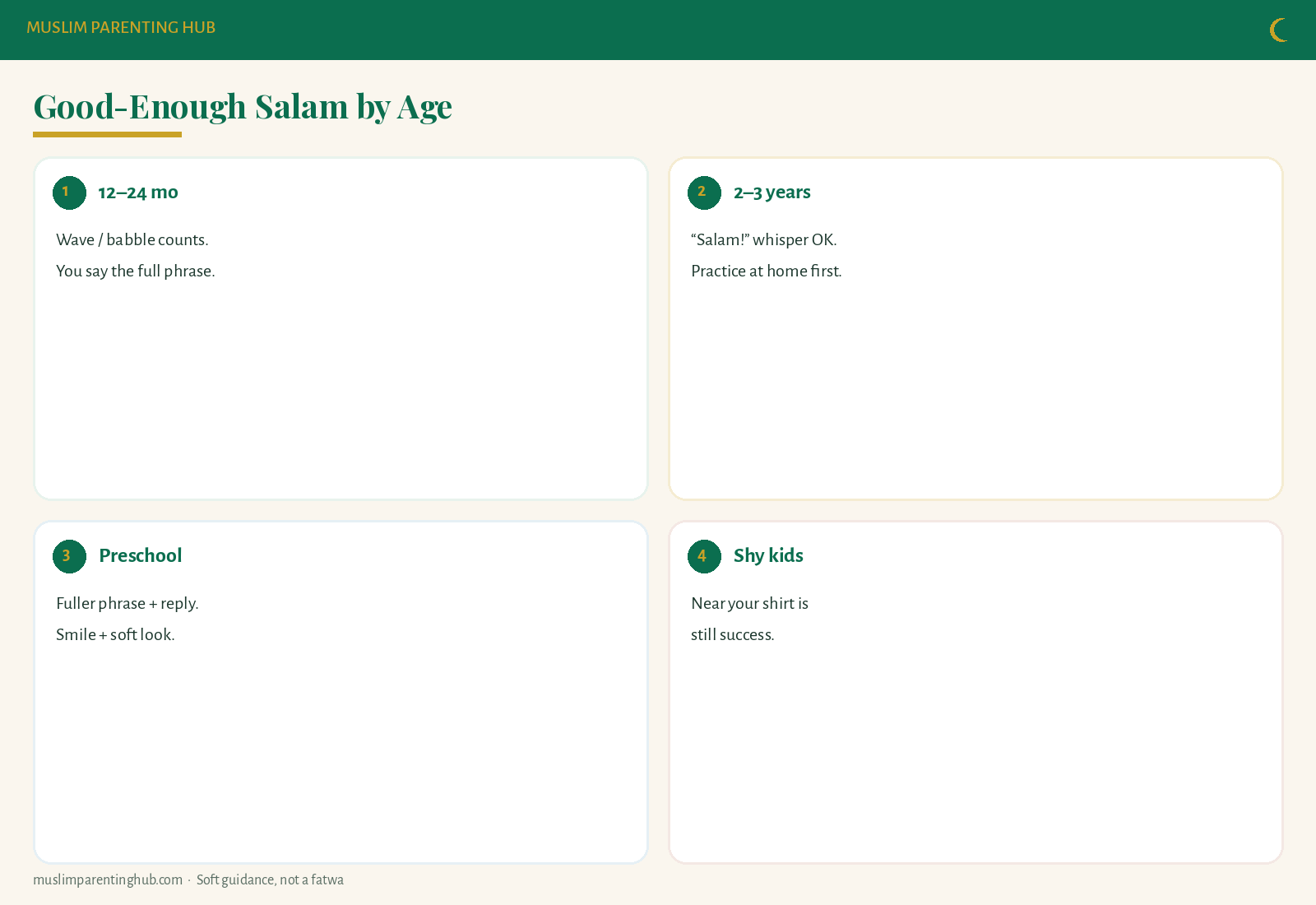
~12–24 months
- Wave, smile, or babble counts.
- You say the full salam; they may echo “salam” or “alaikum.”
- Never force hugs or kisses with the greeting.
~2–3 years
- Short try: “Salam!” or a soft “Assalamu alaikum.”
- Practice at home more than with strangers.
- Allow whisper salams—volume comes later.
Preschool (~3–5)
- Fuller phrase with help.
- Add smile + looking toward the person.
- Teach reply: “Wa alaikum assalam.”
Match expectation to temperament. A shy child who whispers near your shirt is succeeding.
The Core Method: Model → Invite → Celebrate
- Model — You greet first, every time, with a real smile.
- Invite — One soft prompt: “Want to give salam too?”
- Celebrate — “MashaAllah—your salam brought peace.”
Skip drills that feel like quizzes in front of guests. Practice in private; perform less in public.
This mirrors the same gentle skill-building you use for dua—see Teach Kids Dua From the Heart.
A 7-Day Salam Practice Plan
Keep each day under five minutes. Consistency beats intensity.
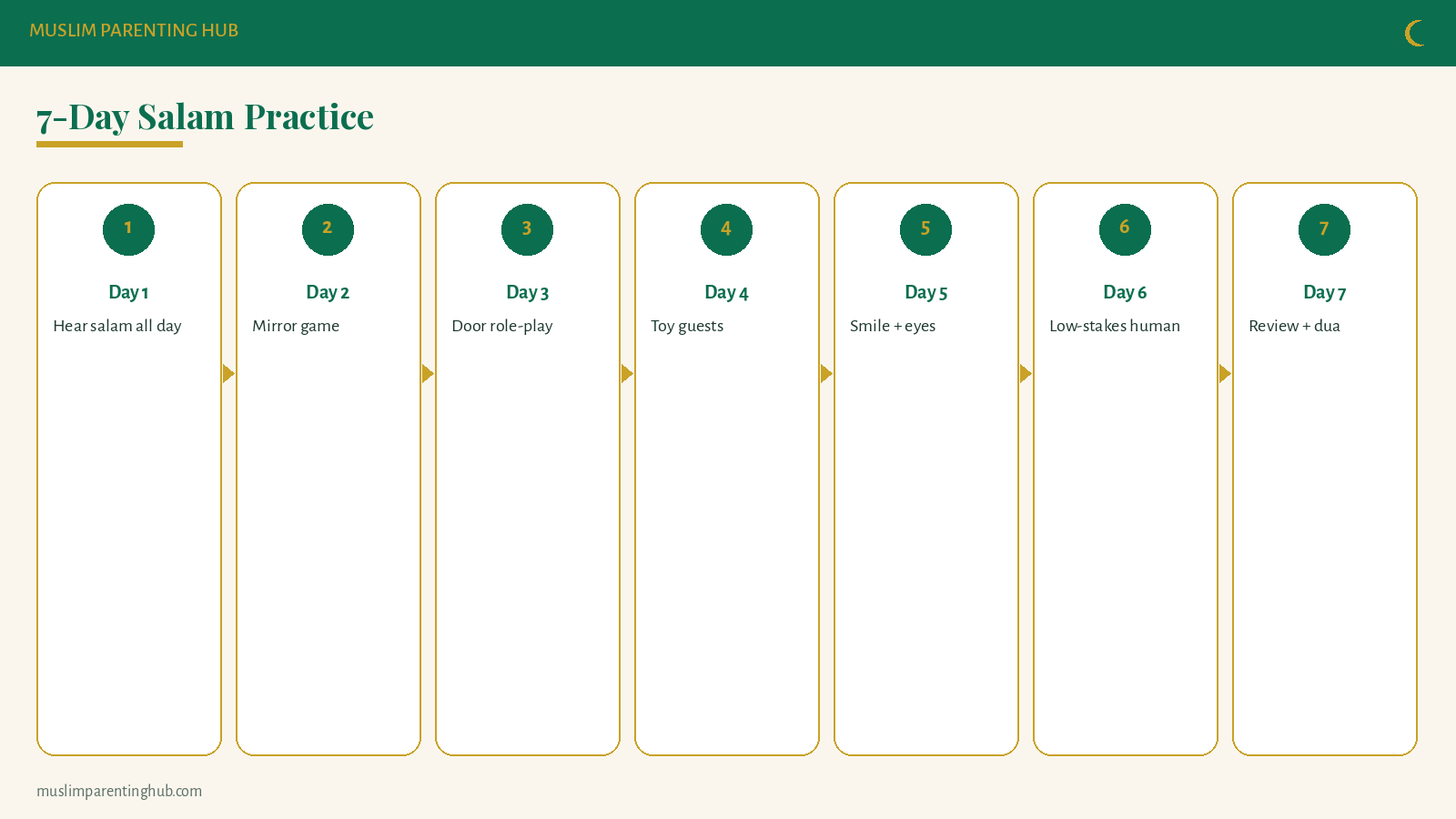
Day 1 — Hear it everywhere
You and your spouse greet each other with salam at breakfast, after work, and at bedtime. Narrate: “Mama said salam to Baba—peace.” Toddler listens. No demand yet.
Day 2 — Mirror game
Sit face to face. You say Assalamu alaikum with a smile. They copy any sound. Clap softly. Switch: they “say” something; you reply Wa alaikum assalam.
Day 3 — Doorway role-play
Use a doorway at home. Knock. Open. You play guest; they play host (or reverse). Prompt once. If they freeze, you model and let them wave.
Day 4 — Stuffed-animal guests
Line up three toys. Child gives salam to each. Silly voices allowed. Joy wires memory.
Day 5 — Smile + eyes
Add: “Salam with a soft look.” Practice glancing at your eyes/forehead for one second—then they can look away. Never pry a chin up harshly.
Day 6 — Real low-stakes human
Try with a familiar person (sibling, uncle on video call). Preview: “When we see Auntie, we can say salam—whisper is okay.” Afterward, praise effort privately.
Day 7 — Review & celebrate
Replay the favorite game. Add a sticker on a “Salam week” card. End with dua: “Ya Allah, make us people who spread peace. Ameen.”
Repeat the week anytime you move house, start school, or notice regression.
Door Scripts (Copy-Paste Calm)
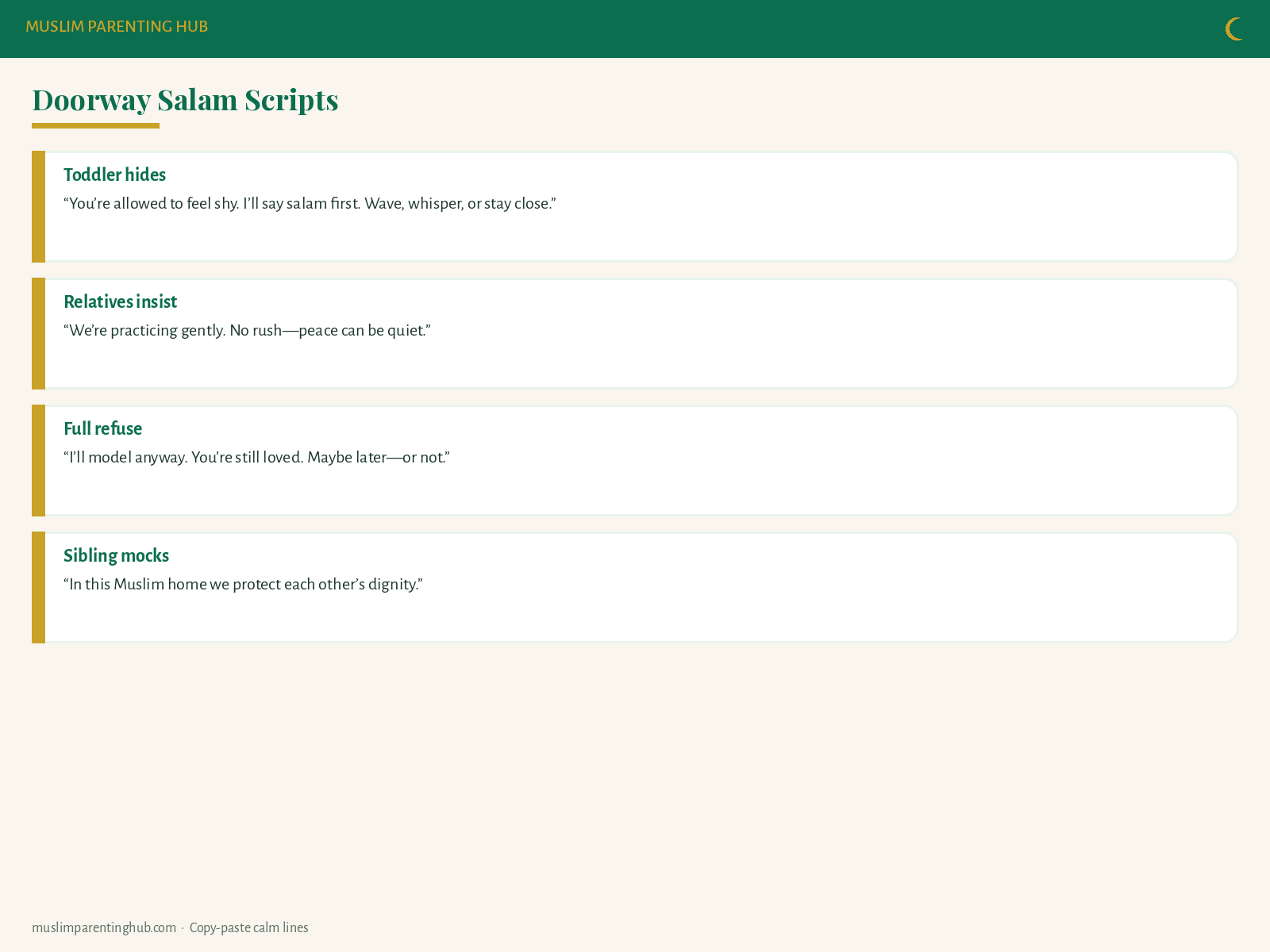
When guests arrive and your toddler hides
“You’re allowed to feel shy. I’ll say salam first. You can wave, whisper, or stay close to me.”
Then you greet warmly so the child sees the skill without shame.
When relatives insist
Smile to the relative: “We’re practicing gently—she’s learning.”
To your child: “No rush. Peace can be quiet.”
When they refuse completely
Do not punish. Model anyway. Offer a later try: “Maybe before dessert we can peek and say salam—or not. You’re still loved.”
When they shout a silly fake greeting
Redirect kindly: “Fun voice for toys. For people, we use our soft salam voice—like this.” Whisper-model once.
Sibling coaching
If an older sibling mocks the toddler’s attempt, intervene: “In this Muslim home we protect each other’s dignity.” Sibling jealousy can spill into manners—pair with fairness tools from Sibling Jealousy in a Muslim Home.
Smile, Eye Contact, and Body Consent
Islamic manners include warmth—but not forced physical contact.
- Teach smile as part of salam when possible.
- Eye contact: encourage brief orientation, not a stare-down.
- Hands: waving is a valid toddler salam partner.
- Hugs/kisses: ask the child; never use salam as a doorway to forced affection with guests.
Consent is part of adab. Children who feel safe greet more freely over time.
Where to Practice in Real Life
- Leaving for school / daycare — salam to parents at the door.
- Entering the house — family replies together.
- Masjid — whisper salam; don’t demand volume in a sacred space.
- Video calls with grandparents — perfect low-pressure reps.
- After Maghrib family time — greet each other afresh as a sweet ritual inside your Maghrib routine.
Link manners to rhythms kids already know. Salam should feel like breathing in a Muslim home—not a performance for Instagram.
Common Mistakes (Easy to Fix)
| Mistake | Fix |
|---|---|
| Only prompting in front of guests | Practice at home all week first |
| “Say salam or no snack” | Remove food punishment; keep salam warm |
| Correcting pronunciation harshly | Celebrate attempt; model correct phrase once |
| Comparing siblings’ confidence | Praise each child’s style privately |
| Forcing handshakes | Offer wave / smile alternatives |
Extending Beyond Toddlers
When preschoolers are ready:
- Teach the reply clearly.
- Add “and mercy of Allah” gradually if your family uses the fuller greeting.
- Role-play entering a room: knock/permission habits later; salam first when appropriate.
- Connect to kindness: salam is a gift of peace—we also use gentle hands and true words.
For bathroom and taharah manners in the same early years, see Islamic Potty Training—adab grows room by room.
What If My Child Has Social Anxiety or Language Delay?
Follow specialists’ guidance. You can still:
- Use AAC / signs / waves as valid salam.
- Keep prompts choice-based.
- Protect against relatives who shame.
- Celebrate any peaceful greeting behavior.
Allah knows every child’s capacity. Your job is pathway + dignity—not identical timelines.
Pairing Salam with Morning and Night
Habits stick when they hitch a ride on existing routines.
Morning: When your toddler wakes, greet them with salam before requests (“Where’s your shoe?”). Children who receive peace learn to give peace.
Night: A soft salam as you enter their room for bedtime wind-down sets a gentle tone—especially useful if evenings are hard. Pair with the calm chain in When Your Muslim Toddler Fights Bedtime.
Friday: Make “Jummah Mubarak + salam” a family joke-free ritual—smiles only—inside your Friday glow.
Mini chart idea
Draw three doors on paper: Home, Masjid, Grandma’s video. Each successful try (including waves) gets a sticker. Stop the chart if it becomes pressure; charts should celebrate, not police.
Teaching Salam Without Performing for Adults
Adults sometimes treat children as entertainment. Protect your toddler from becoming a manners show.
- Stand slightly in front as a shield when relatives demand a “cute” redo.
- Change the subject after one attempt.
- Debrief in private: “You did your best. I’m proud of your quiet salam.”
Remember: the sunnah spirit of salam is spreading peace—not extracting compliance for an audience.
Multilingual Homes
If your home mixes Arabic, English, Urdu, or another language, pick one consistent salam phrase for practice week so the toddler’s motor-mouth can succeed. You can still explain meanings in the home language: “It means we pray peace on you.” Later, add variety. Clarity beats switching phrases every hour.
Neighbors who are not Muslim may smile curiously. A simple parent line—“It’s our greeting of peace”—teaches dawah adab without putting the toddler on a stage.
FAQ: Teaching Toddlers Salam
How do I teach my toddler to say Assalamu alaikum?
Model it daily, invite once without pressure, and celebrate any attempt. Use short home games—mirror, doorway, stuffed animals—before expecting public greetings. Whisper counts.
What is a simple 7-day plan to practice salam?
Day 1 hear it; Day 2 mirror; Day 3 doorway; Day 4 toys; Day 5 smile/eyes; Day 6 low-stakes human; Day 7 review and dua. Keep sessions under five minutes and repeat as needed.
Should I force my shy toddler to greet guests?
No. You greet first. Offer wave, whisper, or closeness as options. Forcing creates fear around people and around Islamic manners. Safety grows courage.
At what age should kids say the full salam?
Many toddlers start with fragments around two; fuller phrases often grow in the preschool years. Temperament and language matter more than a strict age. Keep modeling the complete greeting yourself.
How do I teach the reply “Wa alaikum assalam”?
Play switch games: sometimes they greet, you reply; sometimes you greet, they reply. Sing-song repetition at home works better than correcting them mid-guest-panic.
Can salam practice include videos?
A little modeling video can help, but live practice matters more. If you use kids’ media, keep it calm and approved—see YouTube Kids for Muslim Parents. Avoid content that mocks accents or shames shy kids.
What if grandparents get upset when my child doesn’t salam?
Kindly explain you’re building the habit gently. Ask them to greet with warmth and wait. Privately reassure your child they are not in trouble for shyness.
Closing: Peace, One Soft Hello at a Time
Salam is one of the first ways a toddler tastes the ummah’s warmth. You do not need a perfect greeter by Day 7. You need a home where peace is spoken often, invitations are soft, and attempts are honored.
May Allah make your children keys of peace wherever they enter, and make your coaching full of rahma. Ameen.
FAQs
How do I teach my toddler to say Assalamu alaikum?
Model daily, invite once without pressure, and celebrate any attempt. Practice at home with mirror and doorway games before expecting public greetings. Whisper counts.
What is a simple 7-day plan to practice salam?
Hear it, mirror, doorway, toys, smile/eyes, low-stakes human, then review and dua. Keep sessions under five minutes.
Should I force my shy toddler to greet guests?
No. You greet first and offer wave, whisper, or closeness. Forcing creates fear around people and Islamic manners.
At what age should kids say the full salam?
Many toddlers start with fragments around two; fuller phrases often grow in preschool years. Temperament matters more than a strict age.
How do I teach the reply Wa alaikum assalam?
Play switch games at home so sometimes they greet and you reply, and sometimes you greet and they reply.
What if grandparents get upset when my child doesn’t salam?
Explain you’re building the habit gently. Ask them to greet with warmth and wait. Reassure your child privately that shyness is not trouble.