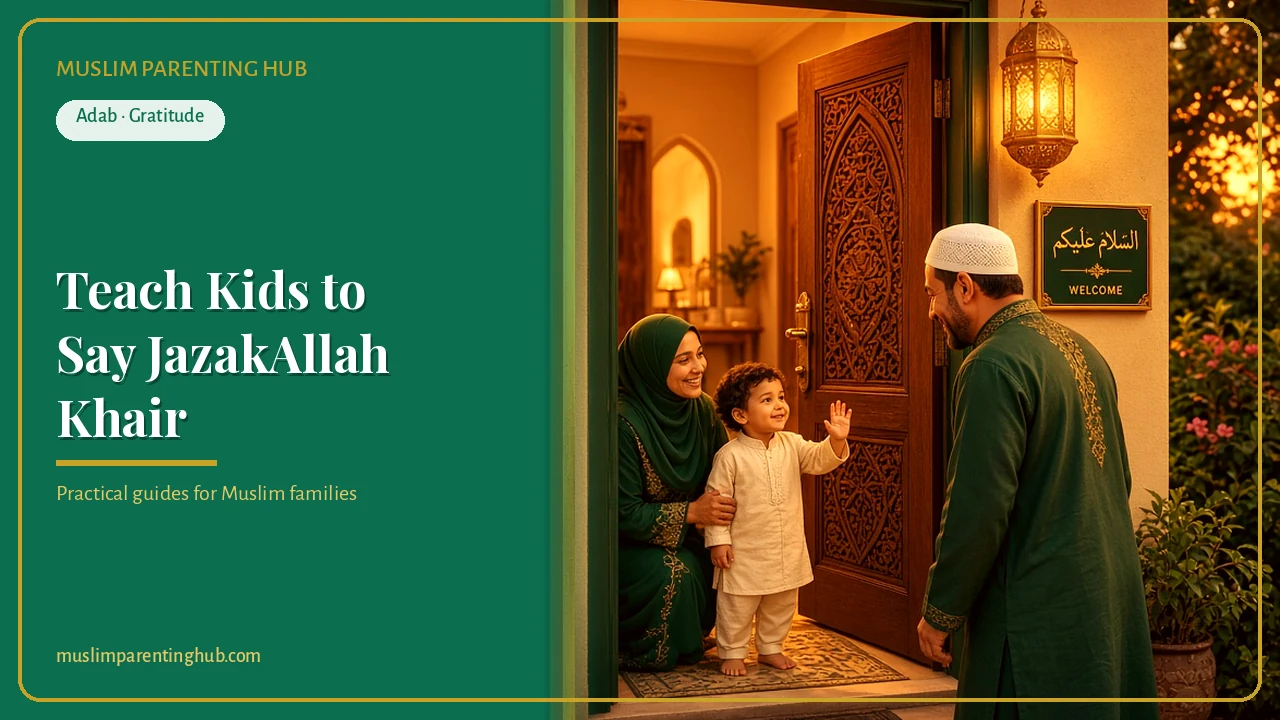
Teach Kids to Say JazakAllahu Khayran: Thank-You Manners for Muslim Kids at Home, School and the Masjid
Your aunt hands your six-year-old a gift at a family dinner. Everyone waits. Your child grabs the box, rips the paper, and runs off to show his cousins. You hear yourself say the line every parent knows by heart: “What do we say?”
He shouts “Thank you!” from across the room without looking back.
Thank-you manners are one of the first things we try to teach and one of the last things kids do on their own. For Muslim families, there’s an extra layer: a short, beautiful phrase, JazakAllahu khayran, that turns a thank-you into a dua for the other person.
This guide explains what JazakAllah khair means, the correct forms and replies, when to use it and when a plain English “thank you” is the better choice, scripts for real American moments (school, the bus, sports, the masjid), and a gentle 7-day plan to build the habit.
If your little one is still learning greetings, our playful 7-day plan to teach toddlers to say salam is a natural first step. Salam and JazakAllah khair are the two phrases that open and close almost every kind interaction.
Why Saying Thank You Matters in Islam
Thanking people is part of thanking Allah. The Prophet ﷺ said, “Whoever does not thank people has not thanked Allah” (Abu Dawud 4811, Tirmidhi 1954).
Kid version: “When we say thank you to people, Allah loves it, because we’re noticing the good He sent through them.”
JazakAllah khair is the best thank-you. The Prophet ﷺ said that whoever has a favor done for them and says to the person, “Jazaka Allahu khayran,” has done the utmost in praising them (Tirmidhi 2035).
Repay kindness, even with a dua. The Prophet ﷺ taught that if someone does you a favor, you should repay it, and if you can’t find anything to repay it with, make dua for them until you feel you’ve repaid them (Abu Dawud 1672, an-Nasa’i 2567). That’s exactly what JazakAllah khair is: a dua that repays a kindness.
What Does JazakAllah Khair Mean?
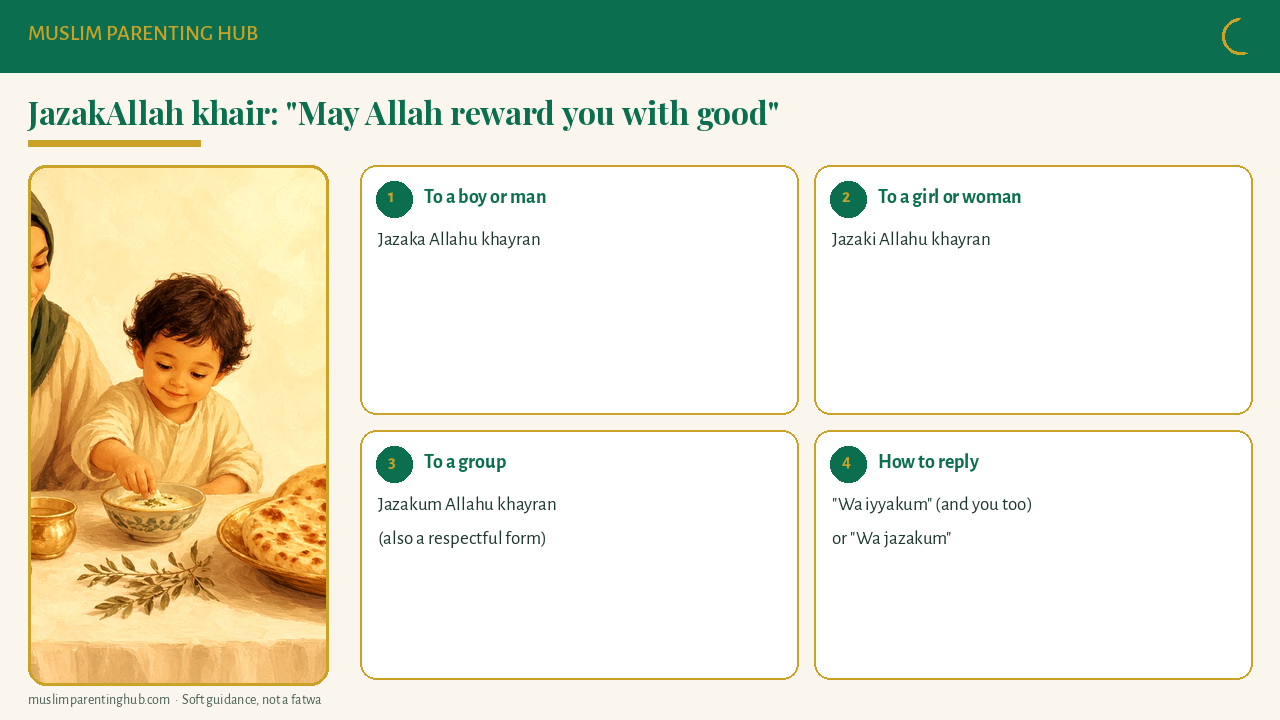
JazakAllahu khayran (جَزَاكَ اللهُ خَيْرًا) means “May Allah reward you with good.”
Kid version: “Thank you, and I’m asking Allah to give you something good back.”
That’s the magic of it. A regular thank-you says “I noticed.” JazakAllah khair says “I noticed, and I’m asking Allah to reward you, because I can’t reward you enough myself.”
The correct forms
In Arabic, the ending changes depending on who you’re talking to. You don’t have to be strict about this with little ones, but older kids enjoy learning it:
| Talking to… | Say | Sounds like |
|---|---|---|
| A boy or man | Jazaka Allahu khayran | ja-ZA-ka-llah-hu KHAY-ran |
| A girl or woman | Jazaki Allahu khayran | ja-ZA-ki-llah-hu KHAY-ran |
| A group (or to be extra respectful) | Jazakum Allahu khayran | ja-ZA-kum-ul-lah-hu KHAY-ran |
Most people shorten it to “JazakAllah khair.” That’s fine, especially for kids.
How to reply
When someone says JazakAllah khair to your child, teach a simple reply:
- “Wa iyyakum” (“And you too”). Simple and common.
- “Wa jazakum” (“And may He reward you too”).
- “BarakAllahu feek” (“May Allah bless you”).
For kids ages 3–6, “Wa iyyakum” is enough. It’s short, and it completes the exchange.
Thank You or JazakAllah Khair? When to Use Each
Both are good adab. The key is choosing the one the other person will understand.
Use JazakAllah khair with: - Family members (parents, siblings, grandparents, aunts and uncles). - Friends and teachers at the masjid or weekend Islamic school. - Muslim neighbors, family friends and community members.
Use a clear “thank you” with: - Teachers and staff at public school. - The bus driver, crossing guard, cafeteria staff and coach. - Store cashiers, restaurant servers and doctors.
A child who says a warm, clear “Thank you, Mr. Davis” while making eye contact is showing beautiful Islamic manners. The adab is in the gratitude, not only in the language. Your child can always add a quiet dua in their heart for the person.
Many families also teach kids to say both with Muslim relatives: “Thank you, Nano! JazakAllah khair!” That’s sweet and natural.
Scripts for Real Moments
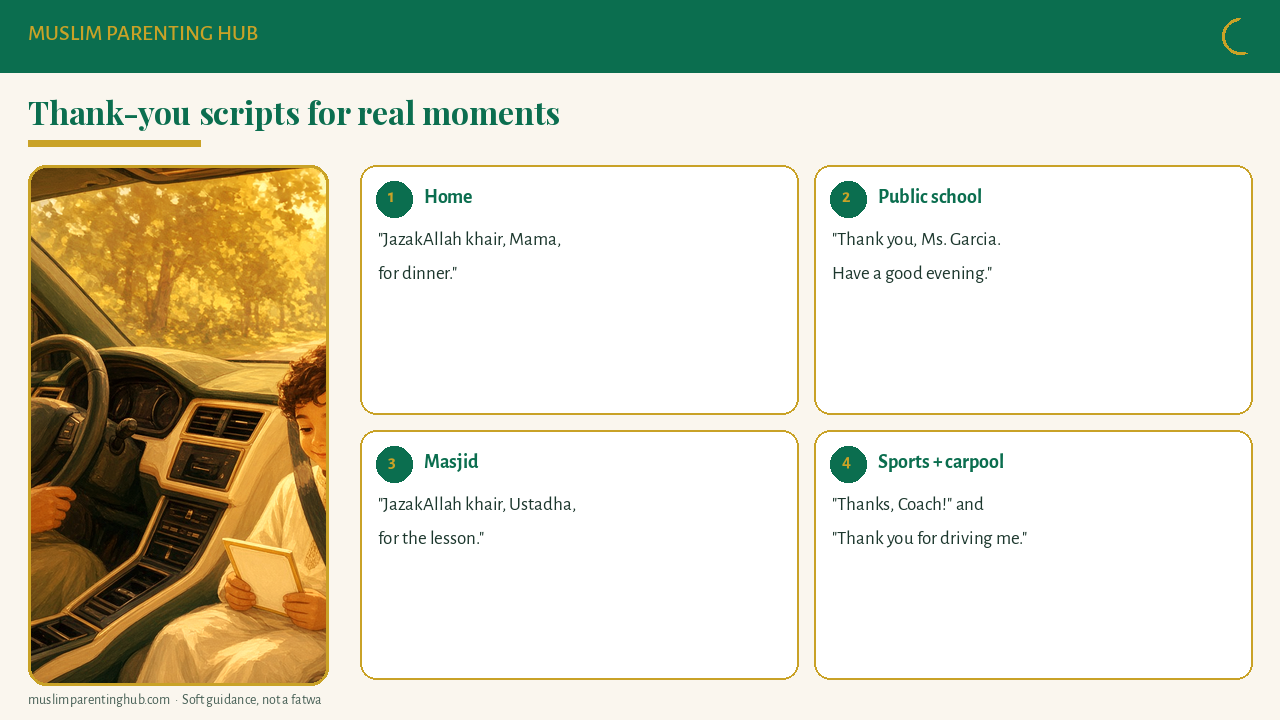
Kids learn faster with specific words for specific places. Here are lines you can practice.
At home
- When a parent serves dinner: “JazakAllah khair, Mama.”
- When a sibling shares: “JazakAllah khair for the Lego piece.”
- When Dad fixes a bike: “Thank you, Baba! JazakAllah khair!”
At school
- To the teacher at pickup: “Thank you, Ms. Garcia. Have a good evening.”
- To the bus driver: “Thank you!” while stepping off.
- To cafeteria staff: “Thank you” when they hand over the tray.
- To a classmate who helped: “Thanks for helping me find my pencil.”
At the masjid
- To the weekend school teacher: “JazakAllah khair, Ustadha.”
- To the uncle handing out dates after Jumu’ah: “JazakAllah khair!”
- To the imam after a class: “JazakAllah khair for the lesson.”
At sports and activities
- To the coach after practice: “Thanks, Coach!”
- To the other team after a game: “Good game, thanks for playing.”
- To the carpool parent: “Thank you for driving me, Auntie Sara.”
With gifts
- In the moment: look at the person, smile, say “Thank you” or “JazakAllah khair,” then open or play.
- Even if they don’t love the gift: “Thank you for thinking of me.” (We teach honesty, so we don’t say “I love it!” if they don’t. We thank the person for the kindness.)
A 7-Day Plan to Build Thank-You Manners
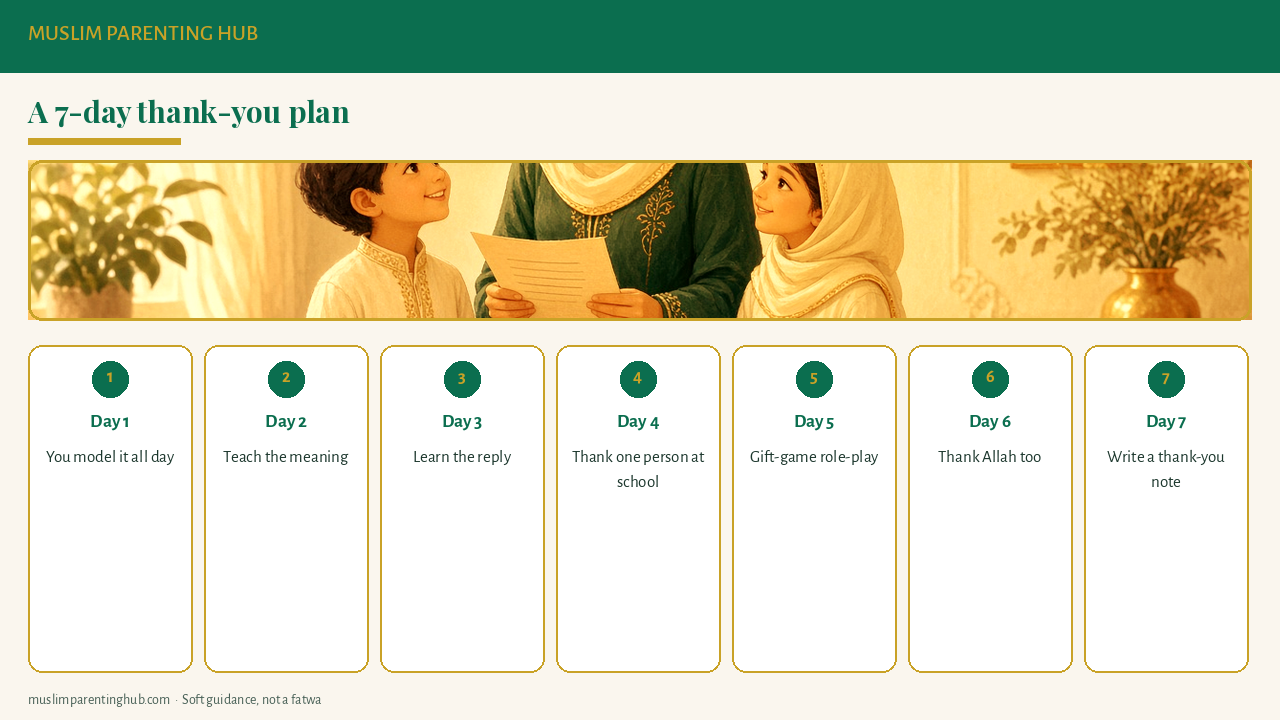
Day 1 — Model only
You say “JazakAllah khair” to your child and your spouse all day: for passing the salt, bringing their shoes, closing the door. Don’t ask your child to say anything yet.
Day 2 — Teach the meaning
At dinner, explain: “JazakAllah khair means ‘May Allah reward you with good.’ It’s a thank-you and a dua at the same time.” Ask your child to say it once to someone at the table.
Day 3 — The reply
Teach “Wa iyyakum.” Practice back and forth: you say JazakAllah khair, they reply, then switch.
Day 4 — Outside the home
On the way to school, pick one person they’ll thank today (teacher, bus driver, crossing guard). At pickup, ask, “Who did you thank today?”
Day 5 — Thank-you role-play
Play “gift game”: wrap a random item (a spoon, a sock) and take turns giving and receiving it. The receiver practices the full thank-you: eye contact, smile, words. Kids find it hilarious.
Day 6 — Thank Allah, too
Connect thanking people to thanking Allah: “Who gave Baba the strength to fix your bike? Allah. So we say JazakAllah khair to Baba and Alhamdulillah to Allah.” Our 14-day shukr plan for kids builds on this beautifully.
Day 7 — A thank-you note
Help your child write or draw a thank-you card for someone who helped them this week: a teacher, grandparent or coach. Deliver it together.
After the 7 days, keep modeling it daily. Expect to keep reminding for months. That’s normal.
Prompting Without Shaming
“What do we say?” in front of guests can make a child freeze, especially a shy one. Some gentler options:
- Pre-teach. Before you walk into Grandma’s house: “When Grandma gives you something, remember to say JazakAllah khair.”
- Model it for them. “JazakAllah khair, Grandma, Yusuf loves cars.” Often the child echoes you.
- A secret signal. Agree on a small sign, like touching your ear, that means “Don’t forget to say thank you.”
- Follow up in private. Later, alone: “I noticed you forgot to thank Auntie. Let’s call her and say it now.”
If your child is shy and struggles with any spoken manners, the same gentle approach in our guide to helping shy kids return the salam works for thank-yous, too. A whispered thank-you or a wave still counts.
Thank-You Notes: A Lost Habit Worth Bringing Back
Handwritten thank-you notes are especially meaningful in an age of quick texts. Good times to write them:
- After birthday parties and Eid gifts.
- At the end of a sports season, for the coach.
- After Thanksgiving dinner at a relative’s house.
- For a teacher at the end of a semester.
- For a neighbor who helped with something.
By age: - Ages 3–5: They draw a picture; you write “Thank you” and they sign their name (or a scribble). - Ages 6–8: “Dear , thank you for . I liked it because . From .” A simple template. - Ages 9+: A few sentences in their own words, with a “JazakAllah khair” for Muslim recipients.
Hosting and Being a Guest
Thank-you manners shine brightest when your family hosts or visits. When guests leave your home, kids can walk them to the door and say, “JazakAllah khair for coming.” When your family visits someone, kids thank the host before leaving: “Thank you for having us, the food was delicious.”
Our guide to guest manners for Muslim kids covers the full set of hosting and visiting adab, from greeting at the door to helping clean up.
Making Gratitude a Family Habit
Thank-you manners aren’t just a skill. They’re part of a bigger character trait: noticing the good in people and in life. They sit right alongside salam, Bismillah, and kindness in a child’s daily adab. If you’re looking for a full picture, our daily adab checklist for Islamic manners for kids shows how thank-you manners fit with everything else.
A few habits that help:
- Thank your kids. “JazakAllah khair for putting your plate away.” Kids who are thanked learn to thank.
- Thank your spouse in front of the kids. It shows that thanking isn’t only for kids or strangers.
- Notice helpers out loud. “Let’s say thank you to the sanitation workers when they come by.”
- Keep it warm, not robotic. A sincere “thanks” with a smile is better than a mumbled “JazakAllah khair” said because a parent is staring.
FAQ
What does JazakAllah khair mean for kids?
JazakAllah khair means “May Allah reward you with good.” For kids, you can explain it as “a thank-you and a dua at the same time”: you’re thanking the person and asking Allah to give them something good back.
How do you reply to JazakAllah khair?
The most common replies are “Wa iyyakum” (“And you too”) and “Wa jazakum” (“And may He reward you too”). Some people say “BarakAllahu feek” (“May Allah bless you”). For young kids, “Wa iyyakum” is simple and easy to remember.
Should my child say JazakAllah khair to non-Muslim teachers?
At a US public school, a clear and warm “thank you” is usually the best choice, because the teacher will understand it. Good manners are about sincere gratitude. Your child can use JazakAllah khair with family, Muslim friends and at the masjid.
What is the difference between jazaka, jazaki and jazakum?
They are Arabic forms for different listeners: “jazaka” is for a male, “jazaki” for a female, and “jazakum” for a group or as a respectful form. Many people shorten all of them to “JazakAllah khair,” which is fine for kids.
At what age should kids start saying thank you?
Toddlers can start by waving or saying “ta” or “thank you” around 18 months to 2 years, mostly by copying parents. By ages 3–5 they can learn JazakAllah khair, and by 6–8 most can thank people without reminders some of the time.
How do I stop asking “What do we say?” all the time?
Pre-teach before visits, model the words yourself, use a quiet signal, and follow up privately instead of correcting in public. Thank your child often, because children who are regularly thanked learn to thank others.
Related guides
- How to teach toddlers to say salam: a 7-day plan
- Islamic manners for kids: a daily adab checklist
- Guest manners for Muslim kids
- How to teach shukr to kids: a 14-day plan
Soft guidance, not a fatwa. For detailed fiqh questions, please ask a trusted local scholar or your masjid’s imam.
Related articles
Islamic Manners for Kids: A Daily Adab Checklist for Home, School and the Masjid (Ages 3–10)
A printable-style Islamic manners checklist for kids: 30 everyday adab habits for home, school, and the masjid, with age guides, scripts, and a weekly focus plan.
Read guide →
How to Teach Toddlers to Say Salam: A Playful 7-Day Plan
Teach your toddler to say Assalamu alaikum in 7 playful days: mirror games, doorway role-play, shy-child scripts and age tips. Start today, no forcing.
Read guide →
Guest Manners for Muslim Kids: Hosting at Home with Islamic Adab
Teach Muslim kids guest manners for hosting at home—shoes, greetings, serving, privacy, and soft scripts. Islamic adab parents can practice tonight.
Read guide →
How to Teach Shukr to Kids: A 14-Day Muslim Family Gratitude Plan
Teach shukr to Muslim kids with a 14-day family plan—Alhamdulillah habits, dinner and bedtime scripts, gratitude jar, age tips, and edge cases. Soft, practical.
Read guide →