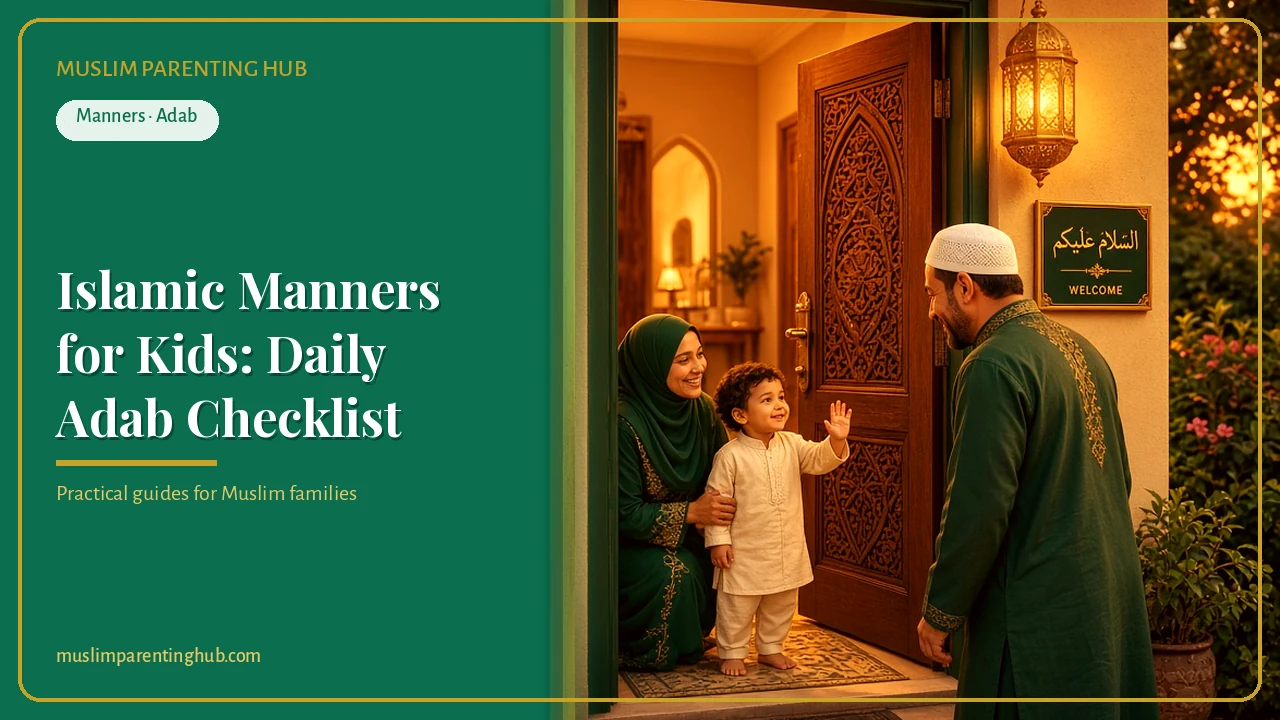
Islamic Manners for Kids: A Daily Adab Checklist for Home, School and the Masjid (Ages 3–10)
“Say salam.” “Use your right hand.” “Did you say Bismillah?” If you feel like a walking reminder app, you’re not alone. Islamic manners—adab—show up in a hundred tiny moments a day, and kids can’t absorb them all at once.
The Prophet ﷺ said, “I was sent to perfect good character” (Ahmad, Bukhari in Al-Adab al-Mufrad). Adab isn’t extra credit in Islam. It’s the visible part of iman, and it’s what your child’s teacher, coach, and neighbors notice first.
This guide pulls the most important Islamic manners for kids into one daily checklist, organized by place—home, table, bathroom, school, and masjid—with simple age expectations and a weekly focus plan so you’re not correcting everything at once. Each item links to a deeper guide if you want to go further.
Soft guidance for homes—not a fatwa.
How to Use This Checklist (Without Becoming the Manners Police)
- Pick one focus per week. The whole list is a map, not a daily test.
- Model first. Kids copy far more than they obey. Say salam to them first.
- Praise specifically. “You used your right hand without me asking—MashaAllah” beats “Good job.”
- Correct privately. A whisper in the ear protects dignity—itself an Islamic manner.
- Connect it to Allah. “We do this because Allah loves good manners,” not “because I said so.”
The heart behind every item is rahma—mercy. If you’ve used our 10 rahma activities to teach kindness, you’ll see the same thread here: manners are mercy you can see.
Home Adab (Daily Basics)
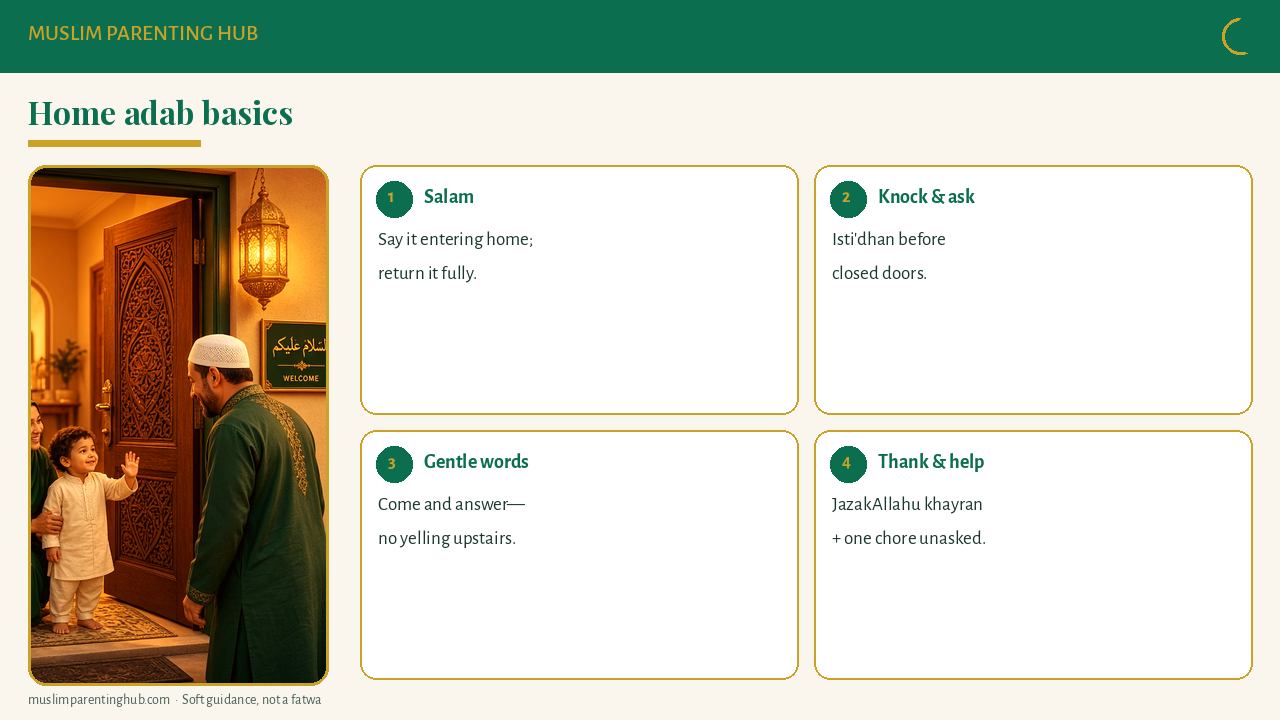
- Say salam when entering the home. “As-salamu ‘alaykum!” even if only family is there.
- Return salam fully. “Wa ‘alaykum as-salam.” Our 7-day plan to teach toddlers to say salam makes it playful for the littlest ones.
- Knock and ask permission before entering a closed room. This is the Islamic adab of isti’dhan.
- Speak gently to parents. No yelling “WHAT?” from upstairs—come and answer.
- Help with one chore without being asked. An age-based chore chart makes this easier to track.
- Say “JazakAllahu khayran” when someone helps you.
- Keep promises, even small ones like “I’ll put my shoes away.”
- Say “Alhamdulillah” after sneezing, and reply “Yarhamukallah” to others.
Table Adab (Meals and Snacks)
- Say Bismillah before eating. If you forget, “Bismillahi awwalahu wa akhirahu.”
- Eat and drink with the right hand.
- Eat from what’s in front of you, not across the table.
- Sit to drink when possible.
- Don’t criticize food. If you don’t like it, quietly leave it—the Prophet ﷺ never criticized food.
- Say Alhamdulillah after eating.
For toddlers, start small with our 7-day Bismillah and right-hand table plan.
Bathroom and Cleanliness Adab
- Enter with the left foot and say the bathroom dua: “Allahumma inni a’udhu bika minal khubuthi wal khaba’ith.”
- Exit with the right foot and say “Ghufranak.”
- Clean with water (istinja) and wash hands well.
- Keep the bathroom clean for the next person.
Younger kids still learning these can follow our Islamic potty training plan with toilet duas. School-age kids can use the same duas quietly in public restrooms.
School Adab (Public School, Bus, and Recess)
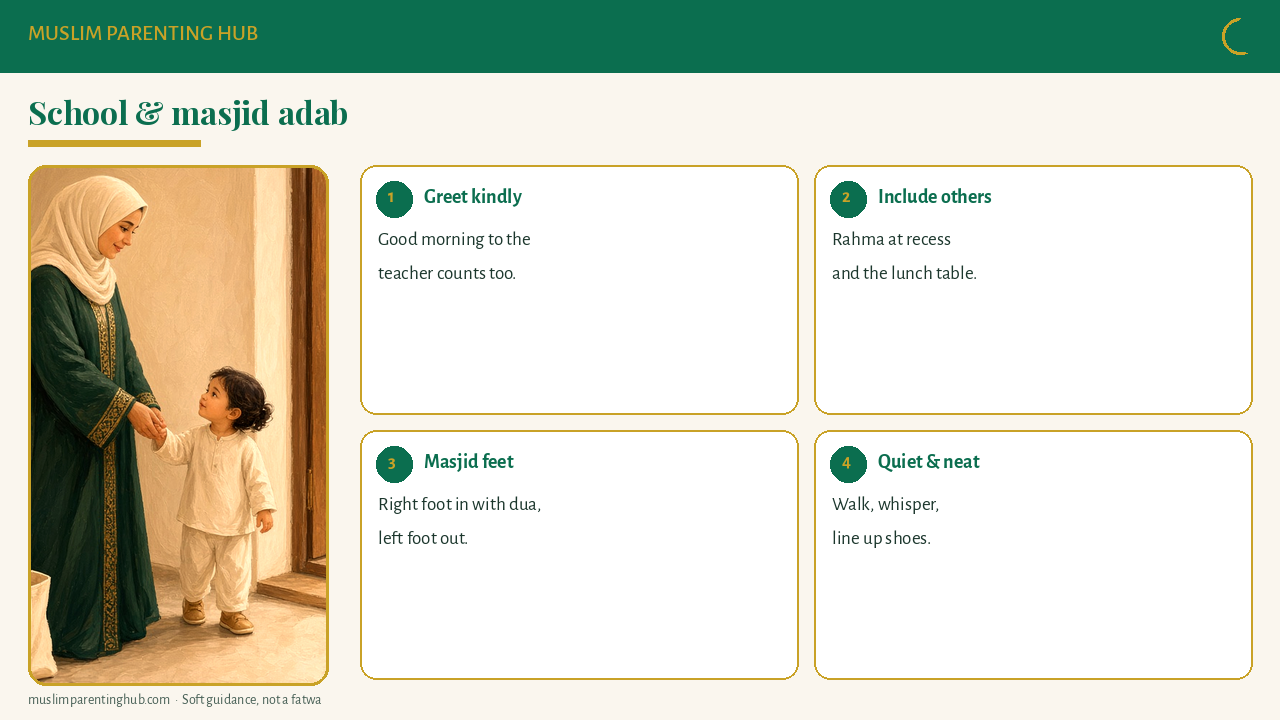
- Greet your teacher kindly. “Good morning, Ms. Johnson” is adab too. Salam is for Muslims; kind greetings are for everyone.
- Listen when others speak. Don’t interrupt in class or at the lunch table.
- Include someone who is alone. A small act of rahma at recess counts for a lot.
- Tell the truth, even about a mistake or a forgotten homework.
- Respect other people’s things. Ask before borrowing a pencil or a Chromebook charger.
- Answer questions about Islam kindly. Your child will be asked “Why do you…?” Our guide to kind answers when classmates ask about Islam gives short scripts.
Masjid Adab
- Enter with the right foot and say “Allahumma iftah li abwaba rahmatik.”
- Walk, don’t run, and use an inside voice.
- Don’t walk in front of someone praying.
- Line up shoes neatly on the rack.
- Greet elders first and offer them a seat.
- Leave with the left foot saying “Allahumma inni as’aluka min fadlik.”
First masjid visit coming up? Practice entering, shoes, and whisper voices at home a few times first.
Adab Outside the Home (Car, Stores, Neighbors, Guests)
Manners don’t stop at the front door. A lot of your child’s adab is on display at Costco, in the carpool line, and at a neighbor’s barbecue.
- In the car: Say the travel dua, keep voices calm, and thank the driver—even if the driver is Mom every single day.
- At the store: Hands to ourselves, no begging scenes, and “excuse me” when passing someone in the aisle.
- With neighbors: Wave, smile, and return borrowed items quickly. The Prophet ﷺ emphasized kindness to neighbors so strongly that companions thought neighbors might inherit.
- When guests visit: Greet them at the door, offer water or a snack, and give them the best seat.
- When visiting others: Knock, wait, take shoes off if that’s their custom, and never open their fridge or closets.
- At sports and practice: Shake hands after games, cheer teammates, and don’t mock the other team.
Adab With Screens and Devices
Modern kids need modern adab, too.
- Ask before picking up someone else’s phone or tablet.
- Put the device down when a parent or elder is talking to you.
- Don’t film or post other people without permission.
- Speak kindly in game chats—what we type is still our words.
- Pause games for salah when the adhan app goes off.
These map directly onto older manners: respecting others’ property, listening to elders, guarding privacy, and guarding the tongue.
Age Guide: What’s Realistic?
| Age | Focus on | Let go of (for now) |
|---|---|---|
| 3–4 | Salam, Bismillah, right hand, “JazakAllah” | Long duas, perfect table manners |
| 5–6 | Bathroom duas, knocking, sneezing reply, shoes neat | Every masjid rule at once |
| 7–8 | Truthfulness, chores without asking, masjid entering/leaving duas | Perfection at every meal |
| 9–10 | Including others, speaking kindly about Islam, guest manners, respecting elders | Nothing—but keep praise high |
Every child is different. A shy seven-year-old may still whisper salam; that’s progress, not failure. A soft wave plus a whispered “wa ‘alaykum as-salam” still counts.
The Weekly Focus Plan (10 Weeks)
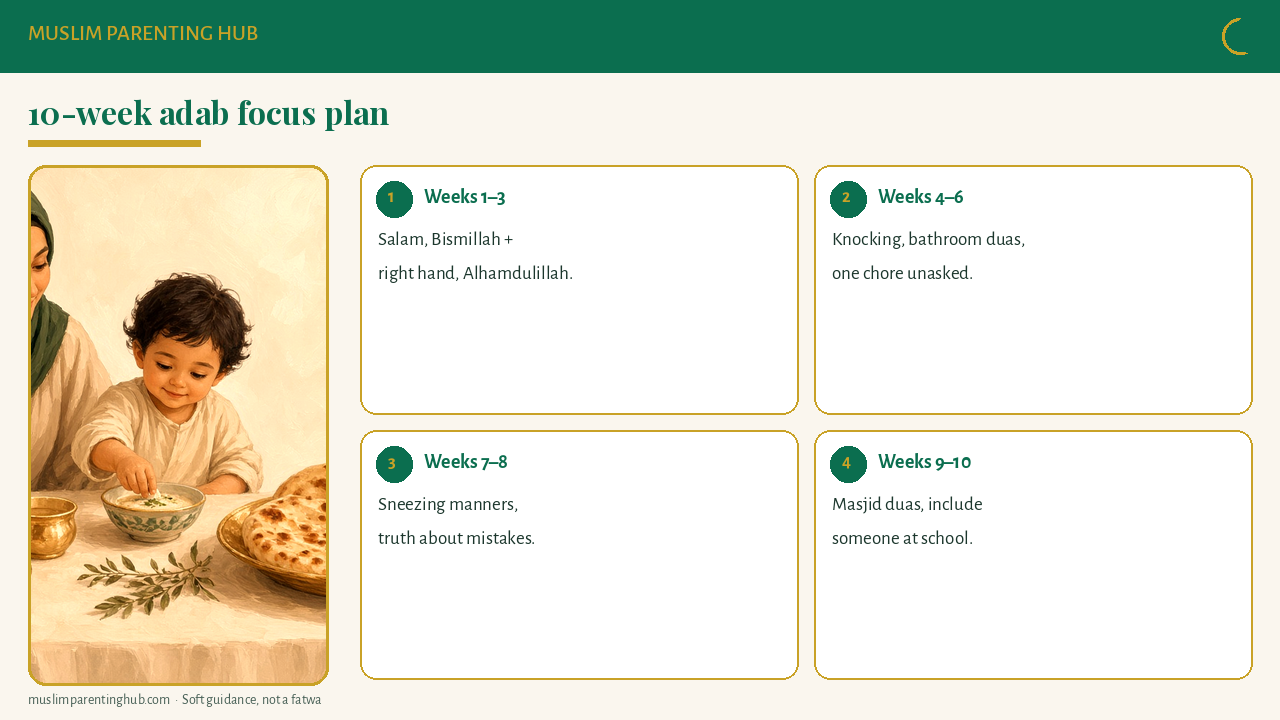
Work through one habit per week. Post it on the fridge, practice it in real moments, and celebrate at the end of the week.
| Week | Focus |
|---|---|
| 1 | Salam entering the home |
| 2 | Bismillah + right hand at meals |
| 3 | Alhamdulillah after eating |
| 4 | Knock and ask permission |
| 5 | Bathroom duas in and out |
| 6 | One chore without being asked |
| 7 | Sneezing manners |
| 8 | Truth-telling (even about mistakes) |
| 9 | Masjid entering/leaving duas |
| 10 | Including someone at school |
After ten weeks, repeat the list. Kids who’ve done it once will often lead the second round.
Scripts That Keep It Gentle
When they forget Bismillah:
“Oops—let’s say Bismillahi awwalahu wa akhirahu together. Allah lets us fix it.”
When they’re rude to a sibling:
“Let’s try that again with rahma. How would you say it if Allah’s Messenger ﷺ were sitting here?”
When they barge into your room:
“Back out, knock, and ask. I love it when you ask—it shows respect.”
When they do it right without reminders:
“I noticed. That was beautiful adab. Allah saw it too.”
Common Questions Parents Ask
“Should I reward manners with stickers?” A short-term sticker chart can help young kids start, but fade it within a few weeks. The goal is love for Allah and good character, not a prize economy.
“My spouse and I have different standards.” Agree on the top five habits together and present a united, gentle front. Small consistency beats big rules.
“My child is the only Muslim kid in class. Does that change anything?” In a way, yes—your child may be the first Muslim their classmates really know. That’s not pressure to be perfect; it’s an opportunity. Kind words, honesty, and including others are manners every family respects, and they quietly show what Islam looks like. Remind your child that Allah sees every small kindness, even when nobody at school knows the reason behind it.
“My child does it at home but not at school.” That’s normal. Practice school moments through role-play: lunch table, bus, hallway. Ask the teacher what they notice.
FAQ
What are the most important Islamic manners for kids?
Start with salam, Bismillah and the right hand at meals, Alhamdulillah after eating, knocking before entering, bathroom duas, telling the truth, and speaking gently to parents. These cover most daily moments.
At what age should I start teaching Islamic manners?
From toddlerhood. Two- and three-year-olds can learn salam, Bismillah, and the right hand through copying. Add bathroom, masjid, and school adab gradually from ages five to ten.
How do I teach adab without nagging?
Pick one habit per week, model it yourself, praise it specifically, and correct privately. A weekly focus keeps reminders short and positive.
Should Muslim kids say salam to non-Muslim classmates?
Teach kids to greet everyone kindly—“Good morning,” “Hi”—and to use salam with Muslims. Kindness to all is part of Islamic manners.
What is the difference between manners and adab?
Adab includes manners but goes deeper: it’s behaving with respect toward Allah, people, and creation because of faith. Good manners are the visible part of adab.
How do I teach manners to a stubborn child?
Keep it calm and consistent, focus on one habit at a time, and connect it to Allah’s love rather than punishment. Notice and praise every small success.
Related guides
- 10 rahma activities to teach Muslim kids kindness
- How to teach toddlers to say salam
- Guest manners for Muslim kids
- Sneezing and yawning manners
Closing: Thirty Small Doors
Thirty habits can feel like a lot. But every one of them is a small door to good character, and your child only needs to walk through one at a time. Pick this week’s focus tonight, say it with a smile, and let Allah put the barakah in the rest.
Related articles
How to Teach Toddlers to Say Salam: A Playful 7-Day Plan
Teach your toddler to say Assalamu alaikum in 7 playful days: mirror games, doorway role-play, shy-child scripts and age tips. Start today, no forcing.
Read guide →
Guest Manners for Muslim Kids: Hosting at Home with Islamic Adab
Teach Muslim kids guest manners for hosting at home—shoes, greetings, serving, privacy, and soft scripts. Islamic adab parents can practice tonight.
Read guide →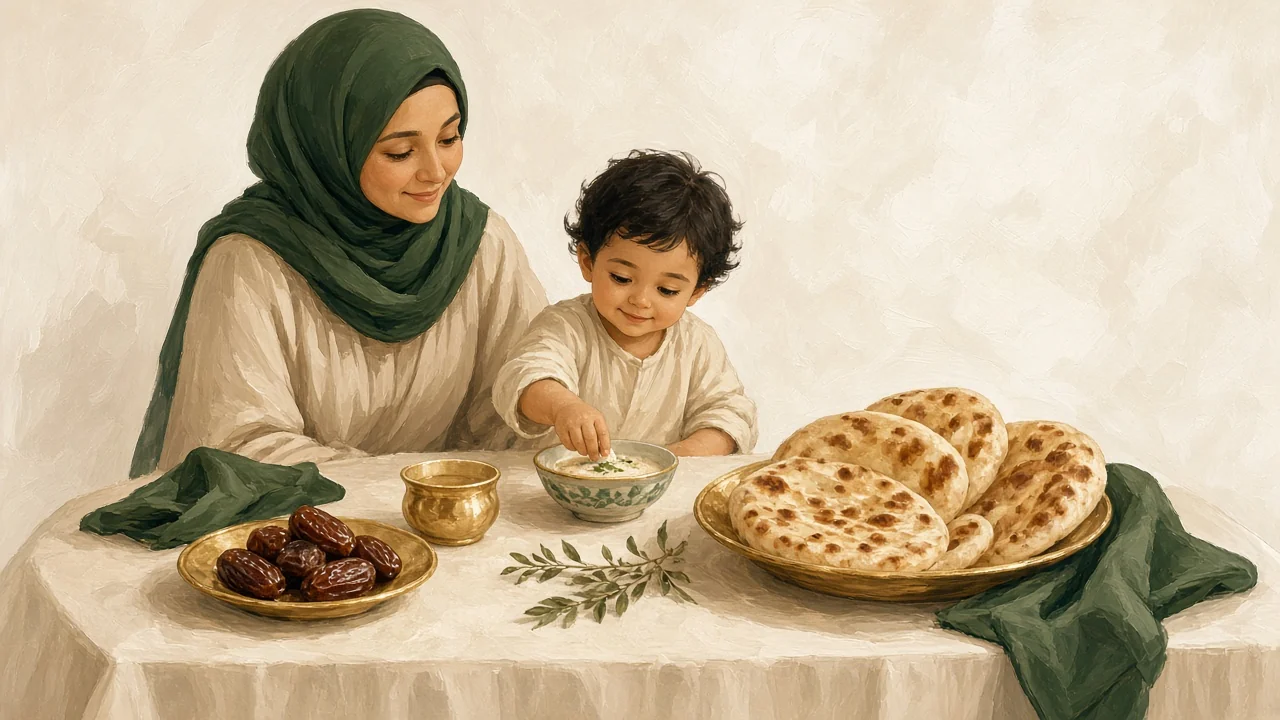
Islamic Table Manners for Toddlers: A 7-Day Bismillah & Right-Hand Plan
Teach Islamic table manners for toddlers with a 7-day Bismillah and right-hand plan—meal scripts, age tips, guest/restaurant edge cases, and a gentle sticker chart.
Read guide →
10 Rahma Activities to Teach Muslim Kids Kindness This Month
Teach Muslim kids rahma with 10 kindness activities—kindness jar, neighbor drops, Prophet ﷺ mercy stories, age charts, and tonight scripts. Soft, practical monthly plan.
Read guide →