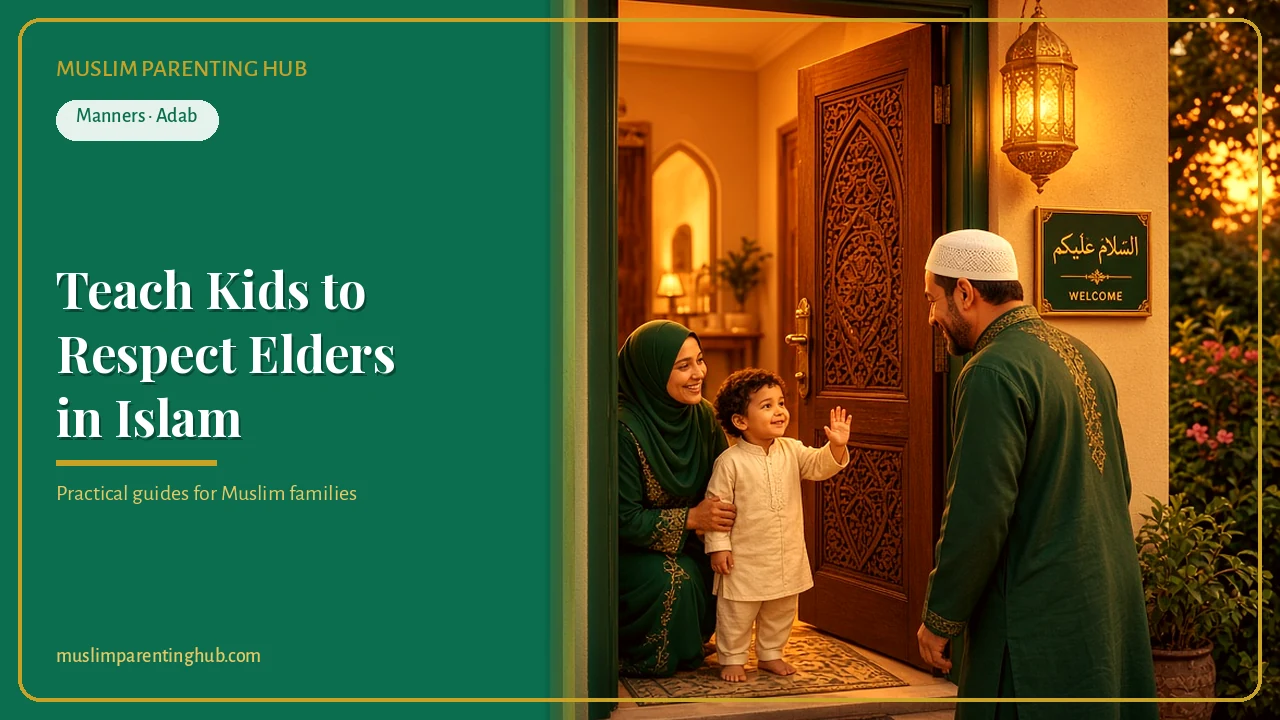
How to Teach Kids to Respect Elders in Islam: Greetings, Words and 10 Daily Habits
Grandpa walks in, and your son keeps his eyes on the tablet. An auntie says salam at the masjid, and your daughter hides behind your legs. A neighbor in his eighties waves from his porch, and nobody waves back.
None of this means your child is rude at heart. Respect for elders is a skill, and like every skill, kids learn it through small, repeated actions that someone shows them.
In Islam, this skill is not optional politeness. The Prophet ﷺ said, “He is not one of us who does not show mercy to our young and respect to our elders” (Tirmidhi, Abu Dawud). Respecting older people is part of what it means to belong to this ummah.
This guide gives US Muslim parents ten simple daily habits, short scripts, and hadith kids can understand, so respect becomes natural at home, at the masjid and with non-Muslim neighbors too. It is gentle home guidance, not a fatwa.
Respect begins with the first word. If your little one is still learning to greet, start with our 7-day plan to teach toddlers salam.
Why Respecting Elders Matters in Islam
Share these three ideas with your child, one at a time:
- It is part of being Muslim. “He is not one of us who does not respect our elders” (Tirmidhi).
- It honors Allah. The Prophet ﷺ said that honoring an older Muslim with gray hair is part of glorifying Allah (Abu Dawud).
- It starts with parents. Allah says, “Do not say to them even ‘uff,’ and do not scold them, but speak to them with honorable words. And lower to them the wing of humility out of mercy” (Quran 17:23–24).
For kids: “Older people have lived a long time, learned a lot and taken care of others. Allah loves it when we treat them gently.”
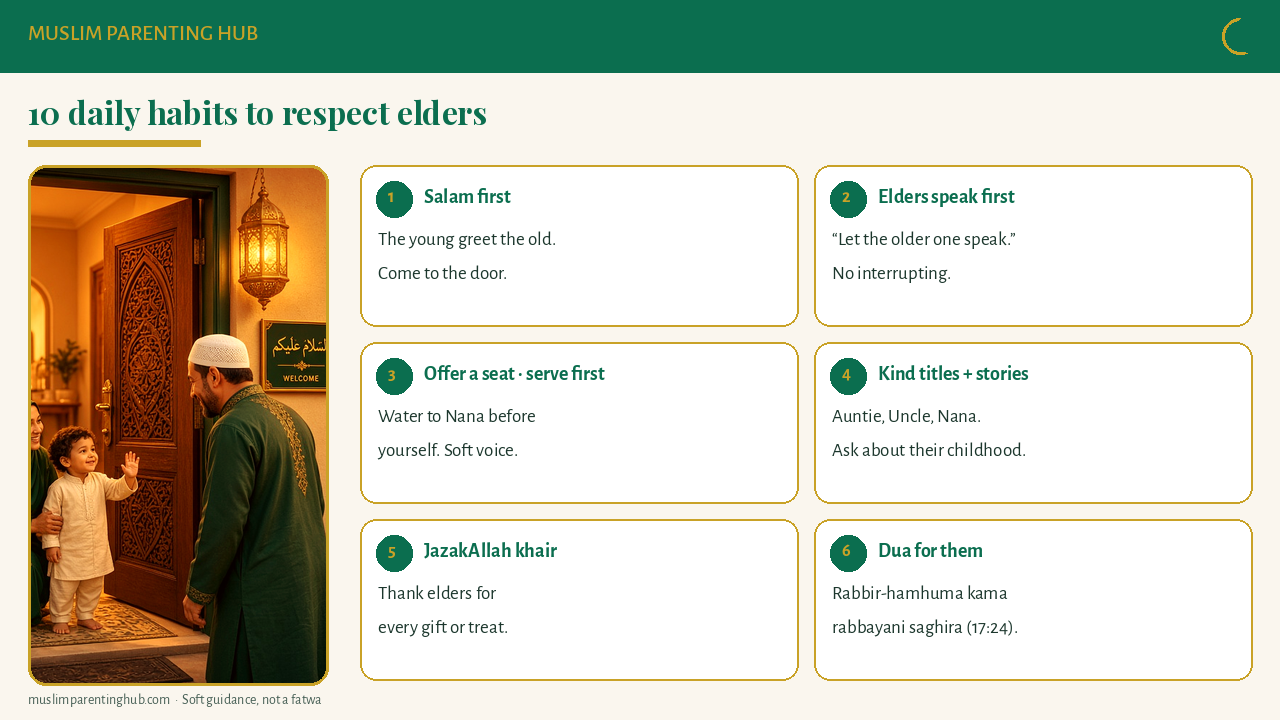
10 Daily Habits That Build Respect
1. Say Salam First
The Prophet ﷺ taught that the younger person greets the older one (Bukhari). Teach your child to be the first to say Assalamu alaikum when an elder walks in. Ready for more? Our guide to the full salam and the best replies shows kids how to greet with wa rahmatullahi wa barakatuh.
Script: “When Nano comes in, who says salam first? You do! That’s a sunnah.”
2. Stand Up and Come Over
When grandparents or guests arrive, kids put down what they are doing and come to the door. Tablets pause. Games wait.
3. Let Elders Speak First
When two young men came to the Prophet ﷺ and the younger began to speak, he said, “Let the older one speak first” (Bukhari, Muslim). At family gatherings, teach kids to wait while an elder is talking and not interrupt.
4. Offer a Seat
“If an older person is standing, offer your seat.” Practice on the couch, at the masjid, and on public transit.
5. Serve Elders First
At dinner, kids bring water or a plate to grandparents before themselves. It’s a small job that makes children feel important.
6. Use Kind Titles
Many Muslim families teach kids to call older adults Auntie, Uncle, Nana, Dada or Mr./Ms. instead of first names. Follow your family and community customs. The goal is warmth and respect in the words.
7. Lower the Voice
“We don’t shout at or over older people.” Practice an “inside voice” with grandparents, especially if they are tired or unwell.
8. Listen to Their Stories
Ask grandparents about their childhood, how they learned to pray, or what life was like in their country. Kids love the stories, and elders love being asked.
9. Say Thank You the Muslim Way
When an elder gives a gift or a treat, kids say JazakAllah khair. Our guide to teaching kids to say JazakAllah khair makes it a habit.
10. Make Dua for Them
Teach the Quran’s dua for parents: Rabbir-hamhuma kama rabbayani saghira, “My Lord, have mercy on them as they raised me when I was small” (Quran 17:24). Kids can add grandparents by name.
Respect at Home, at the Masjid, and in the Neighborhood
At home with grandparents: If grandparents live with you or visit for long stretches, give kids a “grandparent job”: bringing tea, setting their slippers out, or reading them a short surah.
At the masjid: Teach kids to make room in the rows, keep their voice low near older worshippers, and greet the elderly uncles at the door.
With non-Muslim neighbors: Respect for elders is universal. Wave to the older neighbor, help carry groceries, shovel snow in winter. Kids learn that adab is for everyone.
When hosting: Our guide to guest manners for Muslim kids covers greeting, serving and making guests feel welcome at home.
Scripts for Tricky Moments
When your child ignores an elder:
(Quietly) “Grandpa said salam. Let’s go say it back together.” Then praise: “Grandpa smiled so big!”
When your child is shy:
“You can just wave and smile. Next time, maybe a whisper salam.” Never force hugs or kisses. A child can be respectful and keep their body boundaries.
When an elder says something your child disagrees with:
“You can say, ‘I see, Nana,’ and talk to me later. We disagree politely with older people.”
When an elder corrects your child:
“Auntie was helping. Let’s say thank you, and we’ll talk about it at home.” (If something felt wrong or unsafe, your child should always tell you.)
Respect Is Not Blind Obedience
Teach kids that respect means kind words, good manners and patience. It never means doing something wrong or unsafe because an adult said so. The Prophet ﷺ said there is no obedience to anyone in disobedience to Allah (Bukhari, Muslim). Kids should know they can always tell a parent if any adult makes them uncomfortable.
Habits by Age
- Ages 2–4: Wave, salam (even a short one), bring Nana her water.
- Ages 5–7: Salam first, come to the door, offer a seat, JazakAllah khair.
- Ages 8–10: Let elders speak first, serve them at dinner, listen to stories, the dua for parents.
- Ages 11+: Help an elderly neighbor, call grandparents weekly, step in to help at the masjid.
A One-Week Respect Challenge
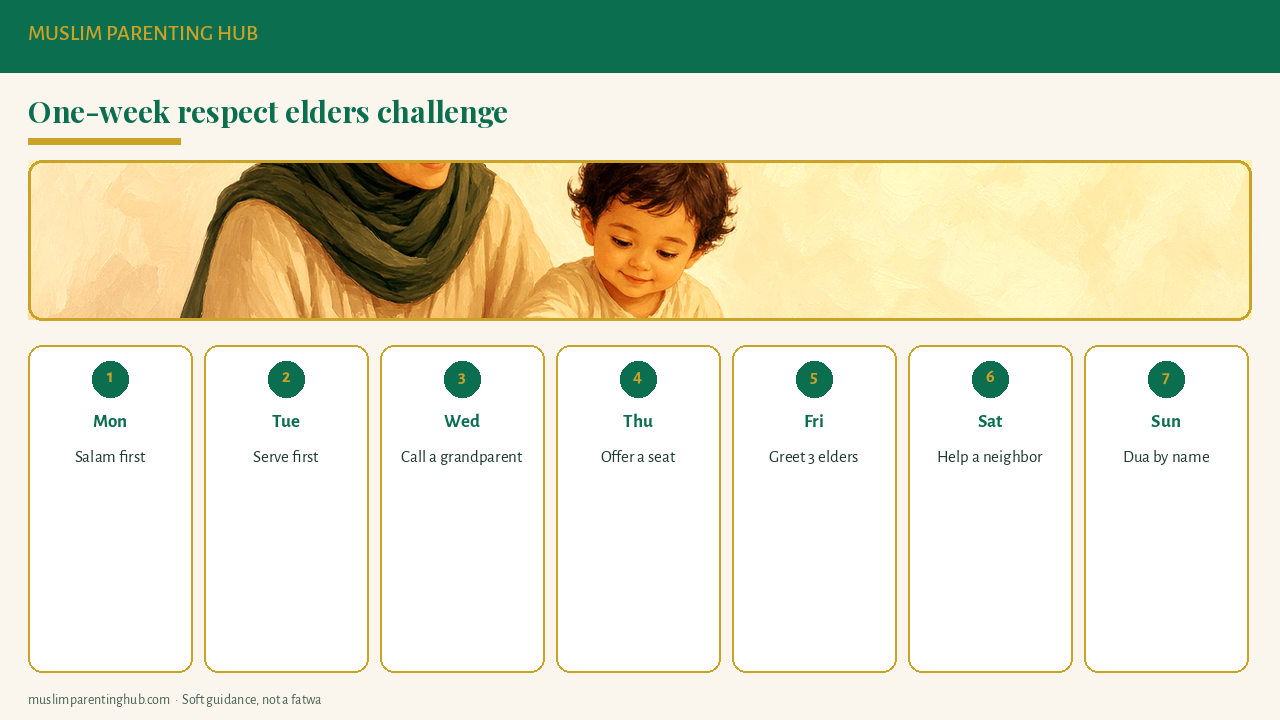
- Monday: Salam first to every adult you see today.
- Tuesday: Serve an elder first at dinner.
- Wednesday: Call or video-chat a grandparent and ask one question about their childhood.
- Thursday: Offer your seat to someone older.
- Friday: Greet three elders at the masjid or Jumu’ah.
- Saturday: Do one helpful job for an older neighbor.
- Sunday: Make dua for grandparents by name.
Put a star on the fridge chart for each one. Our Islamic manners for kids daily adab checklist has more habits to add next week.
With the holidays coming, many families will spend long weekends with relatives. Our guide to Thanksgiving with non-Muslim family helps kids show respect to every grandparent and relative at the table.
FAQ
What does Islam say about respecting elders?
The Prophet ﷺ said, “He is not one of us who does not show mercy to our young and respect to our elders” (Tirmidhi, Abu Dawud). He also taught that honoring an older Muslim is part of glorifying Allah (Abu Dawud).
How do I teach my child to respect elders?
Model it yourself and practice small daily habits: say salam first, come to the door when elders arrive, let them speak first, offer a seat, serve them first, and say JazakAllah khair. Praise every small effort.
Who should say salam first, the child or the elder?
The younger person should greet the older one first. The Prophet ﷺ taught that the young greet the old, the one walking greets the one sitting, and the smaller group greets the larger (Bukhari).
Should I make my child hug or kiss relatives to show respect?
No. Respect can be a warm salam, a smile or a handshake if your child is comfortable. Teaching body boundaries keeps children safe, and kind words and good manners still show full respect.
Does respecting elders mean kids must always obey adults?
No. Respect means kind words, patience and good manners. Kids should never do something wrong or unsafe because an adult told them to, and they should always tell a parent if an adult makes them uncomfortable.
What dua can kids make for their parents and grandparents?
Teach “Rabbir-hamhuma kama rabbayani saghira,” meaning “My Lord, have mercy on them as they raised me when I was small” (Quran 17:24). Kids can add grandparents by name after each prayer.
Related guides
- Teach toddlers to say salam in 7 days
- Teach shy kids to return salam
- Teach kids to knock and ask permission
- Islamic table manners for toddlers
Closing
Respect for elders grows from tiny moments: a salam at the door, a glass of water carried carefully to Nana, a story listened to all the way to the end. Show it, practice it, praise it, and one day you’ll watch your child stand up to greet you the same way. That is the adab the Prophet ﷺ described, and it will bless your home for generations.
Quick steps
One-week respect elders challenge for Muslim kids. One small act of respect for elders each day, tracked with a star on the fridge chart.
- Monday — Salam first — Say salam first to every adult you see today.
- Tuesday — Serve first — Serve an elder first at dinner.
- Wednesday — Call a grandparent — Call or video-chat a grandparent and ask one question about their childhood.
- Thursday — Offer a seat — Offer your seat to someone older.
- Friday — Masjid greetings — Greet three elders at the masjid or Jumu’ah.
- Saturday — Help a neighbor — Do one helpful job for an older neighbor.
- Sunday — Dua — Make dua for grandparents by name.
Related articles
How to Teach Toddlers to Say Salam: A Playful 7-Day Plan
Teach your toddler to say Assalamu alaikum in 7 playful days: mirror games, doorway role-play, shy-child scripts and age tips. Start today, no forcing.
Read guide →
Teach Kids the Full Salam: The Words, the Best Replies and the 10-20-30 Reward
Teach kids the full salam, “Assalamu alaikum wa rahmatullahi wa barakatuh,” the best replies, who greets first and the 10-20-30 reward, with games for ages 4–10.
Read guide →
Islamic Manners for Kids: A Daily Adab Checklist for Home, School and the Masjid (Ages 3–10)
Islamic manners for kids in one checklist: 30 daily adab habits for home, school and the masjid, with hadith, age guides, gentle scripts and a 10-week plan.
Read guide →
Guest Manners for Muslim Kids: Hosting at Home with Islamic Adab
Teach Muslim kids guest manners for hosting at home—shoes, greetings, serving, privacy, and soft scripts. Islamic adab parents can practice tonight.
Read guide →