

Teach Kids to Knock and Ask Permission: The Islamic Adab of Isti'dhan at Home
The bathroom door swings open mid-shower. A small face appears at your bedroom door at 6 a.m. A sibling bursts into a room shouting, “It’s me!” Sound familiar?
Islam gives families a beautiful, practical answer: isti’dhan, the adab of asking permission before entering. It’s one of the few manners the Quran teaches in detail, including specific times when even young children should knock. Teaching it protects everyone’s privacy, builds self-control, and makes your home calmer.
This guide covers what the Quran and Sunnah teach about asking permission, the three “privacy times,” a simple knock-salam-name routine, age bands, scripts, and a 7-day practice plan.
Soft guidance for families. For detailed rulings, follow the scholars you trust.
What the Quran Says About Asking Permission
Two passages in Surah An-Nur shape this adab:
- Entering other people’s homes (24:27): believers are told not to enter houses other than their own until they have asked permission and greeted the people inside.
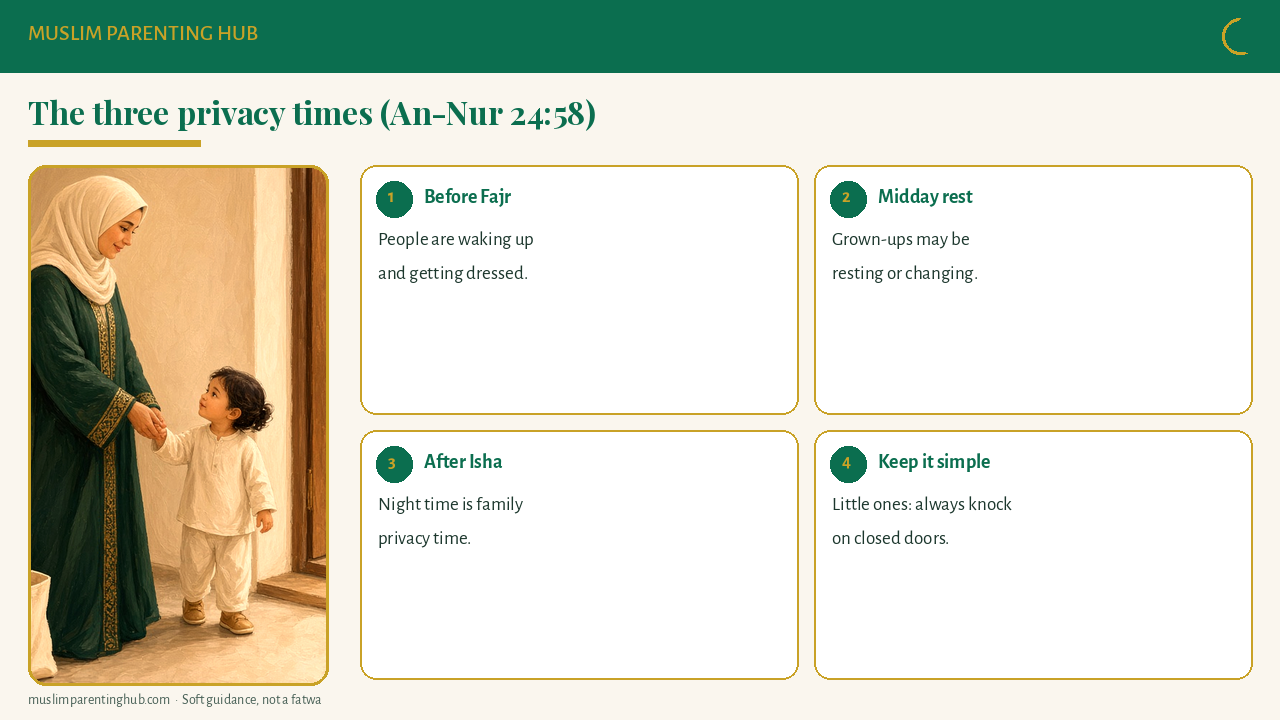
- Inside the family home (24:58–59): children who haven’t reached maturity, and household helpers, should ask permission at three times: before Fajr, at midday when people change out of their clothes to rest, and after Isha. Once children reach maturity, they ask permission at all times, as adults do.
That second passage is remarkable: Allah addresses family privacy inside the home, and He names young children directly. Teaching our kids to knock isn’t a Western politeness add-on. It’s Quranic adab.
What the Sunnah Adds
The Prophet ﷺ modelled this adab in practical ways:
- Ask up to three times. If there’s no permission after the third request, go back (Bukhari and Muslim). Kids learn that “no answer” means “not now,” not “knock louder.”
- Say your name, not “It’s me.” When a Companion knocked and answered “It’s me,” the Prophet ﷺ disliked it (Bukhari). A name tells people who is there.
- Stand to the side of the door, not facing straight into the room when it opens (Abu Dawud). It’s a small, considerate habit that protects privacy.
- Greet with salam. Asking permission and greeting go together.
The Simple Routine: Knock, Salam, Name, Wait
Turn the Quran and Sunnah into four steps a five-year-old can remember:
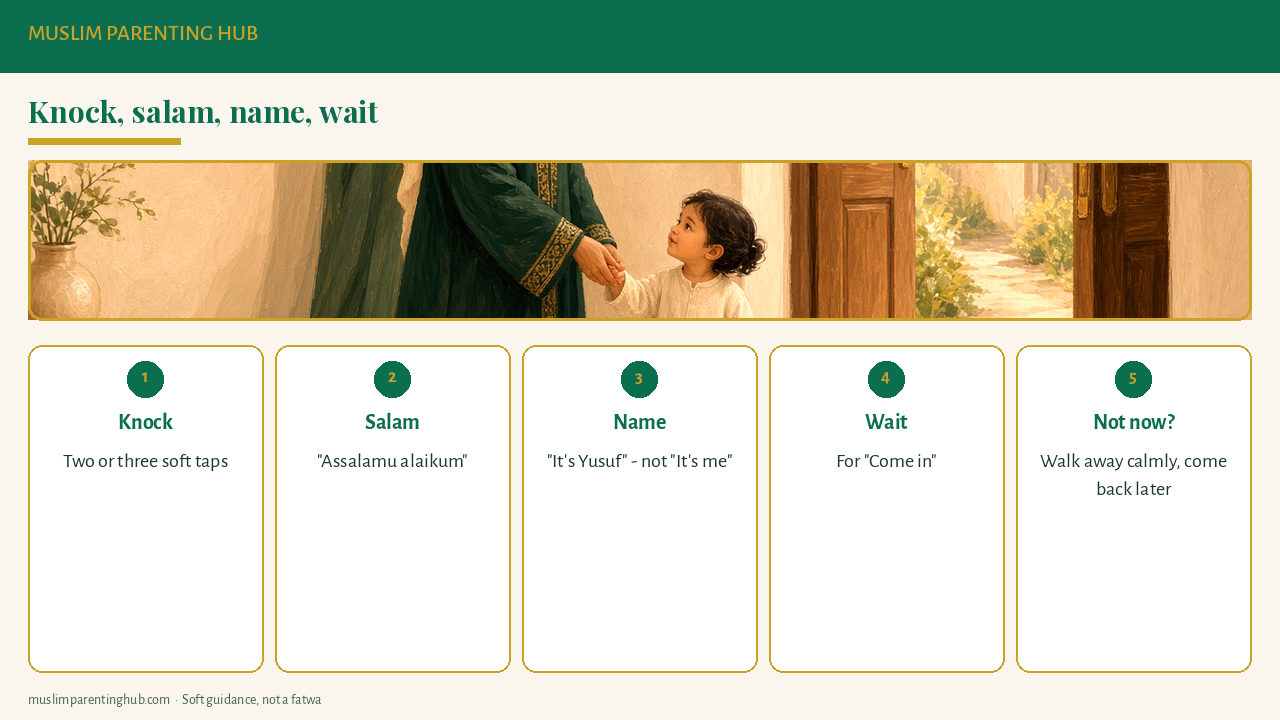
- Knock gently (two or three soft taps).
- Salam: “Assalamu alaikum.”
- Name: “It’s Yusuf.” Not “It’s me.”
- Wait for “Come in.” If there’s no answer after three tries, or the answer is “Not now,” walk away calmly and come back later.
Script to introduce it:
“In our home, closed doors mean someone might want privacy. Allah taught us a special way to ask: knock, say salam, say your name, and wait. If they say ‘not now,’ that’s okay. We come back later.”
Pair it naturally with the greeting habits in how to teach toddlers to say salam. Isti’dhan is basically salam with a door in front of it.
Why This Matters for Kids
- Privacy and modesty. Children learn that bodies and personal spaces deserve respect: theirs and everyone else’s.
- Self-control. Waiting at a door is a small daily rep of patience.
- Safety. Kids who know they can say “not now” at their own door also learn that their body and space have boundaries.
- Respect for parents. It protects the parents’ private times, which the Quran explicitly guards.
- Good guest manners. Kids who knock at home will knock at Grandma’s, at friends’ houses, and in hotel rooms.
It also connects to how we host and visit. See our guide to guest manners for Muslim kids for the visiting side.
The Three Privacy Times, Explained for Kids
Kids understand rules better when they’re tied to the day they actually live. Make it concrete:
| Time | What it looks like at home | Kid-friendly reason |
|---|---|---|
| Before Fajr | Early morning, parents may be sleeping or getting ready | “People are waking up and getting dressed.” |
| Midday rest | Afternoon nap or rest time, people change clothes | “Grown-ups may be resting or changing.” |
| After Isha | Night, parents’ private time | “Night time is family privacy time.” |
Many families simply teach “always knock on closed doors” to keep it simple, and then explain the three times as kids get older.
For older kids (8+): read Surah An-Nur 24:58 together in translation. Ask, “Why do you think Allah mentioned children by name?” Kids love being taken seriously.
Age Bands: What to Expect
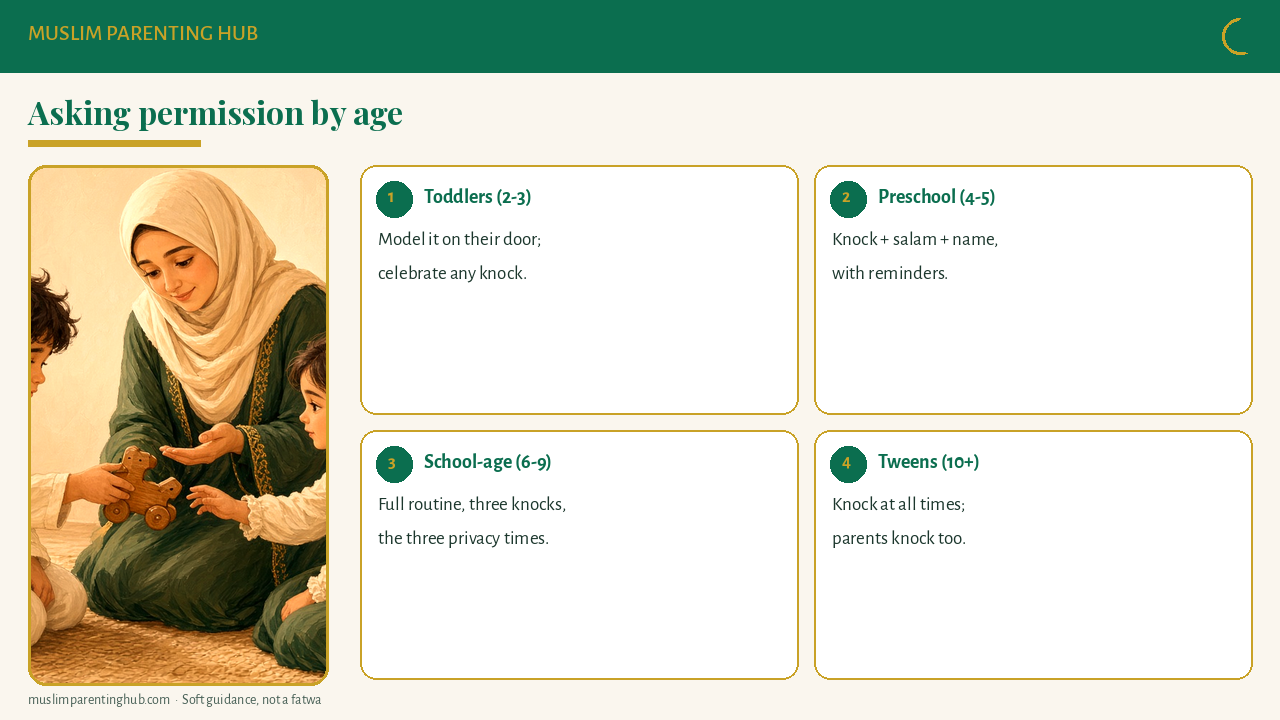
Toddlers (2–3)
- Can’t manage the full routine yet, so keep doors locked when you need privacy
- Model it: knock on their door, say salam and your name
- Celebrate any knock, even if they barge in straight after
Preschool (4–5)
- Can learn knock + salam + name
- Needs reminders, especially in the morning
- Starts to understand “not now” without melting down (most days)
School-age (6–9)
- Can follow the full routine, including waiting after three knocks
- Can learn the three privacy times
- Should knock on siblings’ doors too
Tweens (10+)
- Knocking at all times becomes the norm
- Can explain the Quranic reason to younger siblings
- Their own privacy deserves the same respect: parents knock too
Parents Knock Too
The fastest way to teach isti’dhan is to do it to your kids. When you knock on your child’s door, say salam and your name, and wait for “Come in,” you’re showing them that the rule is about respect, not power.
Script:
knock knock “Assalamu alaikum, it’s Mama. Can I come in?”
There are exceptions: safety checks, little ones who might be in danger, emergencies. Explain these honestly: “If I think you’re hurt or unsafe, I’ll come in straight away. That’s my job.”
A 7-Day Knock-First Practice Plan
Day 1 — Story and reason. Explain that Allah taught us to ask before entering. Mention that the Quran names children.
Day 2 — Knock game. Take turns being “inside” and “outside” a closed door. Practise knock + salam + name. Use silly voices.
Day 3 — The “not now” drill. The person inside says “Not now, please.” The person outside says “Okay!” and walks away. Cheer the walk-away. This is the hardest skill.
Day 4 — Three knocks rule. Practise: knock, wait, knock, wait, knock, wait, then go back. No pounding.
Day 5 — Parents’ privacy times. Introduce the three times with a simple drawing: sunrise, sun overhead, moon.
Day 6 — Real doors, real day. Notice and praise every real knock today: “You knocked and said your name. That’s adab from the Quran.”
Day 7 — Visit practice. Practise knocking at a relative’s or neighbour’s door with you. Say salam, give your name, wait to be invited in.
After the week, keep praising it for a month. Habits stick when they’re noticed.
Scripts for Real-Life Moments
When a child barges into the bathroom:
“Oops! Let’s try again. Close the door, knock, salam, name. I’ll answer.”
When a sibling won’t let them in:
“She said ‘not now.’ That’s her right. You can ask again in ten minutes.”
When your child wants privacy and a sibling barges in:
“Your brother wants privacy. Let’s go out and knock properly.”
When a child says “It’s me!”:
“Who’s me? The Prophet ﷺ liked us to say our names. Try again!”
When guests’ kids open every door:
“In our house, closed doors mean knock first. Want to try the knock game?”
Common Mistakes (Easy to Fix)
- Only correcting, never praising. Notice the good knocks more than the bad barge-ins.
- Parents never knocking. Kids copy what we do, not what we say.
- Turning it into shame. Avoid “That’s so rude!” Try “Let’s do a re-do.”
- Making exceptions without explaining. If you enter without knocking for safety, say why.
- Forgetting the “not now” part. Knocking is half the adab. Accepting “no” is the other half.
Linking Isti’dhan to Wider Adab
Asking permission sits with a family of manners:
- Salam: greeting before entering
- Guest manners: waiting to be invited in, and not wandering rooms
- Body safety: “my space, your space”
- Honesty: saying who you are, not hiding
When kids see these as one connected way of living, adab becomes identity, not a list of rules. Kindness to neighbours fits here too. Try our neighbour kindness 7-day plan once knocking at home is going well.
FAQ
What does the Quran say about children asking permission?
Surah An-Nur (24:58–59) tells believers that children who haven’t reached maturity should ask permission at three times: before Fajr, at midday rest when clothes are removed, and after Isha. Once they reach maturity, they ask permission at all times, as adults do.
How many times should a child knock?
Following the Sunnah, a child can ask up to three times. If there is no answer or permission after the third time, they should walk away calmly and come back later, rather than knocking louder.
Why shouldn’t kids say “It’s me” when they knock?
When a Companion answered “It’s me” at the door, the Prophet ﷺ disliked it, because it doesn’t tell the person inside who is there. Teach kids to say their name instead: “Assalamu alaikum, it’s Maryam.”
At what age should kids learn to knock?
Start modelling it from toddlerhood, teach the routine around ages 4–5, and expect kids to follow it consistently, including the three privacy times, by school age. Tweens should knock at all times.
Should parents knock on their children’s doors?
Yes. Knocking on your child’s door, saying salam and your name, and waiting teaches respect far better than lectures. Explain the exceptions, such as safety concerns or emergencies, honestly.
How do I stop my toddler from barging into the bathroom?
Toddlers can’t fully manage the routine yet, so lock the door when you need privacy, model knocking on their door, and celebrate any attempt they make. Consistency now builds the habit for later.
Related guides
- How to Teach Toddlers to Say Salam: A Playful 7-Day Plan
- Guest Manners for Muslim Kids
- Neighbour Kindness for Muslim Kids: 7-Day Plan
- Islamic Bathroom Manners at School
Quick steps
7-day knock-first practice plan for kids. A week of short games that teach children to knock, say salam, give their name and accept 'not now'.
- Day 1 — Story and reason — Explain that Allah taught us to ask before entering, and that the Quran names children.
- Day 2 — Knock game — Take turns inside and outside a closed door practising knock, salam and name.
- Day 3 — The 'not now' drill — The person inside says 'Not now, please' and the person outside walks away calmly.
- Day 4 — Three knocks rule — Practise knocking up to three times with pauses, then going back without pounding.
- Day 5 — Parents' privacy times — Introduce the three privacy times with a simple drawing of sunrise, midday sun and moon.
- Day 6 — Real doors, real day — Notice and praise every real knock during the day.
- Day 7 — Visit practice — Practise knocking at a relative's or neighbour's door with salam, name and waiting to be invited in.
Related articles

How to Teach Toddlers to Say Salam: A Playful 7-Day Plan
Teach your toddler to say Assalamu alaikum in 7 playful days: mirror games, doorway role-play, shy-child scripts and age tips. Start today, no forcing.
Read guide →
Guest Manners for Muslim Kids: Hosting at Home with Islamic Adab
Teach Muslim kids guest manners for hosting at home—shoes, greetings, serving, privacy, and soft scripts. Islamic adab parents can practice tonight.
Read guide →
Neighbor Kindness for Muslim Kids: A Gentle 7-Day Practice Plan
A gentle 7-day plan to teach Muslim kids neighbor kindness—scripts for Muslim and non-Muslim neighbors, quiet hours, food sharing tips, and safety.
Read guide →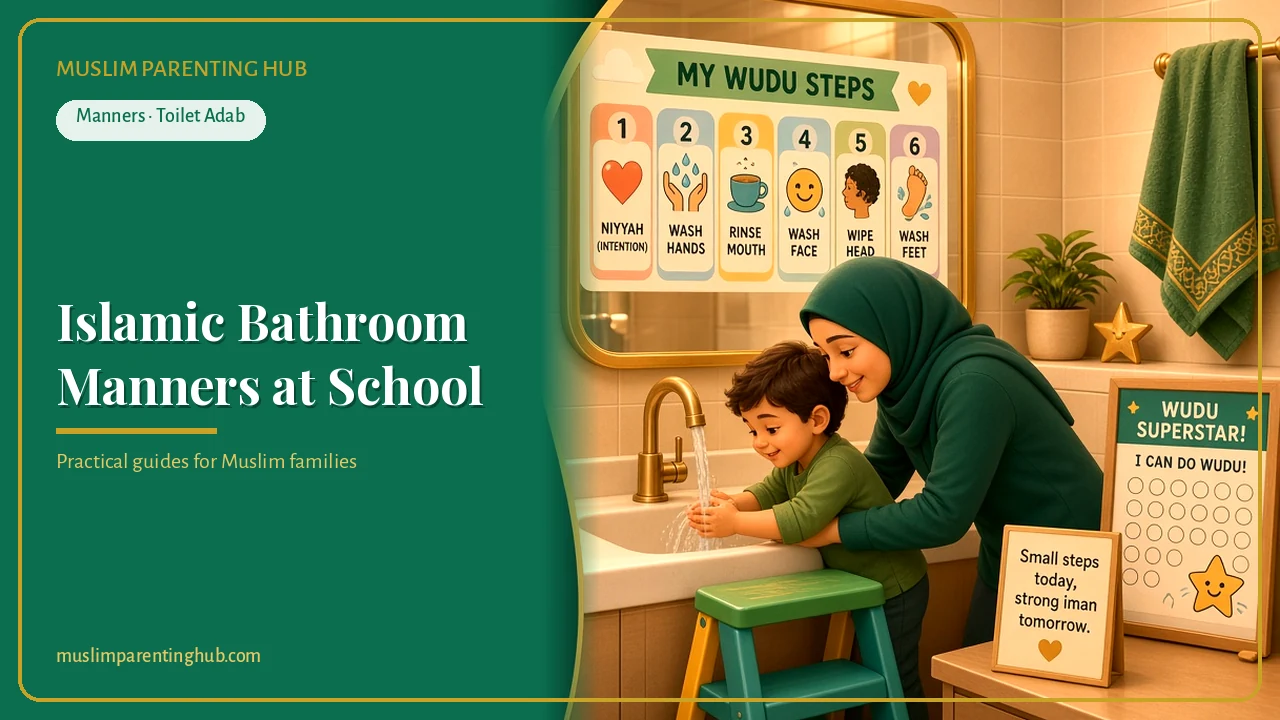
Islamic Bathroom Manners at School: A Kid-Friendly Guide to Public Restrooms
Help your child keep Islamic toilet manners at school and in public restrooms: duas, privacy, istinja without a lota, and calm scripts for teachers.
Read guide →