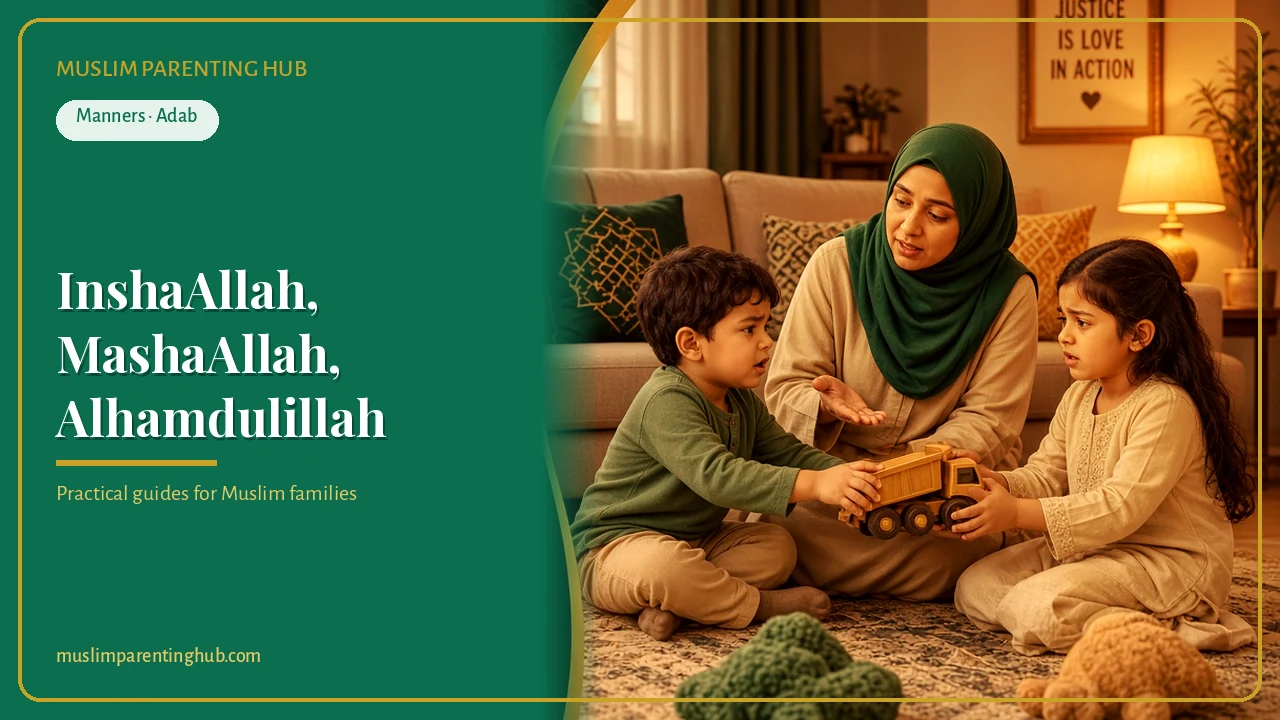
InshaAllah, MashaAllah, Alhamdulillah: Teaching Kids Everyday Islamic Phrases (and When to Say Them)
Muslim children in America grow up between two languages: the English of school and friends, and a handful of Arabic phrases that make a home feel Muslim. “Bismillah” before snack. “Alhamdulillah” after a sneeze. “InshaAllah” when Baba promises the park.
These little words are adab in action. They train a child to remember Allah in ordinary moments: when something good happens, when they plan, when they slip up, and when they admire something. This guide gives US Muslim parents ten everyday phrases, what each means in kid words, exactly when to say it, common mix-ups, and a ten-day plan to build them into family life. It is gentle home guidance, not a fatwa.
Phrases work best alongside greetings, so if you haven’t started yet, our 7-day plan to teach toddlers to say salam is a lovely first step.
The 10 Everyday Phrases
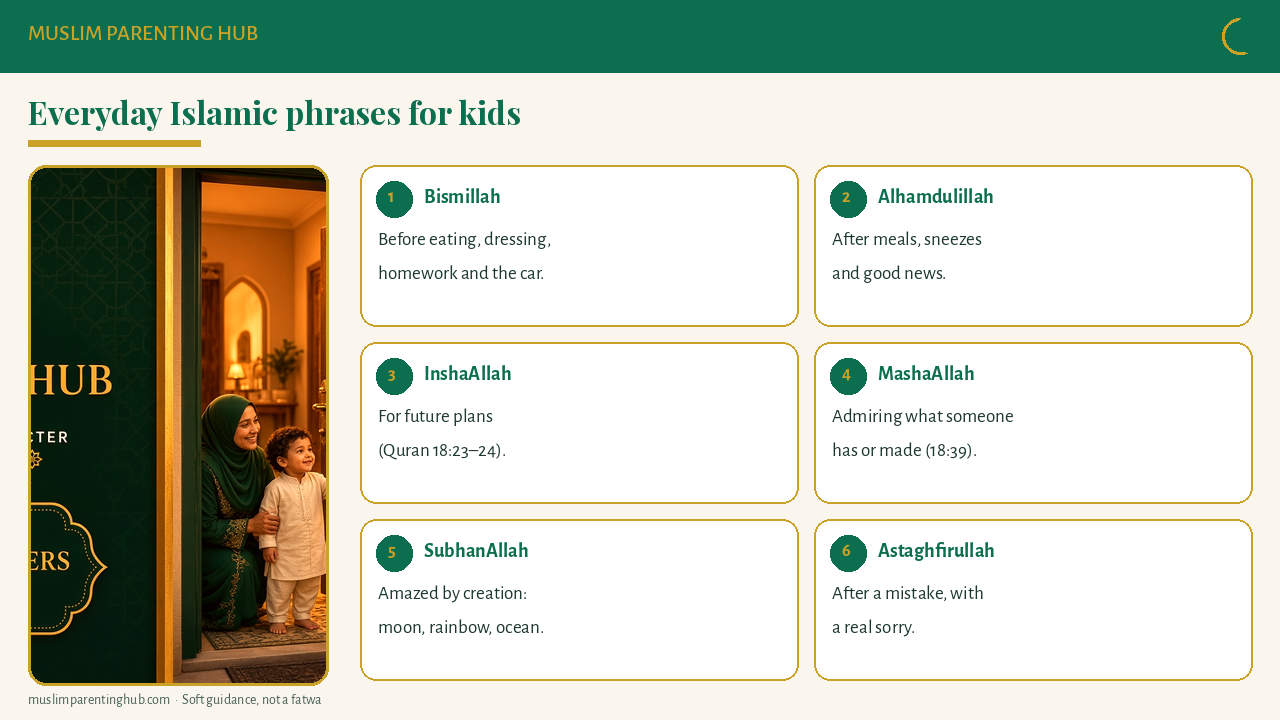
1. Assalamu alaikum, “Peace be upon you”
When: Meeting family, friends at the masjid, coming home. Reply: Wa alaikumus-salam. Our guide on the full salam and reply teaches the longer version.
2. Bismillah, “In the name of Allah”
When: Before eating, drinking, getting dressed, starting homework, getting in the car. More: Teach kids Bismillah in everyday moments.
3. Alhamdulillah, “All praise is for Allah”
When: After eating, after sneezing, when something good happens, when someone asks “How are you?” Why it matters: The Prophet ﷺ said “Alhamdulillah” fills the scale of good deeds (Muslim).
4. InshaAllah, “If Allah wills”
When: Talking about the future: “I’ll see you tomorrow, inshaAllah.” Why: Allah tells us in the Quran never to say “I will do this tomorrow” without adding “if Allah wills” (18:23–24).
5. MashaAllah, “What Allah has willed”
When: Admiring something: a friend’s drawing, a new baby, a beautiful sunset. Why: In Surah Al-Kahf, a man is told he should have said “MashaAllah” when admiring his garden (18:39). It reminds us that good things come from Allah.
6. SubhanAllah, “Glory be to Allah”
When: Seeing something amazing in creation, like a rainbow, a huge tree or a thunderstorm.
7. Allahu Akbar, “Allah is the Greatest”
When: In salah, in the adhan, and when something big and impressive happens.
8. Astaghfirullah, “I ask Allah’s forgiveness”
When: After a mistake, a bad word, or hurting someone. Pair it with a real apology. Our guide on teaching kids to apologize with istighfar has scripts.
9. JazakAllah khair, “May Allah reward you with good”
When: Thanking someone. Our JazakAllah khair guide explains replies like “Wa iyyakum.”
10. Yarhamukallah, “May Allah have mercy on you”
When: Someone sneezes and says “Alhamdulillah.” See our sneezing and yawning manners.
Common Mix-Ups (and Gentle Fixes)
InshaAllah as a polite “no.” Many families slip into using “inshaAllah” to mean “probably not.” Kids notice fast. If you mean no, say no kindly, and save “inshaAllah” for real plans. That way it stays a word of trust, not a dodge.
MashaAllah vs SubhanAllah. Simple rule for kids: MashaAllah when you admire something someone has (“MashaAllah, your drawing is beautiful!”). SubhanAllah when you’re amazed by Allah’s creation (“SubhanAllah, look at that moon!”). There’s overlap, and both are good, but the rule helps them choose.
Saying phrases with no meaning. A child who says “Alhamdulillah” like a robot is still building a good habit, but add meaning often: “Alhamdulillah means thank You, Allah. What are you thankful for?”
Using phrases in the bathroom. Teach kids not to say Allah’s name aloud inside the toilet room. Say Bismillah at the door, and Alhamdulillah or Ghufranak after coming out.
English or Arabic at School?
Many Muslim kids feel shy saying Arabic words around non-Muslim friends. That’s normal. Some tips:
- Arabic phrases are for everyone, but kids can say them quietly at school. Allah hears a whisper.
- If a friend asks, a simple answer works: “Alhamdulillah means thank God. We say it when we’re thankful.”
- Never force a shy child to perform phrases for adults. Our guide for shy kids who struggle to return salam has gentle steps that also work for phrases.
A 10-Day Plan to Make Phrases a Habit
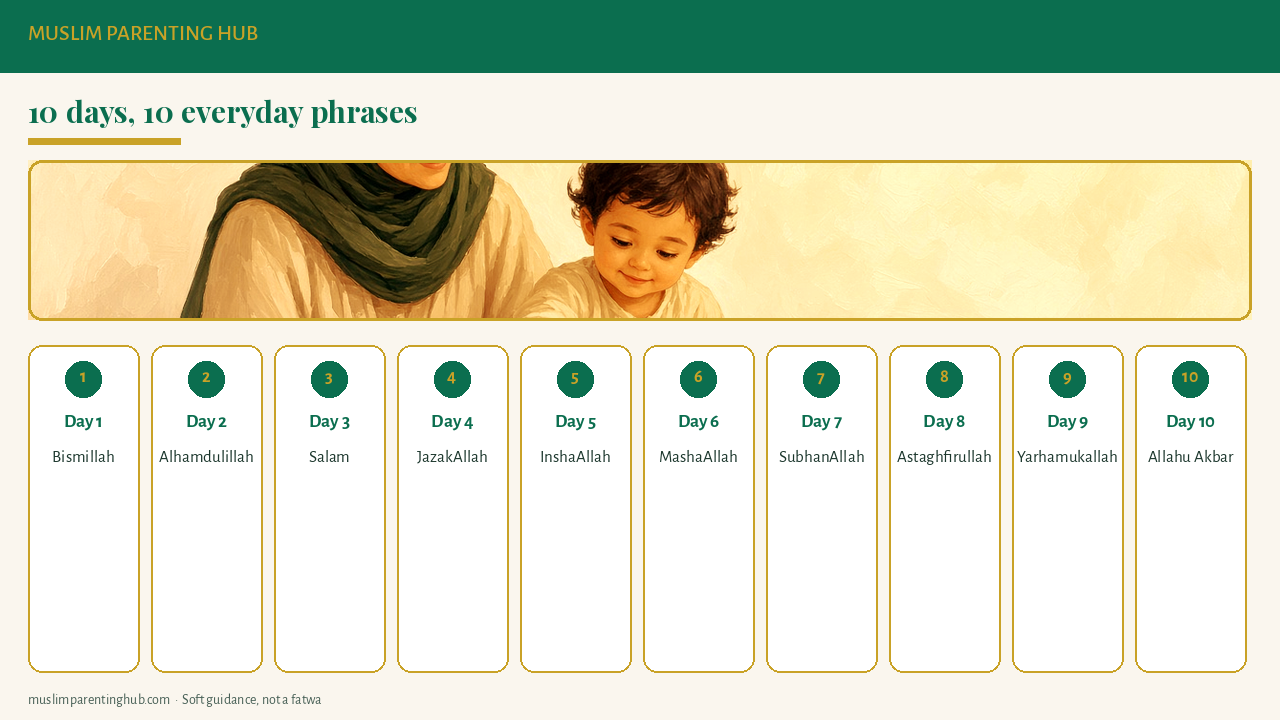
One phrase a day, practiced in real moments. Keep the earlier ones going.
| Day | Phrase | Practice moment |
|---|---|---|
| 1 | Bismillah | Every snack and meal |
| 2 | Alhamdulillah | After meals, plus “3 thank-yous” at bedtime |
| 3 | Assalamu alaikum | Greet everyone at the door |
| 4 | JazakAllah khair | Thank each family member once |
| 5 | InshaAllah | Plan tomorrow together, adding inshaAllah to each plan |
| 6 | MashaAllah | Admire one thing a sibling made |
| 7 | SubhanAllah | A nature walk: say it at 3 amazing things |
| 8 | Astaghfirullah | After any small mistake, say it with a real sorry |
| 9 | Yarhamukallah | Practice with a pretend sneeze game |
| 10 | Allahu Akbar | Listen to the adhan together and repeat |
Make a small chart on the fridge with each phrase and a tick when someone uses it naturally. Parents tick too.
By Age: What to Expect
| Age | Realistic goal |
|---|---|
| 2–3 | Bismillah, Alhamdulillah and salam with you modeling. |
| 4–5 | Most of the 10, with gentle reminders; a meaning for each. |
| 6–8 | Uses phrases on their own; knows the difference between MashaAllah and SubhanAllah. |
| 9+ | Uses phrases sincerely; can explain them to a non-Muslim friend. |
The Secret Ingredient: You
Children copy what they hear. If they hear you say “Alhamdulillah” when you find a parking spot, “InshaAllah” when you plan, and “Astaghfirullah” when you lose your temper and apologize, the phrases become the language of your home. For a bigger picture of daily adab, our Islamic manners for kids checklist puts these phrases next to 30 everyday habits.
FAQ
What Islamic phrases should kids learn first?
Start with Bismillah, Alhamdulillah and Assalamu alaikum around ages 2–3. Then add JazakAllah khair, InshaAllah, MashaAllah and SubhanAllah by 4–5, and Astaghfirullah and Yarhamukallah as social situations come up.
When should kids say InshaAllah?
Whenever they talk about something they plan to do in the future, like “I’ll finish my homework later, inshaAllah.” It comes from Quran 18:23–24. Teach it as a word of trust in Allah, not a polite way to say no.
What is the difference between MashaAllah and SubhanAllah for kids?
A simple rule: say MashaAllah when admiring something a person has or did, and SubhanAllah when amazed by Allah’s creation, like the sky or the ocean. Both remember Allah, and there is some overlap.
How do I explain Alhamdulillah to a child?
Say it means “All praise and thanks are for Allah.” Ask your child to name three things they are thankful for and say Alhamdulillah after each one. Use it after meals, sneezes and good news.
Should my child say Islamic phrases at a public school?
They can, quietly or aloud, and it’s fine if they feel shy. Give them a short English explanation for friends who ask, and never pressure them to perform. Using them at home first builds confidence.
Is it okay if my child says the phrases without understanding them?
Yes, it’s a good start. Habits often come before full understanding. Add one meaning at a time, ask what each phrase means now and then, and model them sincerely yourself.
Related guides
- Teach toddlers to say salam: a 7-day plan
- Teach kids the full salam and reply
- Teach kids to say JazakAllah khair
- Islamic manners for kids: daily adab checklist
Closing
A few short words, said a hundred times a day, quietly shape a child’s heart. Bismillah turns a snack into worship. Alhamdulillah turns a good moment into gratitude. InshaAllah turns a plan into trust. Teach them one at a time, say them yourself, and let your home sound like a Muslim home, one small phrase at a time.
Quick steps
10-day plan to teach kids everyday Islamic phrases. One phrase a day, practiced in real moments, while keeping the earlier ones going.
- Day 1 — Bismillah — Say it before every snack and meal.
- Day 2 — Alhamdulillah — Say it after meals and name three thank-yous at bedtime.
- Day 3 — Assalamu alaikum — Greet everyone at the door.
- Day 4 — JazakAllah khair — Thank each family member once.
- Day 5 — InshaAllah — Plan tomorrow together, adding inshaAllah to each plan.
- Day 6 — MashaAllah — Admire one thing a sibling made.
- Day 7 — SubhanAllah — Say it at three amazing things on a nature walk.
- Day 8 — Astaghfirullah — Say it with a real sorry after a small mistake.
- Day 9 — Yarhamukallah — Practice with a pretend sneeze game.
- Day 10 — Allahu Akbar — Listen to the adhan together and repeat.
Related articles
How to Teach Toddlers to Say Salam: A Playful 7-Day Plan
Teach your toddler to say Assalamu alaikum in 7 playful days: mirror games, doorway role-play, shy-child scripts and age tips. Start today, no forcing.
Read guide →
Teach Kids the Full Salam: The Words, the Best Replies and the 10-20-30 Reward
Teach kids the full salam, “Assalamu alaikum wa rahmatullahi wa barakatuh,” the best replies, who greets first and the 10-20-30 reward, with games for ages 4–10.
Read guide →
Teach Kids to Say JazakAllahu Khayran: Thank-You Manners for Muslim Kids at Home, School and the Masjid
How to teach kids to say JazakAllah khair and thank you: meaning, correct forms and replies, US school and masjid scripts, thank-you notes and a 7-day plan.
Read guide →
Islamic Manners for Kids: A Daily Adab Checklist for Home, School and the Masjid (Ages 3–10)
Islamic manners for kids in one checklist: 30 daily adab habits for home, school and the masjid, with hadith, age guides, gentle scripts and a 10-week plan.
Read guide →