
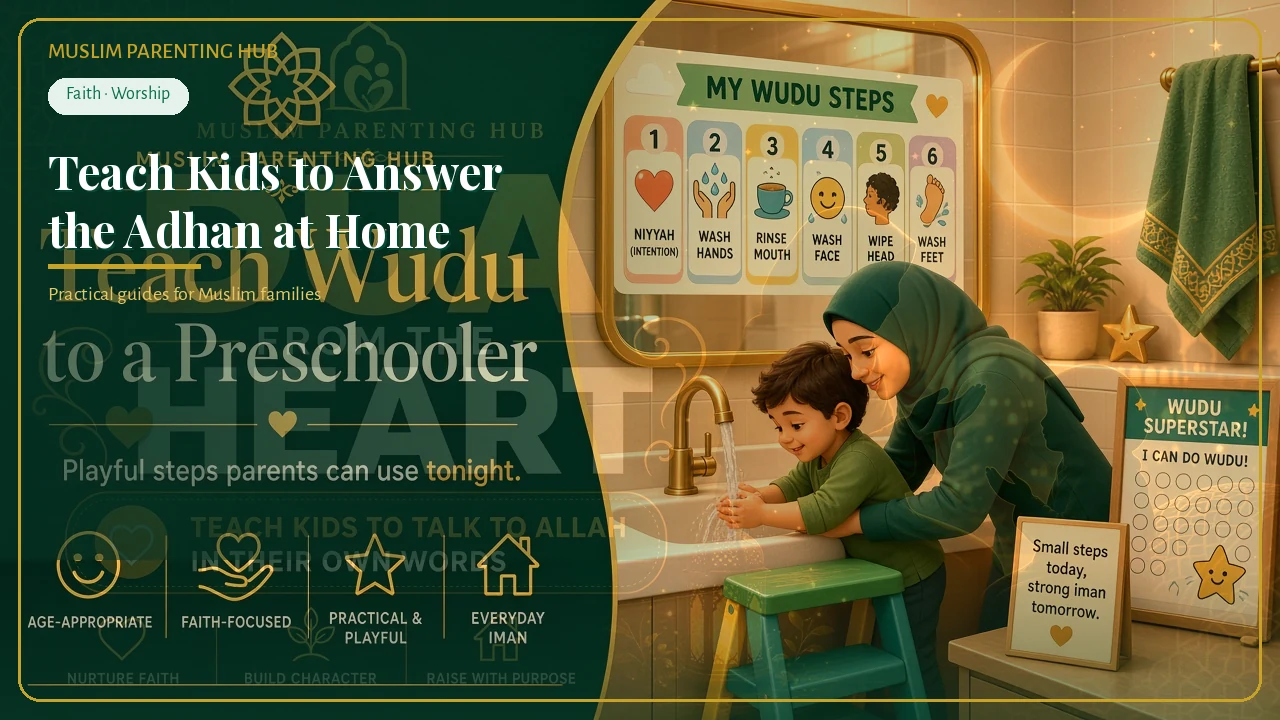
Teach Kids to Answer the Adhan at Home (Playful Practice Plan)
The adhan starts. Someone is mid-snack. Someone is mid-argument. Someone is mid-“one more video.” You freeze for half a second—then life swallows the moment again.
What if that half-second became a tiny family ritual?
This guide gives you a playful home practice plan so kids learn to pause and answer the adhan when it plays—on a phone app, a masjid speaker down the street, or a YouTube clip you use for practice. Soft guidance, not a fatwa. Use the wording and rulings your family and teachers prefer for the reply formulas.
Why Answering the Adhan Matters for Little Hearts
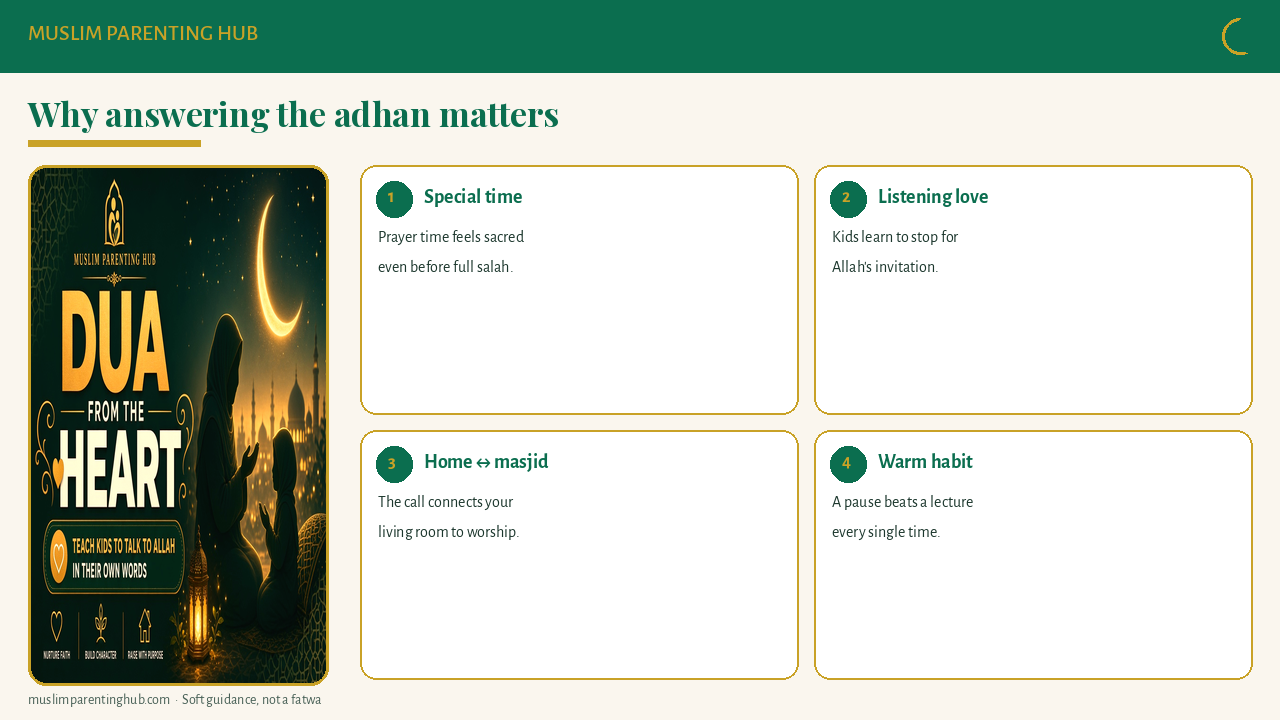
The adhan is not background noise. It is a living invitation: come to prayer, come to success. When kids learn to stop and respond, they learn:
- Prayer time is special—even before they pray full salah
- Listening is an act of love for Allah
- The home can feel connected to the masjid, even on busy weekdays
This pairs naturally with teaching dua from the heart and a calm after-school Maghrib routine. The goal is warmth, not a quiz.
The Pause Game (Your Core Ritual)
Keep one rule that never changes:
When we hear the adhan, we pause.
Not forever. Not perfectly. Just a real pause.
How to play tonight
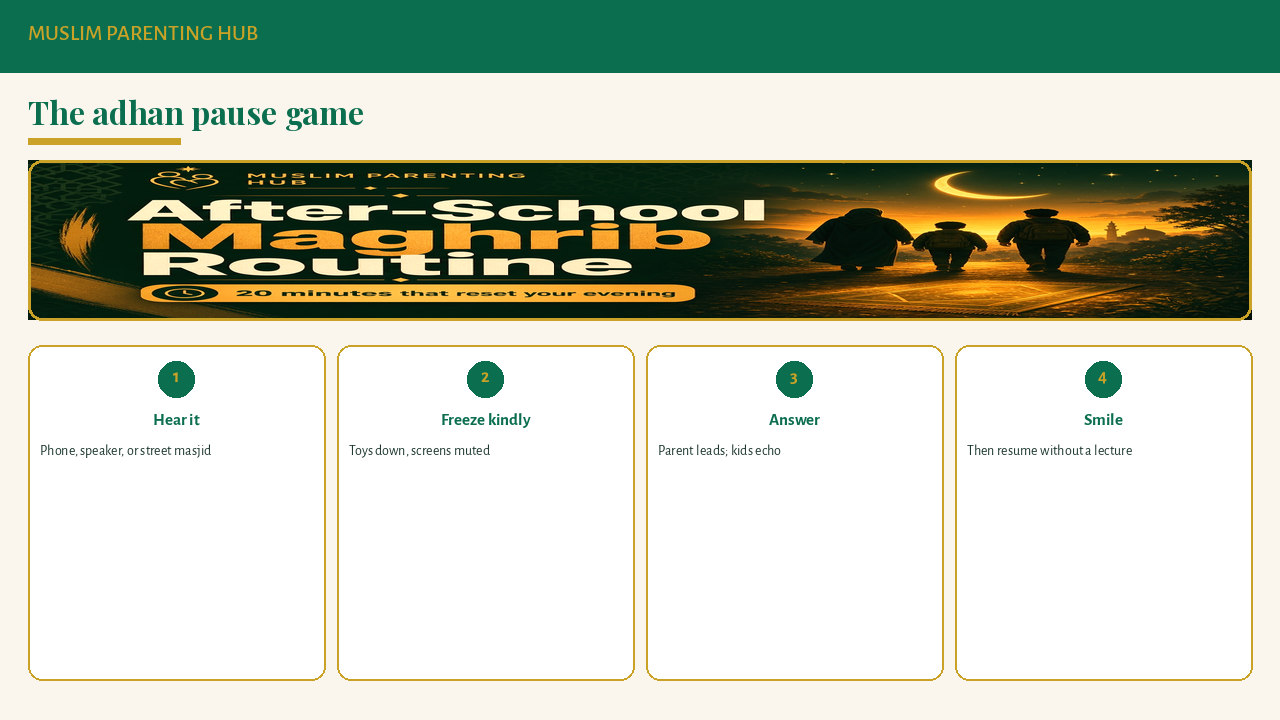
- Hear it — phone, speaker, or street masjid
- Freeze kindly — toys down, screens muted, mouths soft
- Answer — parent leads; kids echo what they can
- Ameen / smile — then resume life without a lecture
Script:
“Adhan time—pause game! Soft bodies. We answer the call with love… then we go back to play.”
If you are cooking and cannot freeze fully, still turn your face toward the sound, lower your voice, and let kids see you care. Modeling beats nagging.
Short Reply Lines Kids Can Actually Own
Toddlers will not recite a full classical response alone. Give them jobs that grow.
Level 1 — Toddler jobs
- Put a finger to lips (“shh—listening”)
- Say “Allah!” or “Ameen!” on cues you choose
- Walk to a “listening spot” (rug corner / prayer mat edge)
Level 2 — Preschool echo
Parent says a short meaning line; child repeats the last word:
Parent: “Allah is the Greatest.”
Child: “Greatest!”
Parent: “Come to prayer.”
Child: “Prayer!”
When ready, add a short authentic reply phrase your household uses after each line of the adhan—slowly, without shame if they mix it up.
Level 3 — School-age lead
- Child mutes the tablet when the adhan starts
- Child leads one line of the response once a week
- Family discusses: “What does ‘come to success’ mean in our home today?”
For kids who already practice wudu playfully, link the adhan moment to getting ready: see teach wudu to a preschooler.
A 7-Day Home Practice Plan
Use a real adhan recording once a day at a predictable time (after snack, before Maghrib prep, or weekend morning). Keep it under three minutes of “training.”
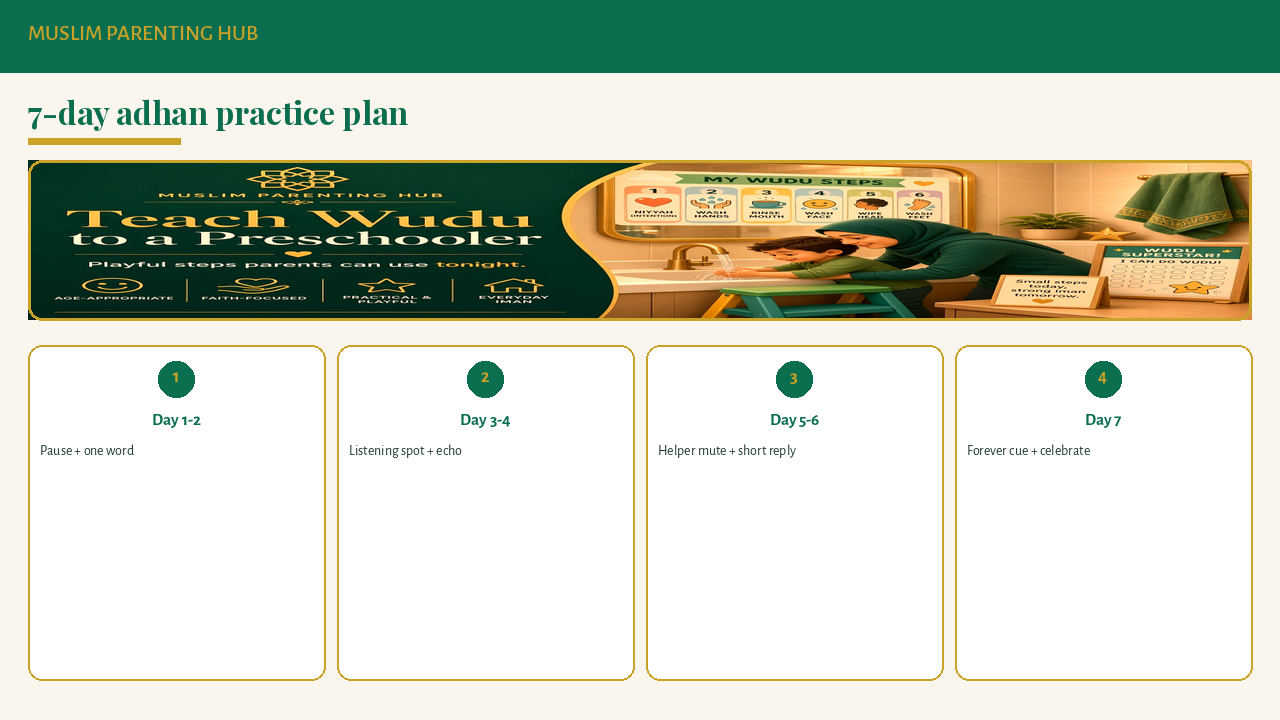
Day 1 — Only the pause
No pressure to speak. Celebrate freeze + soft faces.
Day 2 — One word
Kids say “Ameen” at the end, or “Allah” once in the middle—your choice.
Day 3 — Listening spot
Everyone walks to the same spot when they hear it. Make it fun, not military.
Day 4 — Echo game
Parent says meaning lines; kids echo the last word.
Day 5 — Helper mute
Oldest child becomes “adhan helper”: mute screen, announce “Pause game!”
Day 6 — Full short response (family style)
Use the short reply set your family trusts. Soft voices. No grading.
Day 7 — Celebrate + choose a forever cue
Pick your forever cue: phone volume, street speaker, or both. Take a silly family bow and say Alhamdulillah.
Scripts for Messy Real Life
If kids keep talking through it
“I know you’re excited. Adhan is our pause. We’ll finish the story right after we answer.”
If a sibling laughs or mocks
“We don’t make fun of the adhan. Kind hearts listen. You can stand next to me and try again.”
If you are in the car
Soft volume, short answer, then continue. Pair with your car travel dua routine so the car stays a place of dhikr, not only chaos.
If you miss it completely
“We missed the pause—next adhan is a fresh chance. Allah loves us when we keep trying.”
If they only want the ‘fun’ freeze and not the words
Let freeze stay sacred for a week. Words can wait. Attachment first.
When the Adhan Plays During Screens
Screens are the #1 pause-killer. Decide your house rule before the fight:
- Ideal: mute + pause game every time
- Busy day: mute for the adhan, resume after
- Never: ignore it while a cartoon shouts over it
If YouTube is part of your home, tighten the setup with YouTube Kids for Muslim parents so random loud videos do not train kids to talk over sacred sounds.
Connecting Adhan → Salah Without Pressure
Answering the adhan is not the same as praying a full salah. For little ones, the bridge can be gentle:
- Adhan pause + reply
- “Who wants to make wudu with me?” (optional)
- Short prayer for those who pray; quiet sitting for toddlers
- One hug: “We came when Allah invited us.”
On Maghrib-heavy evenings, fold this into your existing after-school rhythm so it does not feel like a fifth chore.
Age Bands at a Glance
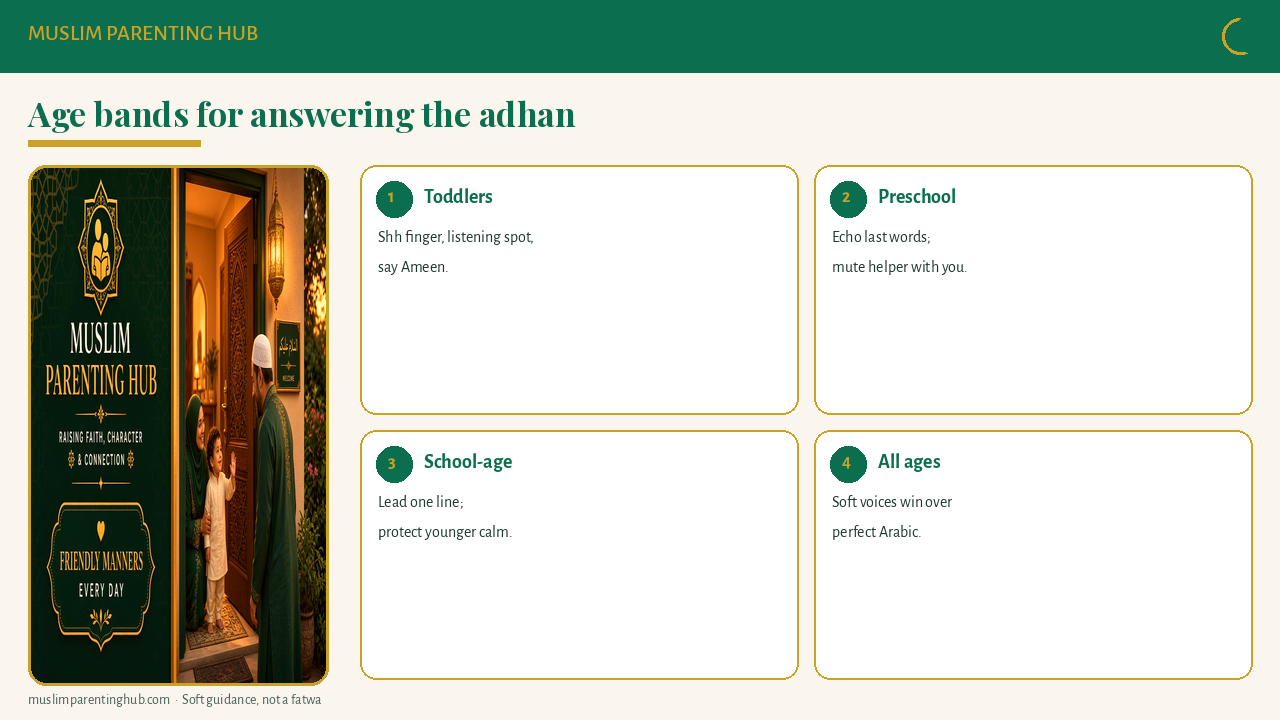
| Age | Win looks like |
|---|---|
| 1–2 | Stops moving for a few seconds; enjoys “listening spot” |
| 3–4 | Echoes words; mutes with help; proud helper badge |
| 5–7 | Leads pause announcement; learns short reply lines |
| 8+ | Understands meaning; protects younger siblings’ calm |
Tonight Scripts (Copy-Paste)
Announcement card on the fridge
When we hear the adhan: 1) Pause 2) Soft voices 3) Answer 4) Smile 5) Continue
Parent self-talk
“I am teaching love for the call, not a performance.”
After a good try
“I loved how your body got soft when the adhan started. That was beautiful adab.”
Common Worries (Gentle Answers)
“My child won’t sit still.”
Stillness is not the only success. A moving child who lowers their voice is already learning.
“We don’t hear a real masjid from our apartment.”
Use a trusted adhan app at one fixed time daily for practice, then also respond when you hear it in public.
“Older kids think it’s babyish.”
Give them leadership: timer, mute button, teaching a younger sibling one line.
“I’m scared of saying the ‘wrong’ reply.”
Learn one short authentic response with a teacher you trust. Until then, pause + soft presence + meaning lines still plant love.
Making a Tiny “Adhan Corner”
You do not need a renovation. You need a cue the body recognizes.
Ideas that work in small homes:
- A small rug corner labeled “Listening spot” with tape on the floor
- A basket with a soft scarf kids can drape over noisy toys during the adhan
- A paper moon/star on the wall that kids touch when they hear the call
- A simple card: “Pause. Answer. Smile.”
Rotate who is “corner captain” each day. Pride builds habit faster than reminders.
If your Maghrib routine already has a wudu station, place the listening spot nearby so the path feels natural: hear → answer → wash → pray for those who pray.
Practice Without Turning It Into a Drill
Kids smell drills. Keep practice short and warm:
- One recording a day is enough
- End with a hug or high-five, not a score
- If they refuse, you still pause—your calm is the lesson
- Once a week, let them choose the practice time (after breakfast? after park?)
On Fridays, connect the adhan moment to family togetherness the way you might protect Friday night Muslim family routine time—sacred rhythms deserve protection.
Travel, Parks, and Public Spaces
Hearing the adhan in a mall, airport, or while visiting relatives is a gift. Whisper:
“That’s the call we practice at home. Soft voices—our pause game works here too.”
If you cannot answer out loud in a quiet library corner, answer in your heart and teach kids that intention still counts. Later in the car, do a joyful thirty-second replay so the body gets the full ritual.
Parent Heart Check
Some of us grew up with harsh “Be quiet!” energy around the adhan. You get to rewrite that story:
- Firm on respect, soft on tone
- Curious about meaning, not obsessed with perfection
- Consistent on the pause, flexible on how many words today
Your child will remember how your face looked when the adhan began more than they will remember a lecture.
FAQ
How do I teach my kids to answer the adhan at home?
Play the pause game: when the adhan starts, freeze kindly, lower voices, and let kids echo short reply lines. Practice once a day with a recording if you do not hear a masjid, and model it yourself every time.
What should kids say when they hear the adhan?
Use the reply formulas your family and teachers prefer. For beginners, meaning lines plus “Ameen” are enough; add authentic Arabic responses gradually without shame.
What if my toddler just shouts during the adhan?
Redirect gently to a listening spot and a quiet job (finger on lips, hold your hand). Celebrate any softer volume. Do not turn the adhan into a scolding moment.
Should we stop cartoons every time?
Yes, as your default. Muting and pausing teaches respect. If you truly cannot, still lower the volume and answer briefly—then repair the habit the next day.
Can girls and boys practice the same way at home?
Yes—home practice of listening and answering is for all children. Keep the tone respectful and age-appropriate.
How long until this becomes a habit?
Many families see a real pause within one to two weeks of consistent daily practice. Keep cues identical so muscle memory forms.
What if we are not ready for salah yet?
Answering the adhan can stand alone as a love-and-listening habit. Salah readiness can grow beside it without pressure.
Related guides
- Teach Kids Dua From the Heart
- After-School Maghrib Routine
- Teach Wudu to a Preschooler
- Car Travel Dua Routine
- YouTube Kids Setup for Muslim Parents
Quick steps
7-day home practice to teach kids to answer the adhan. A short daily plan that builds from a kind pause to family-style adhan replies kids can own.
- Day 1 — Only the pause — Celebrate freeze and soft faces with no pressure to speak.
- Day 2 — One word — Kids say Ameen at the end or Allah once in the middle.
- Day 3 — Listening spot — Everyone walks to the same spot when they hear the adhan.
- Day 4 — Echo game — Parent says meaning lines; kids echo the last word.
- Day 5 — Helper mute — Oldest child mutes screens and announces the pause game.
- Day 6 — Short family response — Use the short reply set your family trusts, soft voices, no grading.
- Day 7 — Forever cue — Choose your forever cue and celebrate with Alhamdulillah.
Related articles

Teach Your Child to Make Dua From the Heart (Not Just Memorized Lines)
Teach kids dua in their own words—age bands, tonight scripts for fear, gratitude & friendship, plus Arabic+English tips. Soft, practical Muslim parenting.
Read guide →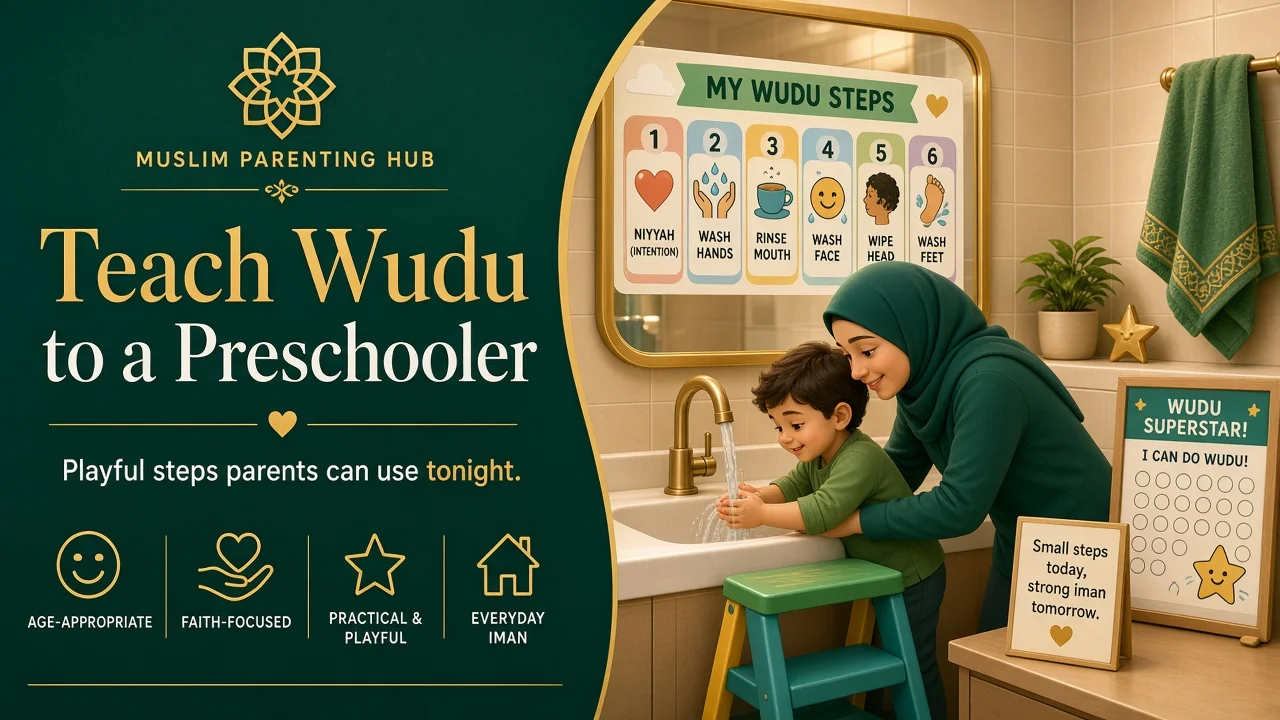
How to Teach Wudu to a Preschooler (Playful Steps Parents Can Use Tonight)
Teach wudu to preschoolers with playful steps—sink poster, doll practice, sticker chart, age tips, and tonight scripts. Gentle Muslim parenting for ages 3–5. Soft, practical.
Read guide →
The Car Dua Routine Muslim Kids Actually Remember (School Run to Road Trip)
Build a car travel dua routine Muslim kids remember—ignition trigger, call-and-response, school-run vs road-trip versions, and printable card placement tips. Soft and practical.
Read guide →
The After-School Maghrib Routine That Actually Works for Muslim Families
A calm 20-minute after-school Maghrib routine for Muslim families—snack, wudu, pray together, then connect. Age tips, scripts, and a screen rule that sticks.
Read guide →