
What Does the Adhan Mean? A Line-by-Line Guide for Kids (With Simple Meanings)
Your adhan app goes off in the kitchen. Your 6-year-old freezes mid-LEGO and asks, “What is he actually saying?”
It’s a wonderful question. Most Muslim kids in the US hear the adhan every day, from a phone, a smart speaker or the masjid on Fridays, but many have never been told what the words mean. Once they understand them, the adhan stops being background noise and becomes a real invitation: Come pray. Come to success.
This guide gives you every line of the adhan in simple kid-friendly English, the reply for each line, a hands-on motion game, and a 7-day plan to learn the meaning. It pairs with our guide to teach kids to answer the adhan, which focuses on the pause-and-reply habit. This one is about understanding what they’re pausing for.
The Big Idea in One Sentence
Before the details, give your child the frame:
“The adhan is Allah’s invitation. Five times a day, someone calls out: Allah is the greatest, come pray, come to what’s really good for you.”
For little kids, even simpler: “The adhan is the prayer bell. It tells us Allah is calling.”
The Adhan, Line by Line
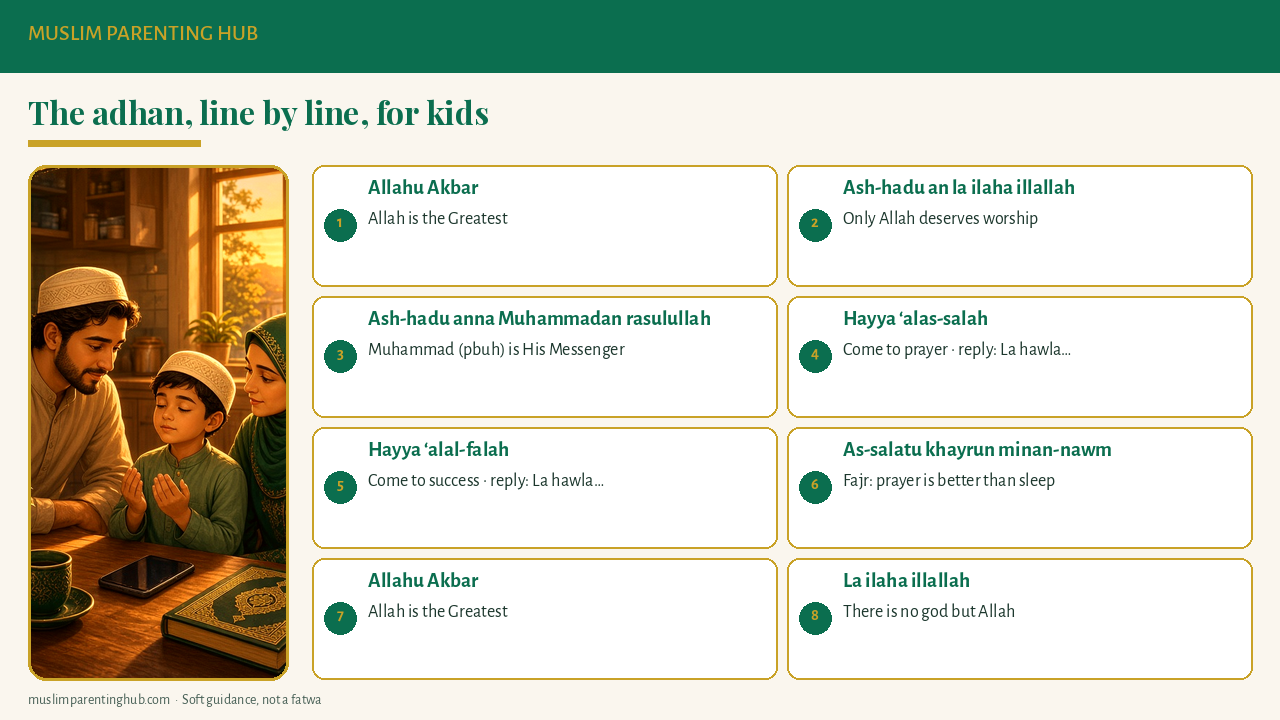
Here is the adhan in the order kids will hear it, with a simple meaning and the reply. Most lines are said twice; the opening “Allahu Akbar” is said four times.
1. Allahu Akbar (4 times) Meaning: Allah is the Greatest. Kid version: “Allah is bigger and better than anything: bigger than the sky, better than any game.” Reply: Allahu Akbar.
2. Ash-hadu an la ilaha illallah (2 times) Meaning: I bear witness that there is no god but Allah. Kid version: “I’m telling everyone: only Allah deserves our worship.” Reply: Ash-hadu an la ilaha illallah.
3. Ash-hadu anna Muhammadan rasulullah (2 times) Meaning: I bear witness that Muhammad is the Messenger of Allah. Kid version: “Prophet Muhammad ﷺ is the one Allah sent to teach us.” Reply: Ash-hadu anna Muhammadan rasulullah.
4. Hayya ‘alas-salah (2 times) Meaning: Come to prayer. Kid version: “Hurry, it’s time to pray!” Reply: La hawla wa la quwwata illa billah (There is no power and no strength except with Allah).
5. Hayya ‘alal-falah (2 times) Meaning: Come to success. Kid version: “Come to what makes you truly win.” Reply: La hawla wa la quwwata illa billah.
6. As-salatu khayrun minan-nawm (2 times, Fajr only) Meaning: Prayer is better than sleep. Kid version: “Waking up for Allah is even better than staying in your cozy bed.” Reply: Many families simply repeat the line quietly. Ask your local imam what your community teaches.
7. Allahu Akbar (2 times) Meaning: Allah is the Greatest. Reply: Allahu Akbar.
8. La ilaha illallah (1 time) Meaning: There is no god but Allah. Kid version: “Only Allah. That’s the last word.” Reply: La ilaha illallah.
Why “La Hawla” for Two Lines?
Kids love spotting the “different” reply. Explain it like this:
“When the caller says ‘Come pray!’ we answer, ‘I can only do it with Allah’s help.’ It’s like saying, ‘I’m coming, Allah, please help me get up.’”
This teaches a beautiful lesson: even good deeds happen because Allah gives us strength. The Prophet ﷺ taught that whoever replies to the adhan sincerely, line by line, from the heart, will enter Paradise (Muslim). That is a big reward for a few small words.
Hand-Motion Game (Ages 3–7)
Young kids remember with their bodies. Practice with a recording, pausing after each line:
- Allahu Akbar: Arms stretch wide and high. “Allah is the GREATEST!”
- Ash-hadu an la ilaha illallah: Hold up one finger. “Only One.”
- Ash-hadu anna Muhammadan rasulullah: Hand on heart. “We love the Prophet ﷺ.”
- Hayya ‘alas-salah: Wave “come here” toward the prayer rug.
- Hayya ‘alal-falah: Both fists up like a winner.
- La ilaha illallah: Finger up again, then a big smile.
When you hear the real adhan later, kids may want to do the motions silently. That’s fine. If they talk over the adhan instead, our scripts for when kids ignore the adhan offer gentle ways to bring the pause back.
Questions Kids Ask About the Adhan
“Who was the first person to call the adhan?” Bilal ibn Rabah, a companion of the Prophet ﷺ with a strong, beautiful voice. He had been enslaved and treated cruelly, and Islam honored him as the first muezzin. Kids love his story.
“Why do we hear it five times?” Because there are five daily prayers. Each adhan says it’s time for the next one. Our guide to the five daily prayers for kids explains Fajr through Isha simply.
“Why don’t we hear it outside like in some countries?” In most US neighborhoods, the adhan is called inside the masjid or played on phones and clocks. It counts just the same when you reply at home.
“Can I call the adhan?” Kids can practice! Many masjids happily let children practice the adhan at home or in Sunday school. It’s a big confidence booster.
What Happens After the Adhan
Once the adhan finishes, three small steps follow:
- Send salawat on the Prophet ﷺ (“Allahumma salli ‘ala Muhammad”).
- Say the dua after the adhan. Our dua after adhan for kids guide has the words, meaning and a 5-day plan.
- Get ready for prayer: wudu, then the prayer rug.
If your child is ready to go from listening to praying, the learn salah for kids 30-day plan builds the habit gently, one week at a time.
A 7-Day Plan to Learn the Adhan’s Meaning
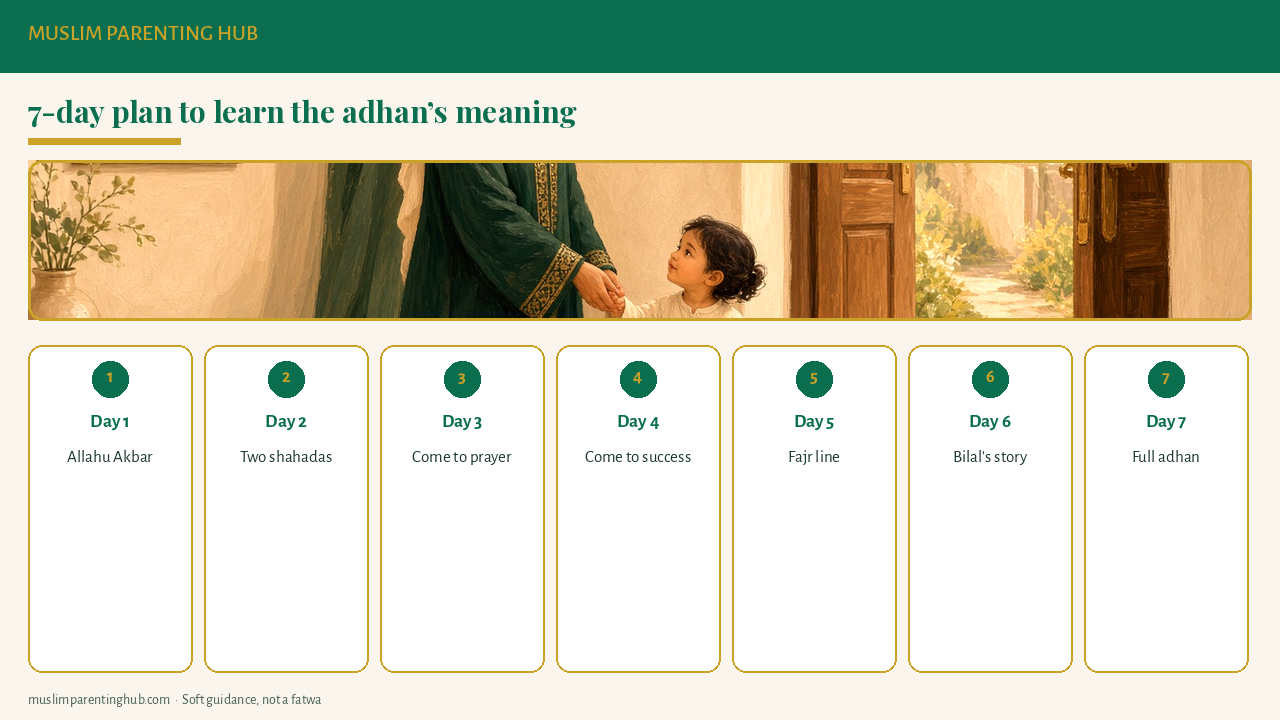
- Day 1 — Allahu Akbar. Learn what it means and do the “arms wide” motion every time you hear it.
- Day 2 — The two shahadas. One finger, hand on heart. Talk about what “bear witness” means: telling the truth out loud.
- Day 3 — Hayya ‘alas-salah. Practice the “come here” wave and the reply “La hawla wa la quwwata illa billah.”
- Day 4 — Hayya ‘alal-falah. Ask, “What does winning mean in Islam?” Talk about real success.
- Day 5 — The Fajr line. “Prayer is better than sleep.” Try a sleepy-to-awake stretch game.
- Day 6 — Bilal’s story. Tell the story of the first muezzin at bedtime.
- Day 7 — Full adhan. Listen together, do all the motions and replies, then make dua.
FAQ
What does the adhan mean in simple English?
The adhan says: Allah is the Greatest; there is no god but Allah; Muhammad is His Messenger; come to prayer; come to success; Allah is the Greatest; there is no god but Allah. In Fajr, it adds “Prayer is better than sleep.”
What should kids reply during the adhan?
Kids repeat each line after the caller, except for “Hayya ‘alas-salah” and “Hayya ‘alal-falah.” For those two lines, they say “La hawla wa la quwwata illa billah.”
What age can kids learn the meaning of the adhan?
Ages 3–5 can learn the big idea (“Allah is calling us to pray”) and hand motions. Ages 6 and up can learn the meaning of each line and the replies.
Who called the first adhan?
Bilal ibn Rabah, a companion of the Prophet ﷺ known for his beautiful voice, was the first muezzin in Islam.
Why is the Fajr adhan different?
The Fajr adhan adds “As-salatu khayrun minan-nawm,” meaning “Prayer is better than sleep,” to remind people that waking up to pray is worth leaving a warm bed.
What do we say after the adhan finishes?
Send salawat on the Prophet ﷺ, then say the dua after the adhan, asking Allah to grant the Prophet ﷺ the special rank of al-wasilah.
Related guides
- Teach kids to answer the adhan at home
- Dua after adhan for kids
- When kids ignore the adhan
- Learn salah for kids: 30-day plan
Closing
When kids understand the adhan, they stop hearing an alarm and start hearing an invitation. Teach one line at a time, add a hand motion, tell Bilal’s story, and pause together when the call comes. Soon your child may be the one saying, “Shh, the adhan!” and that is a moment worth waiting for.
Quick steps
7-day plan to teach kids the meaning of the adhan. Learn one part of the adhan each day with a meaning, a reply and a hand motion, then listen to the full adhan on day 7.
- Day 1 — Allahu Akbar — Learn the meaning and do the arms-wide motion every time you hear it.
- Day 2 — The two shahadas — Hold up one finger and put a hand on the heart; talk about what bearing witness means.
- Day 3 — Hayya ‘alas-salah — Practice the come-here wave and the reply La hawla wa la quwwata illa billah.
- Day 4 — Hayya ‘alal-falah — Talk about what real success means in Islam.
- Day 5 — The Fajr line — Learn that prayer is better than sleep with a sleepy-to-awake stretch game.
- Day 6 — Bilal’s story — Tell the story of the first muezzin at bedtime.
- Day 7 — Full adhan — Listen together with all the motions and replies, then make dua.
Related articles
Teach Kids to Answer the Adhan at Home: Pause Game & 7-Day Plan
Kids talking over the adhan? Use a playful pause game, short reply lines by age, and a 7-day home plan so Muslim kids answer the call to prayer with love.
Read guide →
Dua After Adhan for Kids: Meaning, Easy Transliteration and a 5-Day Way to Learn It
Teach kids the dua after the adhan in small chunks: Arabic, easy transliteration, simple meaning, a 5-day plan and US-home tips for when you can't hear the masjid.
Read guide →
When Kids Ignore the Adhan: Calm Scripts That Actually Work
Calm scripts for when kids ignore the Maghrib adhan for screens, LEGO or games. A 5-day pause-play plan for US Muslim homes—no yelling required.
Read guide →
The 5 Daily Prayers for Kids: Explaining Fajr to Isha With the Sun and Your Family's Day
Explain the five daily prayers to kids with the sun: what Fajr, Dhuhr, Asr, Maghrib and Isha mean, when they come this fall, rak'ah counts, and easy games.
Read guide →