
Learn Salah for Kids: A 30-Day Plan to Teach Your Child to Pray
You know the steps of salah by heart. Teaching them to a wiggly seven-year-old is a different job. Many parents try once, the child gets lost between ruku and sujood, everyone gets frustrated, and practice quietly stops.
The fix is not a longer lesson. It is a smaller one, every day, for a month. This plan breaks salah into four weekly layers so kids learn how to pray in Islam without overload: first the body, then the words, then the order, then the habit. Each day takes 5–10 minutes and fits around a US school schedule.
It works best if your child already pauses for the call to prayer. If not, start with our answer-the-adhan home practice plan — listening to the adhan is the doorway, and salah is the room behind it.
Soft home guidance, not a fatwa. Use the wording and details of your family’s madhhab or your local masjid teacher.
When Should Kids Start Learning Salah?
The Prophet ﷺ said: “Teach your children to pray when they are seven” (Abu Dawud, Tirmidhi). That gives parents a generous runway:
- Ages 3–5: Copy you on the mat. No pressure, lots of joy.
- Ages 5–7: Learn positions and short words with this 30-day plan.
- Age 7+: Start praying regularly with encouragement, building up toward all five prayers by around 10.
If your child is already older than seven, don’t panic. Start this week. Consistency beats the perfect start date.
Before Day 1: Set Up for Success
- A kid-sized prayer mat in a set spot. A simple prayer corner at home makes it feel special.
- Wudu first. If wudu isn’t solid yet, practice it alongside week 1 using our step-by-step salah and wudu guide.
- One fixed practice time. After Maghrib works for most US families because school and homework are done.
- A sticker chart with 30 boxes. Kids love seeing progress.
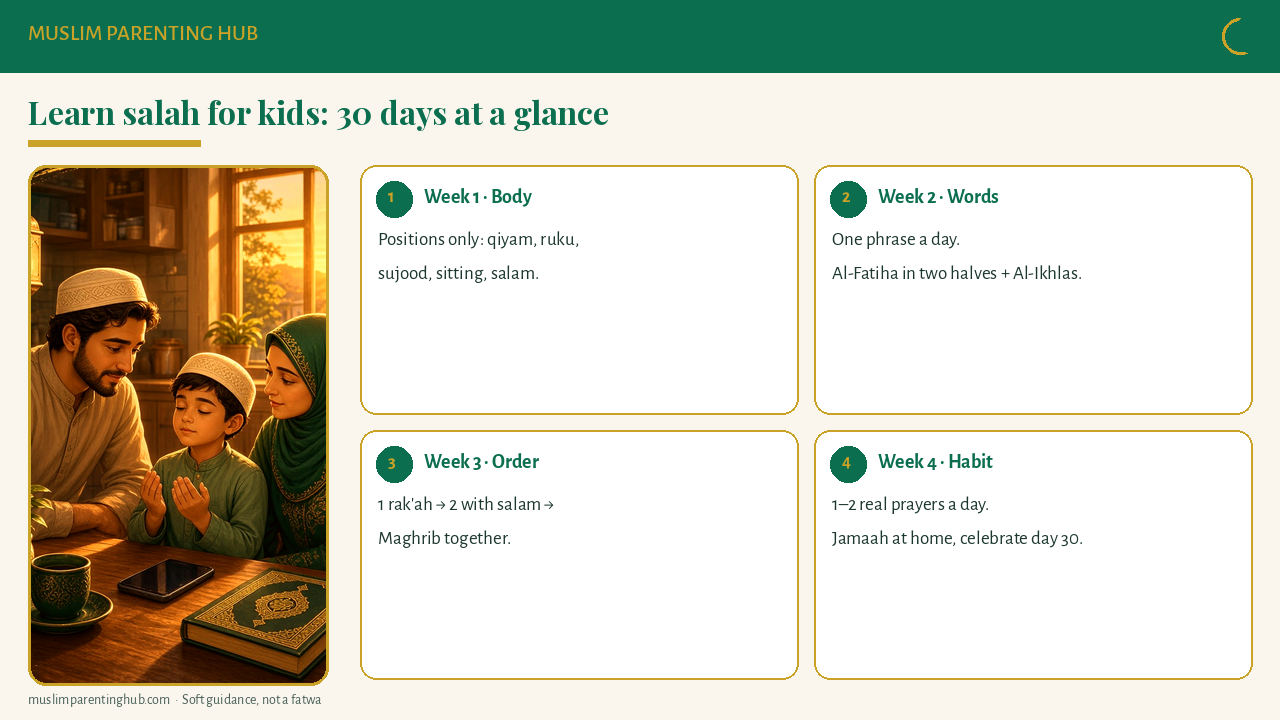
Week 1 (Days 1–7): The Body — Positions Only
No Arabic yet. Just moves.
- Day 1: Standing (qiyam) and the opening Allahu Akbar with hands raised. Play “Salah Simon Says.”
- Day 2: Ruku — bowing with a flat back. Put a toy car on their back; can it stay?
- Day 3: Standing back up and the pause.
- Day 4: Sujood — forehead, nose, palms, knees, toes. Count the seven body parts together.
- Day 5: Sitting between the two sujood.
- Day 6: Sitting for tashahhud and turning the head for salam right and left.
- Day 7: Full silent rak’ah, just the positions, with you leading. Celebrate!
Week 2 (Days 8–14): The Words — Short Phrases First
Teach one phrase a day. Say it, they echo, then they say it alone in the right position.
- Day 8: Allahu Akbar (God is the Greatest) — said at every move.
- Day 9: Subhana Rabbiyal ‘Azeem (Glory to my Lord, the Magnificent) — in ruku.
- Day 10: Sami’ Allahu liman hamidah / Rabbana wa lakal hamd — rising from ruku.
- Day 11: Subhana Rabbiyal A’la (Glory to my Lord, the Most High) — in sujood.
- Day 12–13: Surah Al-Fatiha in two halves. Use a recording on repeat in the car to school.
- Day 14: Review all phrases with positions. Kids can say a short surah they already know after Al-Fatiha — Surah Al-Ikhlas is perfect.
Tashahhud is longer; it’s fine for it to stay “in progress” until week 4 or beyond. Kids can listen to you say it while they sit.
Week 3 (Days 15–21): The Order — Putting Rak’ahs Together
- Day 15: One full rak’ah with words, slowly.
- Day 16: Two rak’ahs — Fajr is the perfect “first prayer” size.
- Day 17: Two rak’ahs with tashahhud and salam.
- Day 18: Learn which prayers have how many rak’ahs (2, 4, 4, 3, 4). Our five daily prayers for kids guide has a kid-friendly chart.
- Day 19: Pray Maghrib together (three rak’ahs) with your child next to you.
- Day 20: Let your child lead a two-rak’ah practice for a sibling or stuffed animal.
- Day 21: Rest day. Talk about how salah felt.
Week 4 (Days 22–30): The Habit — Real Prayers, Real Life
- Days 22–25: Your child prays one real prayer a day with you — Maghrib or Isha.
- Days 26–28: Add a second daily prayer. Weekend Dhuhr is easy to add.
- Day 29: Pray in jamaah at home, with Dad or Mom leading. See how to pray jamaah at home with kids.
- Day 30: Celebration. A special dinner, a new prayer mat, or a trip to the masjid. Say: “You learned salah. That’s a gift for your whole life.”
Making It Work Around US School Days
- Dhuhr and Asr often fall during school. Younger kids aren’t expected to pray at school yet; focus home practice on Maghrib and Isha.
- Older kids (9+) may want to pray Dhuhr at school. Talk to the teacher or counselor; many US public schools allow a quiet space under religious accommodation.
- Daylight saving shifts prayer times. Use a prayer app on the family tablet so kids can see times change.
- Sports and activities: pray before practice or in the car — Islam makes salah portable.
Keep It Joyful (What to Avoid)
- Don’t correct every mistake mid-prayer. Note it, then practice it later in a playful way.
- Don’t make salah a punishment (“Go pray because you were rude!”).
- Don’t compare siblings. Each child learns at their own pace.
- Do praise effort out loud. “I loved how calm your sujood was.”
- Do let them see you pray. Children copy what we do far more than what we say.
FAQ
How do I teach my child to pray in Islam step by step?
Break it into layers: positions first, then short phrases, then the order of rak’ahs, then real daily prayers. Practice 5–10 minutes a day with a fixed time, like after Maghrib.
At what age should a child learn salah?
The Prophet ﷺ said to teach children to pray at seven. You can start playful copying at 3–5 and use a structured plan like this from about 5–7.
How long does it take a child to learn salah?
Many kids learn positions and short phrases in two to four weeks. Al-Fatiha, tashahhud, and full consistency usually take a few months. Steady short practice beats long lessons.
What should a child recite in salah?
Start with Allahu Akbar, the short ruku and sujood phrases, Al-Fatiha, and a short surah like Al-Ikhlas. Tashahhud can come later while they listen to you.
Should my child pray at school in the US?
Young children usually don’t need to; focus on home prayers. Older kids who want to pray Dhuhr can ask the school for a quiet space. Many schools provide religious accommodation.
What if my child doesn’t want to practice?
Shorten practice, add play, and tie it to something they love, like leading the family prayer. Avoid force; stay consistent and warm.
Related guides
- Teach kids to answer the adhan at home
- Teach kids salah and wudu step by step
- When kids ignore the adhan
- Prayer corner at home for kids
Closing
Thirty days from now, your child can stand next to you on the mat and know what to do. It won’t be perfect, and it doesn’t need to be. Small, daily, joyful practice is how a lifetime of salah begins.
Quick steps
30-day plan to teach kids to pray salah. Four weekly layers: positions, words, order of rak'ahs, then real daily prayers.
- Week 1 — Positions — Practice standing, ruku, sujood, sitting and salam silently, one position a day.
- Week 2 — Words — Add one short phrase a day, then Al-Fatiha in two halves and a short surah.
- Week 3 — Order — Put rak'ahs together: one, then two with tashahhud, then three for Maghrib.
- Week 4 — Habit — Pray one, then two real prayers a day together, then pray jamaah at home and celebrate on day 30.
Related articles

How to Teach Kids to Pray Salah Step by Step (With Wudu): A Parent's Guide for Ages 5–10
A calm, step-by-step guide to teaching kids wudu and salah—what to say in each position, a 2-rak'ah practice plan, and age-by-age expectations for ages 5–10.
Read guide →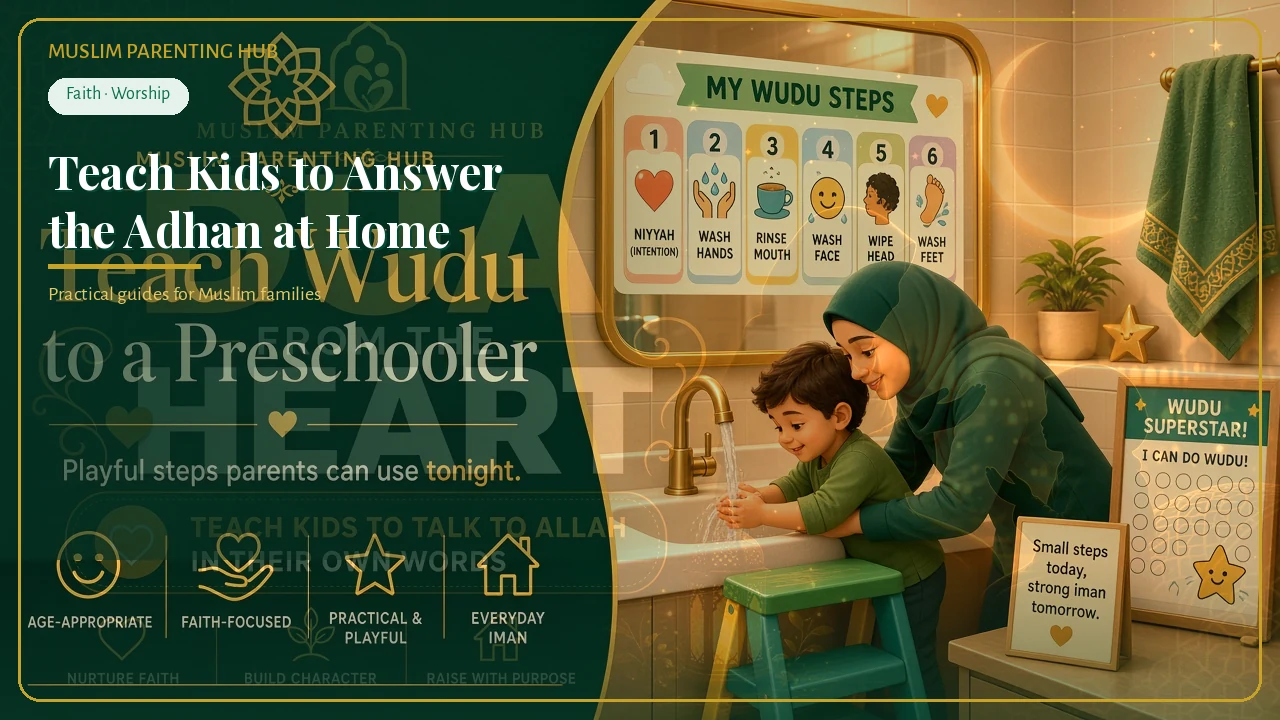
Teach Kids to Answer the Adhan at Home: Pause Game & 7-Day Plan
Kids talking over the adhan? Use a playful pause game, short reply lines by age, and a 7-day home plan so Muslim kids answer the call to prayer with love.
Read guide →
The 5 Daily Prayers for Kids: Explaining Fajr to Isha With the Sun and Your Family's Day
Explain the five daily prayers to kids with the sun: what Fajr, Dhuhr, Asr, Maghrib and Isha mean, when they come this fall, rak'ah counts, and easy games.
Read guide →
How to Set Up a Prayer Corner for Kids at Home: A Small Space That Builds a Big Salah Habit
Set up a kid-friendly prayer corner at home in 6 easy steps: finding the qiblah, rugs, a prayer basket, a salah chart and age-by-age jobs that make salah stick.
Read guide →