

How to Teach Your Child to Call the Adhan at Home: A 2-Week Plan for Young Muezzins
In most American neighborhoods, there is no adhan floating over the rooftops five times a day. The call to prayer lives in a phone app, an adhan clock on the shelf, or the masjid twenty minutes away. For kids, that can make salah feel like something that happens somewhere else.
One of the most beautiful ways to change that is to let your child become the voice of the adhan at home. When a seven-year-old stands in the living room, hands by their ears, calling “Allahu Akbar,” the whole family stops. Siblings come running. And the child learns, in their bones, that they belong to this call.
This guide gives US Muslim parents a simple, two-week plan to teach a child to call the adhan at home: the words, how to stand, how to build a shy child’s confidence, and how to keep it joyful. It is gentle home guidance, not a fatwa; ask your local imam about details your family follows.
If your child is still learning to stop and respond to the adhan, start with our guide on teaching kids to answer the adhan at home. Responding comes first; calling is the next step.
Can a Child Call the Adhan?
Yes. Scholars have long accepted the adhan of a child who is old enough to understand what they are doing (often around 7). The companion ‘Amr ibn Salamah led his people in prayer as a young boy because he had memorized the most Quran (Bukhari), and children learning the adhan has always been part of Muslim homes and masjids.
At home, the adhan is a lovely family Sunnah rather than a strict requirement. Families differ on the details:
- Boys can practice calling the adhan aloud for the family and, when they are ready, may be invited to call it at the masjid by the imam.
- Girls can absolutely learn every word, its meaning and the replies. Many families have girls call a softer adhan or the iqamah at home among family, while public adhan is given by men in most schools. Follow the guidance of your local imam.
Either way, every child gains the same treasure: knowing the call by heart.
The Words of the Adhan
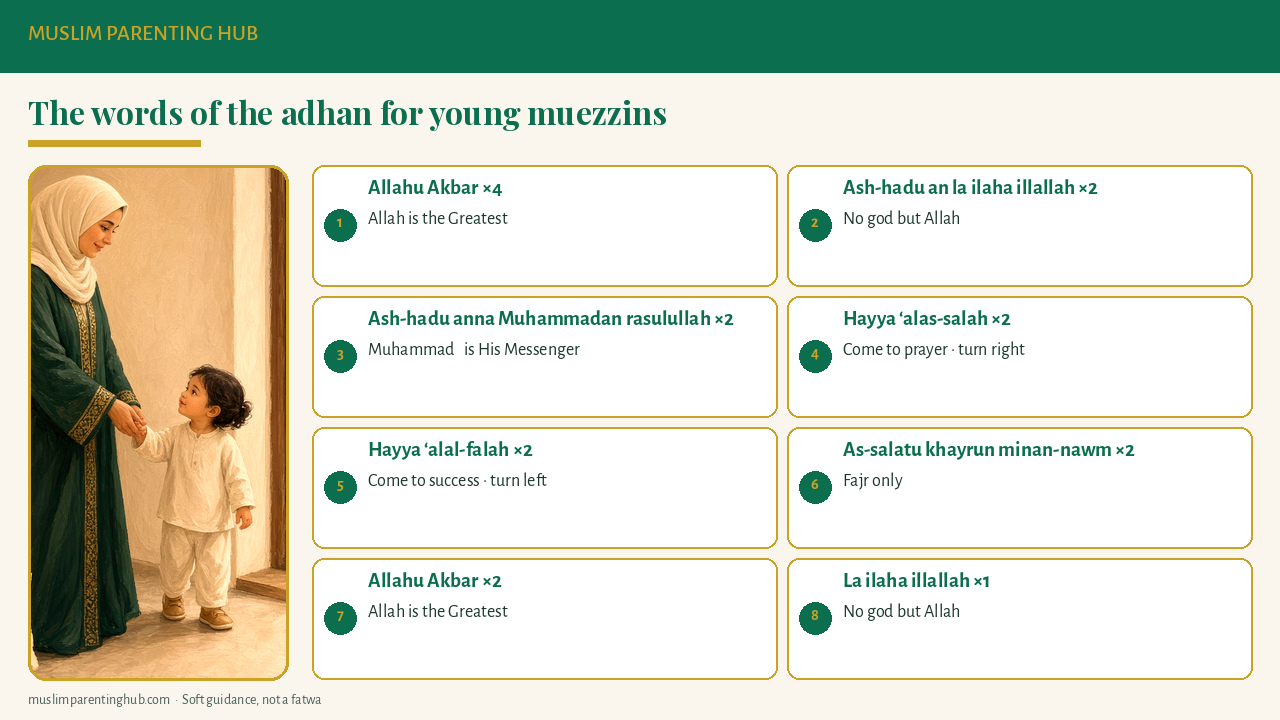
| Line | Times | Meaning |
|---|---|---|
| Allahu Akbar | 4 | Allah is the Greatest |
| Ash-hadu an la ilaha illallah | 2 | I bear witness there is no god but Allah |
| Ash-hadu anna Muhammadan rasulullah | 2 | I bear witness Muhammad is the Messenger of Allah |
| Hayya ‘alas-salah | 2 | Come to prayer |
| Hayya ‘alal-falah | 2 | Come to success |
| (Fajr only) As-salatu khayrun minan-nawm | 2 | Prayer is better than sleep |
| Allahu Akbar | 2 | Allah is the Greatest |
| La ilaha illallah | 1 | There is no god but Allah |
For a deeper, line-by-line explanation in kid language, use our guide to what the adhan means for kids.
How to Stand and Call (The Muezzin Basics)
Teach these five small things. Kids love having a “real” way to do it.
- Wudu first if possible. It’s recommended, and it makes the moment feel special.
- Face the qiblah. Use a compass app or the arrow in your prayer corner.
- Fingers in or near the ears. Bilal (may Allah be pleased with him) put his fingers in his ears while calling the adhan (Tirmidhi). It also helps kids hear their own voice.
- Turn the head. Bilal turned his face to the right and left on the two “Hayya” lines (Bukhari, Muslim). Many teachers say: right for “Hayya ‘alas-salah,” left for “Hayya ‘alal-falah.” Just the head, not the whole body.
- Slow and clear. Pause between lines. Long, steady breaths beat a rushed shout every time.
The 2-Week Young Muezzin Plan
Ten minutes a day is enough. Pick one prayer time, usually Maghrib or Isha when everyone is home.
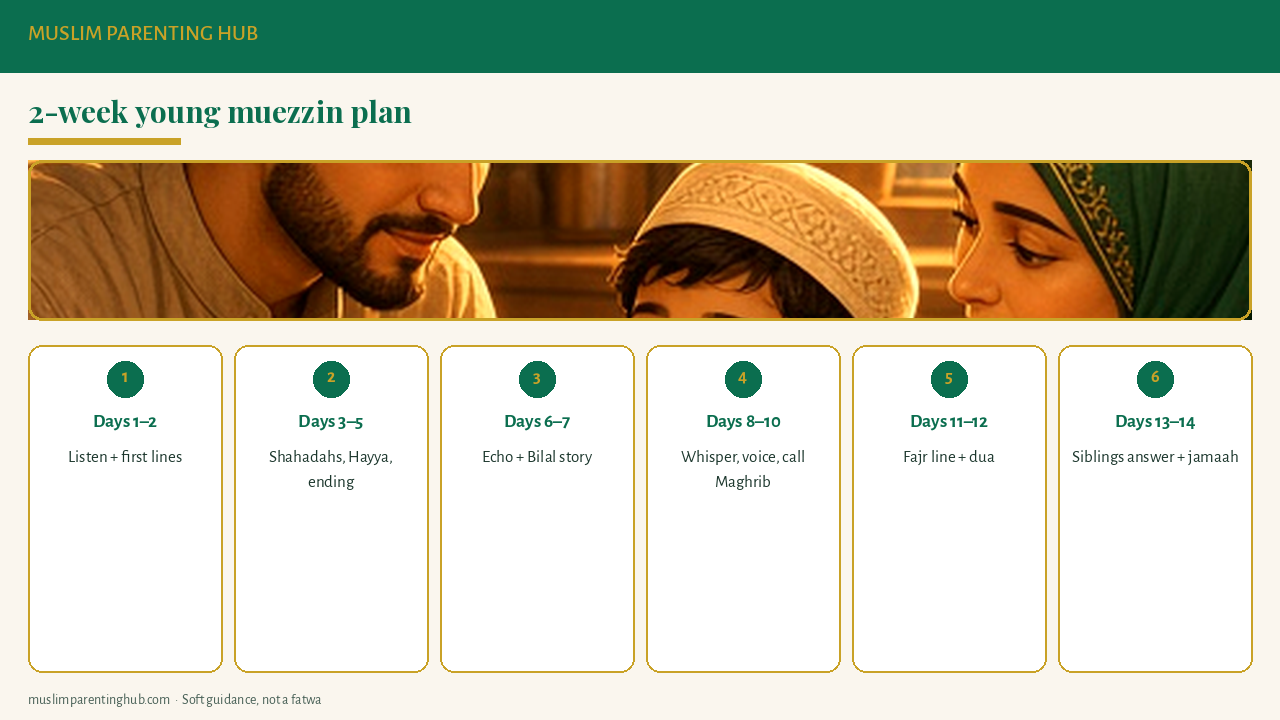
Week 1: Learn the words
- Day 1 — Listen together. Play a recorded adhan from Makkah or your local masjid. Count how many times you hear “Allahu Akbar.”
- Day 2 — The first two lines. Practice the four “Allahu Akbar” and the first shahadah, one breath per line.
- Day 3 — The second shahadah. Add “Ash-hadu anna Muhammadan rasulullah.” Talk about what “bear witness” means.
- Day 4 — Come to prayer, come to success. Add the two “Hayya” lines with the head turns. Kids love this part.
- Day 5 — The ending. “Allahu Akbar” twice, “La ilaha illallah” once. Now say the whole thing with you, line by line.
- Day 6 — Echo practice. You say a line, your child repeats it. Swap roles.
- Day 7 — Rest and celebrate. No practice. Tell the story of Bilal at bedtime and how his beautiful voice was chosen for the first adhan.
Week 2: Call it for real
- Day 8 — Whisper adhan. Your child says the whole adhan softly, with you mouthing along.
- Day 9 — Normal voice. Same, in a speaking voice, facing qiblah, hands at ears.
- Day 10 — Call one prayer. Your child calls the adhan for the family’s Maghrib. Everyone else answers.
- Day 11 — Add the Fajr line. Practice “As-salatu khayrun minan-nawm” for weekends when Fajr is at home.
- Day 12 — Learn the dua after the adhan. See our dua after adhan for kids for the words and meaning.
- Day 13 — Siblings answer. Younger siblings practice replying while the older one calls.
- Day 14 — Family jamaah. Your child calls the adhan, then the family prays together. Our guide to praying jamaah at home with kids shows how to set it up.
Helping a Shy or Nervous Child
Some kids freeze when everyone looks at them. That is fine.
- Start alone. Let them practice in their room, or to a stuffed animal “congregation.”
- Record it. Many shy kids are happy to record the adhan on your phone and play it for the family.
- Lower the volume. A quiet, clear adhan is still an adhan.
- No corrections in front of others. Fix pronunciation later, privately, with a smile.
- Praise the effort, not the voice. “You called people to Allah today. That is a huge deal.”
Keep It Joyful (Not a Performance)
- Never force it. If they don’t want to call it today, someone else does. Invite again tomorrow.
- Rotate roles. One child calls the adhan, another lays out the prayer rugs, a third says the iqamah.
- Mark the moment. A small “Muezzin of the Week” card on the fridge goes a long way.
- Keep it at home first. If the imam later invites your child to call the adhan at the masjid, wonderful, but home is the place to grow confidence.
If your kids sometimes tune out the call completely, our calm scripts for when kids ignore the adhan can help.
FAQ
At what age can a child call the adhan?
Many scholars accept the adhan of a child old enough to understand it, often around age 7. At home, even younger children can practice the words and call a family adhan with a parent beside them.
Can girls call the adhan at home?
Girls can learn every word, its meaning and the replies. Many families let girls call a softer adhan or the iqamah at home among family, while public adhan is given by men in most schools. Ask your local imam for your family’s practice.
Does my child need wudu to call the adhan?
Wudu is recommended for the adhan but not required by most scholars. Teaching kids to make wudu first helps the moment feel special and gets them ready for salah right after.
Why does the muezzin put fingers in the ears?
Bilal, the first muezzin, put his fingers in his ears while calling the adhan (Tirmidhi). It helps the caller project their voice, and kids enjoy copying this Sunnah.
Should we still call the adhan at home if we use an adhan app?
Yes, if you can. An app is a helpful reminder, but a family member calling the adhan, especially a child, builds love for salah and keeps a beautiful Sunnah alive in the home.
How long does it take a child to learn the adhan?
Most children can learn the words in one to two weeks with ten minutes a day. Confidence to call it in front of the family may take a little longer. Keep it relaxed and praise every try.
Related guides
- Teach kids to answer the adhan at home
- What does the adhan mean? A line-by-line guide
- Dua after adhan for kids
- 5 daily prayers for kids explained
Closing
The adhan is a call, and children are wonderful callers. When your son or daughter stands up, faces the qiblah and says “Allahu Akbar” for the family, your home becomes a little masjid for a moment. Start small, keep it warm, and let them grow into the voice that calls your family to prayer.
Quick steps
2-week plan to teach a child to call the adhan at home. Ten minutes a day: learn the words in week one, then call the adhan for the family in week two.
- Days 1–2 — Listen and start — Listen to a recorded adhan together, then practice the four Allahu Akbar and the first shahadah.
- Days 3–5 — Build the words — Add the second shahadah, the two Hayya lines with head turns, and the ending.
- Days 6–7 — Echo and rest — Echo the adhan line by line, then rest and tell the story of Bilal at bedtime.
- Days 8–10 — Call it — Whisper the whole adhan, then say it in a normal voice facing qiblah, then call the family’s Maghrib.
- Days 11–12 — Fajr line and dua — Add As-salatu khayrun minan-nawm and learn the dua after the adhan.
- Days 13–14 — Family jamaah — Siblings answer while your child calls, then the family prays together.
Related articles

What Does the Adhan Mean? A Line-by-Line Guide for Kids (With Simple Meanings)
What does the adhan mean? Each line of the call to prayer in simple English for kids, with what to reply, hand-motion games, and a 7-day learning plan.
Read guide →
Teach Kids to Answer the Adhan at Home: Pause Game & 7-Day Plan
Kids talking over the adhan? Use a playful pause game, short reply lines by age, and a 7-day home plan so Muslim kids answer the call to prayer with love.
Read guide →
Dua After Adhan for Kids: Meaning, Easy Transliteration and a 5-Day Way to Learn It
Teach kids the dua after the adhan in small chunks: Arabic, easy transliteration, simple meaning, a 5-day plan and US-home tips for when you can't hear the masjid.
Read guide →
How to Pray in Jama'ah at Home With Kids: Rows, Iqamah and Wiggly Toddlers
A calm guide to praying in congregation at home with kids: who stands where, letting a child say the iqamah, short recitations, toddlers on the rug and a family dua.
Read guide →