

What Age Should a Child Start Praying in Islam? A Gentle Age-by-Age Guide
Maybe your four-year-old already copies you on the prayer mat, bowing at random moments and giggling in sujood. Or your seven-year-old has just had a birthday and someone at the masjid asked, “Is he praying yet?” Either way, the question comes up for every Muslim parent: when should my child actually start praying?
The short answer is well known: the Prophet ﷺ said to teach children to pray at seven. But the full picture is gentler and more practical than a single number. Prayer grows in stages, from watching and copying, to learning the words, to praying all five on their own.
This guide explains what the hadith says, what to expect at each age, what “firm at ten” does and doesn’t mean, and a gentle four-week starter plan for a seven-year-old. It is home guidance, not a fatwa; follow your local imam where your community has a particular practice.
If you also want a playful way to get even toddlers responding to the call to prayer, our guide on how to teach kids to answer the adhan at home is a great first step at any age.
What the Hadith Says
The Prophet ﷺ said: “Teach your children to pray when they are seven years old, and be firm with them about it when they are ten” (Abu Dawud, Tirmidhi; graded hasan).
Three things follow from this:
- Salah becomes required (fard) at puberty. Before that, a child’s prayers are rewarded, but missing them is not a sin.
- Seven is the age to start teaching seriously. It is the start of a three-year runway, not a deadline for perfection.
- Ten is when the expectation becomes firm. By then, praying all five should be a normal, expected part of the day.
The wisdom is beautiful: three years of practice before firmness, and several more before it is required. By the time salah is fard, it should already feel like home.
What “Firm at Ten” Means Today
The original wording mentions discipline at ten. Many parents worry about this. Scholars explain that the aim is seriousness and consistency, not harshness, and many today stress that any discipline must be gentle, never humiliating, and never in anger. Aisha said the Prophet ﷺ never struck a servant or a woman with his hand (Muslim), and he was famously gentle with children.
In practice, “firm” in a modern Muslim home looks like:
- Salah is not optional, the same way brushing teeth isn’t.
- Missed prayers are noticed and made up, calmly.
- Screens, play and outings wait until the prayer is done.
- Parents pray on time themselves, so kids see it is real.
Shouting, threats and shame usually make kids resent salah. Calm, steady expectations work far better.
Age by Age: What to Expect
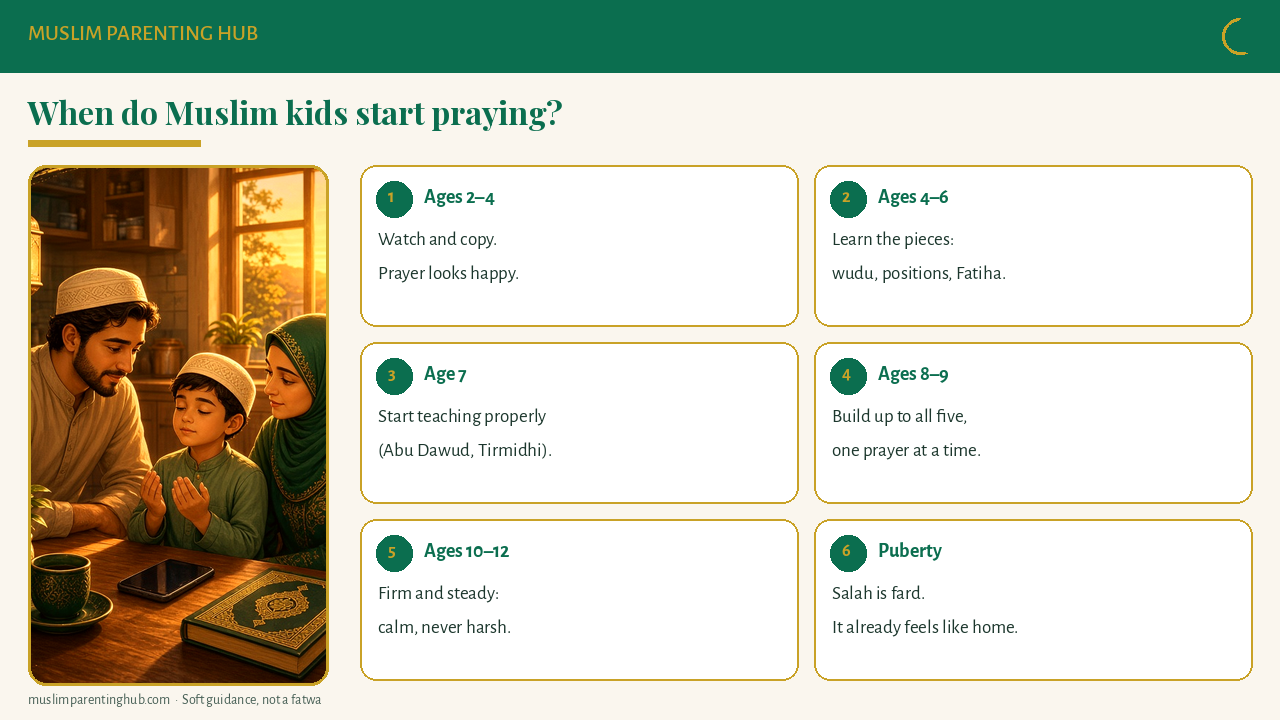
Ages 2–4: Watch and Copy
Toddlers learn by imitation. Let them stand next to you, bow when you bow and put their head down in sujood. They will wander off, climb on your back and lie on the mat. All of that is fine.
Your goal: Prayer looks happy and normal. A small mat of their own helps; our guide to a prayer corner for kids at home shows how to set one up.
Ages 4–6: Learn the Pieces
Now they can learn the parts: “Allahu Akbar,” wudu (playful, splashy and step by step), the positions, and short surahs.
Your goal: One short prayer together most days, often Maghrib. Start memorizing Al-Fatiha slowly. Our Surah Al-Fatiha for kids guide has a 14-day plan.
Age 7: Start Teaching Properly
Seven is the Sunnah start. Teach the whole prayer, including the words in each position, and begin building toward all five. Our step-by-step guide to teaching kids to pray salah with wudu walks through each rak’ah.
Your goal: One or two daily prayers reliably by the end of the first month, growing to five over the year.
Ages 8–9: Build All Five
Add prayers one at a time. School-day Dhuhr and Asr are the hardest; our guide to how Muslim kids can pray at school helps with winter prayer times.
Your goal: All five most days, with gentle reminders.
Ages 10–12: Firm and Steady
Salah is expected. Kids set their own reminders, make wudu alone and make up missed prayers.
Your goal: Consistency and ownership. Praise effort and talk about why we pray, not just whether they did.
Puberty: Required
Once your child reaches puberty, salah is fard. If the earlier years went well, this transition is barely noticeable.
A Gentle Age-7 Starter Month
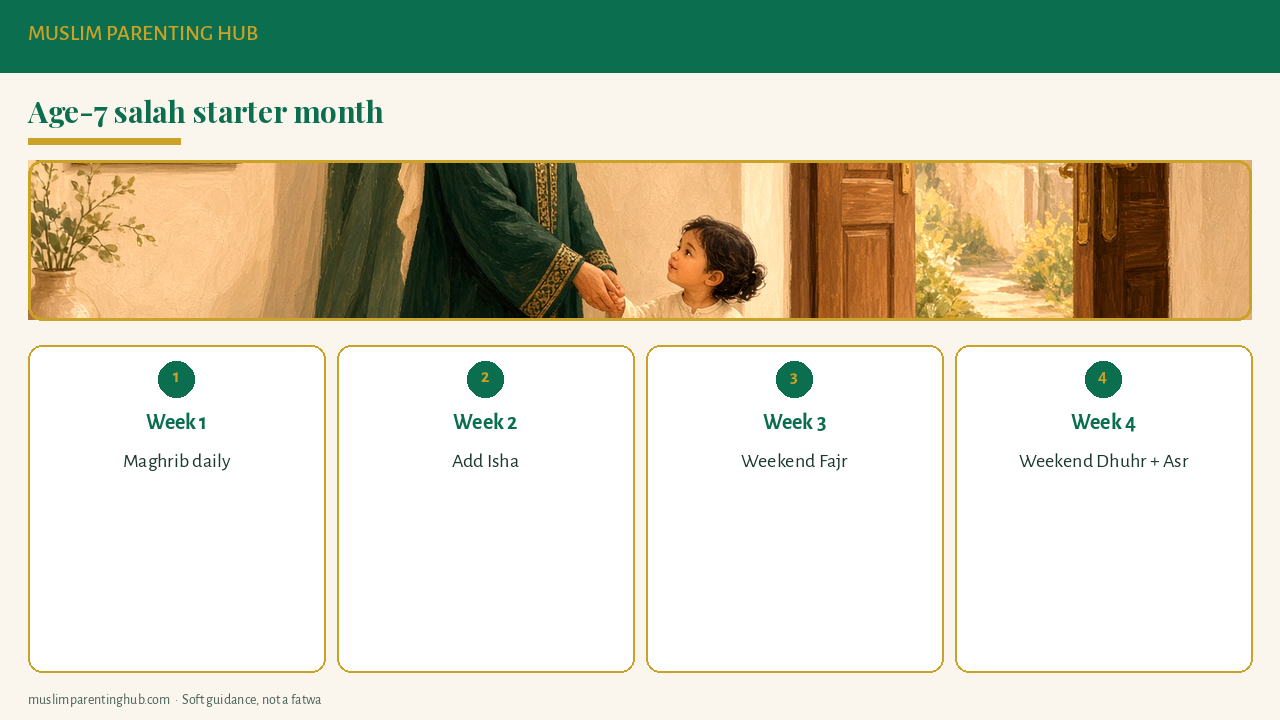
This plan suits a child who knows the basic movements but isn’t praying regularly yet. Adjust it for an older beginner.
- Week 1: One prayer a day. Pray Maghrib together every evening. Keep it short, warm and on time.
- Week 2: Add Isha. Pray Isha before the bedtime routine, then read a story.
- Week 3: Add Fajr on weekends. Wake them gently on Saturday and Sunday. Daylight saving ends on 1 November: Fajr moves an hour earlier on the clock, but your child’s body clock hasn’t shifted yet, so those first mornings feel no earlier than usual. It’s a great time to start. See our gentle plan to wake kids for Fajr.
- Week 4: Add Dhuhr and Asr on weekends. Weekdays can wait until you have a school plan.
Celebrate the end of the month with something special: a new prayer mat, a trip to the masjid or a family dinner.
Tips That Make Starting Easier
- Pray with them. Children copy what they see more than what they hear.
- Keep it short. Two rak’ahs and a quick dua is perfect at first.
- Use the adhan as the cue. When the adhan app plays, everyone pauses. The five daily prayers for kids guide explains each prayer’s time simply.
- Don’t bribe every prayer. A chart with stickers for the first month is fine, but slowly move the motivation to love of Allah.
- Talk about the why. “Salah is our five daily visits with Allah. He’s waiting to hear from you.”
- Expect bad days. A missed prayer is a chance to make it up, not a reason to lecture.
For a full structured approach, our 30-day plan to learn salah breaks the prayer into daily steps.
Common Worries
“My five-year-old wants to pray all five already.” Wonderful. Let them, and don’t push extra.
“My eight-year-old hasn’t started.” That’s okay. Start with the starter month today; there is still plenty of runway before puberty.
“My child rushes through it.” Pray together slowly and model it. Praise calm prayers: “I loved how gently you did your sujood.”
“My child refuses.” Ask why. Often it’s tiredness, a screen or feeling it’s boring. Fix the obstacle and keep the expectation calm.
FAQ
What age should a child start praying in Islam?
The Prophet ﷺ said to teach children to pray at seven and be firm about it at ten (Abu Dawud, Tirmidhi). Toddlers can join in and copy earlier. Salah becomes required at puberty, so seven to ten is a gentle runway to build the habit.
Is prayer compulsory for a 7-year-old?
No. Salah is not fard until puberty, so a seven-year-old is not sinful for missing a prayer. Seven is the age parents should start teaching it properly, and every prayer the child does is rewarded.
What does “be firm at ten” mean for Muslim parents today?
It means salah becomes a firm, expected part of the day: missed prayers are noticed and made up, and play waits until prayer is done. Scholars stress any discipline must be gentle, never humiliating or in anger. Calm consistency works best.
Can toddlers pray with their parents?
Yes. Toddlers can stand beside you, copy the movements and play on the mat. It’s fine if they wander or climb on you during sujood. The goal at this age is that prayer feels happy and normal.
Which prayer should kids start with?
Many families start with Maghrib, because the whole family is usually home and it’s short. Add Isha next, then Fajr on weekends, then Dhuhr and Asr. Build up one prayer at a time over the year.
How do I teach my 7-year-old to pray all five prayers?
Add one prayer at a time over a few weeks, pray together, use the adhan as a cue and keep prayers short. Use a sticker chart for the first month, plan school-day Dhuhr and Asr, and praise effort more than perfection.
Related guides
- Teach kids to answer the adhan at home
- Learn salah for kids: 30-day plan
- Teach kids to pray salah step by step (with wudu)
- 5 daily prayers for kids explained
- How to wake kids for Fajr
Closing
There is no magic birthday when a child suddenly becomes a praying Muslim. Salah grows: a toddler copying on the mat, a five-year-old saying Allahu Akbar, a seven-year-old learning the words, a ten-year-old praying on their own. Start gently, pray together and keep the expectation calm. By puberty, prayer will already be part of who they are.
Quick steps
Gentle age-7 salah starter month. Four weeks that build a seven-year-old from one daily prayer toward all five.
- Week 1 — One prayer a day — Pray Maghrib together every evening, short, warm and on time.
- Week 2 — Add Isha — Pray Isha before the bedtime routine, then read a story.
- Week 3 — Weekend Fajr — Wake your child gently for Fajr on Saturday and Sunday.
- Week 4 — Weekend Dhuhr and Asr — Add Dhuhr and Asr on weekends and celebrate the end of the month.
Related articles
Teach Kids to Answer the Adhan at Home: Pause Game & 7-Day Plan
Kids talking over the adhan? Use a playful pause game, short reply lines by age, and a 7-day home plan so Muslim kids answer the call to prayer with love.
Read guide →
How to Teach Kids to Pray Salah Step by Step (With Wudu): A Parent's Guide for Ages 5–10
A calm, step-by-step guide to teaching kids wudu and salah—what to say in each position, a 2-rak'ah practice plan, and age-by-age expectations for ages 5–10.
Read guide →
The 5 Daily Prayers for Kids: Explaining Fajr to Isha With the Sun and Your Family's Day
Explain the five daily prayers to kids with the sun: what Fajr, Dhuhr, Asr, Maghrib and Isha mean, when they come this fall, rak'ah counts, and easy games.
Read guide →
Learn Salah for Kids: A 30-Day Plan to Teach Your Child to Pray
How to teach kids to pray in Islam, one small layer a week: a 30-day learn-salah plan for ages 5–10 with positions, words and US school-day tips.
Read guide →