

Child Rushing Through Salah? 9 Gentle Ways to Help Kids Slow Down and Focus (Khushu for Kids)
You hear the adhan app, you call “Salah time!”, and your eight-year-old disappears onto the prayer mat. Ninety seconds later, they are back on the couch. “Done!” Four rak’ahs of Isha, finished faster than a commercial break. Or your six-year-old prays beside you while watching their brother, scratching their knee and humming.
First, take a breath: a child who prays fast is still a child who prays. That is a big win. But we also want salah to grow from a quick routine into a real conversation with Allah. That quality has a name: khushu, a calm, present heart in prayer.
This guide explains why kids rush, what khushu realistically looks like at different ages, nine gentle Sunnah-based ways to help, and a seven-day “slow salah” plan. It pairs well with our guide to teaching kids to answer the adhan at home, because the minutes between the adhan and the first “Allahu Akbar” are where focus is won or lost.
Why Kids Rush Salah
Rushing is rarely about faith. It’s usually one of these:
- Something fun is waiting. A game, a show, a sibling mid-Lego build.
- They don’t know what the words mean. Arabic they don’t understand feels like a list to get through.
- Nobody prays with them. Praying alone, children set their own (fast) pace.
- They copied someone fast. Kids imitate the pace they see.
- They’re tired or hungry. Isha after a long day is hard for little bodies.
- Salah feels like a chore, not a connection. Usually because it’s mostly been reminders and nagging.
Notice that most of these are fixable by parents, not by lectures.
What Khushu Looks Like at Each Age
Allah describes the successful believers as “those who are humbly focused (khashi’un) in their prayer” (Quran 23:1–2). For adults, khushu is a lifelong project. For kids, set realistic goals:
- Ages 4–6: Stays on the mat for the whole short prayer. Wandering eyes are normal.
- Ages 7–9: Pauses in each position. Knows the meaning of Al-Fatiha and the ruku’ and sujood words.
- Ages 10–12: Prays at a calm pace without reminders, makes a personal dua in sujood and understands why slowing down matters.
If your child is just beginning, our guide to what age a child should start praying in Islam explains what to expect year by year.
9 Gentle Ways to Help Kids Slow Down and Focus
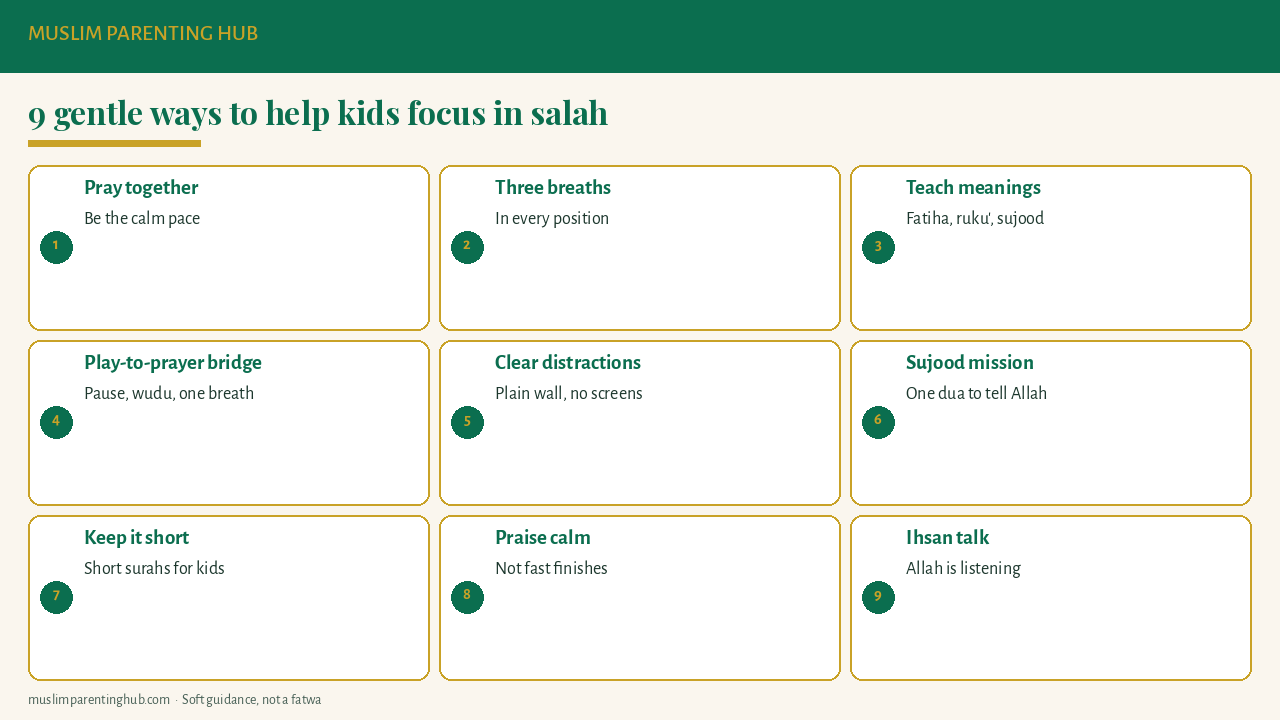
1. Pray Together, and Be the Pace
The single most effective fix. When your child prays next to you, or behind you in a small family jamaah, they follow your speed. Pray at a calm, steady pace, not a slow-motion performance. Our guide to praying jamaah at home with kids shows how to make this a family habit.
2. Teach the “Three-Breath Rule”
The Prophet ﷺ once watched a man pray quickly and told him, “Go back and pray, for you have not prayed.” When the man asked to be taught, the Prophet ﷺ explained each position and said to stay in it “until you are at ease” (Bukhari, Muslim). Scholars call this stillness tuma’ninah, and it is part of a valid prayer.
For kids, turn it into a rule they can feel: take three slow breaths in each position (in ruku’, standing up from ruku’, in sujood and sitting between the two sujood). It is simple, measurable and calming.
3. Teach What the Words Mean
When a child knows that Subhana Rabbiyal ’Azim means “Glory to my Lord, the Most Great,” the words stop being sounds. Start with Al-Fatiha: our Surah Al-Fatiha for kids guide gives the meaning line by line. Then teach one position’s words a week, in English first and then in Arabic.
4. Build a Two-Minute Bridge From Play to Prayer
Rushing often starts before salah. A child yanked from a game prays with their mind still in the game. Create a short bridge:
- Pause the game at the adhan (a “pause game” works well).
- Walk to wudu. Wudu itself is calming, as cool water slows everyone down.
- Stand on the mat and take one quiet breath before “Allahu Akbar.”
If your child tends to ignore the call completely, our guide to what to do when kids ignore the adhan has calm scripts.
5. Clear the Distractions
The Prophet ﷺ once asked Aisha to take down a decorated curtain, saying its pictures kept appearing to him during his prayer (Bukhari). If a busy curtain could distract the best of creation, a TV on in the background will certainly distract a seven-year-old.
Pick a calm prayer spot facing a plain wall, with no screens in view and toys out of reach. Our prayer corner ideas for kids make this easy and inviting.
6. Give Sujood a Job
The Prophet ﷺ said: “The closest a servant is to his Lord is when he is in sujood, so make plenty of dua” (Muslim). Kids love having a mission. Before salah, ask: “What’s one thing you want to tell Allah in sujood today?” In the last sujood, they can say it quietly in their own language. Suddenly sujood is the best part, not the part to rush.
7. Keep Prayers Short (Yes, Really)
Short and focused beats long and fidgety. The Prophet ﷺ said that he would begin a prayer intending to make it long, then hear a baby crying and shorten it, knowing how hard it was for the mother (Bukhari, Muslim). He was gentle about people’s limits. For children, use the shortest surahs after Al-Fatiha, and save long recitations for when they are older.
8. Praise Calm Prayers, Not Fast Finishes
Notice what you want more of: “I loved how still you were in sujood.” “You took your three breaths in every position. MashaAllah!” Avoid praising speed (“Wow, done already!”), and avoid shaming slowness or mistakes. Praise focus, and you will see more focus.
9. Talk About Who You’re Talking To
The deepest fix is understanding. In the famous hadith of Jibril, the Prophet ﷺ described ihsan as “to worship Allah as though you see Him; and if you do not see Him, He sees you” (Bukhari, Muslim). For kids:
“When you pray, Allah is listening to every word. If you were talking to someone who loves you that much, would you hurry away?”
Keep it warm, not guilt-heavy. The goal is love, not fear.
What Not to Say
- “Your prayer doesn’t count!” It discourages children and is usually not true for a learning child.
- “Do it again, properly!” in front of siblings. Correct privately and gently, at another time.
- “Allah is angry with you for rushing.” Teach Allah’s mercy first.
- Long speeches right after salah. Pick one small thing to work on this week.
A Daylight-Saving Fresh Start
Clocks fall back on Sunday 1 November, so Maghrib and Isha suddenly arrive an hour earlier on the clock, often before homework and dinner are done. New prayer times are a natural moment for a reset: “New times, new slow-salah habit.” Our guide to the daylight-saving Maghrib and bedtime shift helps you rearrange evenings, and our gentle plan to wake kids for Fajr uses the same week to start Fajr.
The Seven-Day Slow-Salah Plan

Pick one prayer a day, usually Maghrib, for this plan. Keep the rest as normal.
- Day 1 — Pray together. Pray side by side and let your calm pace lead. Say nothing about speed.
- Day 2 — Three breaths. Introduce the three-breath rule. Practice it once outside of salah, then use it.
- Day 3 — One meaning. Teach the meaning of Subhana Rabbiyal ’Azim and Subhana Rabbiyal A’la.
- Day 4 — The bridge. Pause play at the adhan, make wudu together and take one quiet breath on the mat.
- Day 5 — Sujood mission. Before salah, choose one thing to tell Allah in the last sujood.
- Day 6 — Child leads the pace. Let your child set a calm pace while you follow. Praise the stillness.
- Day 7 — Celebrate and choose. Talk about what felt different. Pick one habit to keep for every prayer.
After the week, keep the three-breath rule and the sujood mission. Revisit the plan whenever rushing creeps back.
FAQ
Is my child’s salah valid if they pray very fast?
Stillness in each position (tuma’ninah) is part of a correct prayer; the Prophet ﷺ told a man who rushed to pray again (Bukhari, Muslim). For young learners, focus on gently teaching the pace rather than declaring prayers invalid. Children aren’t sinful for mistakes before puberty.
How can I help my child focus in salah?
Pray together, clear distractions, teach the meaning of the words, build a short bridge from play to prayer and give sujood a “mission” (one dua). Praise calm prayers rather than fast ones.
What is khushu in simple words for kids?
Khushu means your heart is calm and paying attention while you pray. You know you’re talking to Allah, you don’t rush and you think about the words. Allah praises believers who are “humbly focused in their prayer” (23:1–2).
What is the three-breath rule in salah?
It’s a simple way to teach kids tuma’ninah: take three slow breaths in each position, including ruku’, standing up, sujood and sitting between the sujood. It stops rushing and helps children feel the stillness the Sunnah asks for.
My child looks around during salah. Is that okay?
It is very normal for young children. Gently teach them to look at the place of sujood, pray in a spot without screens or toys in view and praise them when they keep their eyes down. Expect progress over months, not days.
Should I make my child repeat a rushed prayer?
For a young child, it’s usually better to pray the next prayer together slowly than to force a repeat in frustration. Older children can learn the hadith of the man told to “go back and pray,” calmly and privately.
Related guides
- Teach kids to answer the adhan at home
- Teach kids to pray salah step by step (with wudu)
- Surah Al-Fatiha for kids: meaning + plan
- Family prayer at home: jamaah with kids
- Learn salah for kids: 30-day plan
Closing
A rushed prayer is a starting point, not a failure. Pray beside your child, slow your own pace, teach the meaning of a few words and give sujood a purpose. Over time, the ninety-second Isha becomes a calm few minutes, and the calm few minutes become a real conversation with Allah. That is khushu, and it grows best with patience.
Quick steps
Seven-day slow-salah plan for kids. One small change a day, on one daily prayer, to help a child stop rushing salah.
- Day 1 — Pray together — Pray side by side and let your calm pace lead without commenting on speed.
- Day 2 — Three breaths — Introduce the three-breath rule in every position and practice it once outside salah.
- Day 3 — One meaning — Teach the meaning of Subhana Rabbiyal ’Azim and Subhana Rabbiyal A’la.
- Day 4 — The bridge — Pause play at the adhan, make wudu together and take one quiet breath on the mat.
- Day 5 — Sujood mission — Before salah, choose one thing to tell Allah in the last sujood.
- Day 6 — Child sets the pace — Let your child lead a calm pace while you follow, and praise the stillness.
- Day 7 — Celebrate and choose — Talk about what felt different and pick one habit to keep for every prayer.
Related articles

How to Teach Kids to Pray Salah Step by Step (With Wudu): A Parent's Guide for Ages 5–10
Learn salah for kids step by step: wudu in order, what to say in each position, a 2-rak’ah practice plan and what to expect at ages 5–10. A calm parent guide.
Read guide →
Teach Kids to Answer the Adhan at Home: Pause Game & 7-Day Plan
Kids talking over the adhan? Use a playful pause game, short reply lines by age, and a 7-day home plan so Muslim kids answer the call to prayer with love.
Read guide →
How to Pray in Jama'ah at Home With Kids: Rows, Iqamah and Wiggly Toddlers
A calm guide to praying in congregation at home with kids: who stands where, letting a child say the iqamah, short recitations, toddlers on the rug and a family dua.
Read guide →
When Kids Ignore the Adhan: Calm Scripts That Actually Work
Calm scripts for when kids ignore the Maghrib adhan for screens, LEGO or games. A 5-day pause-play plan for US Muslim homes—no yelling required.
Read guide →