

How to Set Up a Prayer Corner for Kids at Home: A Small Space That Builds a Big Salah Habit
The adhan app goes off for Maghrib. One child is searching for a prayer rug under the couch. Another can’t find a scarf. The toddler has taken the only clean mat to the kitchen. By the time everyone’s ready, Maghrib feels like a scramble instead of a pause.
A simple prayer corner can change that. It doesn’t need to be a whole room or look like something from a home décor magazine. A small, clean space with rugs ready, a basket of prayer clothes, and an arrow pointing to the qiblah tells your kids every day: this is where we meet Allah.
This guide walks you through setting one up in six easy steps, what to put in it, how to keep it calm with toddlers around, and jobs that give kids ownership.
Why a Prayer Space at Home Matters
The Prophet ﷺ encouraged families to pray at home. He said, “Perform some of your prayers in your houses, and do not make them like graves” (Sahih al-Bukhari 432). A home where prayer happens is a home full of life.
For children, a dedicated corner makes salah visible and easy:
- It removes friction. No hunting for rugs or scarves. Rugs are out, clothes are folded, and the qiblah is already marked.
- It’s a cue. When kids walk past the corner, they remember prayer. Visual cues matter a lot for young kids.
- It gives them ownership. A child who helped set up “our prayer corner” is more likely to want to use it.
- It helps the whole routine. Answering the adhan, praying, and dua afterward all happen in the same calm place.
Set Up Your Prayer Corner in 6 Steps
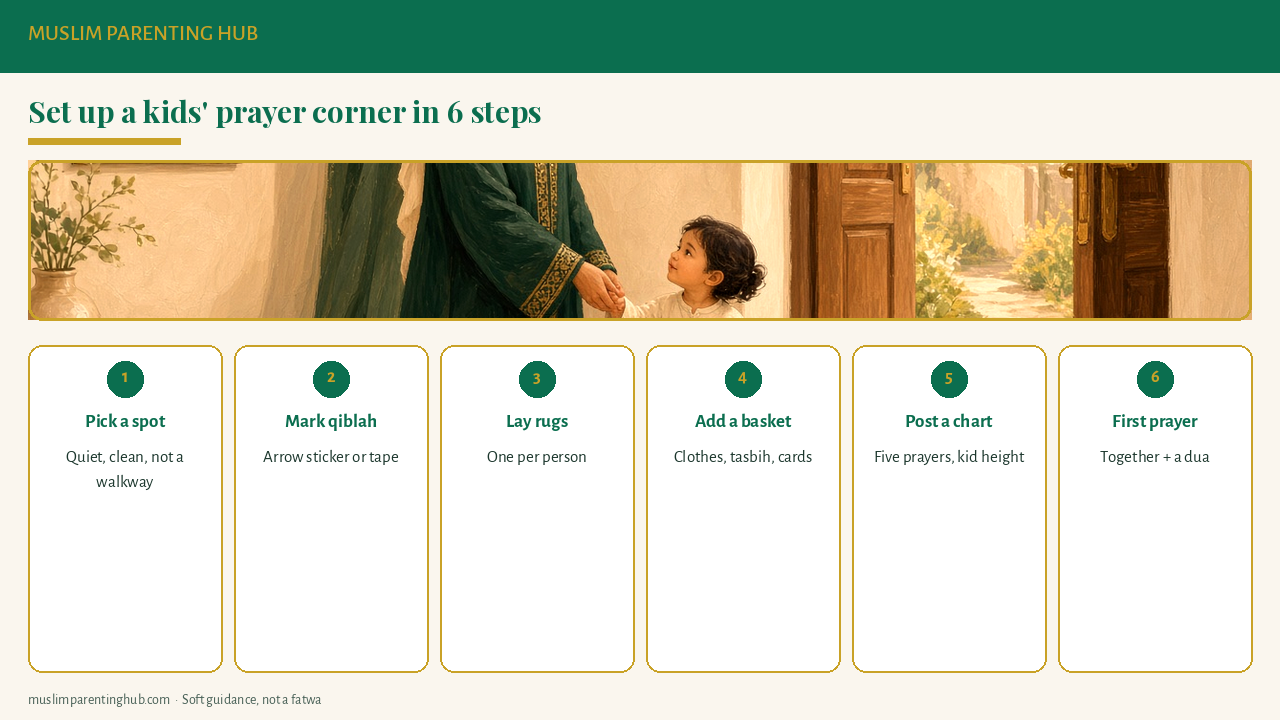
Step 1: Pick a quiet, clean spot
Look for a corner that’s:
- Away from the TV and toys
- Not a walkway where people pass in front of the person praying
- Clean and easy to keep clean, since the place of prayer should be pure
- Close to the bathroom or kitchen sink for quick wudu, if possible
It can be a corner of the living room, a spot in the hallway, part of a bedroom, or a nook by the stairs. Apartment families often use a corner behind the couch or a small rug next to a bookshelf.
Step 2: Find and mark the qiblah
Use a reliable qiblah app or a compass, and double-check with your local masjid’s direction if you’re unsure. Then mark it clearly:
- A small arrow sticker on the wall
- A strip of washi tape on the floor
- A framed card that says “Qiblah” at eye level for kids
From most of the continental United States, the qiblah points roughly northeast, but always check your exact direction.
Step 3: Lay out the rugs
Put out one rug per person who usually prays there, including small ones for little kids. Kids love having their own prayer rug, especially if they helped choose it. Leave a little space between rugs so toddlers don’t crawl over everyone during sujood.
Step 4: Add a prayer basket
A basket or small bin keeps everything together. See the full list below.
Step 5: Post a simple salah chart
A chart at kid height showing the five prayers helps children see where each prayer falls in their day. Our guide to explaining the five daily prayers to kids has simple ways to connect each prayer to the sun and your family’s schedule.
Step 6: Make the first prayer special
Gather the whole family for the first prayer in your new corner. Let a child give the iqamah if they know it. Afterward, make a short dua: “Ya Allah, make this corner a place we love to meet You.”
What Goes in the Prayer Basket
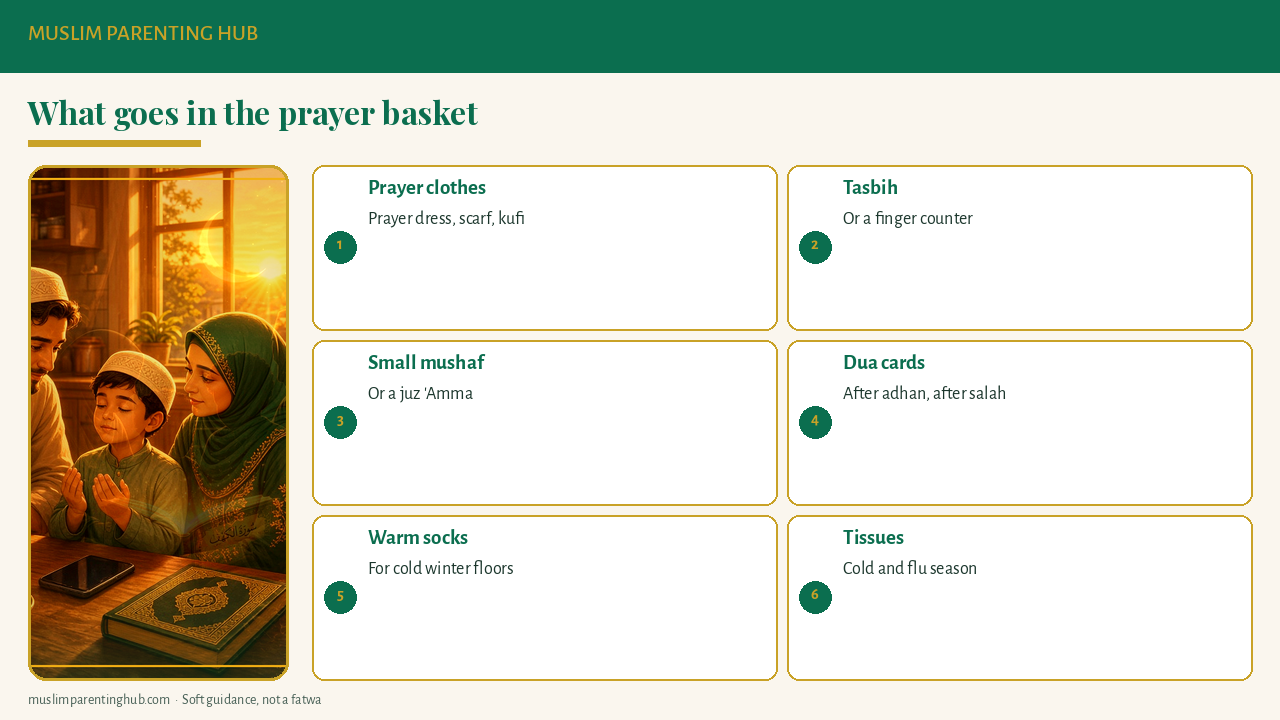
Keep it simple. Too many items become clutter.
- Prayer clothes: a simple prayer dress or khimar for girls, a kufi for boys if your family uses one, and a spare scarf for guests.
- Tasbih or a finger counter for dhikr after salah.
- A small mushaf or a juz ‘Amma for kids who are reading.
- Dua cards with the dua after adhan, the dua after salah, and one or two favorites.
- Socks for chilly floors in the winter.
- Tissues for runny noses during cold and flu season.
Avoid putting pictures or busy decorations right in front of the prayer spot. The Prophet ﷺ once asked Aisha to remove a decorated curtain because its images distracted him in prayer (Sahih al-Bukhari 374). A plain wall or simple calligraphy works best.
Make It Inviting (Without Clutter)
A few small touches make kids want to be there:
- Soft lighting. A small lamp or warm string light is lovely for Maghrib and Isha, especially as days get shorter in the fall.
- A cozy floor. A larger rug or cushions for sitting and dhikr after prayer.
- A low shelf for the basket and a plant.
- A kid-made sign that says “Our Prayer Corner” or “Allahu Akbar.”
- A small adhan clock or app speaker nearby.
Keep the corner tidy. A clean space feels calm, and it shows kids that this place is respected.
Using the Corner Through the Day
Once your corner is set up, connect it to your family’s daily rhythm.
When the adhan plays. Kids can walk to the corner and answer the adhan together. If your children are still learning, our playful plan to teach kids to answer the adhan builds the habit at home, and the dua after adhan for kids fits right after.
Praying together. The corner is the natural place for family jama’ah. Our guide to praying in jama’ah at home with kids covers where everyone stands and how to handle wiggly toddlers.
After school. Many families pray Asr in the corner before homework. Our after-school order for Muslim kids shows how snack, salah and homework fit together.
At Maghrib. The corner becomes the anchor of the evening. Pairing it with our after-school Maghrib routine turns the hour around sunset into a calm family reset.
Quiet time. Kids can sit there to read a Quran storybook, listen to recitation, or make a quiet dua when they feel upset.
Toddlers and the Prayer Corner
Toddlers will crawl on rugs, hide under prayer dresses, and climb on your back during sujood. That’s normal, and it’s not a reason to give up.
- Give them their own small rug and let them copy you.
- Keep one “prayer corner toy”, like a soft Quran cube or a cloth book, that only comes out during prayer.
- Expect interruptions. The Prophet ﷺ prayed while carrying his granddaughter Umamah, setting her down when he bowed (Sahih al-Bukhari 516). Patience with little ones is part of the Sunnah.
- Keep it short and sweet. Even watching you pray is learning.
If you’re preparing a toddler for the masjid, practicing at home first helps. Our home practice plan for a toddler’s first masjid visit uses your prayer corner as the training ground.
Age-by-Age Jobs for the Prayer Corner
Giving kids a job turns the corner into their space.
Ages 2–3: Rug helper. Help unroll the rugs before prayer and roll them after.
Ages 4–5: Basket keeper. Put tasbih and prayer clothes back in the basket. Fold a scarf (imperfectly is fine).
Ages 6–8: Qiblah checker and adhan announcer. Check the qiblah sign is in place and call everyone when it’s time to pray.
Ages 9–12: Corner captain. Keep the corner tidy, vacuum the rugs weekly, and lead the iqamah.
Teens: Prayer leader for siblings. Older kids can lead younger siblings in prayer when a parent is busy.
These jobs fit nicely into a household chore system. Our Islamic chores age chart for Muslim homes shows how to build responsibility step by step.
Seasonal Tips: Fall, Winter and Daylight Saving
Prayer times shift a lot across the American school year, and your corner can help kids keep up.
- Post this week’s prayer times next to the salah chart. Older kids can update them every Sunday.
- Watch the clock change. When daylight saving ends on Sunday, November 1, Maghrib suddenly moves an hour earlier on the clock, often before many parents get home from work. Our guide to shifting your family’s Maghrib routine after daylight saving has a simple plan.
- Keep it warm. Add a thicker rug or socks basket as floors get cold, and a lamp for dark Fajr and Isha prayers.
- Ramadan prep. In the weeks before Ramadan, the corner becomes the natural spot for a family Quran goal chart.
Common Problems (and Calm Fixes)
“We don’t have space.” A single rug rolled up in a basket by the wall is a prayer corner. Size doesn’t matter; consistency does.
“The kids treat it like a play area.” Gently set a rule: “The prayer corner is for salah, dua, and Quran.” Keep toys elsewhere.
“Nobody uses it.” Tie it to an existing routine. “When the adhan plays, we meet at the corner.” Lead by example.
“Siblings fight over rugs.” Give each child their own rug, or use a simple rotation.
“It gets messy.” Make tidying it part of the after-prayer routine: rugs rolled, clothes in the basket, one minute.
FAQ
How do I make a prayer corner for kids at home?
Pick a quiet, clean spot away from the TV, mark the qiblah with an arrow sticker or tape, lay out a rug for each person, add a basket with prayer clothes, tasbih and dua cards, and post a simple salah chart at kid height.
Where should the prayer corner be in the house?
Choose a clean, quiet corner that’s not a walkway and is away from toys and screens. Near a sink for easy wudu is a bonus. A living room corner, hallway nook or bedroom spot all work.
What should I put in a kids’ prayer corner?
Prayer rugs, prayer clothes (a prayer dress or scarf for girls, a kufi for boys), tasbih, a small mushaf or juz ‘Amma, dua cards, and soft lighting. Keep the wall in front of the rugs plain.
How do I find the qiblah direction at home?
Use a reliable qiblah app or compass and double-check with your local masjid. From most of the continental US, the qiblah is roughly northeast, but always confirm the exact direction for your home.
How do I keep my toddler from disrupting prayer?
Give them their own small rug, keep a special quiet toy for prayer time, keep prayers with them short, and expect interruptions with patience. The Prophet ﷺ himself prayed while carrying his granddaughter.
Can a prayer corner help my child pray more consistently?
Yes. A ready, visible space removes small barriers like searching for rugs, acts as a daily reminder, and gives kids ownership, all of which make the salah habit easier to keep.
Related guides
- Teach kids to answer the adhan at home
- How to pray in jama’ah at home with kids
- The 5 daily prayers for kids explained
- How to teach kids to pray salah step by step
Soft guidance, not a fatwa. For detailed questions, please ask a trusted local scholar or your masjid’s imam.
Quick steps
Set up a prayer corner for kids in 6 steps. Turn a small, quiet corner into a ready prayer space with the qiblah marked, rugs out and a prayer basket.
- Pick a quiet, clean spot — Choose a clean corner away from the TV and toys that isn't a walkway, ideally near a sink for wudu.
- Find and mark the qiblah — Use a reliable qiblah app or compass, confirm with your masjid, and mark it with an arrow sticker or tape.
- Lay out the rugs — Put out one rug per person, including small ones for little kids, with a little space between them.
- Add a prayer basket — Keep prayer clothes, tasbih, a small mushaf and dua cards together in one basket.
- Post a simple salah chart — Hang a chart of the five prayers at kid height so children see where each prayer falls in their day.
- Make the first prayer special — Pray together as a family in the new corner and close with a short dua for the space.
Related articles

How to Pray in Jama'ah at Home With Kids: Rows, Iqamah and Wiggly Toddlers
A calm guide to praying in congregation at home with kids: who stands where, letting a child say the iqamah, short recitations, toddlers on the rug and a family dua.
Read guide →
Teach Kids to Answer the Adhan at Home (Playful Practice Plan)
A playful home practice plan so Muslim kids answer the adhan—pause game, short reply lines, age bands, and scripts when the call to prayer plays. Soft & practical.
Read guide →
The 5 Daily Prayers for Kids: Explaining Fajr to Isha With the Sun and Your Family's Day
Explain the five daily prayers to kids with the sun: what Fajr, Dhuhr, Asr, Maghrib and Isha mean, when they come this fall, rak'ah counts, and easy games.
Read guide →
How to Teach Kids to Pray Salah Step by Step (With Wudu): A Parent's Guide for Ages 5–10
A calm, step-by-step guide to teaching kids wudu and salah—what to say in each position, a 2-rak'ah practice plan, and age-by-age expectations for ages 5–10.
Read guide →