

When Kids Ignore the Adhan: Calm Scripts That Actually Work
It’s 6:42 on a Tuesday. Soccer practice just ended, the backpacks are on the floor, and someone already snuck onto the tablet. Your Maghrib adhan app rings—soft, familiar, the same call that has pulled hearts for fourteen centuries.
Your 7-year-old doesn’t look up. Your toddler adds one more LEGO brick. Your 10-year-old mutters, “One more life,” and keeps tapping.
You feel the familiar knot: Do I yell? Do I snatch the device? Do I give up and pray alone again?
You don’t have to choose between peace and prayer. This guide gives you pause-play scripts, a gentle 5-day practice plan, and age-fit expectations for busy American Muslim homes where the adhan lives on a phone, not a neighborhood loudspeaker.
Why Kids “Ignore” the Adhan (It’s Usually Not Rebellion)
Most kids aren’t rejecting Allah. They’re stuck in a dopamine loop. Screens, building sets, and games are designed to hold attention. The adhan is a soft interrupt. Soft interrupts lose to bright ones unless you’ve practiced the pause.
Three common reasons:
- They never practiced pausing on purpose. If every “stop” arrives as a shout, the body braces instead of cooperating.
- The adhan feels like an adult thing. If answering it only happens when you yell “Prayer!”, kids don’t own the moment.
- Timing collides with hunger and transitions. Maghrib often lands right after school, snacks, or homework panic.
Your job isn’t to win a power struggle. It’s to build a tiny family reflex: hear → pause → answer → then return (or pray). That reflex starts with teaching kids to answer the adhan at home—and this article covers what to do when they still ignore it.
The Pause-Play Rule (Your Core Tool)
Name it out loud for a week: “Pause-Play.”
- Pause means freeze the hands, eyes up (or toward the speaker), and join the reply lines you already teach.
- Play means they may return to the toy, game, or show after answering—unless it’s Maghrib time to pray together.
Why this works: kids trust the interrupt more when it isn’t always “forever stop.” Video games taught them “pause menus.” Use that language.
Script (calm, standing near them, not across the room):
“Adhan. Pause-Play. Hands freeze. We answer together. Then you can finish that level / that tower—or we walk to Maghrib.”
If they keep tapping: lower your voice, put a gentle hand on the shoulder, and restart once. One restart. Then help them physically pause (close the app together, set the controller down). No lecture in the first thirty seconds.
Calm Scripts for Screens, LEGO, and “One More Life”
Screens and tablets
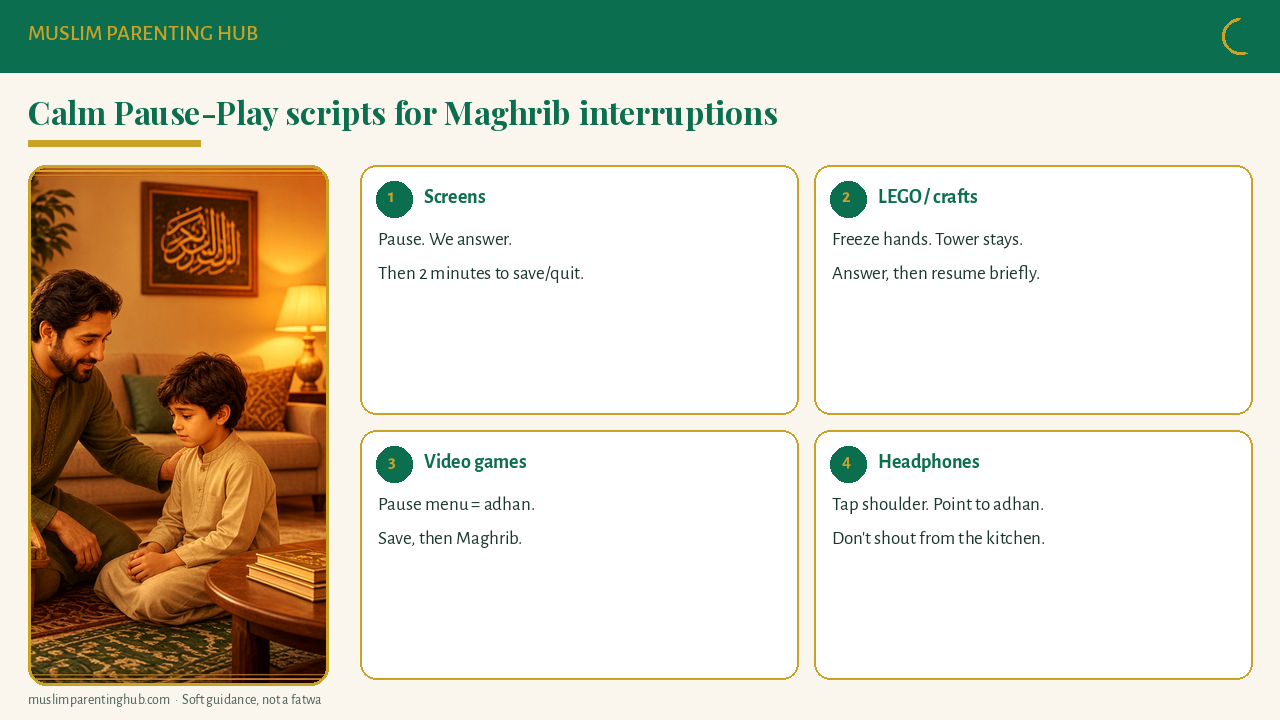
“I see you’re mid-video. Adhan still comes first. Pause. We answer. Then you get three minutes to finish that clip before Maghrib.”
If they melt down:
“You’re mad. I get it. We’re still pausing for Allah’s call. Angry feelings can come to Maghrib with us.”
Pair this with your after-school Maghrib routine so Maghrib isn’t a surprise every night.
LEGO / crafts mid-build
“Don’t knock it down. Just freeze your hands. We answer. Your tower stays.”
Toddlers may need you to hold their hands still for two seconds while you say the first reply line for them.
Video games (“one more life”)
“Pause menu. Adhan. We answer. Then you save and quit for Maghrib—or take two minutes if Maghrib is still five minutes out.”
For older kids, agree on a house rule once: adhan always pauses the game. Saving is allowed; continuing the fight is not.
Headphones on
Walk over. Tap the shoulder. Point to the phone playing the adhan. Don’t shout from the kitchen. Proximity is kindness.
Teach the Answer First (Then Expect the Pause)
If kids don’t know what to say, “ignoring” is actually confusion. Keep the reply short and proud. Review the lines in our adhan practice guide, then add the dua after the adhan once the pause is reliable.
A tiny sequence that fits US homes:
- Adhan app plays (pick one consistent app and volume).
- Someone says, “Adhan!” (rotate who announces).
- Everyone freezes / Pause-Play.
- Reply lines together.
- Short dua after (when ready).
- Walk to the prayer corner for Maghrib—or resume play if it’s not prayer time yet (e.g., a recorded adhan practice at noon on a weekend).
Connecting the call to salah without pressure is easier when kids already understand the five daily prayers as five meetings with Allah, not five chores.
A 5-Day Practice Plan (When They Currently Ignore It)
Use this when Maghrib adhan is routinely ignored. Keep evenings short. Praise the pause more than the perfect Arabic.
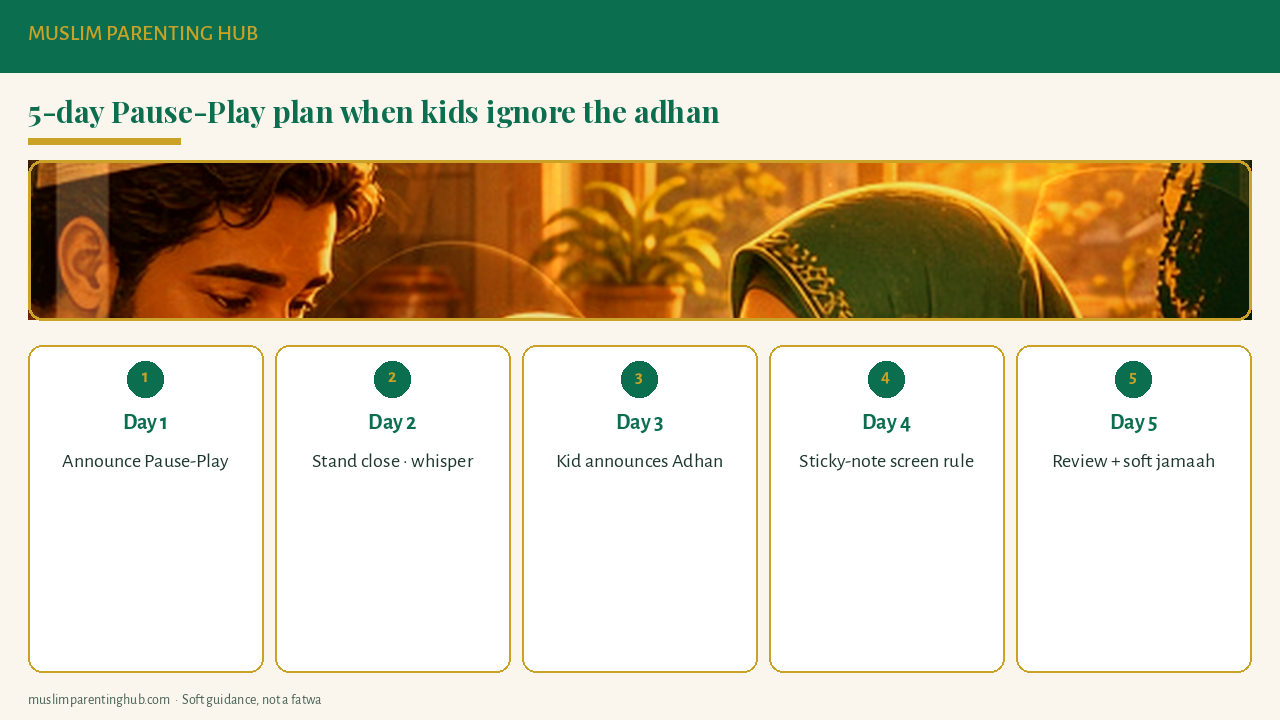
Day 1 — Announce Pause-Play
At snack time (before Maghrib), say: “Tonight when the adhan rings, we practice Pause-Play. Freeze hands, answer together, then finish what you were doing for two minutes before Maghrib.” Role-play once with the adhan app on low volume.
Day 2 — Proximity Parent
Stand near the most likely “ignorer” when Maghrib approaches. No speeches. When it rings, whisper “Pause-Play” and model freezing your own phone.
Day 3 — Kid Announcer
Let one child press play on the adhan (or tap the widget) and shout “Adhan!” Pride beats nagging.
Day 4 — Screen Bargain Written Down
On a sticky note: Adhan = pause. After answer: 2 minutes to save/quit. Then Maghrib. Stick it on the TV stand. Refer to the note, not your rising voice.
Day 5 — Family Replay + Jamaah Soft Launch
After Maghrib, take sixty seconds: “What helped us pause today?” Tomorrow, invite everyone to pray Maghrib in jamaah at home—even one rak’ah together counts as a win for little ones who are still learning.
Repeat the five days if needed. Habits stick on the second and third loop, not the first speech.
Age Bands: What “Listening” Looks Like
Toddlers (2–4): They may freeze for two seconds, echo “Allahu Akbar,” then wander. Celebrate the freeze. Carry them to the prayer area if needed.
Preschool / early elementary (5–7): They can learn Pause-Play as a game. Expect reminders. Keep screens out of bedrooms at Maghrib hour if possible.
Upper elementary (8–10): They understand fairness. Use the written sticky-note rule. Let them be the announcer. Call out respect when they pause without a reminder.
Tweens (11+): Talk values, not only rules. “We pause for Allah’s call the way we’d pause if Grandma FaceTimed.” Invite them to lead the reply or the dua after.
What Not to Do (Even When You’re Exhausted)
- Don’t shame. “You don’t even care about salah” hardens hearts.
- Don’t negotiate every night from scratch. One family rule, repeated calmly, beats nightly auctions.
- Don’t make Maghrib a punishment for screen time. Link them (“after we answer, we pray, then screens are done for the evening”) without using prayer as a threat.
- Don’t expect mosque-level focus on night one. Home adhan habits are built in tiny reps after school, during homework season, and on football Sundays.
Scripts for Real US Life
Car line / parking lot Maghrib: Pull over safely if you can. Play the adhan. Pause-Play in the car. Pray as soon as you get home—or step out carefully if you’ve planned for Maghrib on the go.
Playdate at your house: Softly tell the visiting child, “In our home we pause for thirty seconds when we hear the call to prayer. You’re welcome to listen quietly.” Most kids are curious, not offended.
Sibling sabotage: If one child deliberately talks over the adhan to annoy another, separate the behavior from the worship: “You can be mad at your brother after we answer. We don’t use Allah’s call as a weapon.”
Parent on a work call: Put the call on mute for the reply lines when you can. Kids notice who pauses.
Make the Environment Help the Habit
- Keep the adhan volume audible in the main living space—not only in your pocket on vibrate.
- Dim screens slightly before Maghrib when possible (blue-light reminder = soft cue).
- Lay prayer rugs out before the adhan on hard weeks (visual cue).
- Pair Maghrib with a tiny predictable joy afterward on tough nights: dates, warm milk, or a two-minute story—joy after obedience is Sunnah-shaped parenting, not a bribe forever.
If evenings are chaos, shrink the goal: answer the adhan together even if full Maghrib jamaah only happens four nights this week.
Parent Heart Check
You’re allowed to feel frustrated. You’re also allowed to repair: “Earlier I yelled when the adhan played. I’m sorry. Let’s try Pause-Play again tonight.” Kids learn istighfar by watching you use it.
The Prophet ﷺ loved gentleness. A calm pause taught two hundred times will outlast one perfect lecture.
Keep Going Softly
When kids ignore the adhan, treat it as unfinished training, not a failed faith. Pause-Play, proximity, a sticky-note rule, and five short practice days will move the needle more than raised voices. Celebrate every freeze. Walk to Maghrib when you can. Return to play when you promised. Trust grows in both directions.
Maghrib App Setup That Helps Kids Notice
Pick one adhan app for the whole house and keep it on a shared surface when possible—a kitchen shelf speaker, a parent’s old phone on Wi-Fi, or a smart speaker routine. Kids ignore what they never clearly hear. Vibrate-only in your pocket trains only you.
Try a two-volume habit for one week: normal volume for the first thirty seconds of Maghrib adhan (so everyone hears the opening Takbir), then slightly lower while you answer together. The opening burst is the interrupt; the rest is the calm.
If multiple kids wear headphones after school, make a house rule: headphones off from five minutes before Maghrib until after you answer. Put a cheap analog kitchen timer next to the homework table as a visual cue while Maghrib times shift through fall.
On weekends, let kids take turns choosing which famous muezzin voice you use. Ownership of the sound increases ownership of the pause.
When Guests, Babysitters, or Grandparents Are Home
Brief helpers in one sentence: “When the adhan app plays, we pause and answer for about a minute. You’re welcome to join or wait quietly.” Most babysitters are relieved to have a clear script.
If grandparents prefer a different style—longer reminders, or praying first without kids answering—avoid correcting them in front of children. Later, keep your Pause-Play habit with the kids in another room. Unity in front of little eyes matters.
Playdates at Maghrib: you can postpone a few minutes if guests just arrived and shoes are still on, but don’t skip the answer entirely. A shortened pause still teaches that Allah’s call reshapes the room.
Tracking Progress Without Turning Worship Into a Chart Obsession
For two weeks only, keep a tiny fridge tally: stars for “paused without a reminder.” Then throw the chart away. The chart is scaffolding, not a forever scoreboard. If a child starts performing for stickers and melting down when they miss one, retire rewards and return to quiet praise.
What success looks like by week three: fewer arguments, faster freezes, and at least a few Maghrib nights where someone else says “Adhan!” before you do. That voice—your child’s—is the win.
FAQ
Why do my kids ignore the Maghrib adhan?
Usually because screens and toys hold attention better than a soft audio cue, and the pause was never practiced as a calm family game. Hunger and after-school transitions make it harder. Teach Pause-Play on purpose for a week before assuming they don’t care.
Should I take the tablet away when the adhan plays?
Help them pause and put it down together. Snatching teaches fear of the adhan. After answering, either resume briefly to save/quit or walk to Maghrib per your house rule. Consistency matters more than dramatic confiscation.
What if they only listen when I yell?
Yelling “worked” because volume, not because hearts changed. For seven days, stand close, use a quiet voice, and physically help hands freeze. Praise the first two-second pause loudly. Replace volume with proximity and repetition.
How long should Pause-Play take?
Thirty to ninety seconds: freeze, reply to the adhan, optional short dua after. Then either Maghrib or a brief return to the activity. Keep it short so kids don’t dread the sound.
Can we practice answering the adhan when it isn’t prayer time?
Yes. On a weekend midday, play the adhan once for practice only. Label it “practice round.” Real Maghrib still gets the real pause. Practice without pressure builds the reflex.
What if one child pauses and the sibling keeps playing?
Thank the child who paused by name. Calmly help the other pause without comparing (“Why can’t you be like…?”). After Maghrib, reset the sticky-note rule together so both kids hear the same expectation.
Related guides
- Teach kids to answer the adhan at home
- Dua after the adhan for kids
- Five daily prayers explained for kids
- After-school Maghrib routine for Muslim families
Soft guidance, not a fatwa. For detailed questions, please ask a trusted local scholar or your masjid’s imam.
Quick steps
5-day Pause-Play plan when kids ignore the adhan. Announce Pause-Play, use proximity, let a kid announce, write a screen bargain, then review and soft-launch Maghrib jamaah.
- Day 1 — Announce Pause-Play — Before Maghrib, explain freeze-hands, answer together, then two minutes to finish before prayer; role-play once on low volume.
- Day 2 — Proximity parent — Stand near the child most likely to ignore the adhan; whisper Pause-Play and model freezing your own phone.
- Day 3 — Kid announcer — Let one child start the adhan app and call out Adhan so pride replaces nagging.
- Day 4 — Screen bargain note — Post a sticky note: Adhan equals pause; after answering, two minutes to save or quit, then Maghrib.
- Day 5 — Replay and soft jamaah — After Maghrib ask what helped the pause, then invite a gentle Maghrib jamaah at home the next evening.
Related articles
Teach Kids to Answer the Adhan at Home (Playful Practice Plan)
A playful home practice plan so Muslim kids answer the adhan—pause game, short reply lines, age bands, and scripts when the call to prayer plays. Soft & practical.
Read guide →
Dua After Adhan for Kids: Meaning, Easy Transliteration and a 5-Day Way to Learn It
Teach kids the dua after the adhan in small chunks: Arabic, easy transliteration, simple meaning, a 5-day plan and US-home tips for when you can't hear the masjid.
Read guide →
How to Set Up a Prayer Corner for Kids at Home: A Small Space That Builds a Big Salah Habit
Set up a kid-friendly prayer corner at home in 6 easy steps: finding the qiblah, rugs, a prayer basket, a salah chart and age-by-age jobs that make salah stick.
Read guide →
The After-School Maghrib Routine That Actually Works for Muslim Families
A calm 20-minute after-school Maghrib routine for Muslim families—snack, wudu, pray together, then connect. Age tips, scripts, and a screen rule that sticks.
Read guide →