
The 5 Daily Prayers for Kids: Explaining Fajr to Isha With the Sun and Your Family's Day
“Why do we pray so many times?” “Is it Asr or Maghrib now?” “Why did the prayer move earlier?”
If your child asks questions like these, that’s a good sign: they’re noticing that prayer shapes your family’s day. Before children can pray all five prayers themselves, they need a simple picture in their heads of what the five prayers are, when they come, and why we pray them.
The easiest teacher for that is already in the sky. The five daily prayers follow the sun—dawn, midday, afternoon, sunset, and night. Once a child can “read” the sky, prayer times stop feeling like random numbers on an app and start feeling like part of the rhythm of the day Allah made.
This guide gives you a kid-friendly explanation of each prayer, how they fit into a typical US school day this fall, rak’ah counts, the beautiful story of how the five prayers were given, games and crafts, and what to expect at each age. When your child is ready to learn the actual movements, our step-by-step guide to teaching kids salah with wudu picks up where this one leaves off.
The Big Idea: Five Times, Five Meetings With Allah
Start with one sentence your child can repeat:
“Five times a day, Allah invites us to stop what we’re doing and talk to Him.”
Some families call them “five meetings with Allah” or “five pauses.” The Prophet ﷺ compared the five prayers to a river running by your door that you bathe in five times a day—would any dirt remain on you? The companions said no, and he said that’s how the five prayers wipe away mistakes (Bukhari, Muslim). Children love this picture: prayer is like a refreshing wash for the heart.
How the Five Prayers Were Given (A Story Kids Love)
Tell this story at bedtime or on a Friday night.
On a very special night—the night journey of Isra’ and Mi’raj—the Prophet Muhammad ﷺ was taken up through the heavens. Allah gave him a gift for his ummah: fifty prayers a day. On the way back, he met Prophet Musa (Moses), who said, “Your people won’t be able to do fifty. Go back and ask for less.” The Prophet ﷺ went back again and again, and Allah reduced the number until it was five. Allah, in His mercy, said these five would carry the reward of fifty (Bukhari, Muslim).
Ask your child: “Why do you think Allah made it five instead of fifty?” Let them talk. The answer kids usually land on: because Allah is kind and knows what we can manage.
Meet the Five Prayers
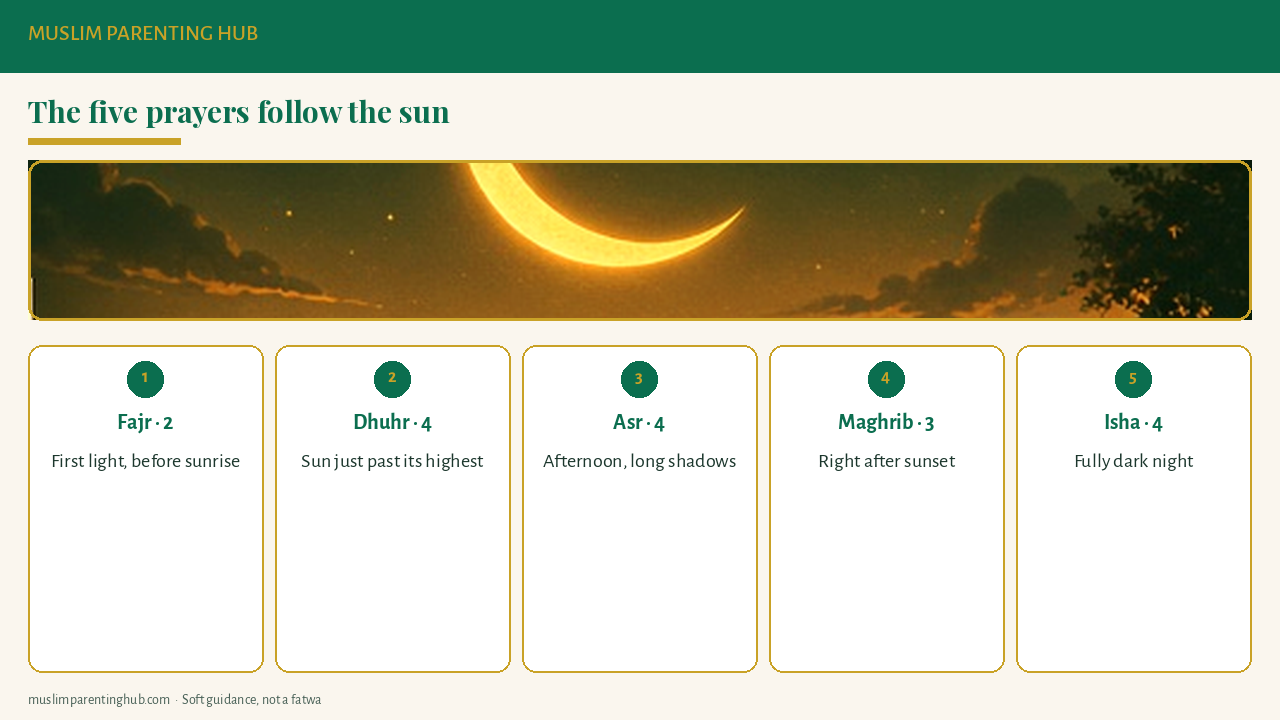
1. Fajr — the dawn prayer
When: When the first light appears in the sky, before the sun comes up.
Sky clue: It’s still a little dark, but the edge of the sky is getting lighter.
Rak’ahs: 2
Kid line: “Fajr is our first hello to Allah, before the day even starts.”
In mid-October, Fajr in much of the US falls roughly between 5:30 and 6:15 a.m. Little ones are usually asleep—that’s fine. Older kids can join on weekends first.
2. Dhuhr — the midday prayer
When: Just after the sun passes its highest point in the sky.
Sky clue: Shadows are at their shortest around lunchtime.
Rak’ahs: 4
Kid line: “Dhuhr is our lunchtime break with Allah.”
During the school week, Dhuhr usually falls while kids are at school. Young children aren’t required to pray yet, so don’t stress. For older children who are praying regularly, some families ask the teacher about a quiet spot—fall parent-teacher conferences are a good time for that friendly conversation.
3. Asr — the afternoon prayer
When: Mid-to-late afternoon, when shadows grow longer.
Sky clue: The sun is lower, and shadows have stretched out—about as long as the thing casting them, or longer.
Rak’ahs: 4
Kid line: “Asr is our after-school check-in with Allah.”
In October, Asr often lands right around school pickup or after-school activities—a natural moment to pray once everyone’s home.
4. Maghrib — the sunset prayer
When: Right after the sun disappears below the horizon.
Sky clue: The sun is gone, and the sky glows orange and pink.
Rak’ahs: 3
Kid line: “Maghrib is when we say goodbye to the sun and thank Allah for the day.”
Maghrib is often the easiest prayer for a family to pray together, which is why so many families build their evenings around it. Our after-school Maghrib routine shows a calm 20-minute way to do it.
5. Isha — the night prayer
When: When the sky is fully dark and the twilight has faded.
Sky clue: Stars and the moon are out; no more color in the sky.
Rak’ahs: 4
Kid line: “Isha is our goodnight to Allah.”
For younger kids, Isha can become part of the bedtime routine—even sitting on the prayer mat with a parent for a minute before stories.
Quick memory trick: 2-4-4-3-4. Some families clap it as a rhythm: “Two! Four! Four! Three! Four!”
Why the Times Keep Moving
Kids notice that prayer times change, and that’s a great science-and-faith lesson. Because the prayers follow the sun:
- In summer, days are long, so Fajr is very early and Isha very late.
- In fall and winter, days are short, so the prayers bunch closer together and Maghrib comes early.
- When the clocks change—daylight saving time ends on Sunday, November 1, 2026—every prayer time jumps an hour earlier on the clock overnight, even though the sun hasn’t changed at all.
That clock change can throw off family routines. Our guide to shifting your Maghrib, homework and bedtime routine when daylight saving ends walks you through it.
Show them: Open a prayer app or your masjid’s timetable and compare a summer date with a December date. “Look—Maghrib was after 8 p.m. in June, and it’ll be before 5 p.m. in December!” (Exact times depend on your city; always use your local masjid’s timetable or a trusted prayer app.)
The Five Prayers in a School Day
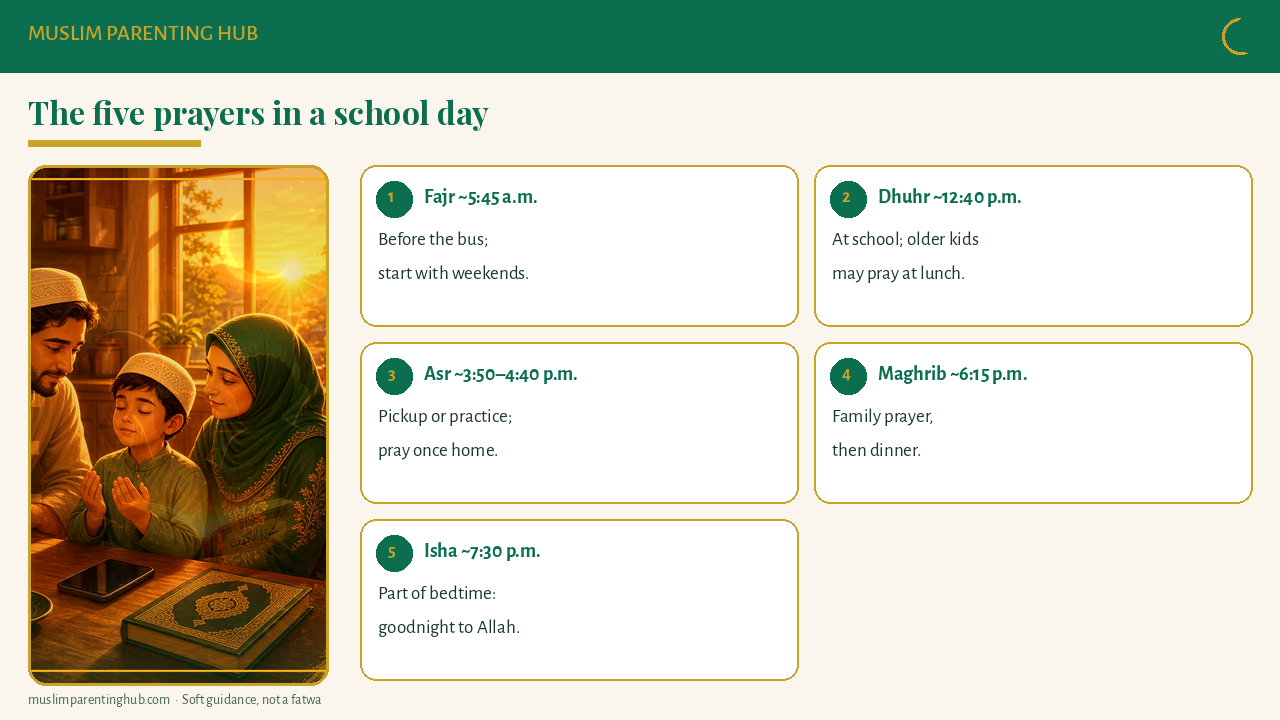
Mapping the prayers onto your child’s real day makes them concrete. Here’s a sample mid-October weekday for a family in the Midwest (times are approximate; Asr is later in the Hanafi calculation):
| Prayer | Approx. time | Where kids usually are |
|---|---|---|
| Fajr | ~5:45 a.m. | Asleep or just waking up |
| Dhuhr | ~12:40 p.m. | At school, lunch or recess |
| Asr | ~3:50–4:40 p.m. | Pickup, home, or practice |
| Maghrib | ~6:15 p.m. | Home before dinner—or at the soccer field |
| Isha | ~7:30 p.m. | Bedtime routine |
Draw this with your child on a paper clock or timeline. Let them color each prayer’s spot: pale blue for Fajr, yellow for Dhuhr, orange for Asr, pink for Maghrib, navy for Isha.
When sports and carpools push Maghrib out of the house, it’s still doable—see praying Maghrib on the go with kids for a 10-minute plan.
Hearing the Adhan: The Call That Starts Each Prayer
Every prayer time begins with the adhan, the call to prayer. Even in a home far from a masjid, a prayer app or a parent can call it. Children learn the five prayers faster when each one “begins” with the same beautiful sound.
Teach kids to stop, listen, and repeat after the mu’adhdhin. Our playful plan to teach kids to answer the adhan at home turns this into a daily game that even three-year-olds enjoy.
Games and Crafts to Learn the Five Prayers
Shadow stick (ages 4–10)
Push a stick into the ground in a sunny spot, or stand a pencil in clay on a windowsill. Mark the tip of the shadow at breakfast, at lunch, after school, and before sunset. Kids see the shadow shrink toward midday (Dhuhr) and then stretch long (Asr). It’s the same sky our grandparents used to tell prayer times.
Prayer-time paper plate clock (ages 3–7)
Divide a paper plate into five sections. Draw a little sun for each prayer: rising, high, lower, setting, and a moon. Add a paper arrow with a brad fastener. Before each prayer, your child moves the arrow.
“Which prayer is next?” (ages 4–10)
At random moments, ask, “Which prayer is next?” Look outside for sky clues together. Older kids can check the app and calculate how many minutes are left.
Five prayers, five colors (ages 3–6)
Make five colored cards and hang them by the prayer mat. After each prayer the family prays, a child flips that card. At bedtime: “How many did our family pray today?”
Sunset watch (all ages)
Once a week, watch the sunset together and pray Maghrib the moment it’s gone. Little ones love “catching” the exact moment the sun disappears.
What to Expect at Each Age
The Prophet ﷺ taught that children should be instructed to pray at seven, with more firmness by ten (Abu Dawud). Scholars explain the details of what that means in practice differently, so ask a trusted teacher about your own situation. In everyday terms, many families find this progression gentle and realistic:
Ages 2–4: Seeing and copying
They stand next to you, copy movements, and wander off. Wonderful. Teach the names of the five prayers and the sky clues. No pressure.
Ages 5–6: Joining sometimes
They join one prayer a day—usually Maghrib—and know the five names in order, plus the 2-4-4-3-4 pattern.
Ages 7–9: Building the habit
Gently encourage all five, starting with the ones they’re home for. Praise every prayer; don’t punish misses. Help them learn the words step by step.
Ages 10–12: Owning it
They track their own prayers (a simple chart or app), know when each prayer starts, and pray Dhuhr or Asr at school or practice when needed.
Throughout, keep prayer warm. Children who associate salah with yelling or punishment often drift from it later. Children who associate it with a parent’s calm voice, the evening light, and a hug afterward come back to it for life.
FAQ
What are the five daily prayers in Islam for kids?
They are Fajr (dawn), Dhuhr (midday), Asr (afternoon), Maghrib (sunset), and Isha (night). Each one happens at a different part of the sun’s journey across the sky.
How many rak’ahs is each prayer?
The obligatory rak’ahs are Fajr 2, Dhuhr 4, Asr 4, Maghrib 3, and Isha 4. Kids can remember it as “2-4-4-3-4.”
Why do Muslims pray five times a day?
Allah gave the five prayers as a gift on the night of Isra’ and Mi’raj. The Prophet ﷺ compared them to washing in a river five times a day—they keep our hearts clean and close to Allah.
Why do prayer times change every day?
Prayer times follow the sun, and sunrise and sunset shift through the year. When daylight saving ends on November 1, 2026, the clock times also jump an hour earlier.
At what age should kids start praying all five prayers?
The Prophet ﷺ taught that children be instructed to pray at seven, with more firmness by ten. Before seven, focus on joy, copying, and learning the names. Ask a trusted scholar about specifics.
How can I explain prayer times to a young child?
Use sky clues: Fajr when the sky first gets light, Dhuhr when the sun is highest, Asr when shadows grow long, Maghrib right after sunset, and Isha when it’s fully dark.
Related guides
- How to teach kids to pray salah step by step (with wudu)
- Teach kids to answer the adhan at home
- The after-school Maghrib routine that works
- Daylight saving ends: shift your Maghrib routine
Closing: Look Up Together
You don’t need a curriculum to start. This evening, step outside a few minutes before sunset with your child. Watch the sun slip down, notice the sky change color, and say, “That’s Maghrib. Let’s go talk to Allah.” Do it again tomorrow, and the next day. Slowly, the five prayers will stop being something your child has to remember—and become the way your family tells time.
Related articles

How to Teach Kids to Pray Salah Step by Step (With Wudu): A Parent's Guide for Ages 5–10
A calm, step-by-step guide to teaching kids wudu and salah—what to say in each position, a 2-rak'ah practice plan, and age-by-age expectations for ages 5–10.
Read guide →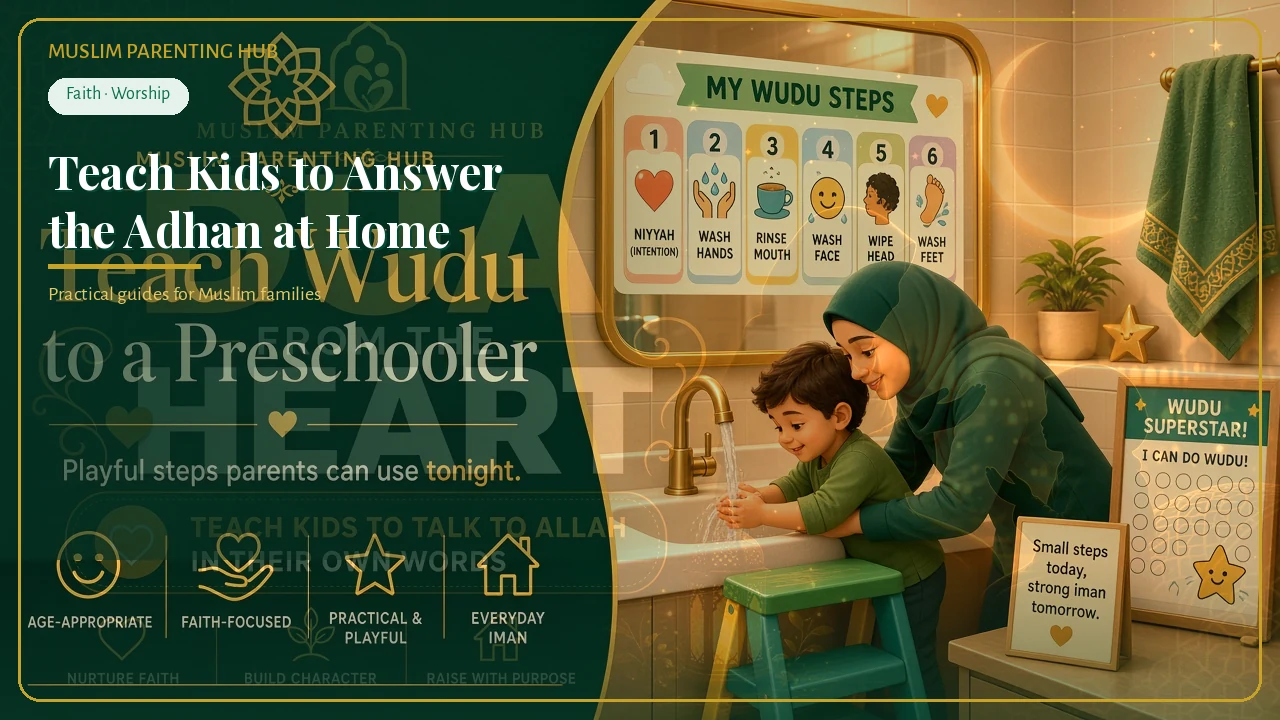
Teach Kids to Answer the Adhan at Home (Playful Practice Plan)
A playful home practice plan so Muslim kids answer the adhan—pause game, short reply lines, age bands, and scripts when the call to prayer plays. Soft & practical.
Read guide →
Daylight Saving Ends Nov 1: How to Shift Your Family's Maghrib, Homework and Bedtime Routine
US clocks fall back Nov 1, 2026—shift Maghrib, homework, and bedtime gently with a week-before plan and sample after-school schedules for Muslim families.
Read guide →
The After-School Maghrib Routine That Actually Works for Muslim Families
A calm 20-minute after-school Maghrib routine for Muslim families—snack, wudu, pray together, then connect. Age tips, scripts, and a screen rule that sticks.
Read guide →