

How to Pray Isha With Kids Before Bed: A Winter Routine for Muslim Families
For most of the year, Isha in the US comes long after little ones are asleep. Then the clocks fall back in early November and something lovely happens: Isha suddenly lands at 6:30 or 7:00 in the evening, often before bath time. For a few months, the whole family can pray the last prayer of the day together and then go straight into bedtime duas.
This guide shows you how to use that winter window. You will get a simple evening order, scripts for each age, a 7-night plan to build the habit, and answers to the questions parents ask most. If your evenings feel rushed since the time change, start with our daylight saving Maghrib routine for kids and then come back here for Isha.
Why Winter Is the Best Season to Start Isha With Kids
Isha begins when the red glow of sunset has left the sky, and its time lasts well into the night (Muslim). In summer, that start time can be 9:30 PM or later in much of the US. In November, December and January it often falls between about 6:15 and 7:15 PM. Check a local prayer-time app for your city, because times differ a lot by location.
That earlier time matters for children:
- Kids are still awake and fresh enough to stand for a few rak‘ahs.
- Isha can become the “door” into bedtime, the same way Maghrib marks the end of the school day.
- It fits the Sunnah rhythm. The Prophet ﷺ disliked sleeping before Isha and long chatting after it (Bukhari). Praying, then winding down, is exactly that pattern.
The Prophet ﷺ also said, “Command your children to pray when they are seven” (Abu Dawud). Younger children are not required to pray, but praying beside you now makes salah feel normal long before it becomes an obligation. Our guide on what age kids start praying in Islam explains the stages.
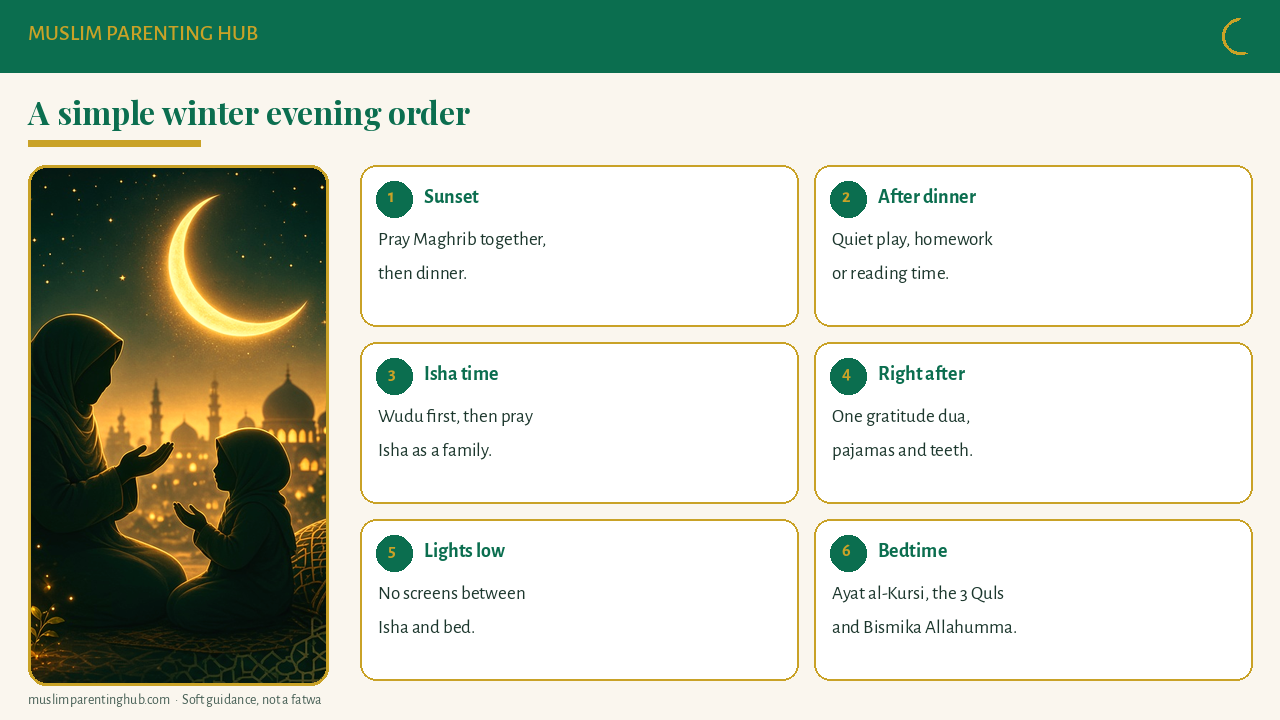
A Simple Winter Evening Order
You don’t need a perfect schedule. You need the same order every night so kids know what comes next.
| Time (example) | What happens |
|---|---|
| Around sunset (about 5:00 PM) | Maghrib together, then dinner |
| After dinner | Quiet play, homework or reading |
| Isha time (about 6:30–7:00 PM) | Wudu, Isha together |
| Right after Isha | Pajamas, teeth, toilet |
| Bed | Ayat al-Kursi, the last three surahs and the sleeping dua |
If Maghrib is already a struggle, the after-school Maghrib routine covers the earlier part of the evening, and our after-school snack, salah and homework order helps the hours between.
Scripts by Age
Ages 3–5: “Isha is our goodnight to Allah”
Little ones don’t need rules about rak‘ahs. Give them one warm idea:
“Isha is the last prayer of the day. It’s how we say goodnight to Allah before we sleep.”
Let them stand next to you on their own small mat. If they copy you for one sajdah and then wander off, that’s normal. Keep your voice calm and finish your prayer.
Ages 6–8: “Two prayers, then bed”
“After Maghrib we eat. After Isha we get ready for bed. Those are our two evening prayers.”
At this age, invite them to pray the four rak‘ahs with you in jama‘ah (as a group). Let them say “Allahu Akbar” out loud to start, so they feel part of it. Our guide to praying in jama‘ah at home with kids has tips for lining up and keeping the youngest ones close.
Ages 9–12: “Isha is your prayer now”
“You’re old enough to own this one. I’ll call you when it’s time, but you’re in charge of your wudu and getting to the mat.”
Older kids can learn the full Isha: four fard rak‘ahs, the two sunnah rak‘ahs after, and witr. Tell them the hadith that whoever prays Isha in congregation is like someone who stood half the night in prayer (Muslim). Kids love a big reward for a small effort.
Five Ways to Make Isha Feel Calm, Not Like a Chore
- Wudu before pajamas. Make wudu the step that comes right before changing for bed. It also cools kids down and helps them settle. See wudu for preschoolers for easy steps.
- Dim the lights after Isha. The prayer becomes the switch from “busy evening” to “quiet night.”
- One family dua after salaam. Keep it short: one child says one thing they are grateful for, and everyone says “Ameen.”
- No screens between Isha and bed. This is the easiest place in the day to draw that line.
- Praise effort, not perfection. “I loved how you stood still for the whole first rak‘ah” works better than correcting every movement.
A 7-Night Plan to Build the Isha Habit
| Night | Focus |
|---|---|
| 1 | Show kids the Isha time in your prayer app and say, “From now, we pray this together.” |
| 2 | Wudu before pajamas, Isha together, straight to bed. |
| 3 | Add one family gratitude dua after salaam. |
| 4 | Let an older child call the iqamah or say “Allahu Akbar” first. |
| 5 | Teach one new piece: the two sunnah rak‘ahs, or a short witr for older kids. |
| 6 | Move one bedtime dua right after Isha so it flows into sleep. |
| 7 | Ask, “What was your favorite part of Isha this week?” and keep what worked. |
After the week, the habit carries itself. For the bedtime part, the 7-night bedtime duas plan fits right after Isha.
When Kids Are Too Tired or Melt Down
Some nights the timing won’t work. A child is half asleep on the couch, or a toddler is crying for bed. Some gentle rules help:
- For children under seven, sleep can win. They aren’t obligated yet, so tuck them in and pray yourself.
- For older kids, pray first, then bed. Keep it to the fard if they’re exhausted, and do the sunnah together another night.
- Never use Isha as a punishment. “You’ll pray Isha because you were rude” teaches kids that salah is a penalty.
- If they ask whether Allah is still awake when they fall asleep, the answer is yes. Our guide does Allah sleep? An answer for kids gives simple words for that question.
If your child ignores the call to prayer altogether, try the calm scripts in when kids ignore the adhan.
What to Avoid
- Waiting until “later.” Later becomes 9 PM, and then the kids are asleep. Pray close to the start time while it’s early.
- Long lectures before salah. Keep instructions to one sentence.
- Comparing siblings. “Look how well your sister prays” turns salah into a competition.
- Turning every mistake into a correction. Fix one thing a week, not five things a night.
FAQ
What time is Isha in winter in the US?
It depends on your city, but after daylight saving ends in early November, Isha often starts between about 6:15 and 7:15 PM in much of the US. It begins when the red twilight disappears from the sky (Muslim). Use a local prayer-time app for the exact time.
Can kids sleep before praying Isha?
Children under seven aren’t required to pray, so if they fall asleep it isn’t a sin. For older children, try to pray before bed, because the Prophet ﷺ disliked sleeping before Isha (Bukhari). In winter, Isha comes early enough that this is usually easy.
How many rak‘ahs is Isha for kids?
Isha is four fard rak‘ahs, followed by two sunnah rak‘ahs and witr. Young children can simply stand beside you for part of it. Older kids can learn the full four first, then add the sunnah and witr later.
What is the reward for praying Isha in congregation?
The Prophet ﷺ said that whoever prays Isha in congregation is as if he prayed half the night, and whoever also prays Fajr in congregation is as if he prayed the whole night (Muslim). Praying together at home as a family is a beautiful way to start.
What should kids do right after Isha?
Keep it short and quiet: a family gratitude dua, pajamas and teeth, then the bedtime routine with Ayat al-Kursi, the last three surahs and the sleeping dua. Avoid screens between Isha and bed.
What if my child cries every time I call them for Isha?
Keep the request short and predictable, make wudu part of getting ready for bed, and let younger children join for just one rak‘ah. If prayer time becomes a daily battle, pause correcting and focus on praising any effort for a week.
Related guides
- 5 daily prayers for kids: Fajr to Isha explained simply
- Learn salah for kids: 30-day plan
- How to set up a prayer corner for kids at home
- Bedtime duas for kids: 7-night plan
Closing
Winter gives Muslim families a small gift: the last prayer of the day arrives while the kids are still awake. Pray Isha together, dim the lights, say your duas and let sleep come. A few months of this, and your children may carry the habit into the long summer evenings too.
This guide shares parenting tips, not fatwas. Follow the scholars and teachers you trust for prayer rulings.
Quick steps
7-night plan to start praying Isha with kids before bed. A week of small steps that turns the early winter Isha into a calm family bedtime habit.
- Find the Isha time — Show kids the Isha time in your prayer app and say you'll pray it together.
- Wudu before pajamas — Make wudu, pray Isha together, then go straight into bedtime.
- Add a gratitude dua — One child names one blessing after salaam; everyone says Ameen.
- Give a role — Let an older child say the iqamah or the first Allahu Akbar.
- Teach one new piece — Add the two sunnah rak‘ahs or a short witr for older kids.
- Link to bedtime duas — Move one bedtime dua right after Isha so prayer flows into sleep.
- Review the week — Ask what their favorite part was and keep what worked.
Related articles

The 5 Daily Prayers for Kids: Explaining Fajr to Isha With the Sun and Your Family's Day
Explain the five daily prayers to kids with the sun: what Fajr, Dhuhr, Asr, Maghrib and Isha mean, when they come this fall, rak'ah counts, and easy games.
Read guide →
Daylight Saving Ends Nov 1: How to Shift Your Family's Maghrib, Homework and Bedtime Routine
US clocks fall back Nov 1, 2026—shift Maghrib, homework, and bedtime gently with a week-before plan and sample after-school schedules for Muslim families.
Read guide →
Bedtime Duas for Kids: What to Recite Before Sleep (With a 7-Night Plan)
Bedtime duas for kids made simple: the sleeping dua, the 3 Quls, Ayat al-Kursi and a calm Sunnah sequence, with meanings, age bands and a 7-night plan.
Read guide →
The After-School Maghrib Routine That Actually Works for Muslim Families
A 20-minute Maghrib routine for kids after school: snack, wudu, pray together, then connect. Updated for early winter sunsets, with age tips and scripts.
Read guide →