

Dua After Adhan for Kids: Meaning, Easy Transliteration and a 5-Day Way to Learn It
The adhan finishes on your phone app. Your seven-year-old has just repeated “Allahu Akbar” along with it, proud of herself, and then looks up at you: “Is that it? Do we go pray now?”
There is one more beautiful step most kids never learn: the short dua the Prophet ﷺ taught us to say right after the adhan ends. It takes about fifteen seconds, it is full of love for the Prophet ﷺ, and it comes with one of the most hopeful promises a child can hear.
This guide gives you the dua in Arabic, a kid-friendly transliteration, a meaning your child can actually understand, a gentle five-day plan to learn it in chunks, and practical tips for American homes where the adhan comes from an app, a clock or a masjid livestream instead of a minaret down the street.
If your child is still learning to pause and repeat the words of the adhan itself, start there first with our playful plan to teach kids to answer the adhan. This article picks up at the moment the adhan ends.
The Dua After Adhan (Arabic, Transliteration and Meaning)
Arabic:
اللَّهُمَّ رَبَّ هَذِهِ الدَّعْوَةِ التَّامَّةِ، وَالصَّلَاةِ الْقَائِمَةِ، آتِ مُحَمَّدًا الْوَسِيلَةَ وَالْفَضِيلَةَ، وَابْعَثْهُ مَقَامًا مَحْمُودًا الَّذِي وَعَدْتَهُ
Easy transliteration (read it the way it sounds):
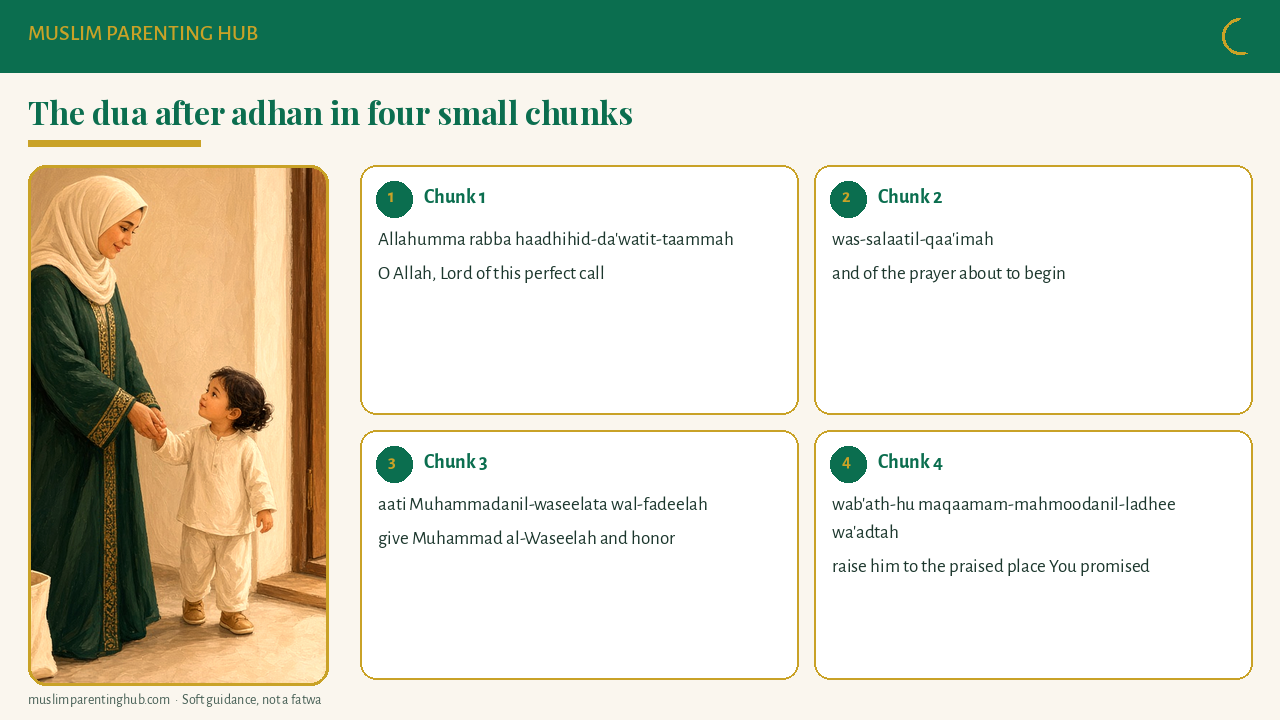
Allahumma rabba haadhihid-da’watit-taammah, was-salaatil-qaa’imah, aati Muhammadanil-waseelata wal-fadeelah, wab’ath-hu maqaamam-mahmoodanil-ladhee wa’adtah.
Meaning:
“O Allah, Lord of this perfect call and of the prayer that is about to begin, give Muhammad al-Waseelah and the special honor, and raise him to the praised place that You promised him.”
This wording is reported in Sahih al-Bukhari (614). The Prophet ﷺ said that whoever says it after hearing the call to prayer, his intercession will be granted for that person on the Day of Resurrection.
Some families add “innaka laa tukhliful-mee’aad” (“You never break Your promise”) at the end. That addition comes in a narration outside Bukhari, and scholars differ about it. If your local masjid or your child’s Islamic school teaches it, that’s fine; if you want the simplest version, the Bukhari wording above is complete on its own.
The kid version of the meaning
Children don’t need every word translated. They need the picture. Try this:
“We just heard Allah’s call. Now we ask Allah to give our Prophet ﷺ the highest, most special place in Jannah. And the Prophet ﷺ promised that if we ask that for him, he will help us on the Day of Judgment.”
Most kids light up at that last part. They are doing something kind for the Prophet ﷺ, and he promised to be kind back to them. That’s a relationship, not a rule.
What is “al-Waseelah”?
Kids will ask. In Sahih Muslim (384) the Prophet ﷺ explained that al-Waseelah is a rank in Paradise fit for only one of Allah’s servants, and he hoped he would be that one. So when your child says “aati Muhammadanil-waseelah,” she is asking Allah to give the Prophet ﷺ that one special place.
A simple line: “It’s like the best seat in Jannah, saved for one person, and we ask Allah to give it to our Prophet ﷺ.”
The Full After-Adhan Order (Short Enough for Kids)
The Prophet ﷺ taught a sequence, reported in Sahih Muslim (384): when you hear the mu’adhdhin, say what he says; then send blessings on the Prophet ﷺ; then ask Allah to give him al-Waseelah. Put together, it looks like this for a family:
- Repeat the adhan line by line (with “laa hawla wa laa quwwata illa billah” when the caller says “hayya ‘alas-salah” and “hayya ‘alal-falah”, as taught in Sahih Muslim 385).
- Send salawat on the Prophet ﷺ. A short version kids learn quickly: “Allahumma salli ‘ala Muhammad” (“O Allah, send blessings on Muhammad”). Older kids can say the full Salat Ibrahimiyyah they already know from salah.
- Say the dua after adhan (the one above).
- Make your own dua. The Prophet ﷺ said that dua between the adhan and the iqamah is not rejected (Abu Dawud 521, Tirmidhi 212). This is the perfect moment for a child’s own words: “Ya Allah, help my grandma feel better.”
That fourth step is the one children often love most. It turns the routine into a conversation. If your child is shy about making dua in their own words, our guide to duas for kids to learn and how to make dua from the heart has easy sentence starters.
By Age: What to Expect
Ages 3–4. Don’t aim for the full dua. Aim for the habit of staying still when the adhan ends and saying “Allahumma salli ‘ala Muhammad” with you. You can say the dua out loud while they sit in your lap. Hearing it every day is learning.
Ages 5–6. Most children at this age can learn the dua in four chunks over a week or two, repeating after you. Expect mix-ups like “da’watit-taammah” becoming “da’wati-tamah.” That’s fine. Correct gently by just saying it right the next time, not by stopping them.
Ages 7–9. They can say it alone, and many enjoy leading it for younger siblings. This is also a good age to add the meaning chunk by chunk, so the words aren’t just sounds.
Ages 10 and up. Invite them to notice that the dua asks for something for someone else. Ask, “Why do you think the Prophet ﷺ taught us to make dua for him right when the prayer is about to start?” Let them think. Older kids can also learn the optional testimony from Sahih Muslim (386), said when hearing the mu’adhdhin’s shahadah: “Wa ana ash-hadu an laa ilaaha illallahu wahdahu laa shareeka lah, wa anna Muhammadan ‘abduhu wa rasooluh, radeetu billaahi rabban, wa bi Muhammadin rasoolan, wa bil-islaami deenaa.” The Prophet ﷺ said that whoever says it, their sins are forgiven.
A 5-Day Plan to Learn the Dua After Adhan
This plan works best at one prayer time a day, ideally the one your family is usually home for. In most US households that’s Maghrib. In early October, Maghrib falls around 6:30–7 p.m. in many US cities; after clocks fall back on Sunday, November 1, it moves to around 5 p.m., which can make it even easier to catch together.
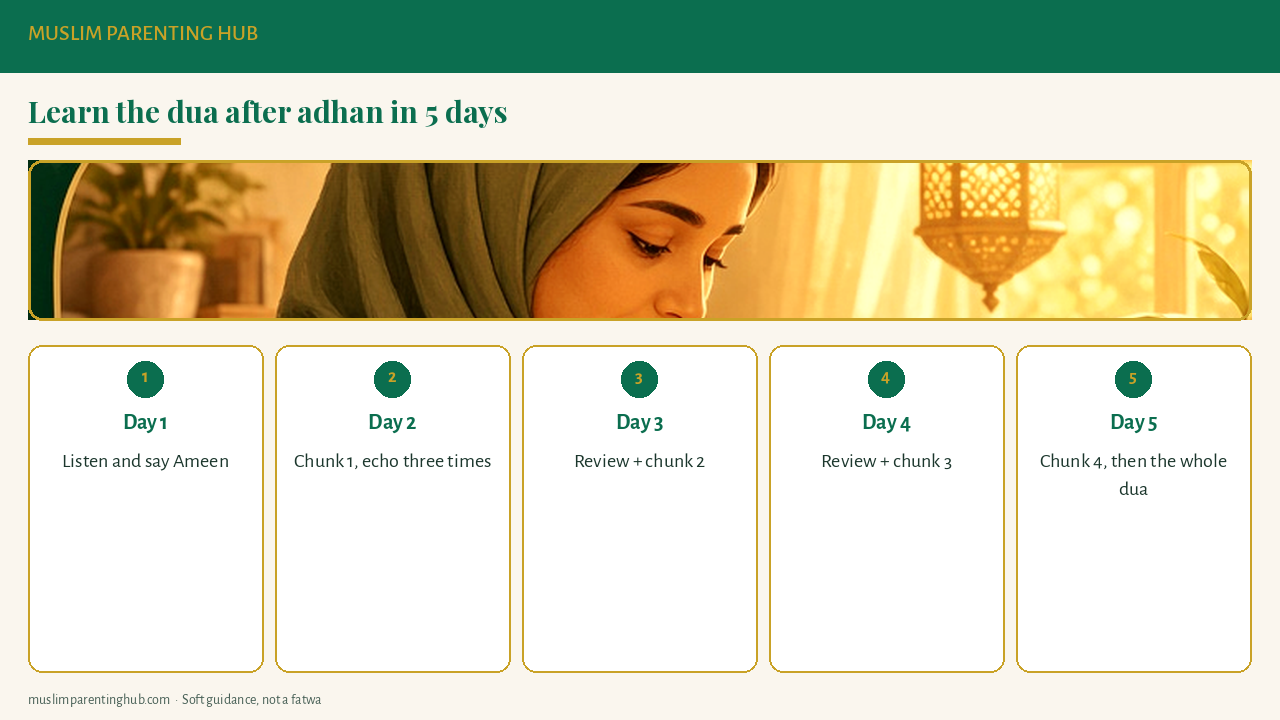
Day 1 — Listen only
When the adhan ends, you say the whole dua slowly while your child sits next to you. Their only job is to listen and say “Ameen” at the end. Tell them the kid meaning in one sentence.
Day 2 — Chunk 1
“Allahumma rabba haadhihid-da’watit-taammah” — “O Allah, Lord of this perfect call.” Say it three times; they echo three times. You finish the rest.
Day 3 — Chunk 2
Review chunk 1, then add “was-salaatil-qaa’imah” — “and the prayer about to begin.” Point to the prayer rug: “This prayer. The one we’re about to pray.”
Day 4 — Chunk 3
Review, then add “aati Muhammadanil-waseelata wal-fadeelah” — “give Muhammad the special place and honor.” Tell the “best seat in Jannah” picture.
Day 5 — Chunk 4 and the whole dua
Add “wab’ath-hu maqaamam-mahmoodanil-ladhee wa’adtah” — “and raise him to the praised place You promised him.” Then say the whole thing together, slowly, once. Celebrate with a hug, not a prize lecture.
After Day 5: Keep saying it together daily. Most kids need two to four weeks of repetition before they can say it alone. If a day gets skipped, just pick up again; don’t restart the whole plan.
Making It Work in a US Home (When You Can’t Hear the Adhan Outside)
In much of America, kids never hear the adhan from a nearby minaret. That doesn’t make the habit harder; it just means you choose the cue.
- A prayer app with the adhan sound. Set it to play the full adhan at Maghrib (and Fajr, if your family is up). Turn the volume up so the kids can hear it from the living room.
- Your local masjid’s livestream or audio. Many masjids stream the adhan. Hearing your own imam’s or mu’adhdhin’s voice makes the community feel close.
- An adhan clock on the kitchen counter. It works even when everyone’s phone is on silent, and kids love being the one to “answer” it.
- Weekends at the masjid. At Jumu’ah or weekend school, coach your child: “When the adhan finishes, let’s whisper the dua together before the iqamah.”
School days and evenings out
Your child won’t hear an adhan at their public school, and that’s okay. The dua is tied to hearing the call, so on school days you simply practice at the times you’re home. If you’re at soccer practice or in the car when your app plays Maghrib, it’s a perfect moment: turn it up, repeat together, say the dua, and then find your spot to pray.
Connecting the Dua to Salah
The dua after adhan naturally leads into prayer: “was-salaatil-qaa’imah” literally points to the salah about to start. Use that.
- After the dua, say: “Okay, we asked Allah for the Prophet ﷺ. Now let’s go meet Allah in salah.”
- Give little ones a job: roll out the rugs, turn off the TV, call Dad.
- For kids still learning the prayer, the dua is a calm bridge between “the adhan happened” and “let’s pray.” Our step-by-step guide to teaching kids salah with wudu and our explainer on the five daily prayers for kids fit right after this habit.
If your kids are not praying regularly yet, that’s fine. The dua after adhan is still a beautiful practice on its own, and it gently builds the connection between the call and the prayer.
Common Mix-Ups (and Soft Fixes)
“My child rushes through it like a tongue twister.” Slow it down by saying it with them at a calm pace, almost like a whisper. Speed usually means they’re nervous about forgetting.
“They mix it up with the dua for entering the masjid.” That’s normal; many short duas start with “Allahumma.” Keep a small card by the rug with the first words of each dua. Our list of short duas for kids to learn by age can help you decide which duas to focus on this month.
“My toddler talks loudly during the adhan.” Don’t fight it daily. Give the toddler a job: hold the rug, sit in your lap, or “listen with your ears like a rabbit.” Silence grows with age.
“I didn’t grow up saying this dua either.” You’re not alone, and it’s never too late. Learn it alongside your child. Children love seeing parents learn. Saying “Let’s both practice” teaches humility and shows the dua matters to you, too.
“They only say it when I remind them.” That’s how almost every habit begins. Keep reminding with a smile. Over months, the reminder shrinks from “Remember the dua?” to a look, to nothing at all.
Make It Stick Without Pressure
- Same time, same spot. Repeat the routine at one prayer time in one place (the living room rug, the kitchen table).
- Let the kid lead sometimes. Once a child knows chunk 1, let them start the dua and you finish it.
- Tell the promise often. “The Prophet ﷺ said he’ll help the people who say this.” Kids remember promises.
- Notice effort, not perfection. “I love how you stopped what you were doing when the adhan finished.” That’s the habit you’re really building.
- Keep it joyful. The adhan is an invitation, not an alarm. If you treat the dua like a test, kids will treat it like one. If you treat it like a gift, they’ll treat it like one.
The goal isn’t a perfect recitation by Friday. It’s a child who, years from now, hears the adhan in a crowded airport or a college dorm and quietly whispers the dua their parent taught them on a living room rug.
FAQ
What is the dua after adhan for kids?
It is the same dua adults say: “Allahumma rabba haadhihid-da’watit-taammah, was-salaatil-qaa’imah, aati Muhammadanil-waseelata wal-fadeelah, wab’ath-hu maqaamam-mahmoodanil-ladhee wa’adtah” (Bukhari 614). Kids can learn it in four short chunks over about a week, then keep practicing daily.
What does the dua after adhan mean in simple words?
“O Allah, Lord of this perfect call and the prayer about to begin, give our Prophet Muhammad ﷺ the most special place in Jannah and the praised station You promised him.” The Prophet ﷺ said whoever says it will receive his intercession on the Day of Judgment.
At what age can kids learn the dua after adhan?
Most children can start learning it around age 5 or 6 by repeating after a parent in chunks. Ages 3–4 can listen, say “Ameen” and learn “Allahumma salli ‘ala Muhammad.” There’s no rush; daily listening is learning too.
Do we have to say salawat before the dua after adhan?
The Prophet ﷺ taught, in Sahih Muslim (384), to repeat the adhan, then send blessings on him, then ask Allah for al-Waseelah for him. A short salawat like “Allahumma salli ‘ala Muhammad” works well for kids before the dua.
Is it okay to say the dua after hearing the adhan on an app?
Many families in the US hear the adhan through a prayer app, an adhan clock or a masjid livestream, and they say the dua afterward as a way of answering the call and building the habit. If you’re unsure about any detail for your family, ask your local imam.
Can kids make their own dua after the adhan?
Yes, and it’s a wonderful time for it. The Prophet ﷺ said dua between the adhan and the iqamah is not rejected (Abu Dawud, Tirmidhi). After the dua after adhan, invite your child to ask Allah for anything in their own words.
Related guides
- Teach kids to answer the adhan at home
- The 5 daily prayers for kids, explained
- How to teach kids salah step by step (with wudu)
- 25 short duas for kids to learn by age
Soft guidance, not a fatwa. For detailed fiqh questions, please ask a trusted local scholar or your masjid’s imam.
Quick steps
5-day plan to teach kids the dua after adhan. Learn the dua after the adhan one small chunk at a time at one prayer a day, ending with the whole dua on day 5.
- Day 1 — Listen only — When the adhan ends, say the whole dua slowly while your child sits beside you and says "Ameen." Share the one-sentence kid meaning.
- Day 2 — Chunk 1 — Teach "Allahumma rabba haadhihid-da'watit-taammah" (O Allah, Lord of this perfect call): you say it three times, they echo three times.
- Day 3 — Chunk 2 — Review chunk 1, then add "was-salaatil-qaa'imah" (and the prayer about to begin), pointing to the prayer rug.
- Day 4 — Chunk 3 — Review, then add "aati Muhammadanil-waseelata wal-fadeelah" and tell the "best seat in Jannah" picture of al-Waseelah.
- Day 5 — Chunk 4 and the whole dua — Add "wab'ath-hu maqaamam-mahmoodanil-ladhee wa'adtah," then say the whole dua together slowly once and celebrate with a hug.
Related articles
Teach Kids to Answer the Adhan at Home (Playful Practice Plan)
A playful home practice plan so Muslim kids answer the adhan—pause game, short reply lines, age bands, and scripts when the call to prayer plays. Soft & practical.
Read guide →
How to Teach Kids to Pray Salah Step by Step (With Wudu): A Parent's Guide for Ages 5–10
A calm, step-by-step guide to teaching kids wudu and salah—what to say in each position, a 2-rak'ah practice plan, and age-by-age expectations for ages 5–10.
Read guide →
The 5 Daily Prayers for Kids: Explaining Fajr to Isha With the Sun and Your Family's Day
Explain the five daily prayers to kids with the sun: what Fajr, Dhuhr, Asr, Maghrib and Isha mean, when they come this fall, rak'ah counts, and easy games.
Read guide →
25 Short Duas for Kids to Learn (By Age, With Meaning and Transliteration)
Short, easy duas for kids by age (2–4, 5–7, 8–10) with transliteration and meaning—plus a gentle 10-minute daily practice for US Muslim families.
Read guide →