Surah Al-Fatiha for Kids: Meaning, Easy Words and a 14-Day Memorizing Plan
If your child is learning to pray, Surah Al-Fatiha is the first big step. It’s recited in every rak’ah of every salah, so a child who knows Al-Fatiha can join the whole family’s prayer, standing in the line, saying the same words, and saying “Ameen” at the end.
It’s also only seven short verses, which makes it a very doable first goal. This guide gives US Muslim parents the meaning of each verse in kid-friendly English, a simple transliteration for parents who are still learning Arabic, the beautiful hadith about what happens when we recite it, and a 14-day plan that fits into your existing routine. It is gentle home guidance. For correct pronunciation, listen to a trusted qari and, if you can, a Quran teacher.
If you’re building the whole prayer step by step, our guide to teaching kids salah and wudu step by step shows where Al-Fatiha fits.
Why Al-Fatiha Matters So Much
- It’s in every rak’ah. The Prophet ﷺ said, “There is no prayer for the one who does not recite the Opening of the Book” (Bukhari, Muslim).
- It’s called Umm al-Quran, “the Mother of the Quran,” because it gathers the whole message: praise of Allah, the Day of Judgment, worship, and asking for guidance.
- It’s a conversation with Allah. In a hadith qudsi, Allah says He has divided the prayer between Himself and His servant, and He answers each verse: when we say “Alhamdu lillahi Rabbil-’alameen,” Allah says, “My servant has praised Me” (Muslim).
That last one is the hook for kids:
“When you say Al-Fatiha in salah, Allah is answering you after every line. You are talking with Allah.”
Line by Line: Meaning in Kid Words
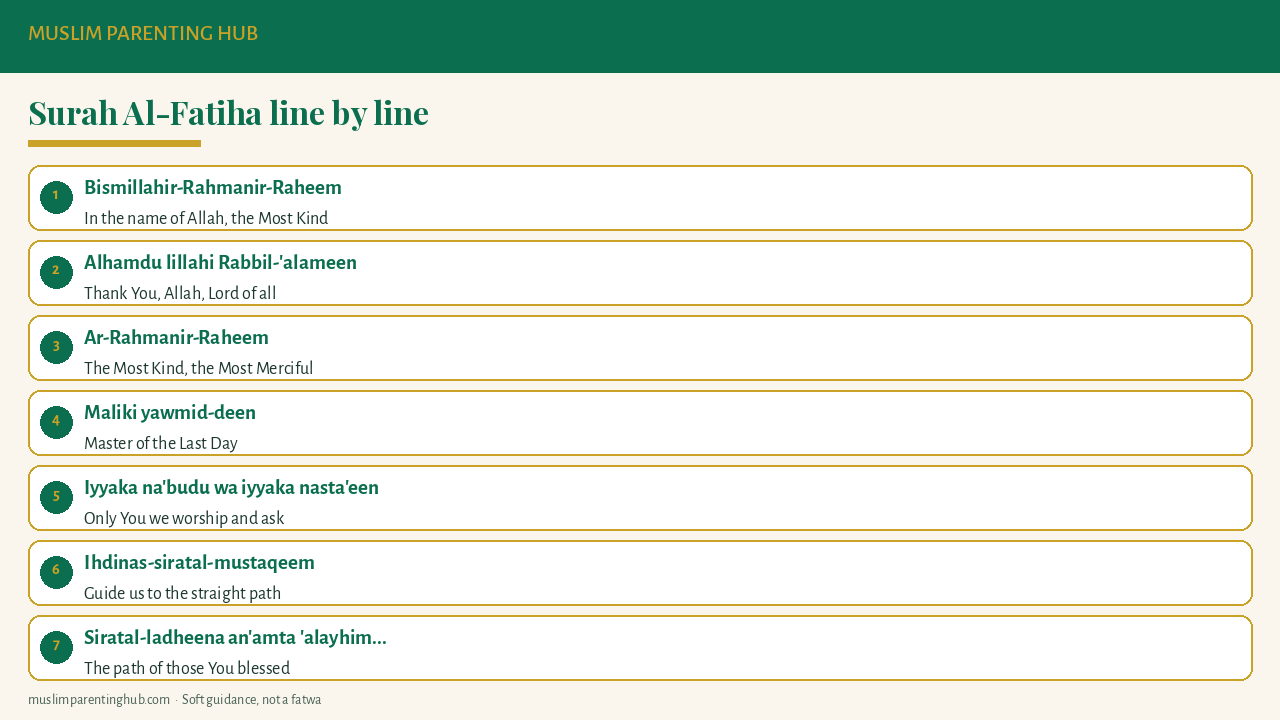
Scholars differ on whether “Bismillah” is counted as the first verse of Al-Fatiha. Many children learn it as the first line either way, so we include it here.
1. Bismillahir-Rahmanir-Raheem “In the name of Allah, the Most Kind, the Most Merciful.” Kid words: We start with Allah’s name, the One who is so, so kind.
2. Alhamdu lillahi Rabbil-’alameen “All praise is for Allah, Lord of all the worlds.” Kid words: Thank You, Allah, for everything. You take care of everything, people, animals, stars and oceans.
3. Ar-Rahmanir-Raheem “The Most Kind, the Most Merciful.” Kid words: Allah is kind to everyone, and especially merciful to people who believe.
4. Maliki yawmid-deen “Master of the Day of Judgment.” Kid words: One day everyone will come back to Allah, and He is in charge of that day.
5. Iyyaka na’budu wa iyyaka nasta’een “You alone we worship, and You alone we ask for help.” Kid words: We pray only to You, Allah, and we ask only You to help us.
6. Ihdinas-siratal-mustaqeem “Guide us to the straight path.” Kid words: Please show us the right way to live.
7. Siratal-ladheena an’amta ’alayhim, ghayril-maghdubi ’alayhim wa lad-dalleen “The path of those You blessed, not of those who earned Your anger, nor of those who went astray.” Kid words: Help us walk the way of good people You love, not the wrong way.
Then we say “Ameen,” which means “O Allah, accept.” Kids love saying it together, out loud, in a family jamaah at home.
A note on transliteration: English letters can’t capture Arabic sounds exactly. Use it as a crutch for parents, and let your child learn by listening to a clear recitation. Small children copy sounds beautifully when they hear them often.
Before You Start: Three Habits That Help
- Listen first. Play Al-Fatiha from a trusted reciter in the car or during breakfast for a few days before you ask your child to say anything. Our guide on Quran listening for infants and toddlers explains why listening comes first.
- One line at a time. Children memorize best in tiny chunks, repeated often.
- Same time every day. Attach it to something that already happens: after Fajr, after breakfast, or at bedtime with Surah Al-Ikhlas.
The 14-Day Memorizing Plan
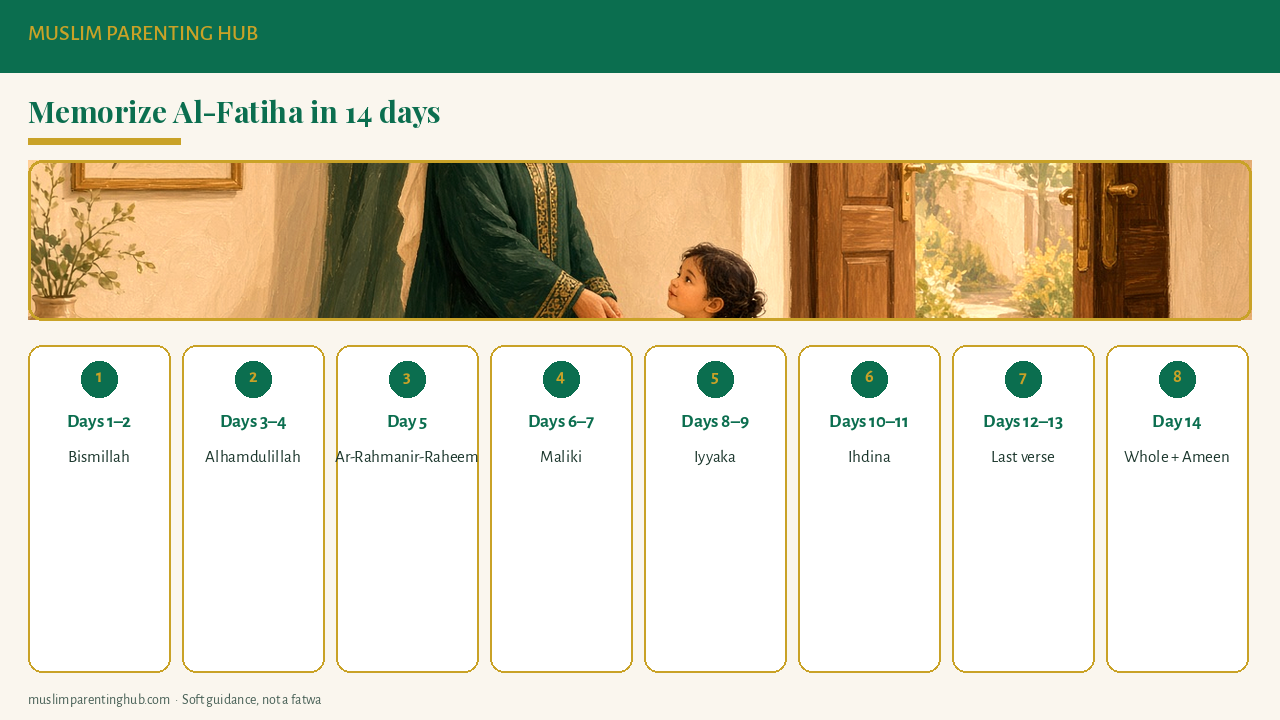
Five minutes a day. Review the old lines, then add the new one.
| Days | New line | What to do |
|---|---|---|
| 1–2 | Bismillahir-Rahmanir-Raheem | Echo it 5 times. Say it before meals all day. |
| 3–4 | Alhamdu lillahi Rabbil-’alameen | Name 3 things to thank Allah for. |
| 5 | Ar-Rahmanir-Raheem | Talk about one kind thing Allah did for you today. |
| 6–7 | Maliki yawmid-deen | Simple talk: “Every good deed counts with Allah.” |
| 8–9 | Iyyaka na’budu wa iyyaka nasta’een | Make one dua asking only Allah for help. |
| 10–11 | Ihdinas-siratal-mustaqeem | Draw a straight path with good deeds along it. |
| 12–13 | Siratal-ladheena… wa lad-dalleen | Split into two halves. Echo slowly. |
| 14 | Whole surah + Ameen | Recite it in a family prayer. Celebrate! |
If a line takes longer, that’s fine. Repeat the same step for two or three more days. Ages 3–5 may need a month, and that’s completely normal.
Turn It Into Salah Practice
Once your child knows Al-Fatiha, invite them into prayer:
- Stand beside you in jamaah at Maghrib and let them say “Ameen” aloud with you.
- Let them lead Al-Fatiha in a pretend practice prayer (not an obligatory one) so they hear themselves.
- Connect it to the adhan. When your child hears the adhan, remind them: “Salah is coming, and you know the Fatiha now!” Our answer-the-adhan home practice makes that moment a routine.
- Use a longer plan like the 30-day learn salah for kids plan once Al-Fatiha is solid.
By Age: Realistic Goals
| Age | Goal |
|---|---|
| 2–3 | Hear it daily. Say “Bismillah” and “Ameen.” |
| 4–5 | Echo line by line. Know the first 2–3 lines alone. |
| 6–7 | Recite the whole surah with gentle prompts. Know a few meanings. |
| 7–10 | Recite clearly in salah. Explain each line in their own words. |
The Prophet ﷺ told parents to teach children salah at seven (Abu Dawud), so Al-Fatiha before seven is a wonderful head start, not a race.
Common Mistakes (and Gentle Fixes)
- Rushing. Kids speed up to “finish.” Model a slow, calm pace and praise slowness.
- Correcting every sound. Fix one important mistake at a time, kindly. Let a teacher handle fine tajweed later.
- Memorizing without meaning. Even one meaning line per day makes the surah feel alive.
- Pressure and comparison. “Your cousin already knows it” makes Quran feel like a test. Compare only with yesterday.
FAQ
At what age should kids learn Surah Al-Fatiha?
Many children start listening as babies and can echo lines by 3–4. Most can recite the whole surah by 5–7. There’s no rush; aim to have it ready around age 7, when parents are told to begin teaching salah.
How do I teach Surah Al-Fatiha to a child?
Play a clear recitation daily, then teach one line at a time for about five minutes a day. Review old lines before adding new ones, add a simple meaning for each line, and practice in a family prayer when it’s done.
What does Surah Al-Fatiha mean for kids?
It means: we start with Allah’s kind name, thank Him for everything, remember He is in charge of the Last Day, worship and ask only Him for help, and ask Him to guide us on the right path of good people.
Why do we say Ameen after Al-Fatiha?
“Ameen” means “O Allah, accept,” because the end of Al-Fatiha is a dua for guidance. In a jamaah prayer, children can say “Ameen” with the imam, a joyful way for them to join in.
Is Bismillah part of Surah Al-Fatiha?
Scholars differ on whether it is counted as the first verse, and families follow their school’s practice. Most children learn it at the start either way, since we begin recitation with Allah’s name.
Can my child learn Al-Fatiha from transliteration?
Transliteration helps parents, but children should learn mainly by listening to a clear reciter and a teacher, because English letters can’t show Arabic sounds exactly. Use both, and let a Quran teacher refine pronunciation.
Related guides
- Teach kids salah and wudu step by step
- Learn salah for kids: a 30-day plan
- Teach kids to answer the adhan at home
- Surah Al-Ikhlas for kids: meaning
Closing
Al-Fatiha is the first conversation many children ever have with Allah in salah, and it’s one they will repeat for the rest of their lives. Teach it slowly, give it meaning, and celebrate the day they say “Ameen” in the line beside you. Seven short verses become a lifetime of talking with Allah.
Quick steps
14-day plan to memorize Surah Al-Fatiha with kids. Five minutes a day: review the old lines, then add one new line with its meaning.
- Days 1–2 — Bismillah — Echo Bismillahir-Rahmanir-Raheem five times and say it before meals.
- Days 3–4 — Alhamdulillah — Learn Alhamdu lillahi Rabbil-’alameen and name three things to thank Allah for.
- Day 5 — Ar-Rahmanir-Raheem — Add the line and talk about one kind thing Allah did today.
- Days 6–7 — Maliki yawmid-deen — Add the line with a simple talk about the Last Day.
- Days 8–9 — Iyyaka na’budu — Add the line and make one dua asking only Allah for help.
- Days 10–11 — Ihdinas-siratal-mustaqeem — Add the line and draw a straight path of good deeds.
- Days 12–13 — Last verse — Learn the last verse in two halves, echoing slowly.
- Day 14 — Whole surah — Recite it with Ameen in a family prayer and celebrate.
Related articles
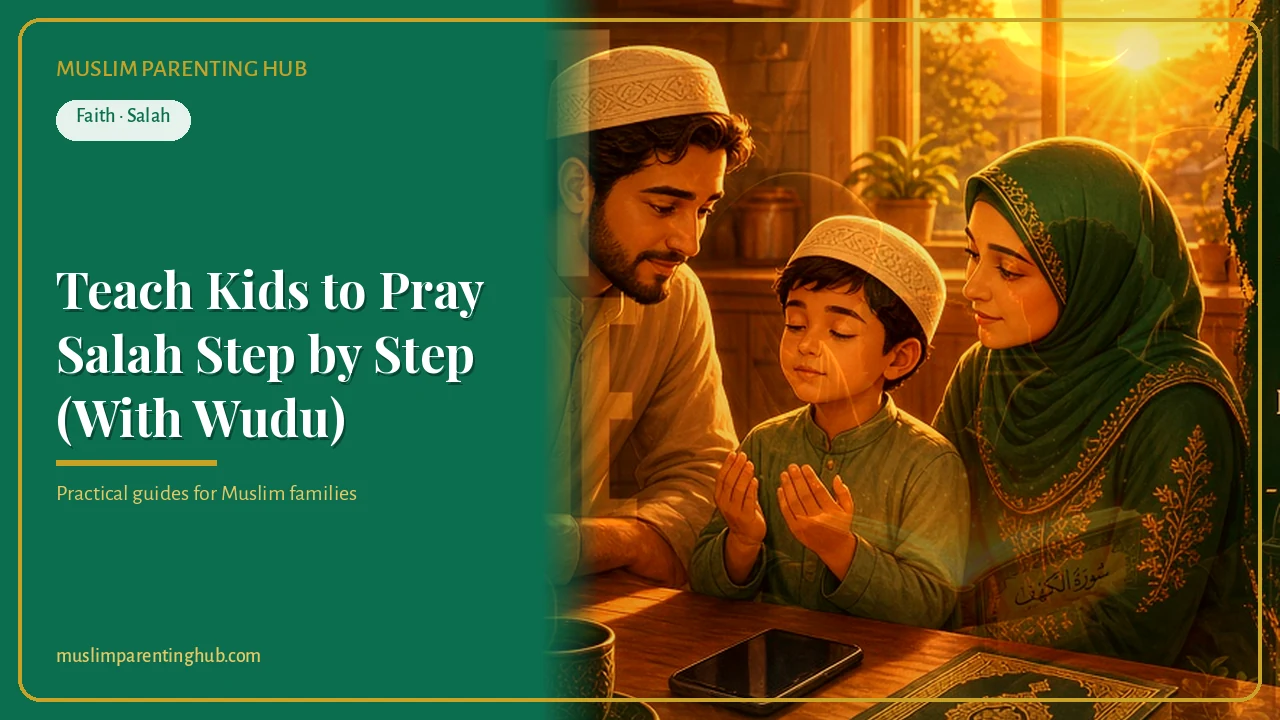
How to Teach Kids to Pray Salah Step by Step (With Wudu): A Parent's Guide for Ages 5–10
A calm, step-by-step guide to teaching kids wudu and salah—what to say in each position, a 2-rak'ah practice plan, and age-by-age expectations for ages 5–10.
Read guide →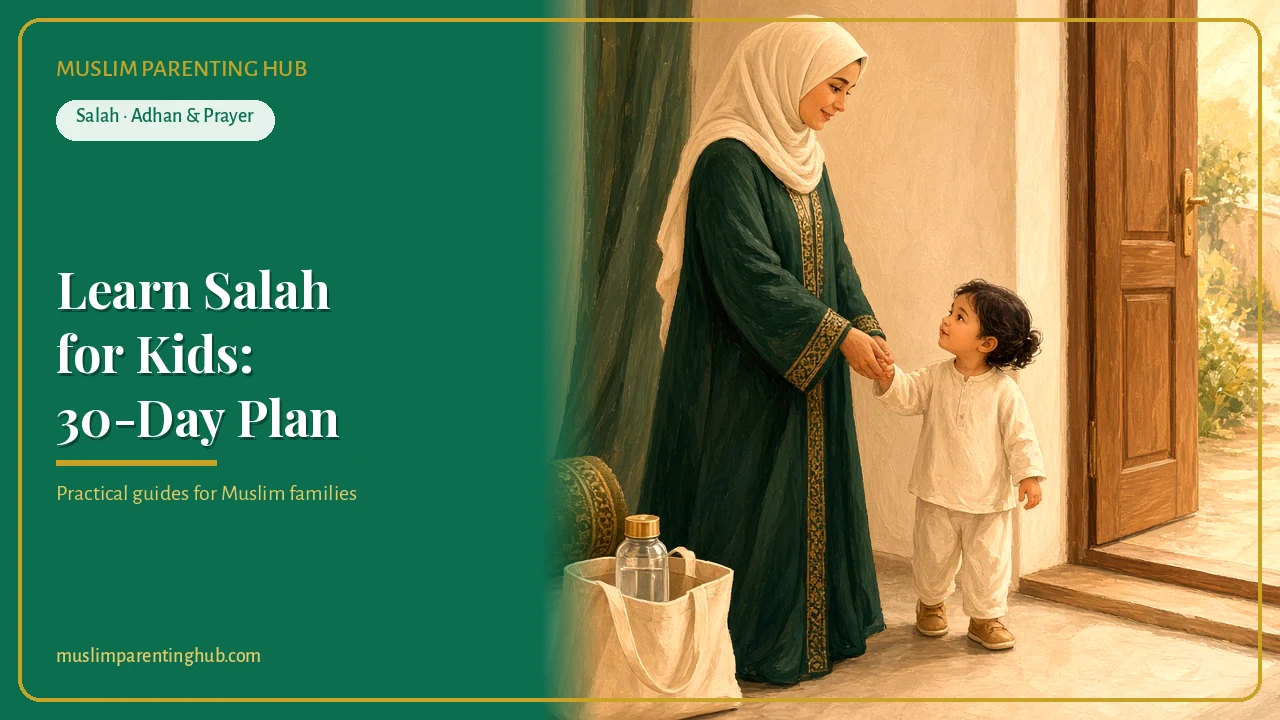
Learn Salah for Kids: A 30-Day Plan to Teach Your Child to Pray
How to teach kids to pray in Islam, one small layer a week: a 30-day learn-salah plan for ages 5–10 with positions, words and US school-day tips.
Read guide →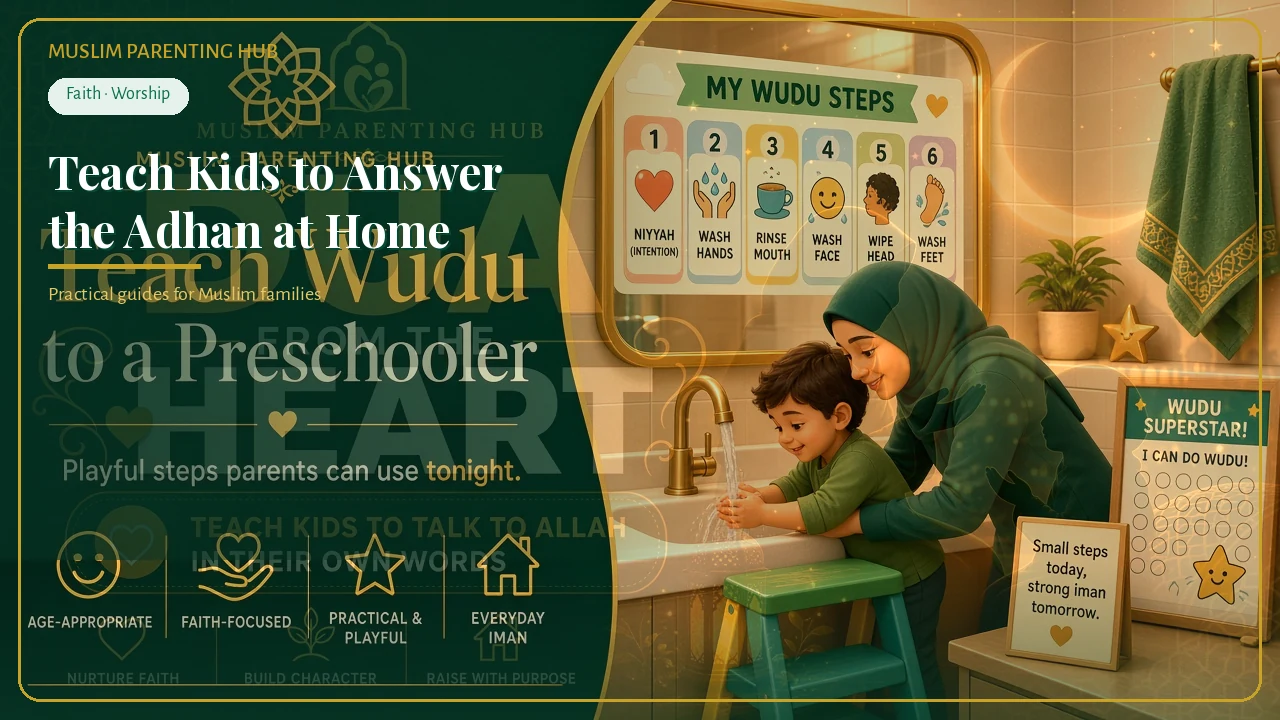
Teach Kids to Answer the Adhan at Home: Pause Game & 7-Day Plan
Kids talking over the adhan? Use a playful pause game, short reply lines by age, and a 7-day home plan so Muslim kids answer the call to prayer with love.
Read guide →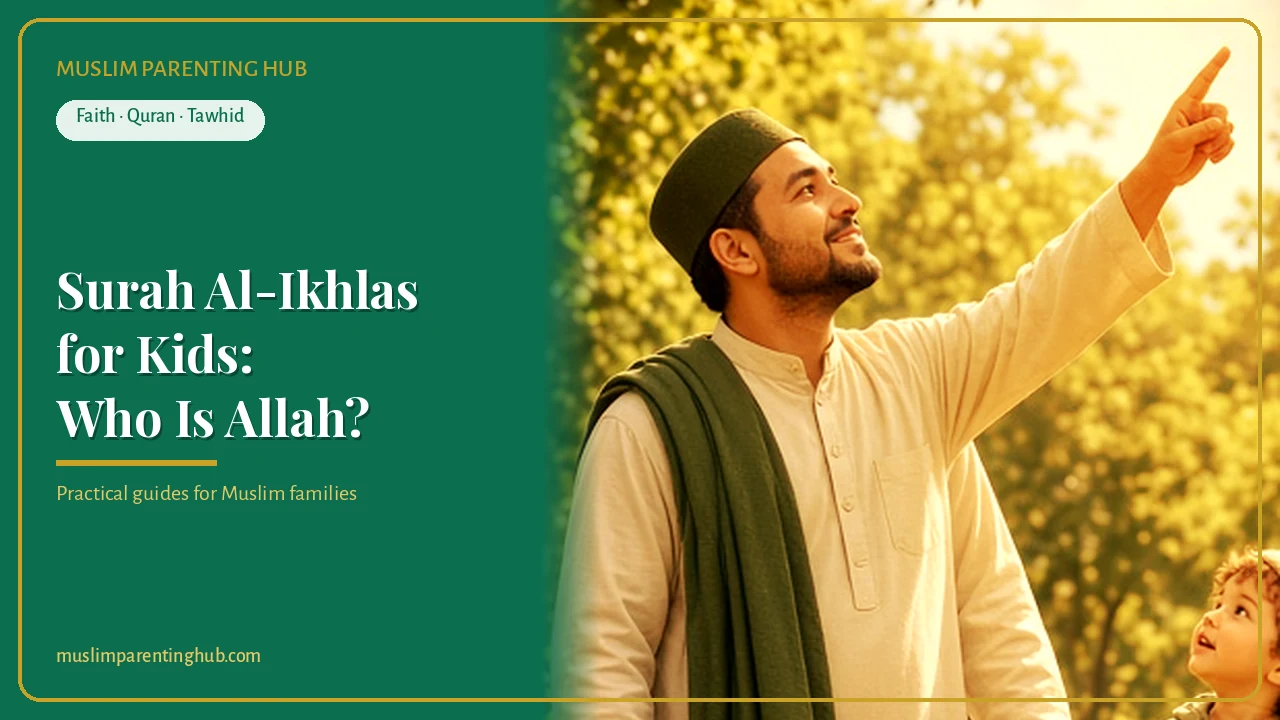
Surah Al-Ikhlas for Kids: Meaning, Easy Transliteration and How It Answers "Who Is Allah?"
Teach kids Surah Al-Ikhlas line by line: Arabic, easy transliteration, a simple meaning, how it answers "Who made Allah?" and a 7-day plan for home and school.
Read guide →