

How to Teach Kids to Pray Salah Step by Step (With Wudu): A Parent's Guide for Ages 5–10
Most Muslim parents remember learning salah by standing next to someone and copying. That still works. But between school, soccer, homework, and the fact that your child may be the only Muslim kid in their class, “just copy me” sometimes isn’t enough. Kids want to know what to say, why they move the way they do, and what counts when they make a mistake.
This guide gives you a clear, step-by-step way to teach wudu and salah to kids ages 5–10, in plain English, with the Arabic they’ll actually use. It builds on two pages families already use: teaching wudu to a preschooler for the youngest learners, and the after-school Maghrib routine for fitting prayer into real weekday evenings.
The Prophet ﷺ said to teach children salah at seven and to be firmer around ten (Abu Dawud). Seven is not a deadline; it’s a window. The years before and after are for practice, warmth, and small wins.
Soft guidance for homes—not a fatwa. Details differ slightly between schools of thought (madhhabs); follow your family’s teacher or local imam for specifics.
Before You Start: Three Mindset Rules
- Love before law. If salah feels like punishment at seven, it will feel like a burden at seventeen. Lead with joy.
- One new piece at a time. Learn the positions first, then the words, then the full sequence.
- You pray, they see. Kids copy what they watch. Let them see you pray calmly, every day, at home.
Part 1: Wudu Step by Step
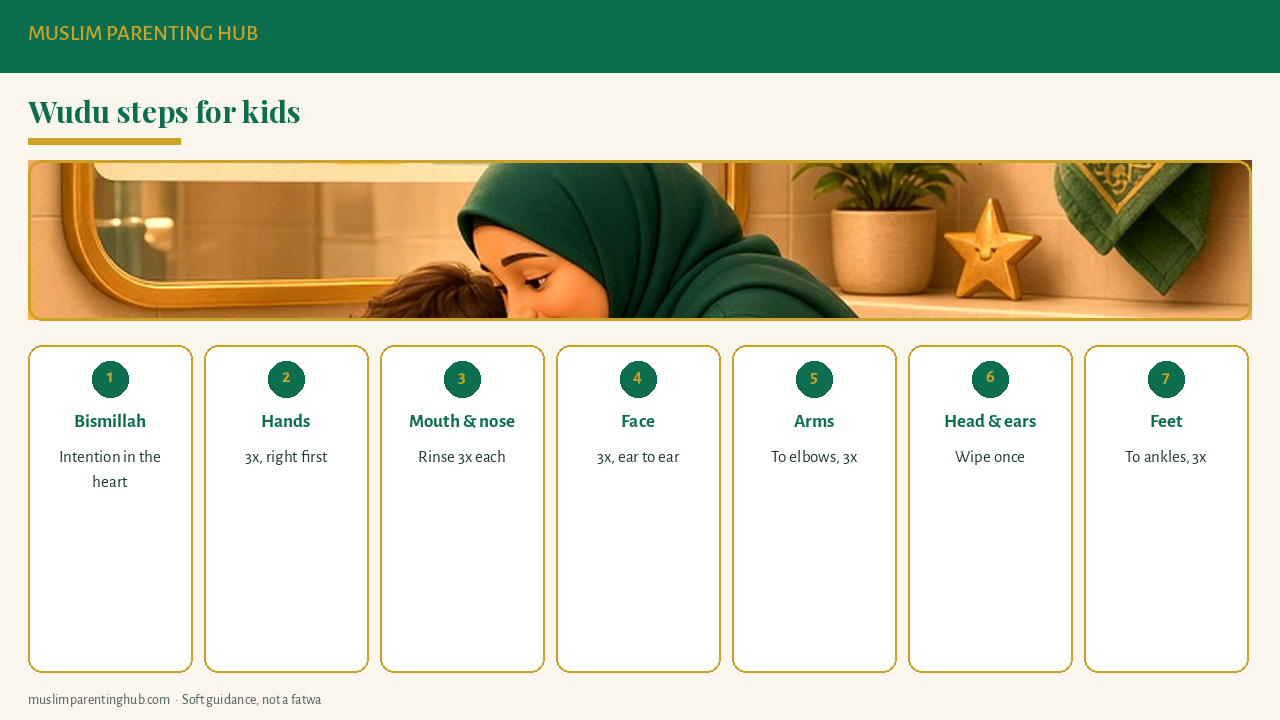
Teach wudu at the bathroom sink with a step stool and a small towel. Use the same order every time, and say the steps out loud together.
- Intention and Bismillah. “I’m making wudu for salah. Bismillah.”
- Wash hands three times, up to the wrists, right hand first.
- Rinse the mouth three times. Swish and spit.
- Rinse the nose three times. Sniff a little water in and blow it out gently (help younger kids with this one).
- Wash the face three times, forehead to chin, ear to ear.
- Wash the arms up to the elbows three times, right arm first, then left.
- Wipe the head once with wet hands, front to back and back to front.
- Wipe the ears with wet fingers—index fingers inside, thumbs behind.
- Wash the feet up to the ankles three times, right foot first, between the toes.
- Finish with the shahadah: “Ash-hadu an la ilaha illallah, wa ash-hadu anna Muhammadan ‘abduhu wa rasuluh.”
Kid-friendly memory line: “Hands, mouth, nose, face, arms, head, ears, feet.”
What breaks wudu (simple version for kids): using the bathroom, passing gas, and deep sleep. Keep it light: “Then we just make fresh wudu.”
Public school tip: Many kids feel awkward washing feet in a school restroom. If your child needs to pray Dhuhr at school, teach them to make wudu at home before leaving and to stay careful about keeping it. If they need to redo it, our guide to Islamic bathroom manners at school covers using public restrooms calmly.
Part 2: Salah Positions (Learn the Body First)
Start with the movements alone—no words—for a few days. Make it a calm game: you call the position, they do it.
- Qiyam (standing): Feet a little apart, facing the qiblah, eyes on the spot where your head will go in sujood.
- Ruku’ (bowing): Hands on knees, back flat “like a table.”
- I’tidal (standing back up): Straight, arms down or folded according to your family’s practice.
- Sujood (prostration): Forehead, nose, both palms, both knees, and toes on the ground—“seven parts touching.”
- Jalsah (sitting between the two sujoods): A short calm sit.
- Tashahhud (sitting at the end): Sitting, right index finger raised during the shahadah.
Five-year-olds love “Simon Says Salah.” Seven-year-olds love being the one who calls out the positions for siblings.
Part 3: The Words for Each Position
Teach these short phrases one or two at a time. Post them on an index card on the fridge.
| Position | What we say | Meaning |
|---|---|---|
| Opening (hands raised) | Allahu Akbar | Allah is the Greatest |
| Standing | Surah Al-Fatiha + a short surah | (Kids start with Al-Ikhlas) |
| Ruku’ | Subhana Rabbiyal ‘Adheem (3x) | Glory to my Lord, the Magnificent |
| Rising | Sami’ Allahu liman hamidah; Rabbana wa lakal hamd | Allah hears those who praise Him; Our Lord, all praise is Yours |
| Sujood | Subhana Rabbiyal A’la (3x) | Glory to my Lord, the Most High |
| Between sujoods | Rabbighfir li | My Lord, forgive me |
| Final sitting | At-Tahiyyat (tashahhud) | Greetings and salutations to Allah |
| Ending | As-salamu ‘alaykum wa rahmatullah (right, then left) | Peace and mercy upon you |
If your child is still learning Al-Fatiha, it’s fine for them to stand with you and say what they know. Learning the words is a process, not a pass/fail test.
Part 4: Put It Together — A 2-Rak’ah Practice Salah
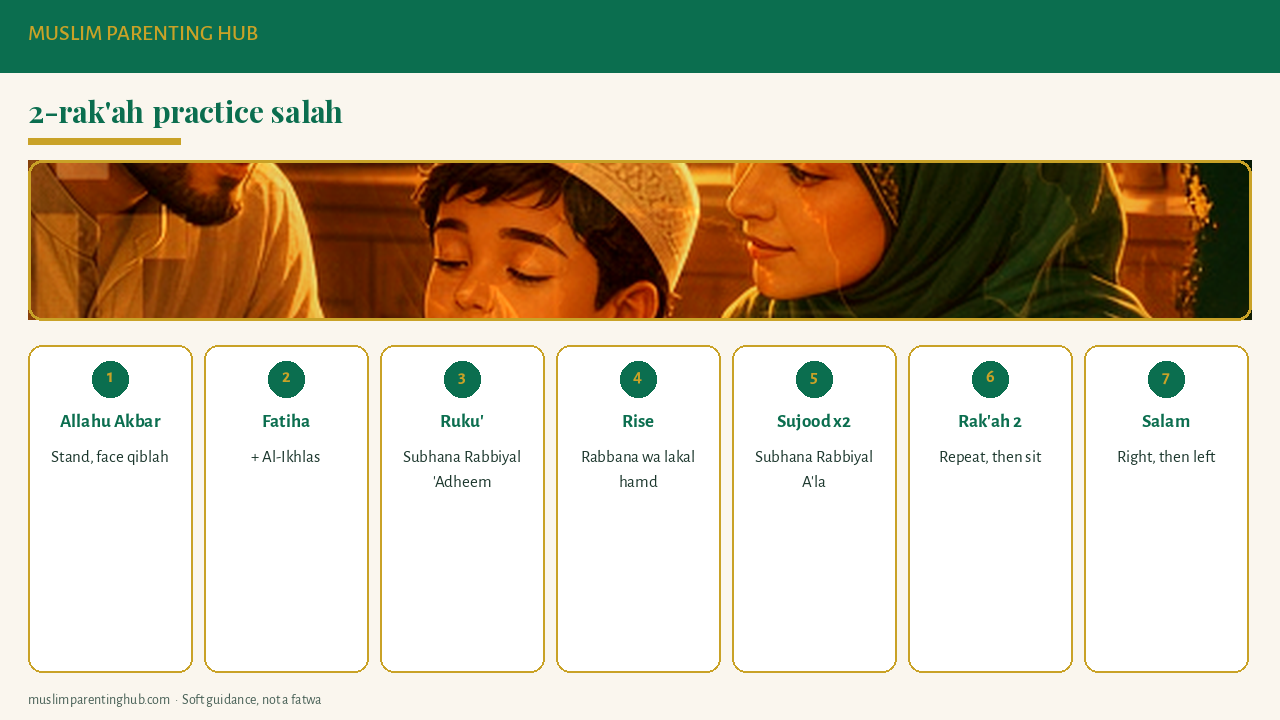
Fajr is two rak’ahs, so a “2-rak’ah practice salah” is the perfect training unit. Do it together, slowly, once a day.
Rak’ah 1
- Stand facing the qiblah and make the intention in your heart.
- Raise hands: “Allahu Akbar.”
- Recite Al-Fatiha, then Al-Ikhlas.
- “Allahu Akbar” — go into ruku’: “Subhana Rabbiyal ‘Adheem” (3x).
- Rise: “Sami’ Allahu liman hamidah… Rabbana wa lakal hamd.”
- “Allahu Akbar” — sujood: “Subhana Rabbiyal A’la” (3x).
- “Allahu Akbar” — sit briefly: “Rabbighfir li.”
- “Allahu Akbar” — second sujood: “Subhana Rabbiyal A’la” (3x).
Rak’ah 2
- “Allahu Akbar” — stand up and repeat Al-Fatiha and a short surah (Al-Falaq or An-Nas).
- Ruku’, rising, and two sujoods, same as before.
- Sit for the tashahhud (At-Tahiyyat), then send salawat on the Prophet ﷺ if your child knows it.
- Turn the head right, then left: “As-salamu ‘alaykum wa rahmatullah.”
That’s it. Celebrate the first full one with a hug, not a prize.
Three- and four-rak’ah prayers: Once two rak’ahs feel easy, add the middle tashahhud after rak’ah two and stand for the third (Maghrib) or third and fourth (Dhuhr, Asr, Isha). In the extra rak’ahs, only Al-Fatiha is recited.
Part 5: The Five Daily Prayers in Kid Terms
| Prayer | Rak’ahs (fard) | When, in kid words |
|---|---|---|
| Fajr | 2 | Before sunrise |
| Dhuhr | 4 | After lunch, midday |
| Asr | 4 | Late afternoon, after school |
| Maghrib | 3 | Right after sunset |
| Isha | 4 | When the sky is fully dark |
Maghrib is the easiest anchor for school-age families because everyone is usually home. If your evenings include sports and carpools, our guide to praying Maghrib on the go with kids helps you keep it even when you’re not home.
Age-by-Age Expectations
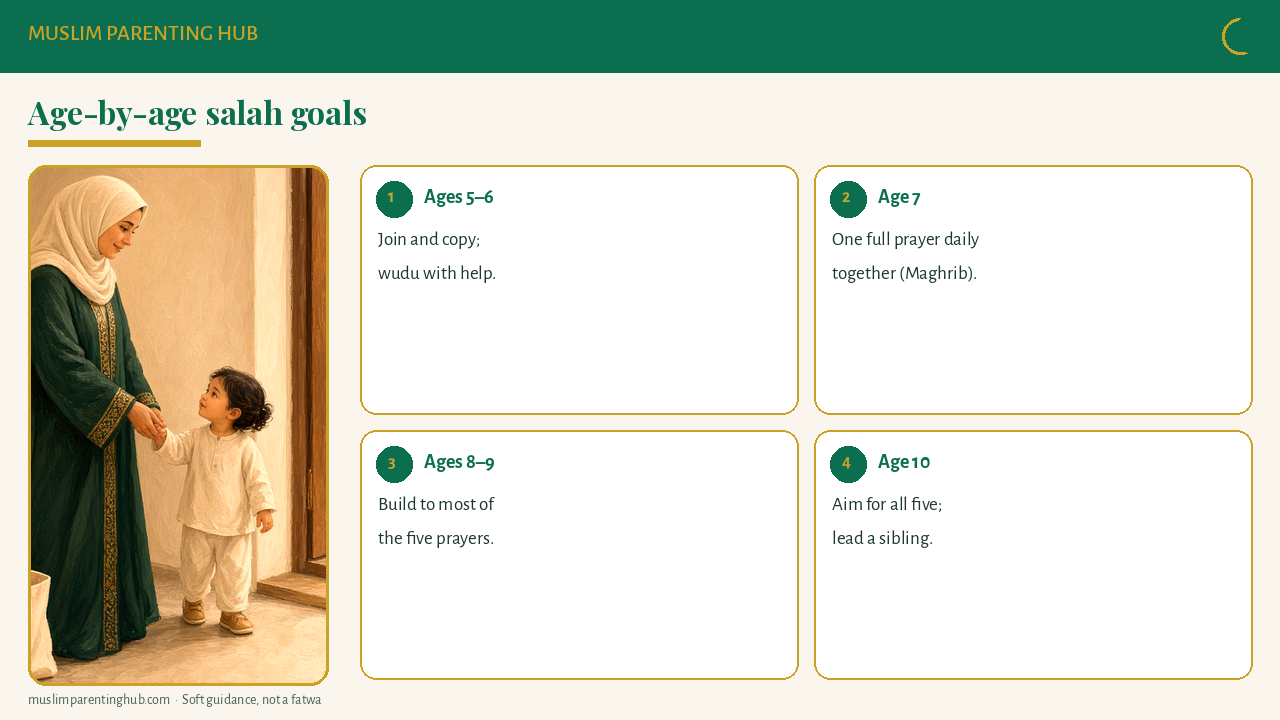
Ages 5–6: Join and copy
- Stands beside you for part of one prayer a day
- Knows “Allahu Akbar,” Al-Fatiha in progress, and the positions
- Wudu with help
Age 7: Start the habit
- One full prayer a day with you (Maghrib works best)
- Wudu mostly independent
- Learning ruku’ and sujood words
Ages 8–9: Build up
- Two or three prayers a day, then most of the five
- Knows the full 2-rak’ah sequence; learning 3 and 4
- Can pray beside a sibling without reminders for every step
Age 10: Steady and responsible
- Aims for all five prayers
- Understands what breaks wudu and how to redo it
- Can lead a younger sibling in a practice salah
These are gentle targets, not grades. Kids with ADHD, autism, or anxiety may need more time and more movement breaks—and that’s fine.
Making It Stick: Small Habits That Work
- Answer the adhan first. A prayer app or wall clock that plays the adhan gives kids a cue. Our answering the adhan at home plan turns it into a playful trigger.
- A kid-sized prayer rug. Ownership matters. Let them choose the color.
- Same spot every day. A corner of the living room becomes “our prayer corner.”
- Pray together at Maghrib. One shared prayer a day builds more than five rushed reminders.
- Short dua after salah. Let your child add their own words after the salam—our short duas for kids to learn by age has easy lines to start with.
- Friday upgrade. Older kids can practice Jumu’ah etiquette with our Jumu’ah prayer plan for families.
Common Mistakes (And Calm Fixes)
“They rush through it.” Pray beside them and slow your own pace. Count “Subhana Rabbiyal A’la” softly so they hear the rhythm.
“They forget what comes next.” Use the fridge card for a few weeks. Forgetting is part of learning.
“They giggle with siblings.” Separate them by a rug width. Laugh together afterward, not during.
“They refuse.” Don’t turn it into a power struggle. “Come stand with me for one rak’ah” is a win. Keep the door open and keep it warm.
“I yell, and then I feel guilty.” Apologize, reset, and try again tomorrow. Children learn salah from your calm far more than from your corrections.
FAQ
At what age should a child start praying salah?
The Prophet ﷺ said to teach children salah at seven and be firmer at ten. Many families invite kids to stand and copy from about age five, then build a steady habit starting at seven.
What order should I teach wudu in?
Intention and Bismillah, hands, mouth, nose, face, arms to the elbows (right first), wipe the head, wipe the ears, then feet to the ankles (right first), finishing with the shahadah. Kids can remember “hands, mouth, nose, face, arms, head, ears, feet.”
What should kids say in ruku’ and sujood?
In ruku’, “Subhana Rabbiyal ‘Adheem” three times. In sujood, “Subhana Rabbiyal A’la” three times. Teach one phrase at a time and post them on a card.
My child doesn’t know Al-Fatiha yet. Can they still pray with me?
Yes. Let them stand with you, do the movements, and say what they know. Practice Al-Fatiha separately in short chunks. Learning is gradual.
How do I teach salah without forcing my child?
Lead with your own calm example, keep one shared prayer a day, celebrate effort, and avoid shame. Invite rather than order, especially before age ten.
Can my child pray at school?
Many US public schools allow a quiet space for prayer if you ask. Teach your child to make wudu at home, find the qiblah, and politely ask a teacher for a few minutes. Your local imam can advise on timing questions.
Related guides
- How to teach wudu to a preschooler
- The after-school Maghrib routine
- Teach kids to answer the adhan at home
- 25 short duas for kids to learn by age
Closing: Stand Beside Them
You don’t have to be a perfect teacher. You just have to stand beside your child, again and again, and let them see that salah is where your family goes to be close to Allah. Start with one prayer tonight. Hands, mouth, nose, face, arms, head, ears, feet—then “Allahu Akbar,” together.
Quick steps
How to teach kids a 2-rak'ah practice salah (with wudu). Make wudu in order, then pray a slow two-rak'ah practice salah together, saying the short phrases in each position.
- Make wudu in order — Intention and Bismillah, then hands, mouth, nose, face, arms to the elbows, wipe head and ears, and feet to the ankles, finishing with the shahadah.
- Stand and say Allahu Akbar — Stand facing the qiblah, make the intention in your heart, raise hands and say Allahu Akbar.
- Recite Al-Fatiha and a short surah — Recite Al-Fatiha, then a short surah such as Al-Ikhlas.
- Ruku' and rising — Bow with hands on knees saying Subhana Rabbiyal 'Adheem three times, then rise saying Sami' Allahu liman hamidah, Rabbana wa lakal hamd.
- Two sujoods — Go into sujood saying Subhana Rabbiyal A'la three times, sit briefly saying Rabbighfir li, then make the second sujood.
- Second rak'ah — Stand up and repeat Al-Fatiha, a short surah, ruku', rising, and two sujoods.
- Tashahhud and salam — Sit for At-Tahiyyat, then turn the head right and left saying As-salamu 'alaykum wa rahmatullah.
Related articles
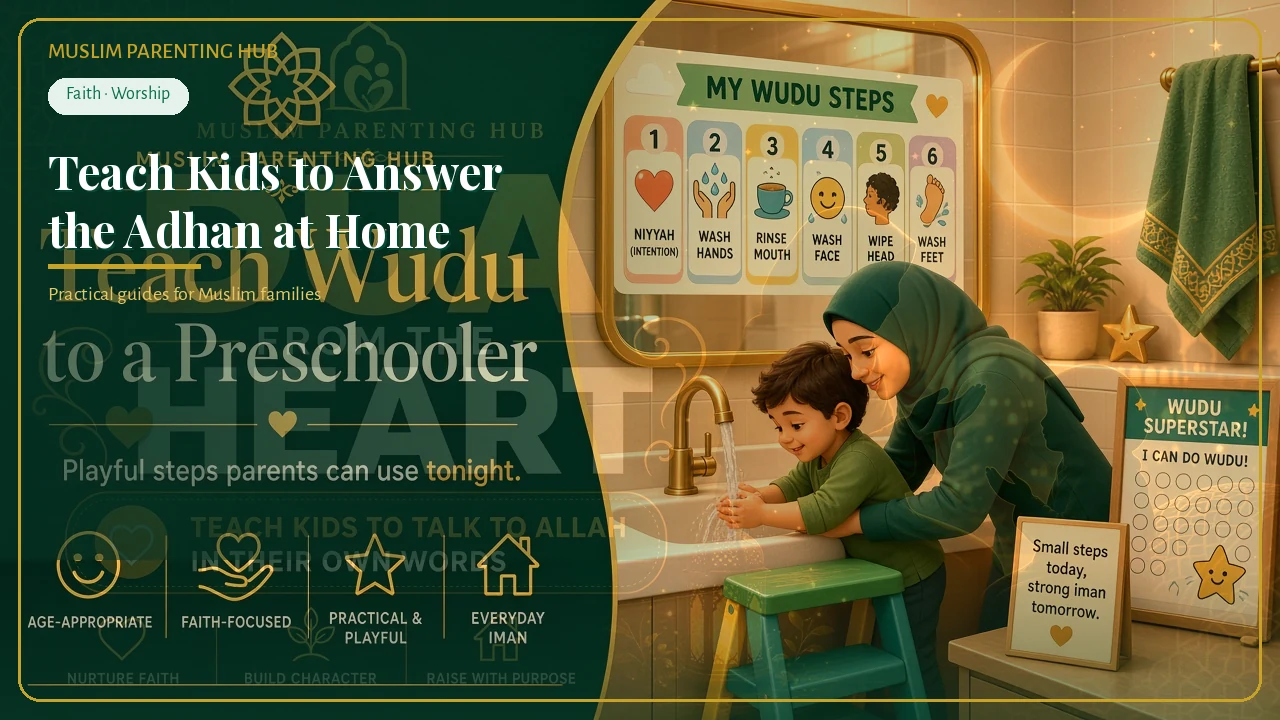
Teach Kids to Answer the Adhan at Home (Playful Practice Plan)
A playful home practice plan so Muslim kids answer the adhan—pause game, short reply lines, age bands, and scripts when the call to prayer plays. Soft & practical.
Read guide →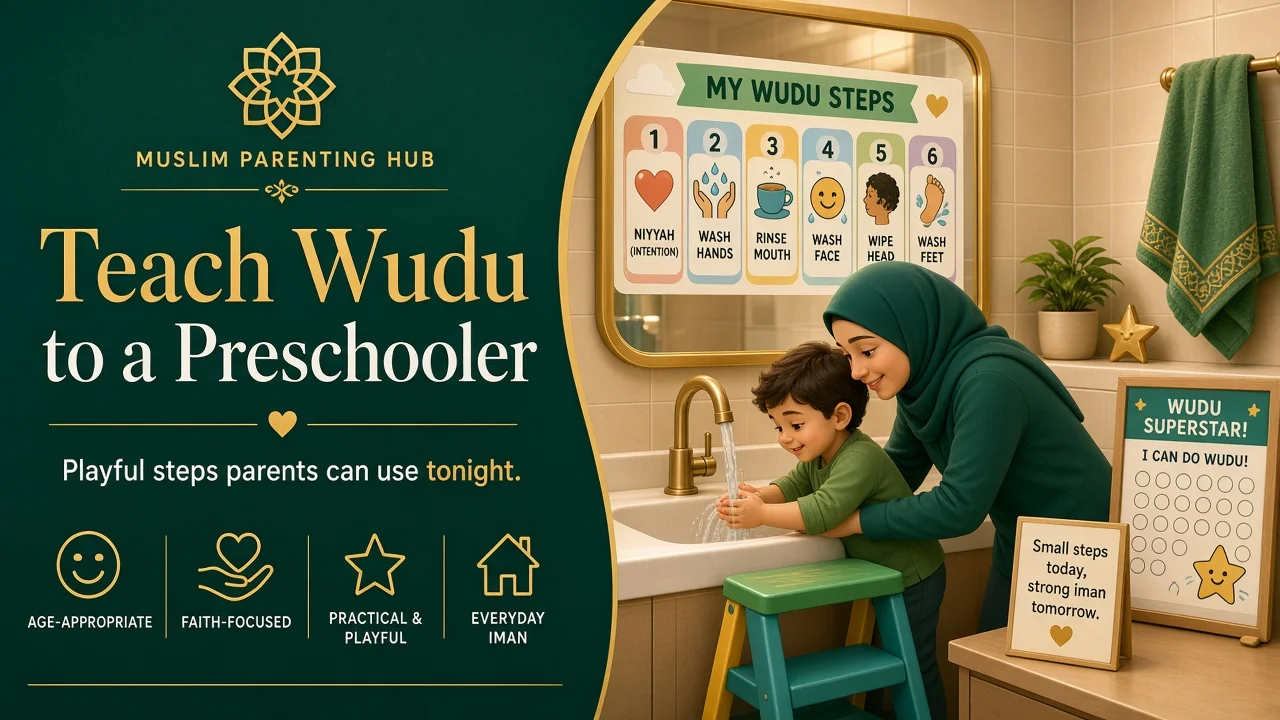
How to Teach Wudu to a Preschooler (Playful Steps Parents Can Use Tonight)
Teach wudu to preschoolers with playful steps—sink poster, doll practice, sticker chart, age tips, and tonight scripts. Gentle Muslim parenting for ages 3–5. Soft, practical.
Read guide →
25 Short Duas for Kids to Learn (By Age, With Meaning and Transliteration)
Short, easy duas for kids by age (2–4, 5–7, 8–10) with transliteration and meaning—plus a gentle 10-minute daily practice for US Muslim families.
Read guide →
The After-School Maghrib Routine That Actually Works for Muslim Families
A calm 20-minute after-school Maghrib routine for Muslim families—snack, wudu, pray together, then connect. Age tips, scripts, and a screen rule that sticks.
Read guide →