
How to Wake Kids for Fajr: A Gentle Plan (and Why Daylight Saving Week Is the Best Time to Start)
Fajr is the prayer many Muslim parents worry about most. It is dark, it is early, and a sleepy seven-year-old is very good at pretending not to hear. Yet the Prophet ﷺ said the two rak’ahs before Fajr are “better than the world and everything in it” (Muslim). It is a gift worth helping our kids reach.
This year in the US, daylight saving time ends on Sunday, 1 November 2026. Clocks go back one hour, so Fajr suddenly arrives about an hour earlier on the clock. That sounds harder, but it is actually the best week of the year to start a Fajr habit, because your child’s body clock is still running an hour “ahead.” A 5:30 AM wake-up the week after fall-back feels like 6:30 AM to their body.
This guide gives US Muslim parents a by-age approach, gentle wake-up scripts, the bedtime side that makes Fajr possible, and a seven-morning starter week. It is gentle home guidance, not a fatwa.
If your kids are still learning to respond to the call to prayer at all, start with our playful plan to teach kids to answer the adhan. Fajr is easiest for kids who already love the adhan.
What Changes When Clocks Fall Back
Here is a typical example for a mid-US city (your local times will differ, so check your masjid’s timetable):
| Date | Fajr | Sunrise | Notes |
|---|---|---|---|
| Sat 31 Oct (daylight time) | ~6:15 AM | ~7:40 AM | Last day of daylight time |
| Sun 1 Nov (standard time) | ~5:16 AM | ~6:41 AM | Clocks go back 1 hour |
Two things happen at once:
- Fajr and sunrise jump an hour earlier on the clock. The sun hasn’t changed; only our clocks have.
- Kids’ bodies don’t change overnight. For about a week, a child who normally wakes at 7:00 AM will naturally stir around 6:00 AM on the new clock.
That makes the first week of November a natural window for a Fajr habit, especially for kids 7 and up. Evenings shift too: Maghrib moves to around 5:00 PM. Our guide to the daylight saving Maghrib and bedtime shift covers the evening side, and how Muslim kids can pray at school covers Dhuhr and Asr in the shorter winter days.
What Age Should Kids Start Praying Fajr?
The Prophet ﷺ said: “Teach your children to pray when they are seven” (Abu Dawud, Tirmidhi). Salah becomes required at puberty. So there is a long, gentle runway:
- Ages 3–6: Fajr is a treat, not a task. If they happen to wake up, let them join you on the mat. Never wake a preschooler just for Fajr.
- Ages 7–9: Weekend Fajr first. Start with Saturday and Sunday mornings, when no school bus is coming. Add school days slowly.
- Ages 10–12: Most days. Aim for Fajr on time most days, with praise and a little independence: their own alarm, their own prayer corner.
- Teens: Their own responsibility. Your job shifts to reminders, encouragement and making sure the household supports early nights.
Our guide to the five daily prayers for kids explains Fajr alongside the other four in simple words.
Gentle Wake-Up Scripts (That Don’t Start a Fight)
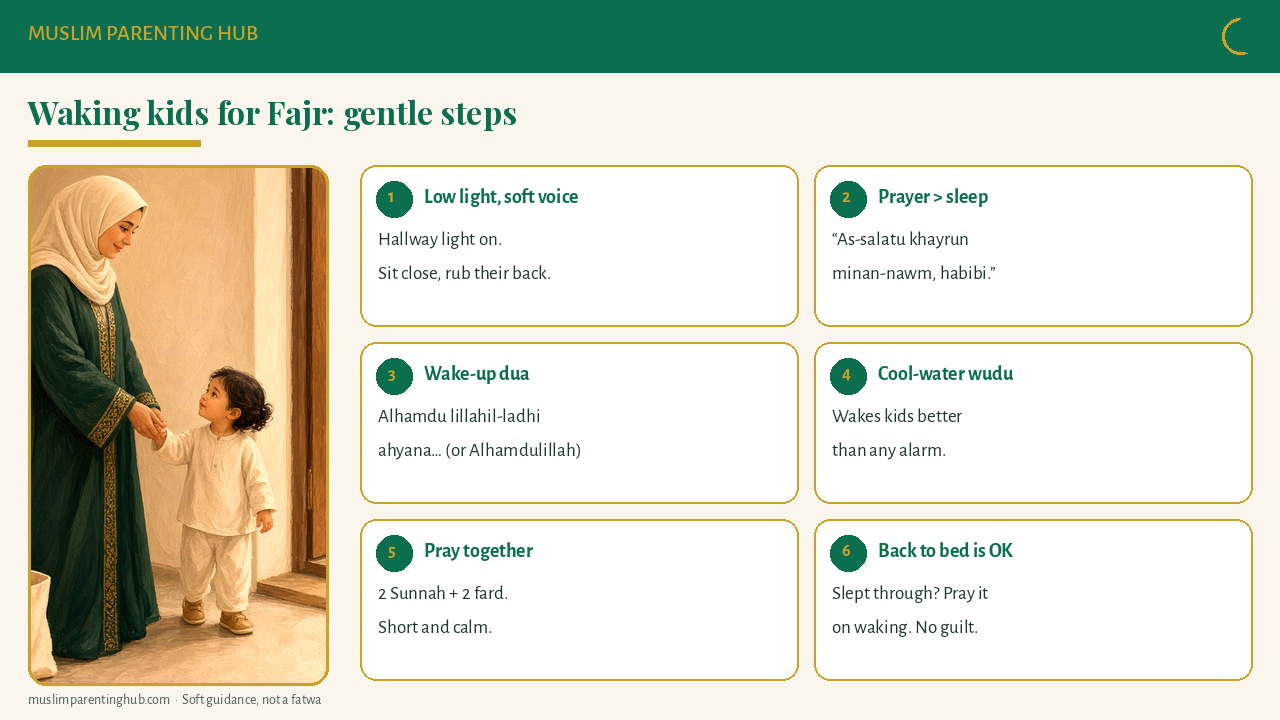
How you wake a child for Fajr sets the tone for the whole habit. Avoid yanking blankets and loud voices. Try this instead:
- Lights low, voice soft. Turn on a hallway light, not the overhead light. Sit on the bed and rub their back.
- Use the adhan words. “As-salatu khayrun minan-nawm. Prayer is better than sleep. Time for Fajr, habibi.” These words are part of the Fajr adhan and sound gentle.
- The wake-up dua together. “Alhamdu lillahil-ladhi ahyana ba’da ma amatana wa ilayhin-nushur” (Bukhari). Little ones can just say “Alhamdulillah.”
- Cool water on the face. Wudu with cool water wakes kids better than any alarm.
- Pray together, short and calm. Two rak’ahs of Sunnah if they can, then the two fard. No long lectures.
- Back to bed is allowed. On school days, if there’s time, let them sleep again until the usual wake-up. Fajr shouldn’t cost them a whole night’s rest.
If they won’t get up: Try once more, kindly. If it doesn’t work, let it go for today and say, “We’ll try again tomorrow, inshaAllah.” A child who sleeps through Fajr without meaning to should pray it as soon as they wake up; the Prophet ﷺ said whoever sleeps through a prayer should pray it when they remember (Muslim). No guilt trips.
Fajr Starts the Night Before
You can’t win Fajr at 5:15 AM if you lost bedtime at 10 PM. The night routine is where most of the work happens:
- Earlier bedtime the week of fall-back. Use the shift to move bedtime 15–30 minutes earlier for good.
- Isha soon after it comes in. In early November, Isha in many US cities is around 6:30 PM, so pray it early and start the bedtime routine.
- Screens off an hour before bed. Bright screens push sleep later.
- Sleep on the right side with bedtime duas. The Prophet ﷺ slept on his right side and made dua before sleep (Bukhari). Our bedtime duas for kids 7-night plan makes this easy.
- Intention before sleep. Say together, “InshaAllah, we’ll wake up for Fajr.” Kids who go to bed planning to wake up do better.
- Lay out a Fajr kit. Prayer clothes or a jacket, socks and the prayer mat by the bed so there’s no searching in the dark.
Make Fajr Feel Special
Children repeat what feels good. A few small touches make Fajr something they want to be part of:
- The Fajr club. Only the people who wake up for Fajr get the secret handshake or the special sticker.
- Dawn walk on weekends. After Fajr, step outside (bundled up) and watch the sky turn pink. Say SubhanAllah together.
- Fajr breakfast. On Saturdays, the early risers get pancakes or hot chocolate before everyone else.
- Quran after Fajr. Five quiet minutes of Surah Al-Fatiha practice, or the morning adhkar, while the house is still sleepy.
- Tell them the reward. The Prophet ﷺ said whoever prays Fajr is under the protection of Allah (Muslim). Kids love knowing that.
The Seven-Morning Fajr Starter Week (1–7 November)

The week after the clocks change is ideal. Keep it light and celebrate every win.
- Sun 1 Nov — Fall-back Fajr. Clocks change overnight. Wake kids 7+ for Fajr with the soft script. Their body clock will help.
- Mon 2 Nov — Fajr kit. Lay out clothes and the mat the night before. Pray, then let them nap if there’s time before school.
- Tue 3 Nov — Wake-up dua. Learn the waking dua together after Fajr.
- Wed 4 Nov — Their own alarm. Older kids (9+) set a gentle alarm themselves.
- Thu 5 Nov — Two rak’ahs Sunnah. Add the two Sunnah rak’ahs before Fajr and share the “better than the world” hadith.
- Fri 6 Nov — Fajr and Friday. Pray Fajr, then read a little of Surah Al-Kahf before school.
- Sat 7 Nov — Dawn walk and pancakes. Celebrate the week with a sunrise walk and a special breakfast.
After the first week, keep weekends steady and add school days as your child is ready. Consistency beats perfection.
FAQ
At what age should kids start waking up for Fajr?
Around age 7, gently, often starting with weekends. The Prophet ﷺ said to teach children to pray at seven. Younger children can join if they wake up, but there’s no need to wake a preschooler for Fajr.
How do I wake my child for Fajr without a fight?
Use low light, a soft voice and a back rub, say “Prayer is better than sleep,” do the wake-up dua together and use cool water for wudu. If they don’t get up after two gentle tries, let it go and try again tomorrow.
What happens to Fajr time when daylight saving ends?
On Sunday, 1 November 2026, US clocks go back one hour, so Fajr and sunrise move about an hour earlier on the clock. Your child’s body clock lags behind for a week, which makes it easier to wake up early.
What if my child sleeps through Fajr?
Have them pray it as soon as they wake up. The Prophet ﷺ said whoever sleeps through a prayer should pray it when they wake or remember (Muslim). Don’t shame them; adjust bedtime and try again tomorrow.
Can kids go back to sleep after Fajr?
Yes. Especially on school days, letting kids sleep again after Fajr is fine and helps protect their rest. Many families pray Fajr, then let kids nap until the usual wake-up time.
How do I get my teenager to pray Fajr?
Make it their responsibility with your support: their own alarm, an earlier bedtime, phones charging outside the bedroom, and quiet encouragement. Pray together when you can, and praise effort rather than nagging.
Related guides
- Teach kids to answer the adhan at home
- The five daily prayers for kids explained
- Daylight saving ends: Maghrib and bedtime shift for kids
- How Muslim kids can pray at school
- Bedtime duas for kids: 7-night plan
Closing
Fajr isn’t won with alarms and arguments. It’s won with early nights, soft voices, a little cool water and a parent who keeps showing up on the prayer mat. Use the fall-back week as your fresh start, celebrate every sleepy success, and trust that the habit you build now will wake your child for Fajr long after you stop knocking on their door.
Quick steps
Seven-morning Fajr starter week for kids. Use the week clocks fall back to build a gentle Fajr habit.
- Sun 1 Nov — Fall-back Fajr — Wake kids 7+ for Fajr with a soft voice; their body clock is still an hour ahead.
- Mon 2 Nov — Fajr kit — Lay out clothes and the prayer mat the night before.
- Tue 3 Nov — Wake-up dua — Learn the waking dua together after Fajr.
- Wed 4 Nov — Own alarm — Older kids set a gentle alarm themselves.
- Thu 5 Nov — Two Sunnah rak’ahs — Add the two rak’ahs before Fajr and share the hadith that they are better than the world.
- Fri 6 Nov — Fajr and Friday — Pray Fajr, then read a little of Surah Al-Kahf before school.
- Sat 7 Nov — Celebrate — Take a dawn walk and have a special breakfast.
Related articles

The 5 Daily Prayers for Kids: Explaining Fajr to Isha With the Sun and Your Family's Day
Explain the five daily prayers to kids with the sun: what Fajr, Dhuhr, Asr, Maghrib and Isha mean, when they come this fall, rak'ah counts, and easy games.
Read guide →
Teach Kids to Answer the Adhan at Home: Pause Game & 7-Day Plan
Kids talking over the adhan? Use a playful pause game, short reply lines by age, and a 7-day home plan so Muslim kids answer the call to prayer with love.
Read guide →
How Muslim Kids Can Pray at School: Dhuhr and Asr in a US School (Winter Prayer Times Guide)
After clocks fall back Nov 1, Dhuhr and Asr land in the school day. How Muslim kids can pray at a US school: when, where, wudu and what to tell the teacher.
Read guide →
Daylight Saving Ends Nov 1: How to Shift Your Family's Maghrib, Homework and Bedtime Routine
US clocks fall back Nov 1, 2026—shift Maghrib, homework, and bedtime gently with a week-before plan and sample after-school schedules for Muslim families.
Read guide →