

How Muslim Kids Can Pray at School: Dhuhr and Asr in a US School (Winter Prayer Times Guide)
On Sunday, November 1, 2026, US clocks fall back an hour. Overnight, prayer times slide earlier. In many cities, Dhuhr starts close to noon, Asr arrives around 2:30–3:00 p.m., and Maghrib comes before 5:00. For the next few months, two prayers fall right inside the school day.
For families with a child who has started praying, that brings real questions. Can my child pray at school? Where? What about wudu? What do I tell the teacher? And what if my child feels shy?
This guide walks US Muslim parents through it calmly, by age, with simple scripts. It is gentle home guidance, not a fatwa. Prayer times vary by city and by the calculation your masjid uses, so always check your local timetable, and ask your local imam about personal fiqh questions.
If your child is still learning the positions, our step-by-step guide to teaching kids salah and wudu is the place to start.
First: Does My Child Need to Pray at School?
It depends on age.
The Prophet ﷺ said, “Command your children to pray when they are seven, and discipline them for it when they are ten” (Abu Dawud). Salah becomes an obligation at puberty. Before that, the years from seven to puberty are for building the habit with love.
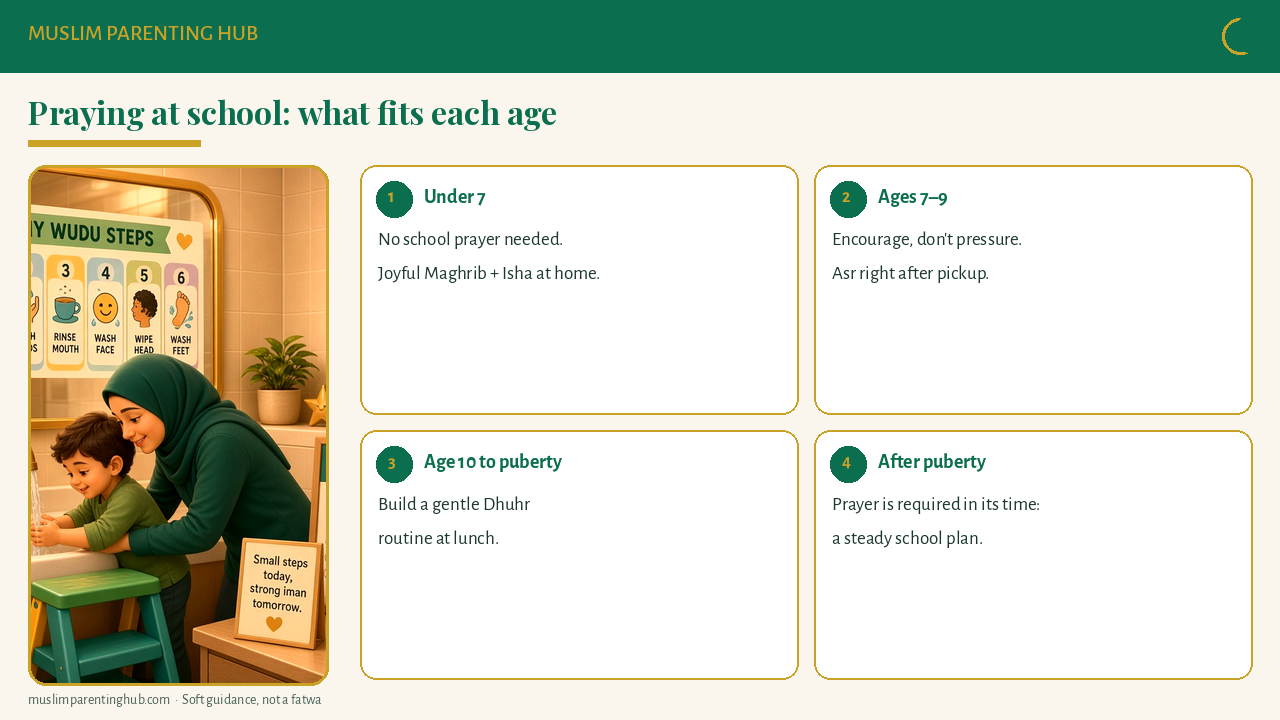
- Under 7: No need to pray at school. Focus on joyful home prayers, especially Maghrib and Isha.
- Ages 7–9: Encourage, don’t pressure. Many families keep Dhuhr and Asr at home on weekends and pray Asr right after pickup on school days. Praying Dhuhr at school is a bonus if your child wants to.
- Ages 10 to puberty: A good time to build a steady school routine, gently, so it feels normal before it becomes required.
- After puberty: The prayer is required within its time, so a reliable school plan really matters.
Winter Prayer Times vs. the School Day
Here is what a typical November weekday can look like in much of the US (your city will differ):
| Time | Prayer / school |
|---|---|
| ~6:15 a.m. | Fajr window (pray before school) |
| ~11:50 a.m.–12:15 p.m. | Dhuhr begins (often near lunch) |
| ~2:30–3:00 p.m. | Asr begins (some calculations later) |
| ~3:00–3:30 p.m. | School dismissal |
| ~4:45–5:10 p.m. | Maghrib |
Two things stand out:
- Dhuhr usually needs to happen at school for older kids, because its window often ends around the time Asr begins, before dismissal.
- Asr can usually be prayed at home right after pickup, as long as you pray it well before sunset. That makes after-school order important: arrive, wudu, Asr, then snack.
For the full shift in evening routines, see our guide to shifting Maghrib and bedtime when daylight saving ends.
Where Can a Child Pray at School?
Federal guidance from the US Department of Education says public school students may pray during non-instructional time, such as lunch or recess, as long as it isn’t disruptive, and they can do so the same way other students can talk or read during that time. Many schools also offer a quiet space as a religious accommodation, but that depends on the school.
Places families commonly use:
- A corner of the library or counselor’s office during lunch (with permission).
- An empty classroom a friendly teacher offers.
- A quiet spot on the playground edge at recess, on a jacket.
- The nurse’s room or a small office, if the school suggests it.
Salah can be prayed on any clean surface. A small folding prayer mat in the backpack helps, but a clean jacket works fine. Use a free compass app for the qiblah (from most of the US it is roughly northeast).
A short Dhuhr only takes three or four minutes. Teach your child to pray calmly, not in a rush, but also not to wait until the last minute of lunch.
Wudu at School Without Stress
Washing feet in a school sink is the part most kids dread. A few tips:
- Make wudu at home before school. If your child keeps it, they can pray Dhuhr without a new wudu.
- If they need to redo it, teach a quick, tidy version in the restroom: sleeves up, a paper towel ready, and no splashing. Our guide to Islamic bathroom manners at school covers using public restrooms calmly.
- Feet: Some families follow the opinion allowing wiping over socks put on after wudu; others don’t. Ask your local imam, then teach your child your family’s practice.
- Practice at home with a timer: “Can you do a neat school wudu in two minutes?”
Talking to the Teacher
A short, friendly note works better than a big meeting. Fall parent-teacher conferences are a good time to bring it up too.
“Hi Ms. Carter, our son Yusuf has started praying the midday prayer, which falls during lunch in the winter. It takes about four minutes. Could he use a quiet corner of the library or your classroom during lunch? He’ll bring a small mat and won’t miss any class time. Thank you so much for your help!”
Keep it simple:
- Ask for a few minutes during lunch or recess, not class time.
- Offer a specific place if you know one.
- Say thank you and follow up with a kind word later.
Most teachers are glad to help when the request is small and clear.
When Your Child Feels Shy
Many kids worry what friends will think. That’s normal, and it’s not weak faith.
Script for your child:
“It’s okay to feel shy. Allah sees you choosing Him, even if it’s in a quiet corner. You don’t need an audience.”
If a friend asks, give them an easy line:
“I’m praying. Muslims pray five times a day. It only takes a few minutes!”
Some kids like to pray with a Muslim friend or sibling at the same school. Praying together makes it feel normal and brave.
If your child isn’t ready this month, don’t force it. Keep Asr steady at home and revisit Dhuhr in a few weeks.
A Simple Weekday Plan
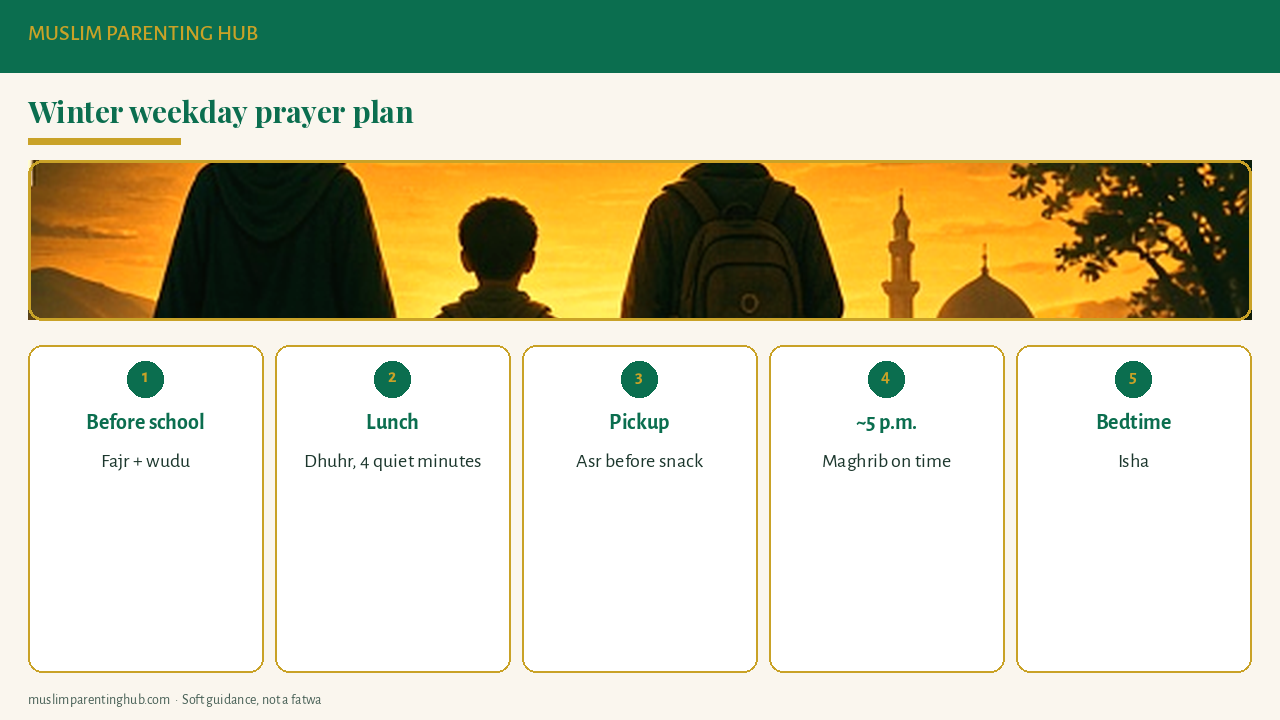
- Before school: Fajr, then wudu before leaving (or keep wudu from Fajr).
- Lunch: Eat first or pray first, whichever fits. Pray Dhuhr in the agreed spot.
- Pickup: Asr soon after arriving home, before snack and screens.
- Maghrib: Right at its time, early now, before 5 p.m. in many places.
- Isha: Before bed, so younger kids aren’t up late.
A small chart on the fridge helps kids track all five without nagging. Our explainer on the five daily prayers for kids has a printable-style chart idea.
What About Combining Prayers?
Some parents ask whether kids can combine Dhuhr and Asr when school makes Dhuhr hard. Scholars differ on combining at home for a need, and some schools of thought don’t allow it outside travel and Hajj. This is a question for your local imam, not something to make the everyday default. For younger children who aren’t yet required to pray, it usually isn’t an issue: focus on the prayers they can pray calmly.
Hearing the Adhan During the School Day
Some kids have an adhan app or a watch reminder. Teach them to set it to vibrate at school, and to answer quietly in their heart. Our guide on teaching kids to answer the adhan has simple practice games for home.
FAQ
Can Muslim kids pray at a public school in the US?
Yes. US Department of Education guidance says students may pray during non-instructional time, like lunch or recess, as long as it isn’t disruptive. Many schools also offer a quiet room as an accommodation, so ask your child’s teacher or counselor.
Which prayers fall during the school day in winter?
After daylight saving ends on November 1, Dhuhr usually begins around noon and Asr around 2:30–3:00 p.m. in many US cities, so Dhuhr often needs to be prayed at school. Asr can usually be prayed at home right after pickup, well before sunset.
At what age should my child pray Dhuhr at school?
Salah is required at puberty. Before that, it’s habit-building: the Prophet ﷺ said to command children to pray at seven. Many families start an optional school routine around 8–10 so it feels normal by puberty.
How can my child make wudu at school?
The easiest way is to make wudu at home and keep it until Dhuhr. If they need to redo it, teach a quick, tidy restroom wudu. For wiping over socks, ask your local imam and follow your family’s practice.
What should I say to my child’s teacher about prayer?
Send a short, friendly note asking for a quiet spot for about four minutes during lunch or recess, not class time. Mention the small prayer mat, offer a place if you know one, and say thank you.
What if my child is too shy to pray at school?
Don’t force it. Keep Asr steady at home, praise any step they take, give them an easy line for curious friends, and revisit Dhuhr later. Praying with a Muslim friend or sibling often helps.
Related guides
- Learn salah for kids: 30-day plan
- After-school order: snack, Asr, homework
- Teach kids to answer the adhan
- Prayer corner for kids at home
Closing
When the clocks fall back, the school day and the prayer times overlap for a few months. That isn’t a problem to dread. It’s a chance for your child to learn that salah fits into real life, in a library corner, on a folded jacket, four quiet minutes between lunch and math. Start small, keep it kind, and let your child feel proud of choosing Allah at school.
Quick steps
Weekday prayer plan for Muslim kids at school in winter. After clocks fall back, fit all five prayers around the school day with one short Dhuhr at school.
- Before school — Pray Fajr and make wudu before leaving, or keep wudu from Fajr.
- Lunch — Dhuhr — Pray Dhuhr in the agreed quiet spot during lunch or recess, in about four minutes.
- Pickup — Asr — Pray Asr soon after arriving home, before snack and screens, well before sunset.
- Maghrib — Pray Maghrib right at its time, often before 5 p.m. in winter.
- Isha — Pray Isha before bed so younger kids aren’t up late.
Related articles

How to Teach Kids to Pray Salah Step by Step (With Wudu): A Parent's Guide for Ages 5–10
A calm, step-by-step guide to teaching kids wudu and salah—what to say in each position, a 2-rak'ah practice plan, and age-by-age expectations for ages 5–10.
Read guide →
The 5 Daily Prayers for Kids: Explaining Fajr to Isha With the Sun and Your Family's Day
Explain the five daily prayers to kids with the sun: what Fajr, Dhuhr, Asr, Maghrib and Isha mean, when they come this fall, rak'ah counts, and easy games.
Read guide →
Teach Kids to Answer the Adhan at Home: Pause Game & 7-Day Plan
Kids talking over the adhan? Use a playful pause game, short reply lines by age, and a 7-day home plan so Muslim kids answer the call to prayer with love.
Read guide →
Daylight Saving Ends Nov 1: How to Shift Your Family's Maghrib, Homework and Bedtime Routine
US clocks fall back Nov 1, 2026—shift Maghrib, homework, and bedtime gently with a week-before plan and sample after-school schedules for Muslim families.
Read guide →