

How to Pray in Jama'ah at Home With Kids: Rows, Iqamah and Wiggly Toddlers
The adhan app goes off at 6:41 p.m. One child is finishing homework at the kitchen table, another is building a Lego tower, and the toddler is “helping” with the laundry basket. Everyone prays at some point, but usually separately, in different rooms, at different times.
What if, three or four nights a week, you all prayed together?
Praying in jama’ah (congregation) at home is one of the simplest ways to make salah feel like a family habit instead of a personal chore. Kids see their parents pray. They learn the movements by following. They hear Quran recited out loud. And they feel like part of something bigger, even on a rug in a suburban living room.
This guide walks you through how to set it up: who stands where, how to let kids take real jobs like the iqamah, how to keep it short enough for little ones, and what to do when the toddler climbs on your back in sujood.
If your kids aren’t yet comfortable answering the adhan, our playful plan to teach kids to answer the adhan at home is a perfect first step. Home jama’ah is what comes after the call.
Why Pray Together at Home?
Kids learn salah by watching. The Prophet ﷺ said, “Pray as you have seen me praying” (Sahih al-Bukhari 631). Children learn the same way: by seeing it done, again and again, by the people they love.
It turns salah into family time. Many US families are pulled in every direction: practice, carpools, homework, work shifts. Ten minutes on the rug together can become the calmest moment of the day.
Congregation has special reward. The Prophet ﷺ said that prayer in congregation is twenty-seven degrees better than praying alone (Sahih al-Bukhari 645, Sahih Muslim 650). For men, the masjid is the main place for congregational prayer when they can get there. But on the many evenings when the family is home, praying together is a beautiful option, and it builds the habit kids will carry to the masjid.
It prepares kids for the masjid. A child who has stood in a row at home, followed an imam, and said “Ameen” after Al-Fatiha will feel far more confident at Jumu’ah or Taraweeh. If your little one hasn’t been to the masjid yet, pair this with our home practice plan for a toddler’s first masjid visit.
Who Stands Where: A Simple Family Guide
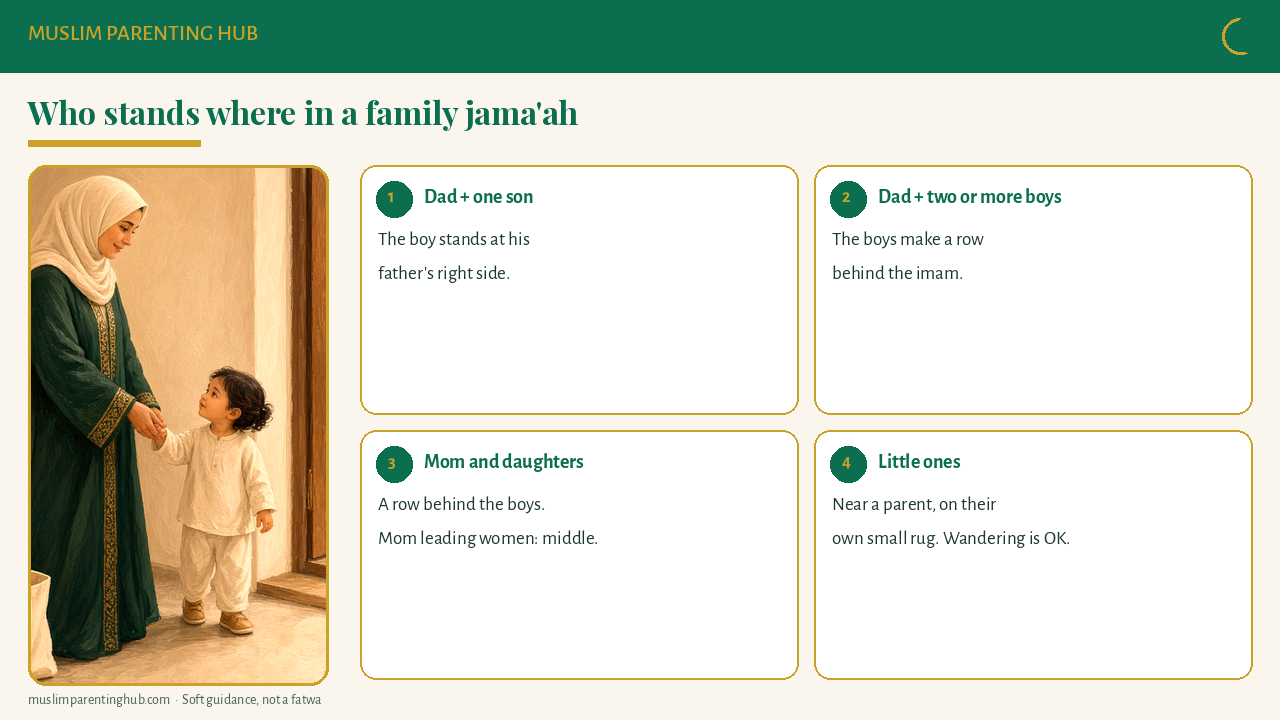
Row positions come straight from the Sunnah, and they’re easier than many parents think. Here are the most common home setups. (Details differ a little between schools of fiqh; ask your local imam if your situation is unusual.)
Dad leads, one son prays with him. The boy stands to the right of his father, about level with him. When young Ibn Abbas stood on the Prophet’s left during a night prayer, the Prophet ﷺ gently moved him to his right side (Sahih al-Bukhari 699).
Dad leads, two or more boys. The boys stand in a row behind the imam.
Dad leads, with Mom and daughters. Boys stand behind the imam (or to his right, if there’s only one), and Mom and the girls form a row behind them. Anas ibn Malik described praying at his family’s home: he and an orphan boy stood behind the Prophet ﷺ, and the elderly woman of the house stood behind them (Sahih al-Bukhari 380, Sahih Muslim 658). It’s a lovely picture to share with kids: a family-sized jama’ah, led by the Prophet ﷺ himself, in someone’s house.
Mom leads her daughters and young children. When women pray in congregation together, the woman leading usually stands in the middle of the first row, slightly ahead or level, rather than out in front. This setup is common when Dad is at work or at the masjid. Ask your imam about details for your family.
Little ones. Toddlers and preschoolers can stand anywhere near their parents, and they will wander. That’s fine. More on that below.
Straight rows. The Prophet ﷺ said straightening the rows is part of establishing the prayer (Sahih al-Bukhari 723). Make it a quick game: “Toes on the line, shoulders touching. Is our row straight like a ruler?”
Give Kids Real Jobs
Kids invest in what they’re trusted with. Rotate these jobs through the week:
- Rug captain: lays out the prayer rugs facing the qiblah.
- Qiblah checker: confirms the direction with a compass app.
- Screen switcher: turns off the TV and puts phones face down.
- Iqamah caller: says the iqamah right before the prayer starts.
- Row straightener: checks toes and shoulders.
- Dua leader: makes a short dua for the family afterward.
Letting a child say the iqamah
The iqamah is the second call, said right before the prayer begins. It’s shorter and quicker than the adhan, and many children can learn it in a week or two. In many families an older boy says it for the family jama’ah, while in a women-and-girls jama’ah a daughter or Mom often says it more quietly.
Practice a phrase a day, just like any short dua. Kids feel enormously proud the first time their voice starts the family prayer.
Can a child lead the prayer?
There’s a well-known story of Amr ibn Salamah, who led his people in prayer as a young boy because he had memorized the most Quran (Sahih al-Bukhari 4302). Scholars differ on whether a child who hasn’t reached puberty may lead adults in an obligatory prayer. At home, a simple approach many families use is letting an older child lead younger siblings in a practice prayer, a sunnah prayer, or on a weekend morning, with a parent praying nearby. Ask your imam if you want details for your family.
Keep It Short (The Sunnah Says So)
Parents sometimes worry that leading a “real” prayer means long recitations. For a family with young children, the opposite is true.
The Prophet ﷺ said, “When one of you leads people in prayer, let him keep it light, for among them are the weak, the sick and the elderly” (Sahih al-Bukhari 703). He also said he would begin a prayer intending to make it long, then hear a baby crying and shorten it so the mother wouldn’t be distressed (Sahih al-Bukhari 707).
What this means for your family:
- Choose short surahs after Al-Fatiha: Al-Ikhlas, Al-Kawthar, Al-Asr, An-Nas. Kids love recognizing a surah they know. If your children are learning Al-Ikhlas right now, our guide to Surah Al-Ikhlas for kids pairs perfectly with home jama’ah.
- Recite clearly and a little slower so kids can follow.
- Aim for about 5–10 minutes from iqamah to the end of a short dhikr.
Following the imam
Teach kids the golden rule of jama’ah: the imam goes first, and we follow. We don’t race ahead into ruku’ or sujood. Make it a game during practice: “Follow the leader, but never pass the leader.”
And remind them to say “Ameen” out loud together after the imam finishes Al-Fatiha in Maghrib, Isha and Fajr. That shared “Ameen” is often the moment little kids love most.
For kids still learning what to say and do in each position, our step-by-step guide to teaching kids salah with wudu covers the basics.
Toddlers on the Rug: What’s Normal
Your toddler will climb, crawl under your legs, say “Mama!” in the middle of Al-Fatiha, and possibly sit on your head in sujood. This is not a failure. It’s how toddlers learn to love the prayer rug.
The Prophet ﷺ prayed while carrying his granddaughter Umamah, putting her down when he went into sujood and picking her up when he stood (Sahih al-Bukhari 516, Sahih Muslim 543). And it’s reported that when his grandson climbed on his back in sujood, he stayed in prostration longer so as not to rush the child (an-Nasa’i 1141).
A few practical ideas:
- Give toddlers their own small rug right next to a parent.
- Keep a “rug basket” with one quiet board book or a soft toy that only comes out during salah.
- Don’t break your prayer for minor things. Keep praying calmly; your calm teaches more than any lecture.
- One parent can pray with the toddler first while the older kids pray with the other parent, if needed.
Which Prayers to Start With
Don’t try to pray all five together from day one. Start with one.
Maghrib is the easiest for most US families because everyone is usually home. In early October it falls around 6:30–7 p.m. in many US cities. After clocks fall back on Sunday, November 1, Maghrib moves to around 5 p.m., right in the after-school window. Our guide to shifting your Maghrib and bedtime routine when Daylight Saving ends helps you plan for that change.
Isha works for families with older kids who are still up.
Fajr on weekends can become a special family tradition, followed by a cozy breakfast.
A realistic goal for the first month: Maghrib together three or four nights a week. Once it feels normal, add a second prayer. If you want a simple way to explain all five prayers to your kids first, see the 5 daily prayers for kids, explained.
After the Salam: A Two-Minute Family Close
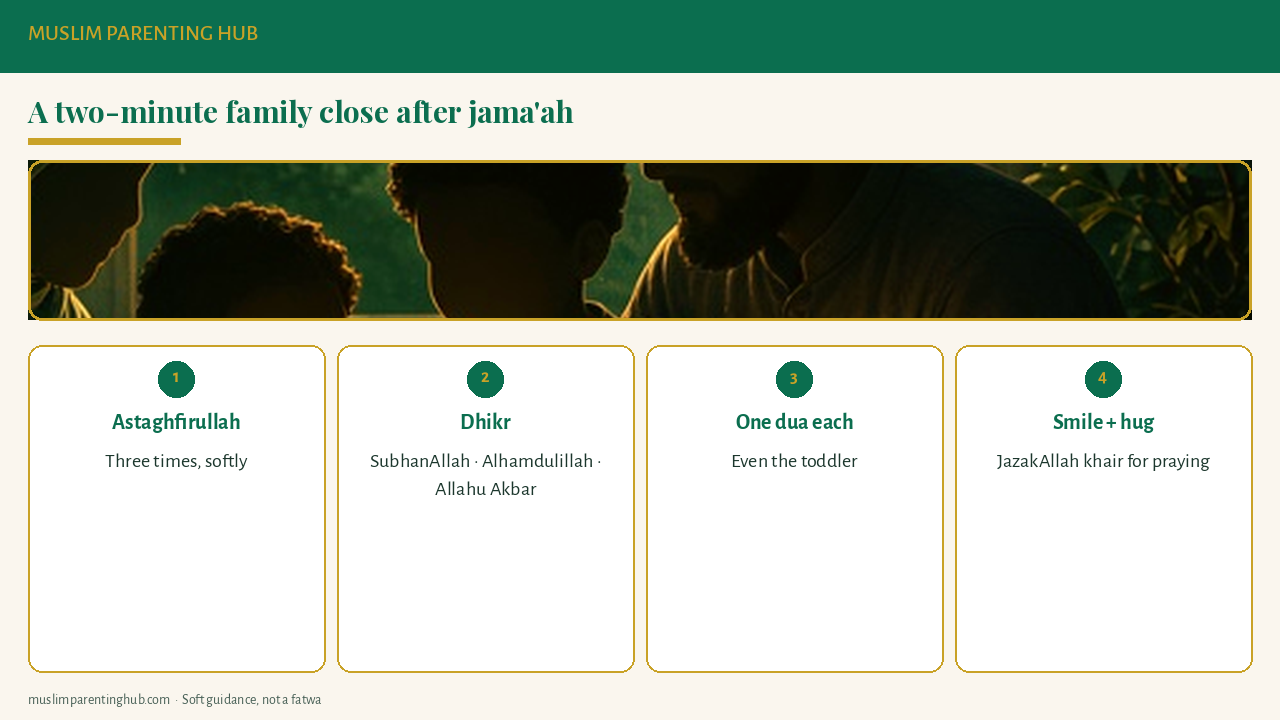
How you end the prayer shapes how kids feel about it. Keep it short and warm.
- Astaghfirullah ×3, said softly together.
- A little dhikr: SubhanAllah, Alhamdulillah, Allahu Akbar a few times each (or the full 33 with older kids). Our guide to simple dhikr for kids has easy ways to make this stick.
- One dua each: everyone, even the toddler, asks Allah for one thing in their own words.
- A smile and a hug. Turn to each other and say “JazakAllah khair for praying with me.”
Many families find this two-minute close becomes the part kids remind them about.
Common Problems (and Calm Fixes)
“My kids giggle the whole time.” Laughter usually means nervous energy. Keep the prayer short, put the gigglers in different spots, and praise the calm moments afterward.
“My teen won’t join.” Invite, don’t force. Ask them to take a job, like leading the dua or saying the iqamah. Responsibility often works better than reminders.
“We miss days constantly.” That’s normal. Pick it back up the next day without guilt. A habit built three nights a week for a year is stronger than seven nights for a week.
“Dad works evenings.” Mom can lead the daughters and younger children, or the family can make Fajr on weekends the “together” prayer.
“I’m not confident leading.” Start with the shortest surahs you know well. Your kids need a parent who shows up, not a perfect reciter.
FAQ
Can a family pray jama’ah at home?
Yes. Praying in congregation at home is part of the Sunnah; the Prophet ﷺ led a small family prayer in a companion’s home (Bukhari 380). For men, the masjid remains the main place for congregational prayer when possible, but home jama’ah is a beautiful option on evenings the family is home together.
Where does a boy stand when praying with his father?
If one boy prays with his father, he stands to his father’s right, about level with him (Bukhari 699). If there are two or more boys, they stand in a row behind the imam. Women and girls form a row behind the boys.
Where does a mother stand when leading her daughters?
When women pray in congregation together, the woman leading usually stands in the middle of the first row rather than out in front. Details vary slightly between schools of fiqh, so check with your local imam.
Can my child say the iqamah at home?
Yes, many families give this job to an older child. It’s shorter than the adhan, kids can learn it in a week or two, and it gives them a real role in starting the family prayer.
How long should a family jama’ah prayer be?
Keep it short. The Prophet ﷺ told imams to keep prayer light for the weak and elderly (Bukhari 703) and shortened his prayer when he heard a baby crying (Bukhari 707). With young kids, about 5–10 minutes including a short dhikr is plenty.
What if my toddler climbs on me during salah?
Keep praying calmly. The Prophet ﷺ prayed while carrying his granddaughter Umamah (Bukhari 516) and lengthened his sujood when his grandson climbed on his back. A small rug and a quiet book next to you can help.
Related guides
- Teach kids to answer the adhan at home
- Dua after adhan for kids
- The 5 daily prayers for kids, explained
- How to teach kids salah step by step (with wudu)
Soft guidance, not a fatwa. For detailed fiqh questions, please ask a trusted local scholar or your masjid’s imam.
Quick steps
How to pray Maghrib in jama'ah at home with kids. A short family congregational prayer: answer the call, set up the rugs, line up in Sunnah rows, let a child say the iqamah, pray a light prayer and close with a two-minute family dhikr and dua.
- Answer the adhan — When the adhan plays on your app or clock, pause together and answer it, then say the dua after the adhan.
- Give out jobs and set up — The rug captain lays out prayer rugs facing the qiblah, the qiblah checker confirms the direction and the screen switcher turns off the TV.
- Line up in Sunnah rows — One boy stands at the imam's right; two or more boys make a row behind the imam; Mom and the girls form a row behind them. Straighten the rows: toes on the line, shoulders touching.
- A child says the iqamah — An older child says the iqamah right before the prayer begins.
- Pray a light prayer — The imam recites short surahs clearly, everyone follows without racing ahead, and the family says Ameen together after Al-Fatiha.
- Two-minute family close — Say Astaghfirullah three times, a little dhikr, one dua each, then a smile and a hug.
Related articles
Teach Kids to Answer the Adhan at Home (Playful Practice Plan)
A playful home practice plan so Muslim kids answer the adhan—pause game, short reply lines, age bands, and scripts when the call to prayer plays. Soft & practical.
Read guide →
Dua After Adhan for Kids: Meaning, Easy Transliteration and a 5-Day Way to Learn It
Teach kids the dua after the adhan in small chunks: Arabic, easy transliteration, simple meaning, a 5-day plan and US-home tips for when you can't hear the masjid.
Read guide →
The 5 Daily Prayers for Kids: Explaining Fajr to Isha With the Sun and Your Family's Day
Explain the five daily prayers to kids with the sun: what Fajr, Dhuhr, Asr, Maghrib and Isha mean, when they come this fall, rak'ah counts, and easy games.
Read guide →
How to Teach Kids to Pray Salah Step by Step (With Wudu): A Parent's Guide for Ages 5–10
A calm, step-by-step guide to teaching kids wudu and salah—what to say in each position, a 2-rak'ah practice plan, and age-by-age expectations for ages 5–10.
Read guide →