Simple Dhikr for Kids: SubhanAllah, Alhamdulillah, Allahu Akbar and How to Make Them a Daily Habit
You’re driving home from soccer practice. The sky over the highway is streaked pink and orange, and your five-year-old in the back seat says, “Whoa, Mama, look!” You answer, almost without thinking, “SubhanAllah.”
A week later, in the grocery store parking lot, the same child sees a huge harvest moon and says it first: “SubhanAllah!”
That’s dhikr. Not a lecture, not a worksheet, not a counting contest. Just a child’s heart reaching for Allah in an ordinary moment because they heard it in yours.
Dhikr means remembrance of Allah. For kids, it’s a small set of short, powerful phrases that they can attach to everyday life: waking up, eating, climbing the stairs, seeing something beautiful, making a mistake, lying in bed. This guide covers six easy phrases, what they mean in kid language, when to use them, how to count on fingers the Sunnah way, and how to build the habit gently in a busy American family schedule.
If you’re working with a toddler, our guide to talking about Allah with toddlers in simple words is a perfect companion. Dhikr phrases are often a toddler’s very first words about Allah.
Why Dhikr Matters (In Words Kids Understand)
Allah says in the Quran: “Surely, in the remembrance of Allah do hearts find rest” (Ar-Ra’d 13:28). And: “So remember Me; I will remember you” (Al-Baqarah 2:152).
Kid version: “When you remember Allah, Allah remembers you. And remembering Allah makes your heart feel calm.”
In a hadith qudsi, Allah says that when His servant remembers Him in himself, He remembers that servant in Himself, and when His servant remembers Him in a gathering, He remembers him in a better gathering (Bukhari 7405, Muslim 2675). Children love the idea that when they say “Alhamdulillah” at the dinner table, Allah is remembering them too.
The Prophet ﷺ also told us about two short phrases that are “light on the tongue, heavy on the scale, and beloved to the Most Merciful”: SubhanAllahi wa bihamdihi, SubhanAllahil-‘Adheem (Bukhari 6406, Muslim 2694). Light on the tongue is exactly what kids need: easy to say, big in reward.
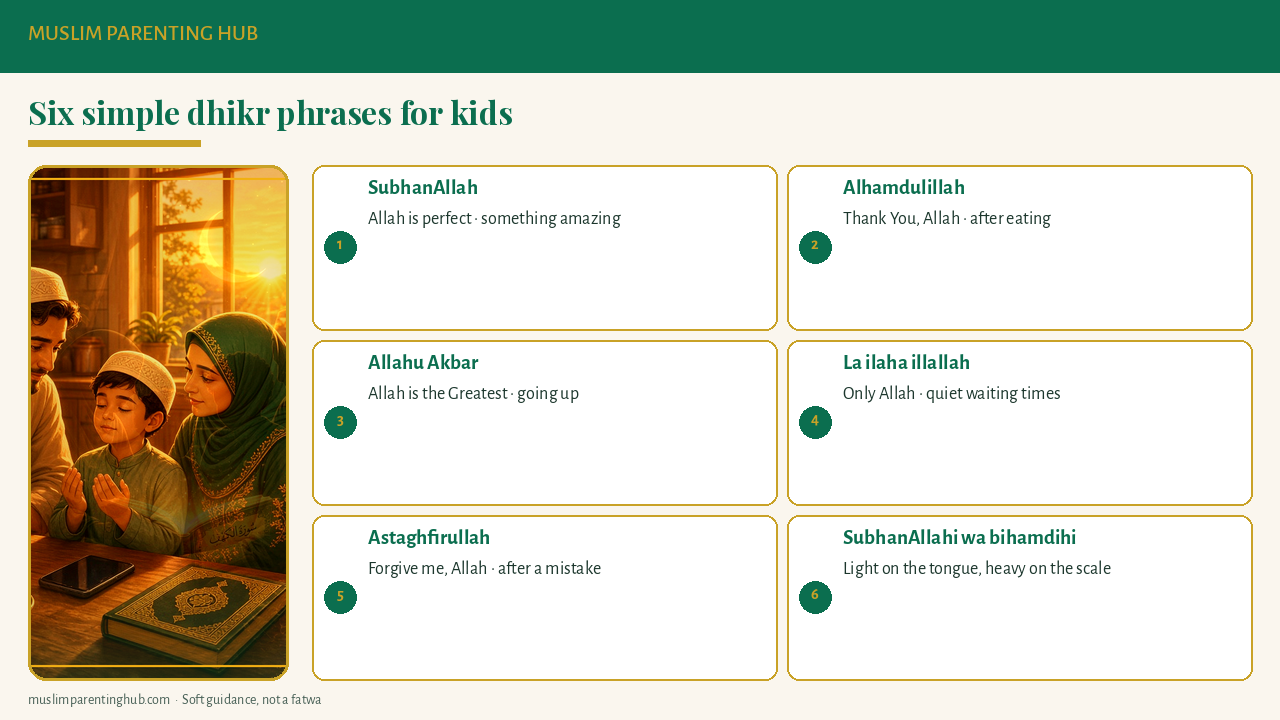
Six Simple Dhikr Phrases for Kids
1. SubhanAllah (سُبْحَانَ اللهِ)
Meaning: “Allah is perfect” or “Glory be to Allah.” When kids can say it: When they see something amazing: a sunset, fall leaves, a rainbow, a baby sibling’s tiny hands. Also when walking down stairs or a hill. The companion Jabir said that when they went up they said “Allahu Akbar,” and when they went down they said “SubhanAllah” (Bukhari 2993). Kid line: “Allah made it so perfectly!”
2. Alhamdulillah (اَلْحَمْدُ لِلّٰهِ)
Meaning: “All praise and thanks belong to Allah.” When: After eating, after sneezing, when they wake up, when something good happens, when someone asks “How are you?” Kid line: “Thank You, Allah!” For a fuller gratitude habit, our 14-day plan to teach shukr to kids builds on this one word.
3. Allahu Akbar (اَللّٰهُ أَكْبَرُ)
Meaning: “Allah is the Greatest.” When: Going up stairs, a hill, or the ladder at the playground. In the adhan and salah. When something feels big or scary. Kid line: “Allah is bigger than everything, even my worries.”
4. La ilaha illallah (لَا إِلٰهَ إِلَّا اللهُ)
Meaning: “There is no god except Allah.” When: Anytime. The Prophet ﷺ called it the best dhikr (Tirmidhi 3383). It’s a great phrase for quiet moments, like waiting in the school pickup line. Kid line: “Only Allah. Nobody else is like Him.”
5. Astaghfirullah (أَسْتَغْفِرُ اللهَ)
Meaning: “I ask Allah to forgive me.” When: After a mistake, after saying something unkind, or simply as a daily habit. The Prophet ﷺ himself asked Allah’s forgiveness more than seventy times a day (Bukhari 6307). Kid line: “Ya Allah, I’m sorry. Help me do better.” Keep this one soft. It should never feel like a punishment. Pair it with a hug and a fresh start.
6. SubhanAllahi wa bihamdihi (سُبْحَانَ اللهِ وَبِحَمْدِهِ)
Meaning: “Glory be to Allah, and all praise is His.” When: As a “bonus” dhikr for kids ages 6 and up who already know the first five. Kid line: “Allah is perfect, and I thank Him.”
Bonus for older kids: La hawla wa la quwwata illa billah (“There is no power or strength except with Allah”). The Prophet ﷺ called it a treasure from the treasures of Paradise (Bukhari 6384). It’s perfect before a spelling test or a big game.
The Prophet ﷺ also said the most beloved words to Allah are four: SubhanAllah, Alhamdulillah, La ilaha illallah, Allahu Akbar (Muslim 2137). If your child learns only those four this year, that’s a beautiful year.
Where Dhikr Fits in an Ordinary Day
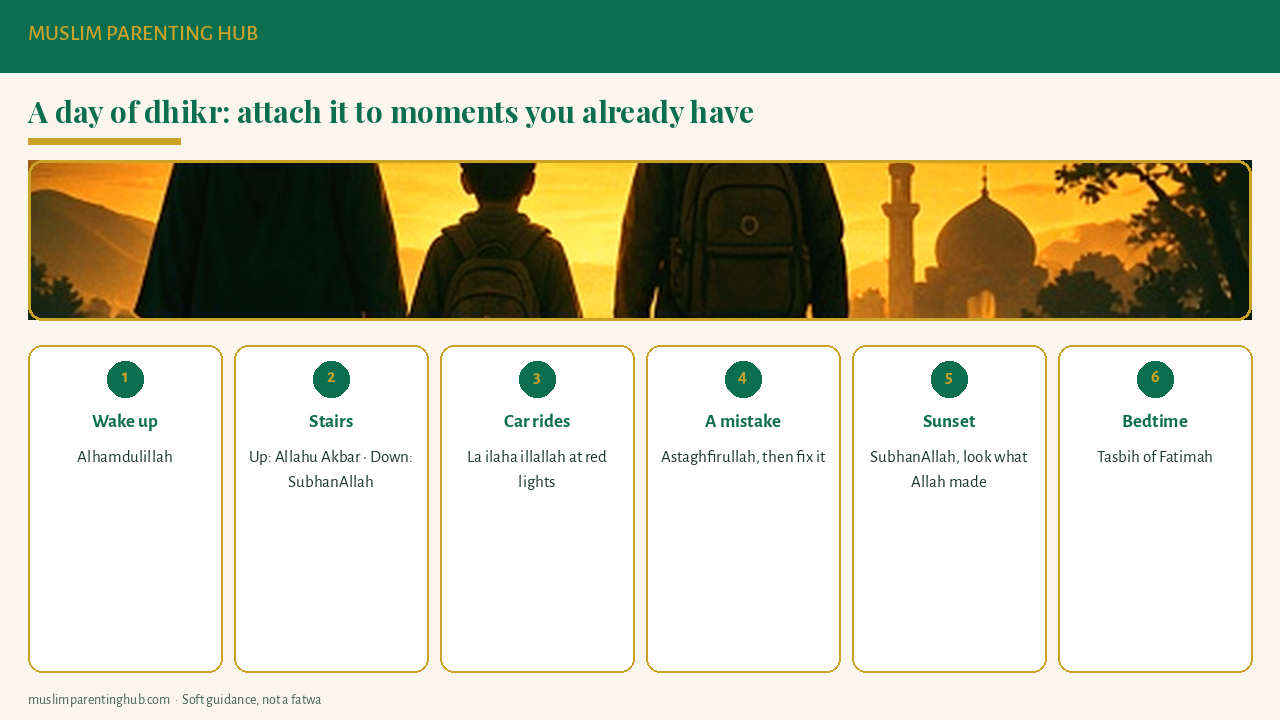
The secret to dhikr for kids is attaching each phrase to something that already happens every day. You don’t add a new “dhikr time” to an already packed schedule; you sprinkle remembrance into the moments you already have.
| Moment | Dhikr | What you say |
|---|---|---|
| Waking up | Alhamdulillah | “Alhamdulillah, Allah gave us a new day.” |
| Going downstairs | SubhanAllah | Whisper it on every step. |
| Breakfast and lunch | Bismillah / Alhamdulillah | Before and after. |
| School bus or car ride | La ilaha illallah | Count on fingers at red lights. |
| Recess, a goal, a good grade | Alhamdulillah | Instead of “I’m the best!” |
| Climbing the playground ladder | Allahu Akbar | Every rung. |
| A mistake | Astaghfirullah | Calmly, then fix it. |
| Seeing fall leaves or a sunset | SubhanAllah | “Look what Allah made.” |
| Bedtime | Tasbih of Fatimah | 33 / 33 / 34 (see below). |
You’ll notice Bismillah is on the list, too. It isn’t one of the six phrases above, but it’s the most natural “partner” to Alhamdulillah. Our guide to teaching kids to say Bismillah in everyday moments covers it in detail.
One respectful rule: We don’t say dhikr out loud in the bathroom. Teach it simply: “In the bathroom, we keep Allah’s name in our hearts and say it again when we come out.”
Counting Dhikr on Fingers (The Sunnah Way)
Kids love counting, and the Prophet ﷺ counted his tasbih on his right hand (Abu Dawud 1502, Tirmidhi 3486). He also encouraged counting on the fingertips, because the fingers will be asked about and made to speak on the Day of Judgment (Abu Dawud 1501, Tirmidhi 3583).
Kid version: “Your fingers are going to say, ‘She used us to remember Allah!’”
How to teach it:
- Hold up the right hand.
- Touch the thumb to each finger section, three sections per finger.
- Each touch is one “SubhanAllah.”
- One hand gives about 15 counts. Two passes and a few more get you to 33.
For little ones (ages 3–5), forget the exact number. “Let’s say SubhanAllah on each finger” (five times) is plenty.
Many families also use a tasbih (prayer beads) or a small counter, and kids often enjoy them. Fingers are free, always with you, and work in the back seat of a minivan.
Bedtime: The Tasbih of Fatimah
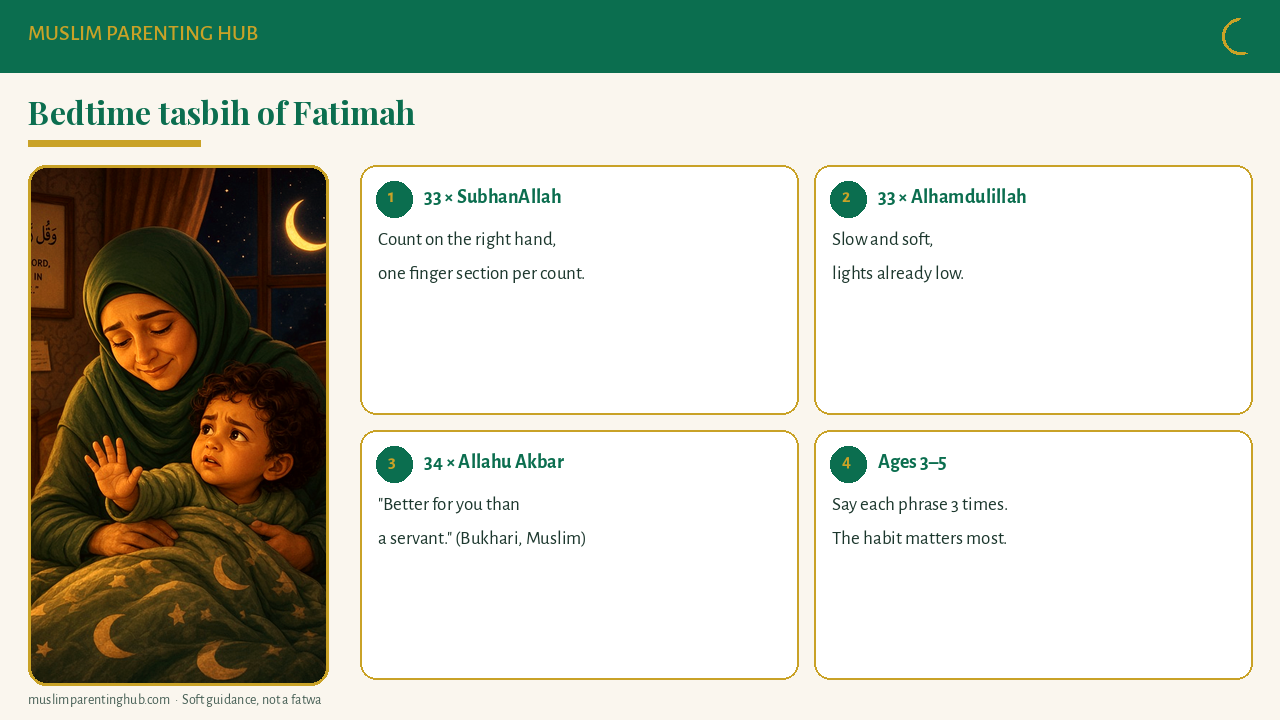
This is one of the most beautiful stories to tell children at night.
Fatimah, the Prophet’s ﷺ daughter, worked so hard at home that her hands were sore from the grinding stone. She went to ask her father for a helper. That night, the Prophet ﷺ came to Fatimah and Ali and said: shall I not tell you something better than a servant? When you go to bed, say SubhanAllah thirty-three times, Alhamdulillah thirty-three times, and Allahu Akbar thirty-four times. That is better for you than a servant (Bukhari 3705, Muslim 2727).
Kid takeaway: “When we’re tired, dhikr gives us strength from Allah.”
How to do it at bedtime:
- Lights low, kids in bed.
- Parent and child count on fingers together.
- For ages 3–5: say each phrase three times instead of 33. That’s still the habit.
- For ages 6–9: the full count, slowly. It takes about two minutes.
- For older kids: let them lead younger siblings.
Pair it with the short duas your family already says at night. Our bedtime duas for kids 7-night plan shows how to fit everything in without making bedtime drag.
Dhikr on the Go: Cars, Carpools and Fall Walks
American family life happens in the car. Use it.
- Red-light dhikr: At every red light, the family says one round of “SubhanAllah” together. It turns a frustrating commute into a game.
- Carpool counting: If friends are in the car, keep it quiet and personal: your child counts on their fingers silently.
- Road trip rounds: On longer drives to Grandma’s for Thanksgiving break, take turns choosing a dhikr and saying it 10 times as a family.
- Fall leaf walk: Collect leaves and say “SubhanAllah” for each different color. Remind kids that Allah says not a leaf falls except that He knows it (Al-An’am 6:59).
A 4-Week Dhikr Habit Plan
You don’t need to teach all six phrases at once. Try one new “dhikr of the week.”
Week 1: Alhamdulillah. Attach it to waking, eating, and sneezing. Say it out loud yourself, often.
Week 2: SubhanAllah. Go hunting for “SubhanAllah moments” on the way to school: the sky, a squirrel, a big tree.
Week 3: Allahu Akbar. Stairs, hills, playground ladders. Kids love the up/down pairing with SubhanAllah.
Week 4: Astaghfirullah and the tasbih of Fatimah. Add soft istighfar for mistakes and the bedtime count.
After four weeks, review on Fridays: “Which dhikr did you say most this week?” No scores, no charts. Just a conversation.
What to Avoid
- Don’t turn dhikr into a punishment. “Go say Astaghfirullah 100 times” teaches kids to dread the words.
- Don’t over-reward. A sticker for every SubhanAllah can make kids perform instead of remember. Praise the heart: “I love that you noticed Allah’s creation.”
- Don’t correct pronunciation harshly. Model the right pronunciation calmly and move on.
- Don’t force older kids to perform for guests. Dhikr is between them and Allah.
- Don’t forget your own dhikr. Children copy what they hear. If you say “Alhamdulillah” when the bills are paid or the baby finally sleeps, they’ll say it too.
Linking Dhikr to Allah’s Names
Once kids know the basic phrases, connect them to Allah’s names: “SubhanAllah, Allah is Al-Khaliq, the Creator, look at this tree He made.” This is a lovely next step. Our guide to the names of Allah for kids and where to start has ten beautiful names that fit naturally beside everyday dhikr.
FAQ
What is the easiest dhikr for kids?
Alhamdulillah, SubhanAllah and Allahu Akbar are the easiest. They’re short, kids hear them often, and each one fits a clear moment: Alhamdulillah after eating, SubhanAllah when seeing something beautiful, Allahu Akbar when going up stairs.
At what age can kids start doing dhikr?
Toddlers as young as 18 months often say “Alhamdulillah” or “SubhanAllah” by copying parents. Ages 3–5 can learn four or five phrases with simple meanings, and ages 6+ can count the bedtime tasbih of Fatimah on their fingers.
How do I teach my child to count dhikr on their fingers?
Use the right hand and touch the thumb to each finger section, one dhikr per touch. The Prophet ﷺ counted tasbih on his right hand and said the fingers will speak on the Day of Judgment. For young kids, one phrase per finger is enough.
What dhikr should kids say before bed?
The tasbih of Fatimah: SubhanAllah 33 times, Alhamdulillah 33 times and Allahu Akbar 34 times, which the Prophet ﷺ taught his daughter Fatimah for bedtime. Little ones can say each phrase three times instead.
Can kids say dhikr in the bathroom?
Teach kids to keep Allah’s name in their hearts in the bathroom and not say dhikr out loud there. They can say it again as soon as they come out.
Should I reward my child for doing dhikr?
Light, warm praise is better than prizes. Notice the heart behind it (“You remembered Allah when you saw the moon!”). Big rewards can turn dhikr into a performance instead of a habit of the heart.
Related guides
- How to talk about Allah with toddlers
- Names of Allah for kids: where to start
- Bedtime duas for kids: a 7-night plan
- 25 short duas for kids to learn by age
Soft guidance, not a fatwa. For detailed fiqh questions, please ask a trusted local scholar or your masjid’s imam.
Related articles

Bedtime Duas for Kids: What to Recite Before Sleep (With a 7-Night Plan)
Bedtime duas for kids made simple: the sleeping dua, the 3 Quls, Ayat al-Kursi and a calm Sunnah sequence, with meanings, age bands and a 7-night plan.
Read guide →
How to Talk About Allah With Toddlers: Simple Words and a 7-Day Plan
What to say when your toddler asks “Who made the moon?” Loving phrases about Allah for ages 0–3, bedtime lines and a 7-day plan—no fear, no lectures.
Read guide →
25 Short Duas for Kids to Learn (By Age, With Meaning and Transliteration)
Short, easy duas for kids by age (2–4, 5–7, 8–10) with transliteration and meaning—plus a gentle 10-minute daily practice for US Muslim families.
Read guide →
Names of Allah for Kids: 10 Beautiful Names to Start With (and How to Teach Them)
Teach kids the Names of Allah one at a time: 10 starter names with simple meanings, everyday moments, a name-of-the-week plan, and crafts for ages 3–10.
Read guide →