Surah Al-Ikhlas for Kids: Meaning, Easy Transliteration and How It Answers "Who Is Allah?"
“Mama, who is Allah? Like, what is He?”
Kids ask this in the car, at bath time, or right after a classmate at their public school mentions God. It’s a beautiful question, and it can leave parents searching for words.
Here’s the good news: Allah already gave us the answer in four short lines. Surah Al-Ikhlas (chapter 112 of the Quran) is the Quran’s own description of who Allah is. It’s one of the first surahs most Muslim children memorize, and it’s short enough for a four-year-old and deep enough for a lifetime.
This guide gives you the surah in Arabic, an easy transliteration, a meaning your child can picture, line-by-line conversations, a 7-day learning plan, and simple ways to use it when the big “Who made Allah?” questions show up.
If your child is younger and you’re just starting to talk about Allah at all, begin with our gentle guide on how to talk about Allah with toddlers. This article is for when they’re ready for the words of the Quran itself.
Surah Al-Ikhlas: Arabic, Transliteration and Meaning
Arabic:
بِسْمِ اللَّهِ الرَّحْمَٰنِ الرَّحِيمِ
قُلْ هُوَ اللَّهُ أَحَدٌ اللَّهُ الصَّمَدُ لَمْ يَلِدْ وَلَمْ يُولَدْ وَلَمْ يَكُن لَّهُ كُفُوًا أَحَدٌ
Easy transliteration:
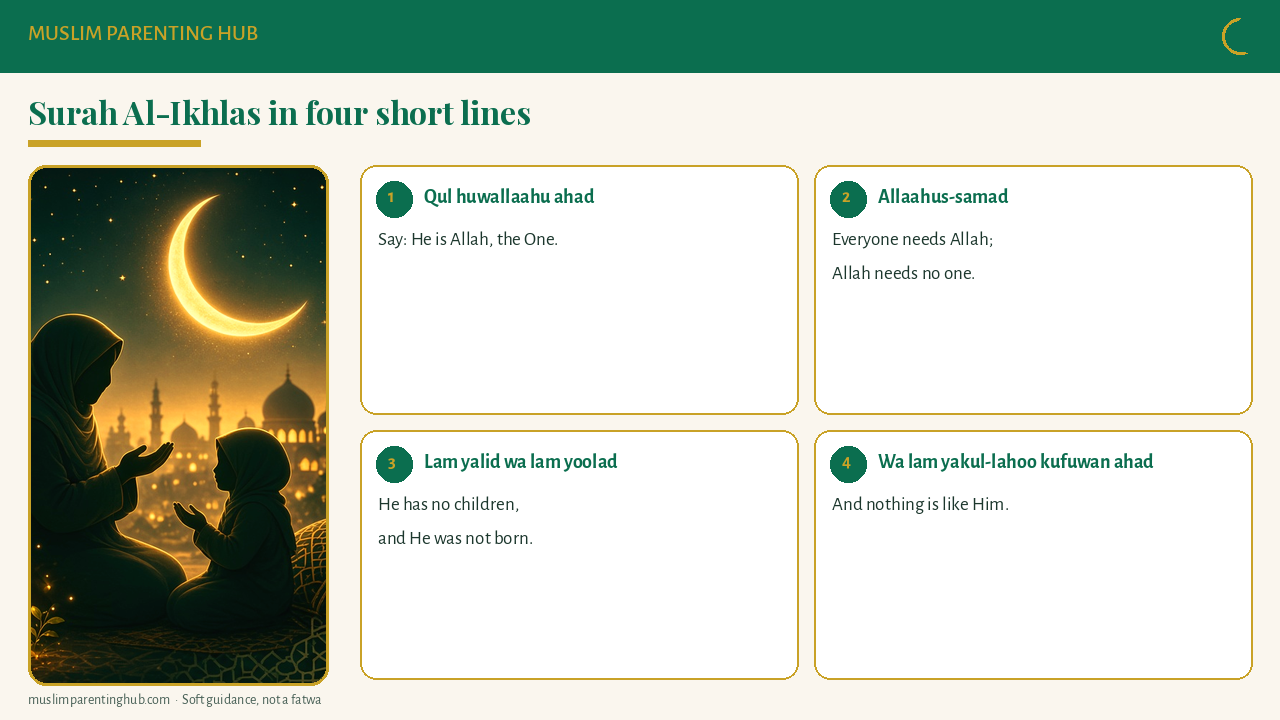
- Qul huwallaahu ahad.
- Allaahus-samad.
- Lam yalid wa lam yoolad.
- Wa lam yakul-lahoo kufuwan ahad.
Meaning:
- Say: He is Allah, the One.
- Allah, the One everyone needs, who needs no one.
- He has no children, and He was not born.
- And there is nothing like Him at all.
The one-breath kid version: “Allah is One. Everybody needs Allah, and Allah doesn’t need anybody. Allah wasn’t born and has no children. Nothing is like Allah.”
“Ikhlas” means sincerity or purity. The surah purifies our idea of Allah, clearing away anything that doesn’t belong. It’s a perfect first lesson in what scholars call tawhid: Allah’s Oneness.
Why This Little Surah Is So Special
Children love to know why something matters. Share these with excitement, not as a lecture.
It equals one-third of the Quran. The Prophet ﷺ told his companions that Surah Al-Ikhlas is equal to a third of the Quran (Sahih al-Bukhari 5013). Kids are amazed by this. A simple way to explain it: “The Quran teaches us about Allah, about stories of the prophets, and about how to live. This surah is all about Allah, so it’s like a big piece of the whole Quran in four lines.”
Allah loves those who love it. A companion used to finish his recitation in prayer with Surah Al-Ikhlas every time. When asked why, he said it describes Ar-Rahman and he loved to recite it. The Prophet ﷺ said, “Tell him that Allah loves him” (Sahih al-Bukhari 7375, Sahih Muslim 813). Tell your child this story. It shows that loving a surah is itself something Allah loves.
It’s part of the bedtime and morning routine. The Prophet ﷺ would recite Al-Ikhlas, Al-Falaq and An-Nas into his cupped hands before sleep, then wipe over his body (Sahih al-Bukhari 5017). Reciting the three “Quls” in the morning and evening is also taught for protection (Abu Dawud 5082, at-Tirmidhi 3575). If you already have a bedtime routine, our bedtime duas for kids with a 7-night plan shows exactly where the three Quls fit.
Line by Line: Conversations for Kids
Don’t try to cover all four lines in one night. Pick one line, ask a question, and let your child think. These are starting points.
Line 1 — “Qul huwallaahu ahad” (Say: He is Allah, the One)
The idea: There is only one Allah. Not two, not a team, not a family of gods.
Try this: Hold up one finger. “How many suns do we have? One. How many Allahs? One. Everything else, the trees, the stars, you and me, Allah made.”
For older kids (7+): “Ahad means one in a special way. Allah is one, and there’s nothing else like Him. When we raise our finger in tashahhud during salah, we’re saying the same thing.”
Line 2 — “Allaahus-samad” (Everyone needs Allah; Allah needs no one)
The idea: As-Samad is hard to translate. It means the One everyone turns to with their needs, while He needs nothing.
Try this: “What do you need every day? Food, water, sleep, hugs. Do plants need things? Sun and rain. Do I need things? Yes! Does Allah need food or sleep? No. Allah doesn’t need anything, and everybody needs Allah.”
This line connects beautifully to dua. “That’s why we ask Allah for things. He’s the One who can give everybody what they need.”
Line 3 — “Lam yalid wa lam yoolad” (He has no children and was not born)
The idea: Allah doesn’t have parents or children like people and animals do.
Try this: “You have a mom and dad. Grandma had a mom and dad. Puppies have a mama dog. But Allah was never born, and Allah doesn’t have children. Allah was always there, before anything.”
Kids sometimes ask about Prophet Adam: “He didn’t have parents either!” Great observation. Explain: “Right, Allah made Adam without parents. But Adam was still made. Allah was never made. Allah made everything.”
Line 4 — “Wa lam yakul-lahoo kufuwan ahad” (Nothing is like Him)
The idea: Nothing in creation is equal to or like Allah.
Try this: “When you imagine something, your brain uses things you’ve seen. A dragon is like a lizard with wings. But Allah isn’t like anything we’ve seen. That’s why we can’t picture Allah, and we don’t draw Allah. We get to know Allah through His names and what He made.”
This is a natural bridge to the Names of Allah for kids. Ar-Rahman, Al-Khaliq, As-Sami’ — each name tells us something true about Allah without picturing Him.
How Surah Al-Ikhlas Answers “Who Made Allah?”
At some point, almost every curious child asks, “If Allah made everything, who made Allah?” Parents often panic. Don’t. This question is normal, and Surah Al-Ikhlas already answers it.
Line 3 says lam yoolad: Allah was not born, not made, not started. Everything that has a beginning needs someone to begin it. Allah has no beginning, so Allah doesn’t need a maker.
A simple script for ages 5–8:
“Great question. Everything we see had a beginning: you, me, the house, even the sun. Things with a beginning need a maker. But Allah didn’t have a beginning. Allah was always there. Remember the surah? Lam yalid wa lam yoolad. Allah wasn’t born and wasn’t made. That’s what makes Allah different from everything else.”
The Prophet ﷺ even told us this kind of question would come up. He said that Shaytan may whisper, “Who created this? Who created that?” until he asks, “Who created your Lord?” and that when this happens, a person should seek refuge in Allah and stop there (Sahih al-Bukhari 3276, Sahih Muslim 134). For kids, keep it gentle: “Some questions our brains go around and around on. When that happens, we say A’oodhu billaah and remember Surah Al-Ikhlas.”
For more short, honest answers to questions like “Can Allah see me?” and “Why can’t I see Allah?”, see our guide on answering “Where is Allah?” and kids’ other big questions.
A 7-Day Plan to Learn Surah Al-Ikhlas
Choose one consistent time, like after Maghrib, in the car on the way to school, or right before bed. Five minutes is plenty.
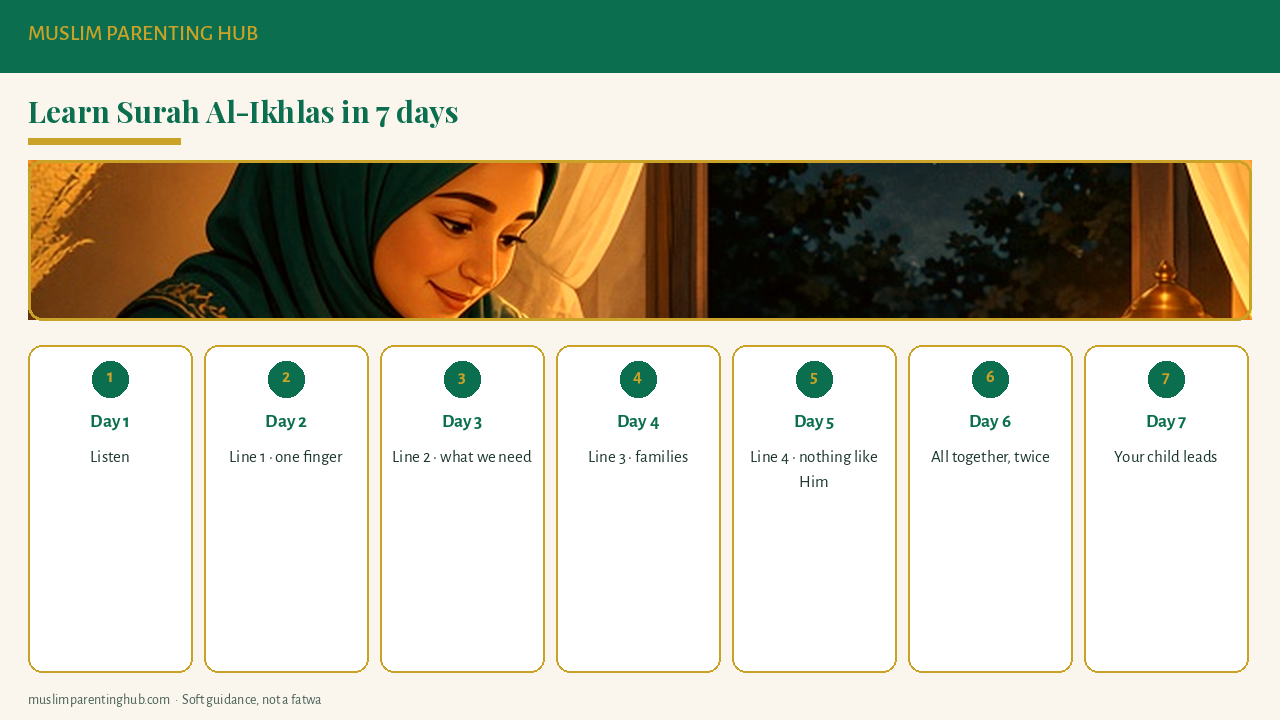
- Day 1 — Listen. Play a slow recitation two or three times while your child plays nearby. Recite it yourself at bedtime.
- Day 2 — Line 1. “Qul huwallaahu ahad.” You say it three times; they echo. Hold up one finger.
- Day 3 — Line 2. Review line 1, add “Allaahus-samad.” Talk about what everyone needs.
- Day 4 — Line 3. Review, then add “Lam yalid wa lam yoolad.” Talk about families.
- Day 5 — Line 4. Add “Wa lam yakul-lahoo kufuwan ahad.” Play “Is anything like Allah?”
- Day 6 — All together. Recite the whole surah together, slowly, twice.
- Day 7 — Your child leads. They recite; you say “Ameen” or “MashaAllah” at the end. Celebrate with a hug or a special Maghrib dessert.
Tips: - Many kids learn faster from a recording they hear daily. Our guide to starting Quran with infants and toddlers by listening first explains why listening builds memory. - Correct pronunciation gently, by saying it right again, not by stopping them mid-line. - Once they know it, keep it alive by reciting it daily.
Making It Part of Everyday Life
In salah. Al-Ikhlas is one of the most common surahs recited after Al-Fatiha. When your child begins learning to pray, this is often the first surah they use. Our step-by-step guide to teaching kids salah with wudu shows where it goes.
At bedtime. Recite the three Quls, blow gently into cupped hands, and wipe over the body, starting with the head and face. Kids love the “wiping” part.
In the morning. Add it to the morning routine before school. Saying the three Quls three times takes about a minute, which fits even a rushed weekday. Our 5-minute morning protection dua routine builds this in step by step.
In the car. Recite it together at red lights or on the way to soccer practice.
When they’re scared. After a scary dream or before a big test, reciting the three Quls is both a comfort and a Sunnah.
When Classmates Believe Differently
In a US public school, your child will have friends who celebrate Christmas or who believe God has a son. Surah Al-Ikhlas, especially line 3, may raise questions: “My friend says God has a son. Is my friend bad?”
Teach respect and clarity together:
“Muslims believe Allah has no children. That’s what Surah Al-Ikhlas teaches us. Your friend’s family believes something different. We can be kind and respectful to everyone, and we can still know what we believe.”
Avoid any message that makes your child look down on friends. Islam teaches us to be fair and kind to people of other faiths. If classmates ask your child questions about Islam, our guide to kind answers Muslim kids can give when classmates ask has short, friendly scripts.
Age-by-Age Expectations
Ages 2–3. Listening and joining in on “ahad” with one finger up is plenty.
Ages 4–5. Most can memorize the full surah in a week or two with daily practice. Focus on the one-breath meaning.
Ages 6–8. They can explain each line in their own words and use it in salah. This is the perfect age for the “Who made Allah?” conversation.
Ages 9–12. Explore deeper meanings: why “Qul” (Say) begins the surah, what As-Samad means, and how the surah connects to tawhid in the rest of the Quran. Invite them to teach a younger sibling.
FAQ
What is Surah Al-Ikhlas about for kids?
Surah Al-Ikhlas tells us who Allah is: Allah is One, everyone needs Allah and Allah needs no one, Allah has no children and was not born, and nothing is like Allah. It’s the Quran’s short description of Allah’s Oneness (tawhid).
What is the easy transliteration of Surah Al-Ikhlas?
“Qul huwallaahu ahad. Allaahus-samad. Lam yalid wa lam yoolad. Wa lam yakul-lahoo kufuwan ahad.” Kids can learn it one line a day, then put it all together within a week.
Why does Surah Al-Ikhlas equal one-third of the Quran?
The Prophet ﷺ said it equals a third of the Quran (Bukhari 5013). Many scholars explain that the Quran teaches about Allah, stories and guidance, and laws, and Surah Al-Ikhlas is entirely about Allah, so it carries a third of the Quran’s meaning. It doesn’t replace reading the whole Quran.
At what age can a child memorize Surah Al-Ikhlas?
Many children memorize it between ages 3 and 5 with daily listening and repetition. Younger toddlers can listen and join in on single words. There’s no rush; consistency matters more than age.
How do I use Surah Al-Ikhlas to answer “Who made Allah?”
Point to line 3, “lam yalid wa lam yoolad”: Allah wasn’t born and wasn’t made. Explain that things with a beginning need a maker, but Allah has no beginning. Keep it short and calm, and say it’s a great question.
When should kids recite Surah Al-Ikhlas?
In salah after Al-Fatiha, before sleep with Al-Falaq and An-Nas (blowing into the hands and wiping the body, Bukhari 5017), and three times each in the morning and evening for protection (Abu Dawud 5082).
Related guides
- How to talk about Allah with toddlers
- “Where is Allah?” Answers to kids’ big questions
- Names of Allah for kids: where to start
- Bedtime duas for kids: a 7-night plan
Soft guidance, not a fatwa. For detailed questions, please ask a trusted local scholar or your masjid’s imam.
Related articles
"Where Is Allah?" How to Answer Kids' Big Questions About Allah (Ages 4-8)
Gentle, love-based answers for ages 4–8: Where is Allah? Can He see me? Who made Allah?—plus scripts, what to avoid, and when you don't know.
Read guide →
How to Talk About Allah With Toddlers: Simple Words and a 7-Day Plan
What to say when your toddler asks “Who made the moon?” Loving phrases about Allah for ages 0–3, bedtime lines and a 7-day plan—no fear, no lectures.
Read guide →
Names of Allah for Kids: 10 Beautiful Names to Start With (and How to Teach Them)
Teach kids the Names of Allah one at a time: 10 starter names with simple meanings, everyday moments, a name-of-the-week plan, and crafts for ages 3–10.
Read guide →
Bedtime Duas for Kids: What to Recite Before Sleep (With a 7-Night Plan)
Bedtime duas for kids made simple: the sleeping dua, the 3 Quls, Ayat al-Kursi and a calm Sunnah sequence, with meanings, age bands and a 7-night plan.
Read guide →