Teach Kids Salawat on the Prophet ﷺ: Easy Words, Meaning and a Friday Habit
Your son comes home from weekend school and announces, “Every time you say the Prophet’s name, you have to say something after it.” Then he looks at you: “What do I say again? And why?”
That “something” is salawat (also called durood in many South Asian families): asking Allah to send blessings and peace on the Prophet Muhammad ﷺ. It is one of the easiest acts of worship a child can learn, it takes only a few seconds, and the reward is enormous.
This guide gives you the short and full words with easy transliteration, a kid-friendly meaning, the everyday moments to say it, and a simple Friday habit your family can start this week.
What Is Salawat? A Kid-Friendly Explanation
Salawat comes from the Arabic word salah. When we send salawat on the Prophet ﷺ, we are making dua: “O Allah, honor him, bless him, and raise his rank.”
Allah tells us in the Quran: “Indeed, Allah and His angels send blessings upon the Prophet. O you who believe, send blessings upon him and greet him with peace” (Al-Ahzab 33:56).
For a young child, you can say it like this:
“The Prophet ﷺ loved us so much. He worried about us and made dua for us. When we say salawat, we’re making dua for him and saying thank you. And Allah is so generous that every time we do it, He sends blessings back to us.”
That last part is straight from the Prophet ﷺ: “Whoever sends blessings upon me once, Allah will send blessings upon him ten times” (Sahih Muslim 408). Kids love the math: one salawat, ten blessings back.
The Words: Short, Medium and Full
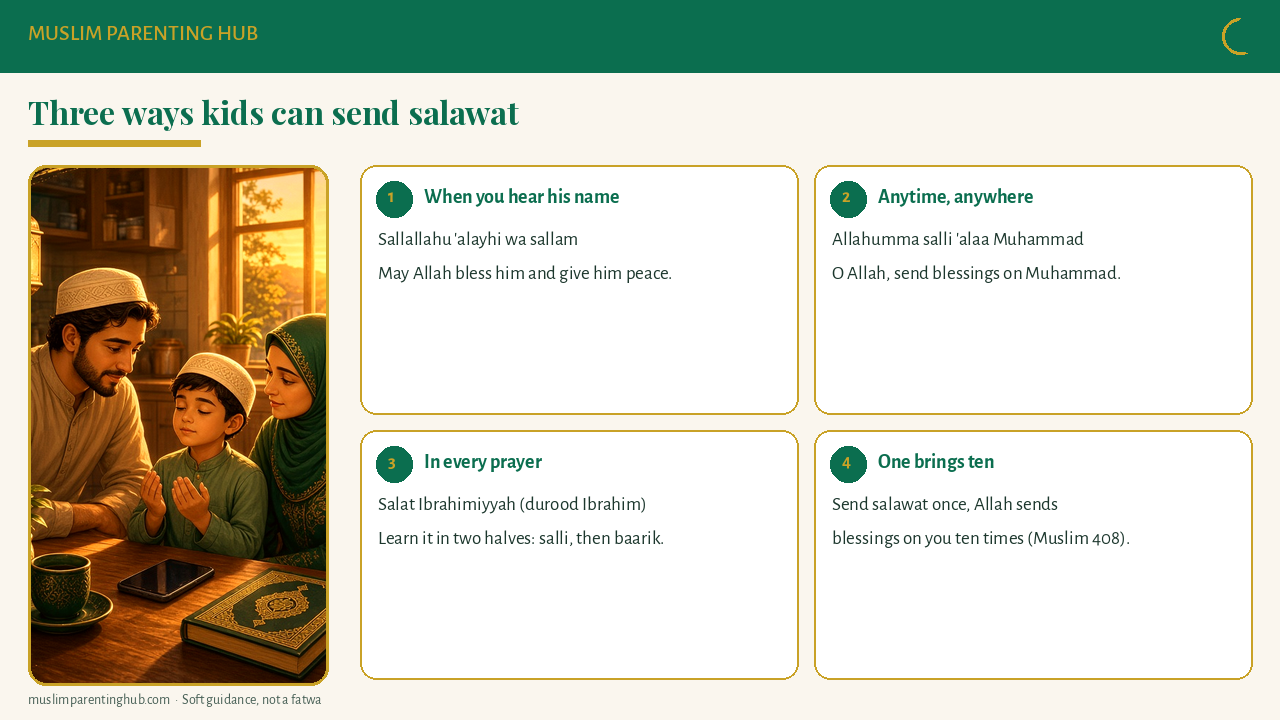
You don’t have to start with the long version. Grow it in three steps.
1. The short reply: when you hear his name
Sallallahu ‘alayhi wa sallam (often written ﷺ) “May Allah send blessings and peace upon him.”
This is the phrase Muslims say right after the name Muhammad ﷺ or “the Prophet.” The Prophet ﷺ said, “The stingy person is the one in whose presence I am mentioned and he does not send blessings upon me” (Jami’ at-Tirmidhi 3546). Kids understand “don’t be stingy” right away.
2. The everyday salawat: anytime
Allahumma salli ‘alaa Muhammad “O Allah, send blessings upon Muhammad.”
Short enough for a 3-year-old, and perfect for car rides, waiting in line at Target, or the minute before a test. It’s also the line children say after answering the adhan; our guide to the dua after adhan for kids shows how salawat leads straight into that dua.
3. The full salawat: Salat Ibrahimiyyah
This is the salawat the Prophet ﷺ taught his companions when they asked how to send blessings on him (Sahih al-Bukhari 3370), and it’s the one we say in the final sitting of every prayer.
Allahumma salli ‘alaa Muhammadin wa ‘alaa aali Muhammad, kamaa sallayta ‘alaa Ibraaheema wa ‘alaa aali Ibraaheem, innaka Hameedun Majeed. Allahumma baarik ‘alaa Muhammadin wa ‘alaa aali Muhammad, kamaa baarakta ‘alaa Ibraaheema wa ‘alaa aali Ibraaheem, innaka Hameedun Majeed.
“O Allah, send blessings upon Muhammad and the family of Muhammad, as You sent blessings upon Ibrahim and the family of Ibrahim; You are Praiseworthy, Glorious. O Allah, bless Muhammad and the family of Muhammad, as You blessed Ibrahim and the family of Ibrahim; You are Praiseworthy, Glorious.”
Kid meaning: “Ya Allah, bless our Prophet and his family the way You blessed Prophet Ibrahim and his family. You deserve all praise, and You are so great.”
Kids who are learning to pray need this anyway. If your child is working through the steps of prayer, our step-by-step salah and wudu guide for kids shows exactly where it goes in the tashahhud.
When to Say Salawat (Everyday Moments)
Salawat fits into the day more easily than almost any other worship. Pick two or three of these to start:
- When anyone says the Prophet’s name. At the dinner table, during a story, in the masjid. Make it a family reflex.
- After the adhan. Answer the adhan, then salawat, then the dua. If you’re still building the adhan habit, start with our playful plan to teach kids to answer the adhan.
- In every prayer. The Salat Ibrahimiyyah in the last sitting.
- Before making dua. Many scholars recommend opening dua with praise of Allah and salawat. Kids can learn: “Alhamdulillah, Allahumma salli ‘alaa Muhammad, then ask.”
- In the car. A school-run “salawat minute” turns traffic into reward.
- When feeling stressed or sad. A gentle habit to calm down: breathe, then salawat.
Why Friday Is Salawat Day
The Prophet ﷺ said, “Among the best of your days is Friday… so send a lot of blessings upon me on that day, for your blessings are presented to me” (Sunan Abi Dawud 1047).
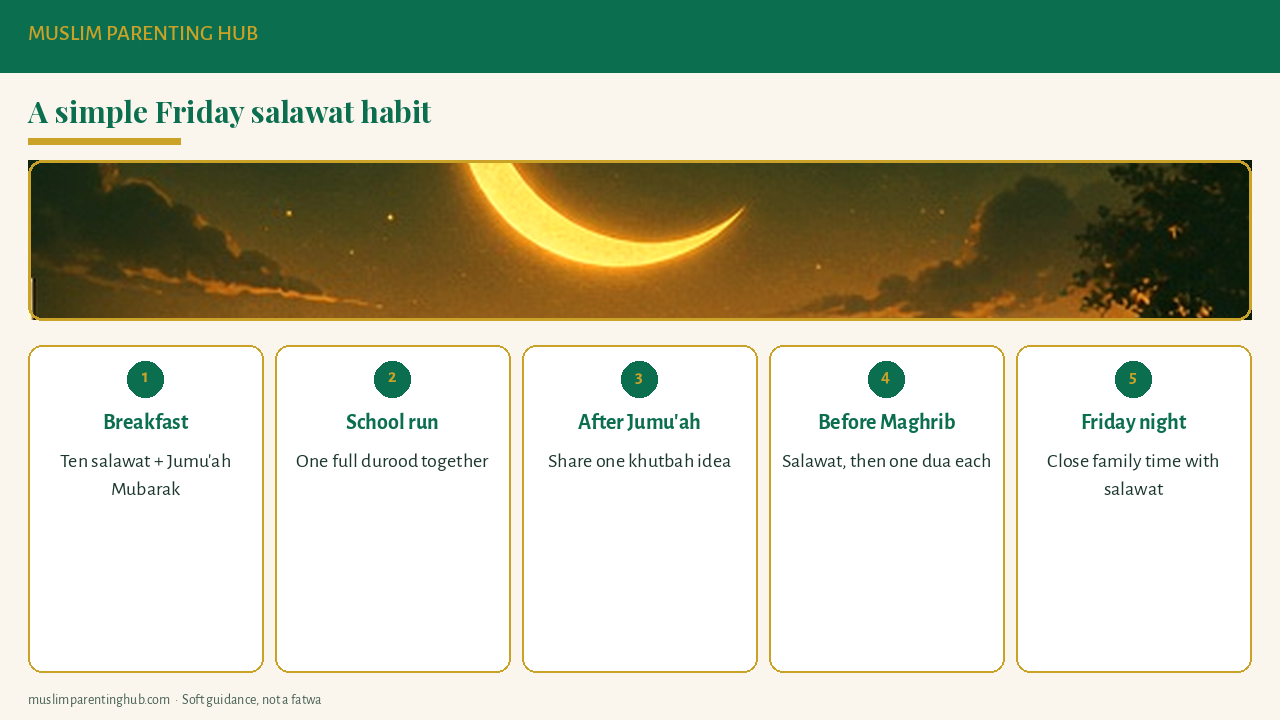
That gives families a beautiful weekly rhythm: Friday is the day we increase our salawat. Here’s a simple Friday plan that works even on a regular school-and-work day:
- Morning (2 minutes). At breakfast, everyone says “Allahumma salli ‘alaa Muhammad” ten times. Say “Jumu’ah Mubarak!” before backpacks go on.
- School run (3 minutes). One full Salat Ibrahimiyyah together in the car, then free salawat until the drop-off line.
- After Jumu’ah or after school. Kids who went to the masjid can share one thing from the khutbah. Our guide to taking kids to Jumu’ah prayer has ideas for making that part easy.
- The hour before Maghrib. Many scholars describe the last hour of Friday afternoon as a time when dua is answered. Gather for a few minutes of salawat, then let each child make one dua.
- Friday night. Close the family evening with salawat as part of your dua time.
If your family already has a Friday evening rhythm, salawat slides right in. Our Friday night Muslim family routine shows a simple 60–90 minute plan with Maghrib, Surah Al-Kahf and family joy; adding a five-minute salawat circle before the joy block takes almost no effort.
Fun, Gentle Ways to Build the Habit
Kids learn worship through love and repetition, not pressure. Try one or two of these:
The salawat jar. Every time a child says salawat on Friday, they drop a pom-pom or dried bean into a jar. When the jar is full, celebrate with a family treat. Keep it about joy, not competition between siblings.
The name rule game. Anyone who catches someone else saying the Prophet’s name without salawat gets to say “Sallallahu ‘alayhi wa sallam!” first. Kids love being the one who “catches” a parent.
Story first, salawat after. Tell a short story about the Prophet ﷺ, then close with salawat. Stories make kids love the person they’re sending blessings on. Our 5-minute prophet bedtime story method works well for little ones.
Counting on fingers. The Prophet ﷺ encouraged counting dhikr on the fingers. Kids can count ten salawat on their fingers before bed. Our guide to simple dhikr for kids has more counting ideas.
Sing it softly. Many families have a gentle tune for Allahumma salli ‘alaa Muhammad. Keep it simple and soft.
Stories That Make Kids Love the Prophet ﷺ
Salawat means more when children know who they’re praying for. A few true stories that young kids connect with:
- He kissed and hugged children. When a man said he had ten children and never kissed any of them, the Prophet ﷺ said, “Whoever does not show mercy will not be shown mercy” (Sahih al-Bukhari 5997).
- He carried his granddaughter in prayer. He would pray while carrying his granddaughter Umamah, putting her down when he bowed and picking her up when he stood (Sahih al-Bukhari 516).
- He was sent as a mercy. Allah calls him “a mercy to the worlds” (Al-Anbiya 21:107). Kindness to animals, neighbors, and people who were unkind to him filled his life.
After a story, ask: “What’s one way we can be kind like the Prophet ﷺ this week?” Our rahma activities for Muslim kids has ten ideas you can pick from.
Age-by-Age: What to Expect
Ages 2–3. Hear it and echo the last word. “Allahumma salli ‘alaa…” “Muhammad!” That’s a great start.
Ages 4–5. Learn “Allahumma salli ‘alaa Muhammad” and “sallallahu ‘alayhi wa sallam.” Practice the name rule at home.
Ages 6–7. Begin the Salat Ibrahimiyyah in two halves: the “salli” half, then the “baarik” half. Learn one half per week.
Ages 8–10. Say the full salawat in prayer, lead the family Friday salawat, and understand why we say it.
Ages 11 and up. Talk about the meaning: what it means for Allah to bless someone, why Prophet Ibrahim ﷺ is mentioned, and how our salawat reaches the Prophet ﷺ.
Common Questions From Parents
“What’s the difference between salawat and durood?” None in practice. Salawat is Arabic; durood is the Persian and Urdu word many South Asian families use. Both mean sending blessings on the Prophet ﷺ.
“Is it okay to write PBUH or ﷺ?” Writing ﷺ or “peace be upon him” is common and fine. Many scholars encourage writing or saying it in full rather than shortening it to letters, but the most important thing is that kids actually say it.
“My child says it really fast.” That’s normal. Model it slowly yourself, and occasionally say the meaning out loud so it doesn’t become empty sounds.
“There are so many long salawat in books. Which should we use?” Start with the Salat Ibrahimiyyah, which the Prophet ﷺ taught directly. It is the safest and most complete. Short forms like “Allahumma salli ‘alaa Muhammad” are perfect for everyday use.
FAQ
What is the easiest salawat for kids?
“Allahumma salli ‘alaa Muhammad” (O Allah, send blessings upon Muhammad) is the easiest for young children. They can also learn “sallallahu ‘alayhi wa sallam” to say whenever they hear the Prophet’s name.
What does Allahumma salli ala Muhammad mean?
It means “O Allah, send blessings upon Muhammad.” It’s a dua asking Allah to honor the Prophet ﷺ and raise his rank. The Prophet ﷺ said whoever sends blessings on him once, Allah sends blessings on that person ten times (Sahih Muslim 408).
Why do Muslims send extra salawat on Friday?
The Prophet ﷺ said Friday is among the best days and told us to send a lot of blessings on him on that day, because our blessings are presented to him (Sunan Abi Dawud 1047).
What is durood Ibrahim?
Durood Ibrahim, also called Salat Ibrahimiyyah, is the full salawat the Prophet ﷺ taught his companions (Sahih al-Bukhari 3370). Muslims recite it in the final sitting of every prayer, asking Allah to bless Muhammad ﷺ and his family as He blessed Ibrahim and his family.
At what age should kids learn salawat?
Toddlers can echo it from age 2 or 3, preschoolers can learn the short form, and most kids ages 6 to 8 can learn the full Salat Ibrahimiyyah in a few weeks, usually as they start learning to pray.
How can I make salawat fun for my kids?
Try a Friday salawat jar, a “name rule” game, counting ten salawat on fingers at bedtime, or telling a short story about the Prophet ﷺ before saying salawat together. Keep it joyful, not pressured.
Related guides
- Friday night Muslim family routine
- Dua after adhan for kids
- Taking kids to Jumu’ah prayer
- Teach kids to answer the adhan at home
Soft guidance, not a fatwa. For detailed questions, please ask a trusted local scholar or your masjid’s imam.
Related articles
Dua After Adhan for Kids: Meaning, Easy Transliteration and a 5-Day Way to Learn It
Teach kids the dua after the adhan in small chunks: Arabic, easy transliteration, simple meaning, a 5-day plan and US-home tips for when you can't hear the masjid.
Read guide →
Simple Dhikr for Kids: SubhanAllah, Alhamdulillah, Allahu Akbar and How to Make Them a Daily Habit
Teach kids simple dhikr—SubhanAllah, Alhamdulillah, Allahu Akbar and more—with meanings, when to say them, finger counting, bedtime tasbih and car-ride ideas.
Read guide →
Taking Kids to Jumu'ah Prayer: A Calm Friday Plan for Muslim Families
Take kids to Jumu'ah without stress: Friday Sunnahs for kids, what to pack, how to sit through the khutbah, age bands and a simple Friday timeline.
Read guide →
Friday Night Muslim Family Routine: 5 Simple Steps Kids Look Forward To
Make Jumuah special at home: a 60–90 minute Friday night routine with Maghrib, kid-sized Surah Al-Kahf, a family joy block and dua. Try it this week.
Read guide →