

The After-School Order for Muslim Kids: Snack, Salah, Homework, Then Maghrib
It’s 3:25 p.m. The bus drops them off, the front door bangs open, and three backpacks hit the floor. One child is starving. One wants to “just relax for a minute” with a tablet. One has a math worksheet due tomorrow and is already melting down about it. And somewhere in the next hour, Asr time is quietly slipping by.
Most after-school chaos isn’t about bad kids or lazy parents. It’s about order. When nobody knows what comes next, every step becomes a negotiation. When the order is the same every day, kids stop arguing with you and start following the routine.
This guide gives you a simple, repeatable order that works for many Muslim families in the US: snack, salah, homework, play, then Maghrib together. We already have a full guide to the after-school Maghrib routine that focuses on the 20-minute Maghrib reset. This article covers the hours before that: from the moment kids walk in to the moment the sun goes down.
Why Order Matters More Than a Perfect Schedule
Kids thrive on predictability. When they know that snack always comes first and homework always comes after Asr, their brains stop fighting each transition. You also stop being the “bad guy” because the routine decides, not you.
A good after-school order should:
- Meet the body’s needs first (food, water, bathroom, a short rest)
- Protect the prayer time so Asr doesn’t get squeezed out
- Get homework done while kids still have energy
- Leave room for play, outdoor time, and family connection
- Land softly at Maghrib, so evenings don’t feel like a sprint
The Prophet ﷺ was asked which deed is most beloved to Allah, and he said, “Prayer at its proper time” (Bukhari). An after-school routine is really a way of teaching kids, day after day, that prayer gets a real place in our schedule, not the leftovers.
The Order at a Glance
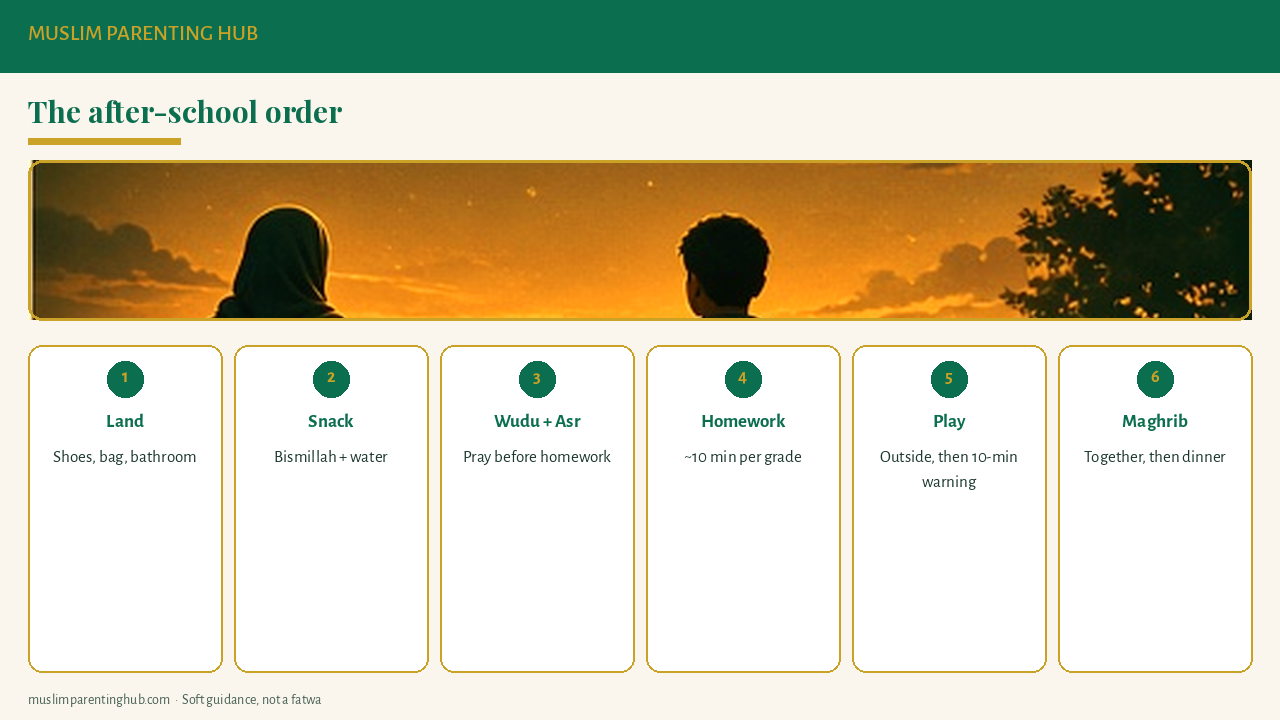
- Land (5–10 minutes): shoes off, backpack in its spot, bathroom, hand wash.
- Snack and water (10–15 minutes): sit down, Bismillah, a real snack.
- Wudu and Asr (10 minutes): pray together if Asr has come in.
- Homework block (20–60 minutes depending on grade).
- Play and outdoor time (until about 20 minutes before Maghrib).
- Maghrib together, then dinner and the evening routine.
Now let’s look at each step and the common problems that come up.
Step 1: Land (5–10 Minutes)
Children walk in the door carrying a whole day: a friend who ignored them, a test, a loud cafeteria, a long bus ride. Don’t start with questions or demands. Start with landing.
- Shoes off at the door, right foot first if you’re building that Sunnah habit.
- Backpack in its spot (a hook or bin, not the middle of the kitchen).
- Lunchbox on the counter.
- Bathroom and hand wash.
- A smile and “Assalamu alaikum.”
That’s all. Save “How was your day?” for the snack table. Many kids answer better once they’ve eaten.
Tip: If kids come home from after-school care or a sitter, the same landing steps apply. It’s the predictability that matters, not the clock time.
Step 2: Snack and Water (10–15 Minutes)
Hungry kids can’t pray calmly or focus on homework. Feed them first.
Make it a sit-down snack, not a grazing session. Bismillah before, Alhamdulillah after. This is a great time for a quick chat: “What’s one good thing that happened today?”
Snack ideas that fuel without crashing: - Apple slices with peanut butter - Cheese and whole-grain crackers (check labels for animal rennet if your family avoids it) - Hummus with carrots and pita - Dates and a glass of milk - Leftover rice, pasta, or a small wrap - Yogurt with granola
Keep it filling but not dinner-sized, especially on days when dinner comes right after Maghrib. Older kids can make their own snack; this is a perfect starter job from our Islamic chores age chart.
Water matters, too. Many kids barely drink at school. A full glass of water at snack time helps with focus and headaches.
Step 3: Wudu and Asr (10 Minutes)
Here’s the step that makes this a Muslim routine. Asr time usually comes in during the school day or right around pickup in the fall. In much of the US in October, Asr starts somewhere between about 3:15 and 4:30 p.m., depending on where you live and your prayer timetable. Check your local masjid’s calendar or prayer app.
Why pray before homework? - The time is limited. Asr ends at sunset, which comes earlier every week in the fall. If homework drags on, Asr can get pushed right up against Maghrib. - It’s a reset. Wudu cools the body and calms the mind. Many parents notice homework goes better after salah. - It sets priorities. Kids learn that we don’t fit prayer around our tasks; we fit tasks around prayer.
By age: - Under 7: They join if they want, stand next to you, copy movements. No pressure. The Prophet ﷺ said to instruct children to pray at seven (Abu Dawud), so before that it’s gentle exposure. - Ages 7–9: Encourage them to pray Asr every school day. Pray together when you can. If they need help with steps, our salah and wudu step-by-step guide walks through it. - Ages 10+: They should be praying consistently. Let one child lead the family Asr sometimes, or call the iqamah.
If Asr hasn’t started yet (more common in late spring), flip steps 3 and 4: do a short homework block first, then pray as soon as the time comes in.
If it’s a hard day: Pray anyway, but keep it short and kind. “We just pray the four rakat together and then you can rest.” Avoid turning salah into a punishment or a battle.
Step 4: Homework Block (20–60 Minutes)
Now the brain has fuel and a reset. This is the best window for homework.
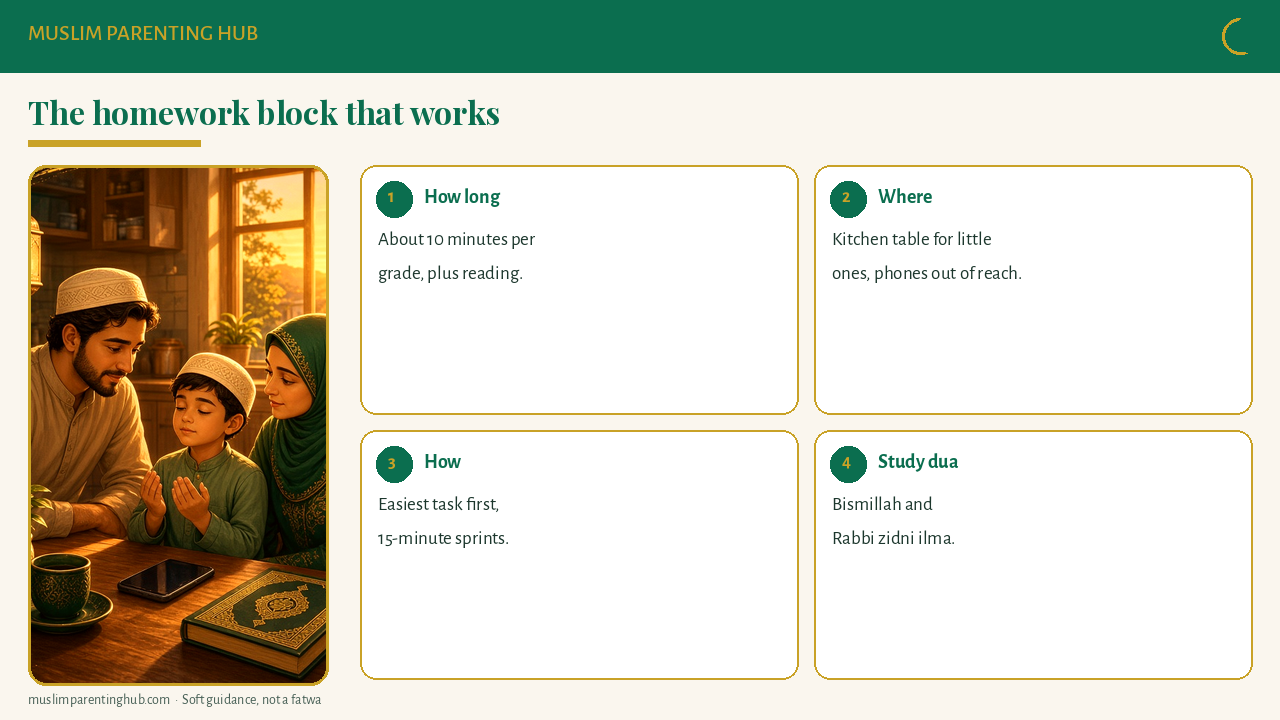
How long? A common US guideline is about ten minutes per grade level: twenty minutes for second grade, fifty minutes for fifth grade. Many teachers also assign daily reading of fifteen to twenty minutes.
Set up a homework spot: the kitchen table works well for younger kids because you can help while you start dinner. Older kids may prefer a desk, but keep phones and tablets out of reach until homework is done.
Keep it calm: - Start with the easiest task to build momentum. - Use a timer for short focus sprints (15 minutes on, 3 minutes off). - Help, but don’t take over. “Show me what you tried.” - Say Bismillah before starting and “Rabbi zidni ilma” (My Lord, increase me in knowledge, Quran 20:114). Kids love having a “study dua.”
When there’s no homework: Use the time for reading, a short Quran review, or a quiet activity. The block itself is the habit.
Step 5: Play and Outdoor Time
Once homework is done, kids have earned free time. This is where the day breathes.
- Outside if possible. October is perfect for bikes, the park, raking leaves into piles to jump in.
- Screens, if your family allows them, after homework and Asr. Set a clear end time, usually 20 minutes before Maghrib.
- Chores can fit here too: five minutes of tidying the living room before Maghrib gives kids a clean space to pray.
The transition is key. Give a 10-minute warning before Maghrib: “In ten minutes we start getting ready for Maghrib.” When the adhan app goes off, kids already know what’s next. If you’re practicing answering the adhan at home, this is a natural daily moment to repeat after the muadhin.
Step 6: Maghrib Together, Then Dinner
Maghrib is the anchor of the evening. In October, it falls around 6:15–6:45 p.m. in much of the US, and it moves earlier each week. When daylight saving time ends on Sunday, November 1, 2026, Maghrib will suddenly shift an hour earlier on the clock, often right after school. Our guide to shifting your routine when daylight saving ends shows how to adjust ahead of time.
After Maghrib, many families eat dinner, then do the bedtime routine. Because the hard work (homework and Asr) is already done, evenings can stay calm.
Sample Fall Schedules
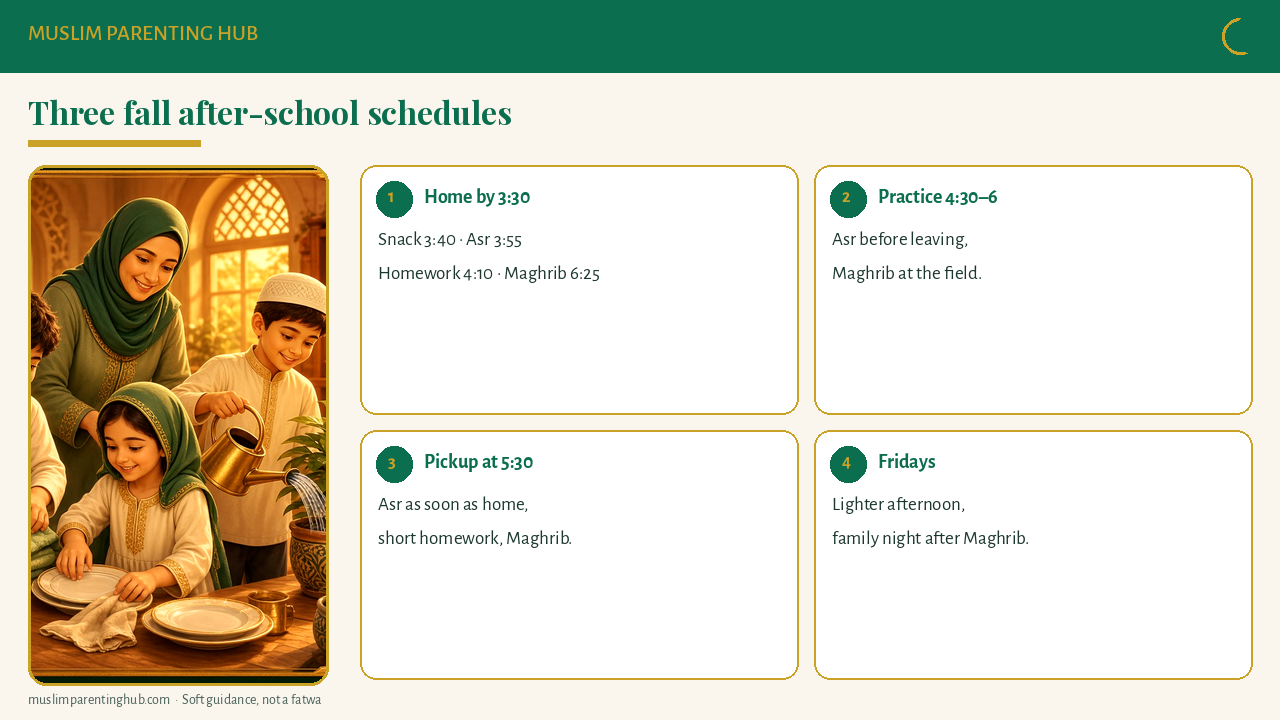
Regular school day (home by 3:30)
| Time | Step |
|---|---|
| 3:30 | Land: shoes, backpack, bathroom |
| 3:40 | Snack and water |
| 3:55 | Wudu and Asr together |
| 4:10 | Homework block |
| 4:50 | Play, outside, screens if allowed |
| 6:10 | Tidy-up and wudu |
| 6:25 | Maghrib together |
| 6:40 | Dinner |
Sports or activity day (practice 4:30–6:00)
| Time | Step |
|---|---|
| 3:30 | Land and a bigger snack |
| 3:50 | Wudu and Asr before leaving |
| 4:05 | Quick homework (reading or one worksheet) |
| 4:30 | Practice |
| ~6:20 | Maghrib at the field, in the parking lot, or right after getting home |
| 6:45 | Dinner, finish homework if needed |
For praying at the field or in the car line, see our guide to praying Maghrib on the go with kids.
After-school program (pickup at 5:30)
| Time | Step |
|---|---|
| School | Ask the program if your child can pray Asr in a quiet corner (older kids), or pray Asr together as soon as you get home if time allows |
| 5:45 | Home, land, quick snack |
| 5:55 | Wudu and Asr if not yet prayed |
| 6:10 | Short homework or reading |
| 6:25 | Maghrib together |
| 6:40 | Dinner and finish homework |
On these days, homework often gets split. That’s okay. Protect salah first, then do what you can.
Common Problems (And Calm Fixes)
“I’m too tired to pray!” Feed them first, then make wudu together with cool water. Keep the prayer short and pray right next to them. Fatigue is real, but a five-minute Asr is usually doable.
“Can I play first and do homework later?” Once in a while, sure. But if homework always slides to after Maghrib, evenings get crushed. Keep the order on school nights and allow flexibility on Fridays.
Siblings with different schedules. Little ones can nap, play, or “do homework” with coloring sheets while big kids work. Pray Asr together as a family whenever possible; it’s a great anchor that pulls everyone into the same room.
The tablet trap. If kids reach for screens the moment they get home, the whole order falls apart. A simple rule many families use: no screens until Asr and homework are done. It works best when parents follow a similar rule.
You’re not home until 6. Leave a simple checklist on the fridge for the sitter or older sibling: snack, wudu, Asr, homework. When you walk in, your job is Maghrib and dinner, not catching up on everything.
Making It Stick
- Post the order on the fridge with pictures for younger kids.
- Run it for two weeks before changing anything. Routines feel clunky at first.
- Praise the routine, not just the result. “You did snack, salah, and homework without me reminding you. MashaAllah!”
- Keep Fridays softer. A lighter Friday afternoon makes room for a special Friday night family routine.
The goal isn’t a military schedule. It’s a rhythm your kids can feel in their bones: eat, pray, work, play, Maghrib. Years from now, they may not remember the worksheets, but they’ll remember that in your home, prayer always had its place.
FAQ
Should my child pray Asr before or after homework?
If Asr time has started, pray first. It protects the prayer from being rushed, gives kids a calming reset, and teaches that salah gets a real place in the day.
How long should the after-school homework block be?
A common guideline is about ten minutes per grade level, plus daily reading. Use short timed sprints for younger kids and keep phones away until homework is done.
What if Asr ends before my child gets home?
In the fall, Asr ends at sunset, which comes earlier each week. If pickup is late, ask about praying at the after-school program, or pray as soon as you get home before Maghrib.
What is a good after-school snack before salah?
Choose something filling but light: fruit with peanut butter, hummus and veggies, dates and milk, yogurt, or a small wrap. Sit down, say Bismillah, and drink water.
Should kids under 7 pray Asr every day?
There’s no obligation before seven. Invite them to join, let them copy you, and keep it joyful so that when they reach seven, praying feels normal.
Related guides
- The after-school Maghrib routine
- Praying Maghrib on the go with kids
- Daylight saving ends: shift Maghrib and bedtime
- The 5 daily prayers for kids
Quick steps
After-school order for Muslim kids: snack, salah, homework, then Maghrib. A repeatable after-school sequence that meets kids' needs, protects Asr, gets homework done and lands calmly at Maghrib.
- Land — Shoes off, backpack in its spot, bathroom and hand wash, and a warm salam (5–10 minutes).
- Snack and water — A sit-down snack with Bismillah and a full glass of water (10–15 minutes).
- Wudu and Asr — If Asr has come in, make wudu and pray together before homework (about 10 minutes).
- Homework block — About ten minutes per grade level plus reading, with phones away and Rabbi zidni ilma to start.
- Play and outdoor time — Free play, outside time or allowed screens, ending with a 10-minute warning before Maghrib.
- Maghrib together — Tidy up, make wudu, pray Maghrib as a family, then dinner and the evening routine.
Related articles

The After-School Maghrib Routine That Actually Works for Muslim Families
A calm 20-minute after-school Maghrib routine for Muslim families—snack, wudu, pray together, then connect. Age tips, scripts, and a screen rule that sticks.
Read guide →
Praying Maghrib on the Go With Kids: Soccer Practice, Carpools and Evening Errands
Maghrib hits during soccer practice, carpool, or a Target run? A portable prayer kit, where to pray, a 10-minute on-the-go plan, and coach scripts for US families.
Read guide →
Daylight Saving Ends Nov 1: How to Shift Your Family's Maghrib, Homework and Bedtime Routine
US clocks fall back Nov 1, 2026—shift Maghrib, homework, and bedtime gently with a week-before plan and sample after-school schedules for Muslim families.
Read guide →
The 5 Daily Prayers for Kids: Explaining Fajr to Isha With the Sun and Your Family's Day
Explain the five daily prayers to kids with the sun: what Fajr, Dhuhr, Asr, Maghrib and Isha mean, when they come this fall, rak'ah counts, and easy games.
Read guide →