
Ayatul Kursi for Kids: Meaning, Easy Transliteration and a Line-by-Line Way to Learn It
It’s 8:15 on a school night. Teeth are brushed, the night-light is on, and your 6-year-old suddenly asks, “Does Allah sleep?” Or maybe it’s the bigger one: “Where is Allah, and how can He see everybody at the same time?”
There is one ayah in the Quran that answers both questions beautifully, and Muslim families have recited it at bedtime for fourteen centuries: Ayatul Kursi, verse 255 of Surah Al-Baqarah.
It is longer than the short surahs most kids learn first, so many parents assume it’s “too hard” for young children. It isn’t. Broken into nine short lines, with a simple meaning for each one, Ayatul Kursi becomes one of the most comforting things your child ever memorizes.
This guide gives you a kid-friendly meaning, easy transliteration, a bedtime habit, and a line-by-line plan that works for busy American families with school mornings, soccer practice and homework in the mix.
What Is Ayatul Kursi?
Ayatul Kursi means “the Verse of the Kursi” (often translated as “the Footstool” or “the Seat”). It is verse 255 of Surah Al-Baqarah, the second chapter of the Quran.
The Prophet ﷺ once asked his companion Ubayy ibn Ka’b which verse of the Quran was the greatest. Ubayy answered with Ayatul Kursi, and the Prophet ﷺ was so pleased that he patted his chest and said, “May knowledge be a joy for you” (Sahih Muslim 810).
Why is it so great? Because almost every line tells us something about who Allah is: alive, never tired, never sleeping, knowing everything, owning everything, and guarding the whole universe without effort. For a child, that is the perfect answer to big questions about Allah.
Ayatul Kursi Line by Line (With Kid Meanings)
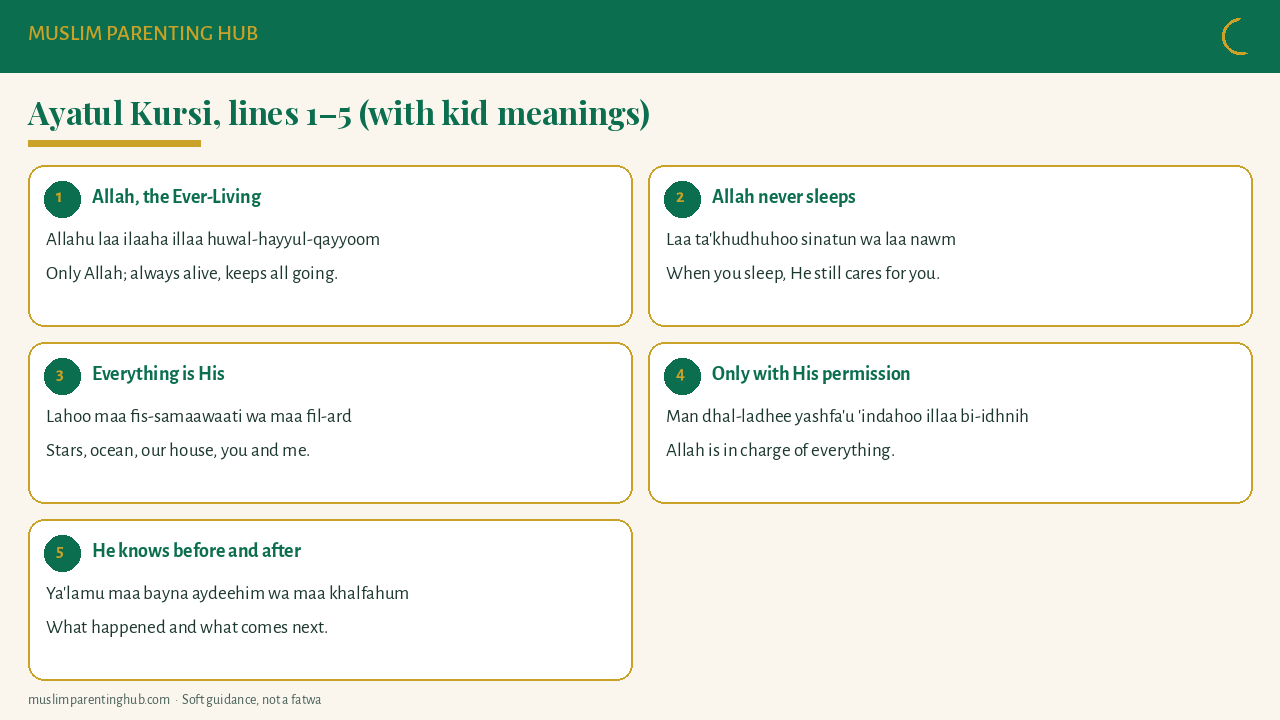
Here is the ayah in nine short pieces. The transliteration is simplified for parents who are still learning Arabic; the best way for your child to learn the sounds is always by listening to a good reciter or a teacher.
Line 1: Allahu laa ilaaha illaa huwal-hayyul-qayyoom Allah: there is no god except Him, the Ever-Living, the One who takes care of everything. Kid meaning: “Allah is the only One we worship. He is always alive, and He keeps everything going.”
Line 2: Laa ta’khudhuhoo sinatun wa laa nawm Neither drowsiness nor sleep overtakes Him. Kid meaning: “Allah never gets sleepy and never sleeps. When you sleep, He is still taking care of you.”
Line 3: Lahoo maa fis-samaawaati wa maa fil-ard To Him belongs everything in the heavens and everything on the earth. Kid meaning: “Everything belongs to Allah: the stars, the ocean, our house, even you and me.”
Line 4: Man dhal-ladhee yashfa’u ‘indahoo illaa bi-idhnih Who could speak up for anyone before Him without His permission? Kid meaning: “Nobody can do anything with Allah unless Allah allows it. He is in charge.”
Line 5: Ya’lamu maa bayna aydeehim wa maa khalfahum He knows what is in front of them and what is behind them. Kid meaning: “Allah knows what already happened and what will happen next.”
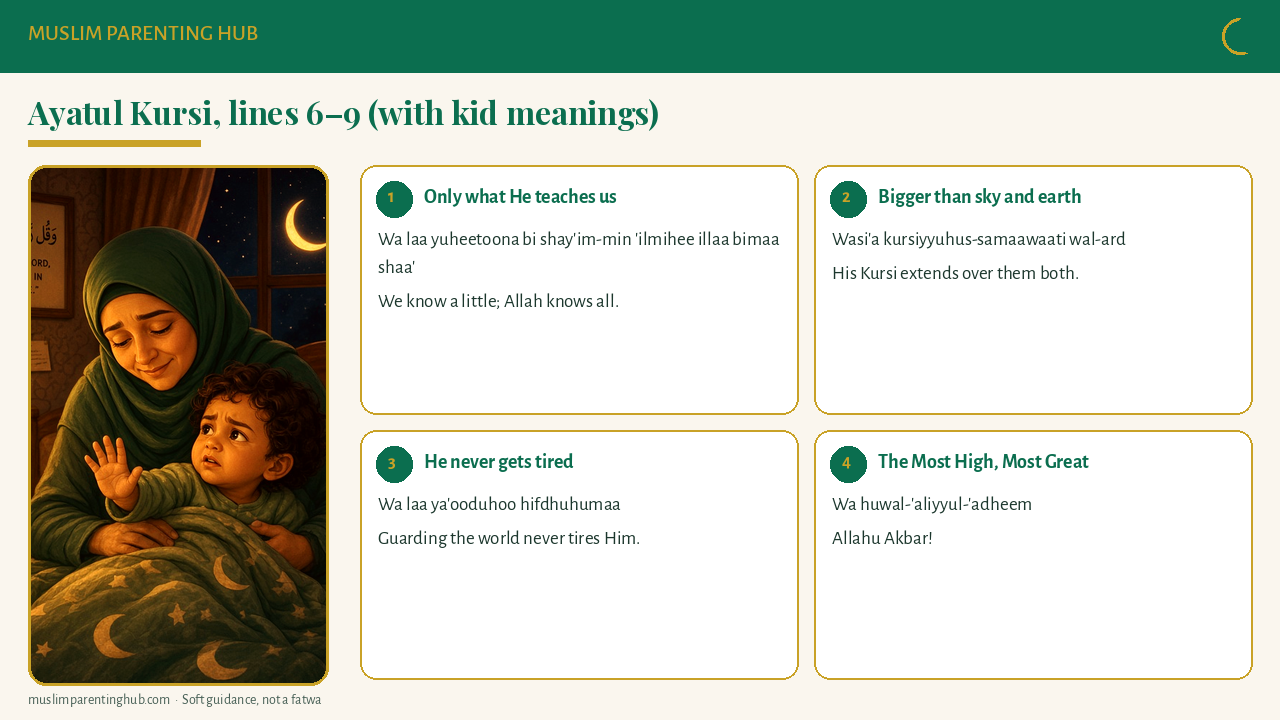
Line 6: Wa laa yuheetoona bi shay’im-min ‘ilmihee illaa bimaa shaa’ And they cannot grasp any of His knowledge except what He wills. Kid meaning: “We only know the little bit Allah teaches us. Allah knows everything.”
Line 7: Wasi’a kursiyyuhus-samaawaati wal-ard His Kursi extends over the heavens and the earth. Kid meaning: “Allah made the Kursi, and it is bigger than the whole sky and the whole earth. And Allah is greater than everything He made.”
Line 8: Wa laa ya’ooduhoo hifdhuhumaa Guarding them both does not tire Him. Kid meaning: “Allah takes care of the whole world, and it never makes Him tired.”
Line 9: Wa huwal-‘aliyyul-‘adheem And He is the Most High, the Most Great. Kid meaning: “Allah is the Highest and the Greatest. Allahu Akbar!”
If your child asks how something can be bigger than the sky, you don’t need a long lecture. “It’s a creation of Allah we can’t see, and it’s so big it makes the whole universe look small. Isn’t Allah amazing?” is enough at this age.
How Ayatul Kursi Answers Kids’ Big Questions About Allah
Young children are natural philosophers. Ayatul Kursi gives you calm, Quran-based answers instead of guesses.
“Does Allah sleep?” No. Line 2 says it directly. This is a wonderful bedtime comfort: “You can close your eyes. Allah doesn’t.”
“Where is Allah?” Line 9 tells us Allah is the Most High, and line 7 tells us His creation is huge beyond imagining. For more gentle wording, including what to say when kids ask if Allah lives in the sky, see our guide on how to answer “Where is Allah?” for kids.
“How can Allah see everybody at once?” Lines 5 and 6: Allah’s knowledge has no limits. “You can only look at one thing at a time. Allah knows everything, everywhere, all the time.”
“Who made Allah?” Ayatul Kursi pairs perfectly with Surah Al-Ikhlas here: Allah was not born and has no beginning. Our guide to Surah Al-Ikhlas for kids walks you through that answer in four short lines.
For toddlers who are not ready for any of these questions yet, start with the tiny phrases in our guide on how to talk about Allah with toddlers. “Allah made the moon” comes before “Allah’s Kursi is bigger than the heavens.”
The Bedtime Protection Story Kids Love
There is a true story from the life of the Prophet ﷺ that makes Ayatul Kursi unforgettable for children.
Abu Hurayrah was given the job of guarding the zakat food in Madinah. One night, a man came and started taking handfuls of food. Abu Hurayrah caught him, and the man begged to be let go because he was poor and had a family. This happened three nights in a row. On the third night, the man said, “Let me go, and I’ll teach you words that Allah will benefit you with. When you go to bed, recite Ayatul Kursi. A guardian from Allah will stay with you, and no devil will come near you until morning.”
The next day, the Prophet ﷺ told Abu Hurayrah, “He told you the truth, even though he is a liar. Do you know who you were talking to these three nights? That was a shaytan” (Sahih al-Bukhari 2311).
Kids love this story because it has a night guard, a sneaky visitor and a surprise ending. Tell it with suspense and a smile, not fear. The takeaway is simple: Allah protects us, and Ayatul Kursi is one of the ways we ask for that protection.
If your child worries about the dark, scary dreams, or “things they can’t see,” keep the focus on Allah’s care. Our guides on scary dreams and nighttime comfort scripts and talking to kids about angels at bedtime have gentle words that pair well with this story.
When Do Muslims Recite Ayatul Kursi?
Three simple moments are enough for a family:
- At bedtime. Based on the hadith above. Most families recite it as part of a short bedtime sequence with the three Quls and the sleeping dua. Our bedtime duas for kids with a 7-night plan shows how Ayatul Kursi fits into that routine without making bedtime long.
- After each obligatory prayer. Imam an-Nasa’i reported that the Prophet ﷺ said whoever recites Ayatul Kursi after every obligatory prayer, nothing stands between him and Paradise except death; many scholars graded this hadith authentic. Kids who already pray can add it after Maghrib or Isha first.
- In the morning and evening remembrance. Many families include it in their morning adhkar. If you already have a 5-minute morning protection dua routine, Ayatul Kursi slots in naturally once your child knows it.
You don’t have to do all three right away. Start with bedtime. One consistent moment beats three forgotten ones.
A Line-by-Line Plan That Fits a Busy Week
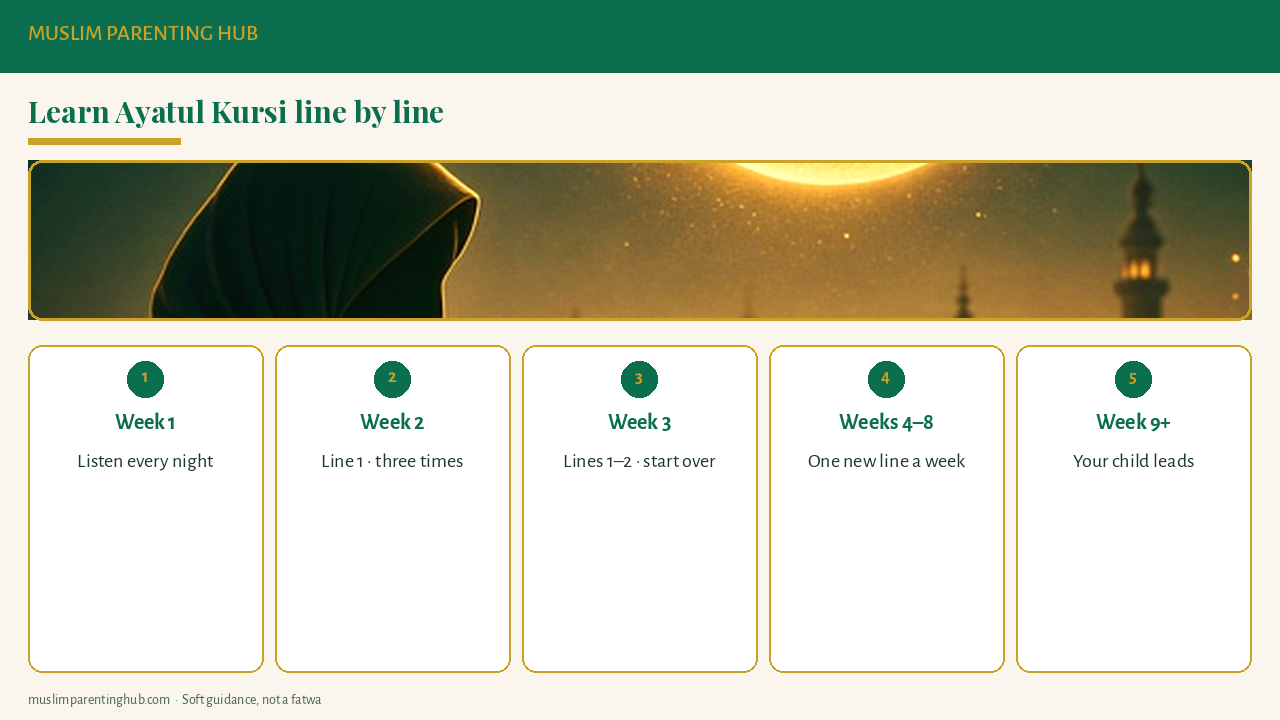
The secret to memorizing a long ayah is stacking: learn one line, then recite from the beginning each time you add the next. Here’s a plan that works for most kids ages 5 to 9.
Week 1: Listen only. Play Ayatul Kursi every night at bedtime and once in the car on the way to school. Don’t ask your child to repeat anything yet. Their ears are learning the rhythm.
Week 2: Line 1. Say “Allahu laa ilaaha illaa huwal-hayyul-qayyoom” together three times at bedtime. Share the kid meaning.
Week 3: Lines 1–2. Add “Laa ta’khudhuhoo sinatun wa laa nawm.” Always start again from line 1.
Weeks 4–8: One new line a week. Keep stacking. Some kids move faster; some need two weeks on a hard line like line 6. Both are fine.
Week 9 and after: Your child leads. Let them recite it for the whole family at bedtime, or for a grandparent on a video call. That moment of pride is worth more than any sticker.
A few tips that make this easier:
- Use a hand signal for each line. Line 2 can be “sleeping” hands that shake no. Line 7 can be arms stretched wide. Movement helps young brains remember.
- Listen in the car. School drop-off and the carpool to practice are perfect for one or two replays.
- Don’t correct every sound. Gently model the right pronunciation and keep going. If your child’s masjid or weekend school teacher is working on tajweed, let them lead the fine details.
Age-by-Age: What to Expect
Ages 2–4: Listening and loving. Toddlers and preschoolers can listen nightly and may join in on “Allah” or “hayyul-qayyoom.” The goal is warmth: a cuddle, a soft voice, the same ayah every night.
Ages 5–6: The first two lines. Many kindergartners can learn lines 1 and 2 and understand “Allah never sleeps.” That alone is a beautiful bedtime comfort.
Ages 7–9: The whole ayah. With the stacking plan, most kids in this age range can memorize all nine lines in two to three months.
Ages 10 and up: Meaning and reflection. Older kids can connect the lines to the Names of Allah inside the ayah: Al-Hayy (the Ever-Living), Al-Qayyum (the Sustainer), Al-‘Aliyy (the Most High) and Al-‘Adheem (the Most Great). Our guide to the first names of Allah to teach kids has simple activities for each.
Common Struggles (and Calm Fixes)
“My child mixes up the lines.” That’s normal for a long ayah. Go back one line and stack again. Playing a recitation with the words on screen can help older kids.
“He’s scared after the shaytan story.” Retell it with the ending first: “This is a story about how Allah protects us.” Remind him that the shaytan himself admitted Ayatul Kursi keeps him away. If fears about the unseen keep coming up, our guide on talking to kids about jinn without fear can help.
“We keep forgetting at bedtime.” Tie it to something that already happens every night, like turning off the lamp. “Lamp off, Ayatul Kursi on.” Sticky habits ride on existing routines.
Keep It Soft
The goal isn’t a memorization checklist. It’s for your child to fall asleep knowing that Allah is awake and never tired of taking care of them. Recite it with them, not at them, and praise the effort. Every night your child hears Ayatul Kursi in your voice, they’re learning it.
FAQ
What is Ayatul Kursi in simple words for kids?
Ayatul Kursi is verse 255 of Surah Al-Baqarah. It tells us that Allah is the only One we worship, He is always alive, He never sleeps, everything belongs to Him, He knows everything, and taking care of the whole universe never makes Him tired.
At what age can a child learn Ayatul Kursi?
Toddlers can listen to it every night from age 2. Many kids learn the first two lines around ages 5 to 6, and most children ages 7 to 9 can memorize the whole ayah in two to three months by learning one line a week.
Why do Muslims recite Ayatul Kursi before sleeping?
The Prophet ﷺ confirmed that whoever recites Ayatul Kursi when going to bed will have a guardian from Allah, and no shaytan will come near him until morning (Sahih al-Bukhari 2311). It’s a simple way to ask for Allah’s protection at night.
How do I teach Ayatul Kursi to my child quickly?
Listen to it daily for a week, then learn one line at a time and always recite from the beginning when adding a new line. Use hand signals, replay it in the car, and let your child lead the family recitation once they know it.
Is it okay if my child’s pronunciation isn’t perfect?
Yes. Children are still learning, and their effort is beautiful. Model the correct sounds gently, play a good reciter, and let a Quran teacher refine tajweed over time. Don’t stop the habit because of small mistakes.
Can kids recite Ayatul Kursi after salah?
Yes. Imam an-Nasa’i reported a hadith, graded authentic by many scholars, encouraging Ayatul Kursi after every obligatory prayer. Kids who already pray can start by adding it after one prayer, such as Maghrib or Isha.
Related guides
- Bedtime duas for kids: what to recite before sleep
- “Where is Allah?” How to answer kids’ big questions
- Surah Al-Ikhlas for kids: meaning and transliteration
- How to talk about Allah with toddlers
Soft guidance, not a fatwa. For detailed questions, please ask a trusted local scholar or your masjid’s imam.
Quick steps
Learn Ayatul Kursi line by line. Listen for a week, then stack one new line each week, always reciting from the beginning, until your child can lead it.
- Week 1 — Listen only — Play Ayatul Kursi every night at bedtime and once in the car; don't ask your child to repeat yet.
- Week 2 — Line 1 — Say "Allahu laa ilaaha illaa huwal-hayyul-qayyoom" together three times at bedtime and share the kid meaning.
- Week 3 — Lines 1–2 — Add "Laa ta'khudhuhoo sinatun wa laa nawm," always starting again from line 1.
- Weeks 4–8 — One new line a week — Keep stacking one line at a time; take two weeks on a hard line if needed.
- Week 9 and after — Your child leads — Let your child recite the whole ayah for the family at bedtime or for a grandparent.
Related articles
Surah Al-Ikhlas for Kids: Meaning, Easy Transliteration and How It Answers "Who Is Allah?"
Teach kids Surah Al-Ikhlas line by line: Arabic, easy transliteration, a simple meaning, how it answers "Who made Allah?" and a 7-day plan for home and school.
Read guide →
Bedtime Duas for Kids: What to Recite Before Sleep (With a 7-Night Plan)
Bedtime duas for kids made simple: the sleeping dua, the 3 Quls, Ayat al-Kursi and a calm Sunnah sequence, with meanings, age bands and a 7-night plan.
Read guide →
"Where Is Allah?" How to Answer Kids' Big Questions About Allah (Ages 4-8)
Gentle, love-based answers for ages 4–8: Where is Allah? Can He see me? Who made Allah?—plus scripts, what to avoid, and when you don't know.
Read guide →
How to Talk About Allah With Toddlers: Simple Words and a 7-Day Plan
What to say when your toddler asks “Who made the moon?” Loving phrases about Allah for ages 0–3, bedtime lines and a 7-day plan—no fear, no lectures.
Read guide →