Is Allah Real? How to Answer Your Child’s Honest Question (Ages 4–12)
It might come in the car on the way home from soccer practice, or after a classmate says, “My family doesn’t believe in God.” Your child looks up and asks, quietly or bluntly: “Is Allah real? How do we know?”
Take a breath. This is not a crisis. It is one of the healthiest questions a child can ask. The Quran invites people again and again to look, think and reflect. A child who asks “How do we know?” is doing exactly that, and your calm answer now will shape how safe they feel bringing big questions to you at 14 and 17.
This guide gives US Muslim parents short, honest answers for ages 4–12, three hands-on “sign spotting” activities, the Quran’s own reasoning in kid language, and scripts for the moments that usually trigger the question. It is gentle home guidance, not a fatwa or a theology course. For deeper creed questions, an imam or Islamic school teacher you trust is a great partner.
If your child is in a season of big questions, you may also want our map of where is Allah answers for kids, which covers “Where is He?”, “Does He sleep?” and more.
Why Kids Ask “Is Allah Real?”
Kids usually ask for one of four reasons:
- They can’t see Him. Young children trust what they can touch. “I can see you, Mama. Why can’t I see Allah?”
- Someone they like believes differently. A best friend, a teacher or a TV character says God isn’t real.
- They are testing the floor. They want to know if this belief is solid enough to lean on.
- They are learning “real vs. pretend.” Around 4–6, kids sort Santa, superheroes and dragons into “pretend.” They want to know which bin Allah goes in.
None of these is a sign that you failed. Each is a sign that your child trusts you enough to ask out loud.
The Short Answer by Age
Ages 4–6
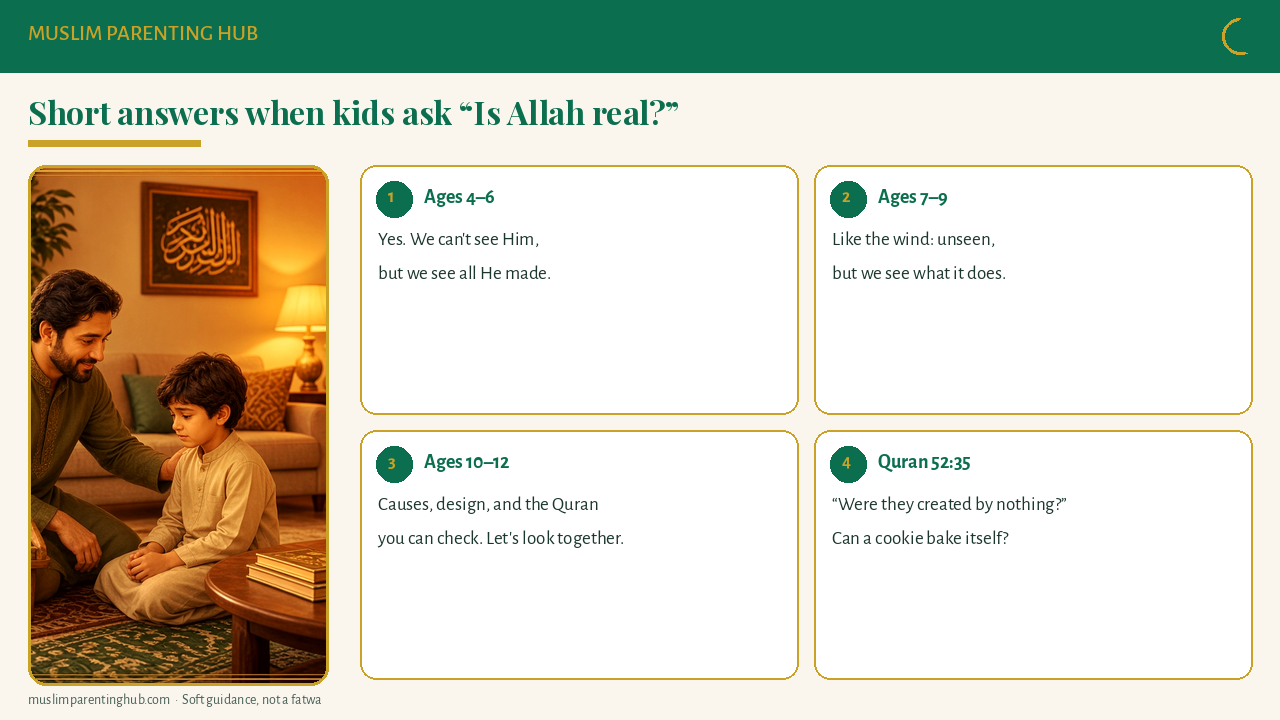
“Yes, Allah is real. We can’t see Him with our eyes, but we can see everything He made: the sun, the rain, your heartbeat. Things that are made always have a Maker.”
Ages 7–9
“Yes. We know Allah is real a bit like we know the wind is real. We can’t see the wind, but we see the trees move. We can’t see Allah, but we see His signs everywhere, and He sent us the Quran and prophets to tell us about Himself.”
Ages 10–12
“That’s a great question, and Muslims have thought about it for 1,400 years. Here are three reasons we believe: everything that begins needs a cause, the world is full of order and design, and the Quran and the Prophet ﷺ have a track record you can actually check. Want to look at one of those together this week?”
Then pause. Ask, “What made you wonder?” The real question is often hiding underneath.
The Quran Already Speaks to This Question
You don’t have to invent arguments. The Quran asks the question back to the reader:
“Were they created by nothing, or were they the creators of themselves?” (Quran 52:35)
For kids, turn it into a simple riddle: “Can a cookie bake itself? Can a LEGO tower build itself while you sleep?” Children laugh, and then you say, “Allah asks us the same thing about the whole world.”
The Quran also calls the things in nature ayat, the same word used for its verses. Signs. When your child counts stars, watches a seed sprout or feels their pulse, they are “reading” Allah’s signs. Our guide to Surah Al-Ikhlas for kids is a perfect next step, because it describes who Allah is in four short lines.
Three “Sign Spotting” Activities (10 Minutes Each)
1. The Wind Test
Go outside on a breezy day, or use a fan. Ask, “Can you see the wind?” (No.) “Is it real?” (Yes!) “How do you know?” (The leaves move, my hair moves.) Then: “That’s how we know lots of real things. We see what they do.”
2. The Design Hunt
Give your child a paper bag and five minutes in the backyard or a park. Collect three things that look “designed”: a pinecone spiral, a leaf with veins, a perfectly round pebble. Back home, ask, “Did anyone at a factory make this?” Fall is perfect for this, and it pairs well with our fall activities for Muslim kids.
3. The Thank-You Trail
At dinner, trace one food back: rice → farmer → rain → clouds → sun. “Who made the sun shine on the field?” Kids discover that every chain ends with Allah. Say “Alhamdulillah” together.
When the Question Comes From School
Many US kids first meet the question in a classroom, on the playground or in a library book. Your child needs two things: a short line to say, and permission not to win the argument.
If a friend says, “God isn’t real”:
“In my family we believe Allah is real and He made everything. It’s okay if we think differently.”
If a teacher or book presents a different view:
“Lots of people believe different things. At home, we’ll look at what we believe and why.”
Then actually do that at home. The kind, respectful tone in our guide for when Muslim kids answer classmates’ questions about Islam works well here too.
When It’s Really a Doubt, Not a Question
Older kids (9–12) sometimes ask with a worried face: “What if it’s not true?” Treat that as a doubt, and treat doubts gently.
- Normalize it. “Even the companions of the Prophet ﷺ had moments of worry. When they told him, he said that disliking those thoughts is a sign of faith” (Muslim).
- Separate the feeling from the facts. “Your brain is asking a big question. Let’s find answers together; you don’t have to figure it out alone.”
- Give them a dua. “Ya Muqallibal-qulub, thabbit qalbi ‘ala dinik” (O Turner of hearts, keep my heart firm on Your religion), which the Prophet ﷺ said often (Tirmidhi).
- Keep the door open. “You can ask me this any time. I will never be mad at you for asking.”
If the question is tangled up with fear, such as “Is Allah watching me to catch me?”, the scripts in Does Allah see me everywhere? help turn it into care, not surveillance. And if the next question is “Then who made Allah?”, use our calm who made Allah answer for kids.
What to Avoid
- “Don’t ask that.” Kids hear, “This belief can’t handle questions.” Then they ask the internet instead.
- Getting angry or hurt. Your child is not rejecting you. Stay curious.
- Overloading. A 6-year-old needs one picture (the wind), not a 20-minute lecture.
- Fear as the main reason. “Believe or you’ll be punished” may get compliance, but not love. Lead with Allah’s mercy and care.
- Pretending to know everything. “I don’t know that part. Let’s ask Imam on Friday” is a strong answer.
A 5-Day Mini Plan
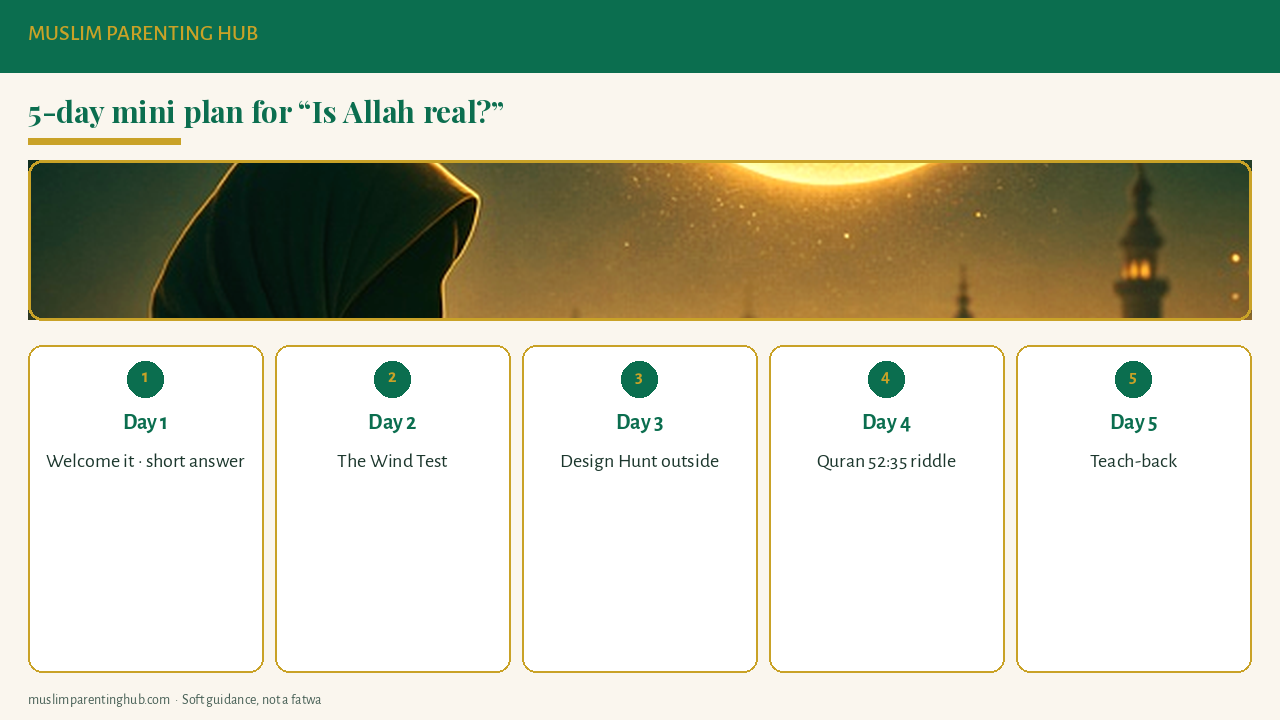
- Day 1 — Welcome it. “Great question.” Give the short answer for their age and ask what made them wonder.
- Day 2 — The Wind Test. Fan or backyard. Real things we can’t see.
- Day 3 — The Design Hunt. Collect three “designed” things from nature and talk about them.
- Day 4 — The Quran’s riddle. Read Quran 52:35 and play “Can a cookie bake itself?”
- Day 5 — Teach-back. Your child explains one reason to a sibling, grandparent or stuffed animal. Celebrate.
For toddlers who are not asking yet, start even smaller with the loving phrases in how to talk about Allah with toddlers.
FAQ
How do I answer “Is Allah real?” for a young child?
Say: “Yes, Allah is real. We can’t see Him, but we can see everything He made, like the sun, the rain and your heartbeat.” Keep it to one or two sentences and invite more questions later.
How do we know Allah is real if we can’t see Him?
We know many real things by their effects, like wind, gravity and love. Muslims see Allah’s signs in creation, in the order of the world, and in the Quran and the life of the Prophet ﷺ.
Is it a bad sign if my child doubts Allah exists?
No. Questions and passing doubts are normal, and the Prophet ﷺ reassured companions who felt them. Stay calm, answer simply, offer a dua for a firm heart, and keep the door open.
What should my child say if a classmate says God isn’t real?
A short, kind line works best: “In my family we believe Allah is real and He made everything. It’s okay if we think differently.” They don’t need to win a debate at recess.
Which Quran verse helps explain that Allah is real?
Quran 52:35 asks, “Were they created by nothing, or were they the creators of themselves?” For kids, turn it into a riddle: “Can a cookie bake itself?”
What if I don’t know the answer to my child’s follow-up question?
Say, “I don’t know that part yet. Let’s find out together.” Then ask an imam or teacher you trust. Honest “I don’t know” answers build more trust than guesses.
Related guides
- Where is Allah? Answers for kids’ questions
- Who made Allah? Calm answers for kids
- Does Allah see me everywhere?
- Names of Allah for kids
Closing
“Is Allah real?” is the question that turns inherited faith into a child’s own faith. You don’t need a perfect argument. You need a calm face, a short true answer, a walk outside to look at the signs, and a promise that no question is too big for your family. That promise may be the strongest answer of all.
Related articles
Who Made Allah? Calm Answers for Kids’ Biggest Question
Your child asked “Who made Allah?” Here are calm, age-fit answers, a simple maker-chain game, Surah Al-Ikhlas meanings, and scripts for school questions.
Read guide →
Where Is Allah? Gentle Answers Kids Ages 4–8 Can Understand
Where is Allah? Simple, love-based answers for ages 4–8—scripts for “Can He see me?” and “Who made Allah?”, what to avoid, and when you don’t know.
Read guide →
Does Allah See Me Everywhere? Gentle Answers for Curious Kids
When kids ask “Does Allah see me?”, answer with care—not fear. Soft scripts for bathroom, school, and bedtime, plus a 5-day habit US Muslim families can start tonight.
Read guide →
How to Talk About Allah With Toddlers: Simple Words and a 7-Day Plan
What to say when your toddler asks “Who made the moon?” Loving phrases about Allah for ages 0–3, bedtime lines and a 7-day plan—no fear, no lectures.
Read guide →