
Parent-Teacher Conferences for Muslim Parents: What to Ask About Prayer, Lunch, Holidays and Belonging
The sign-up link arrives in your inbox: fifteen-minute slots, Thursday afternoon or Monday evening. Fall parent-teacher conferences are here.
For most families, the conference is about reading levels, math facts, and whether your child talks too much during group work. For Muslim families in US public schools, it is also a rare, calm, face-to-face window to talk about the things that quietly shape your child’s school year: where they can pray, what happens at the class party, whether the lunch line has something they can eat, and whether they feel like they belong.
This guide helps you walk in prepared, warm, and brief. You will find what to bring, the questions worth asking, scripts that sound friendly rather than demanding, what to do if the answer is “I’m not sure,” and a short follow-up email you can copy. It is soft guidance for real families—not legal advice and not a fatwa.
Why the Fall Conference Matters So Much
Teachers meet your child for six hours a day, but most of them meet your family’s faith only through small moments: a missed party, a question about pepperoni, a long sleeve in gym class. Without context, those moments can be misread as shyness, picky eating, or “not joining in.”
The October or November conference is the best time to give that context because:
- It’s early enough. Halloween, Thanksgiving crafts, winter parties, and (in some years) Ramadan are still ahead.
- It’s relational, not reactive. You are not responding to a problem. You are building a partnership.
- Teachers are listening. The whole point of the meeting is your child. Most teachers genuinely want to know what helps.
Think of it like the start of a sports season: you talk to the coach once, kindly, before conflicts come up. Many parents already do this with coaches when Maghrib falls during fall practice; the same friendly, early conversation works with teachers.
Before the Conference: A 10-Minute Prep
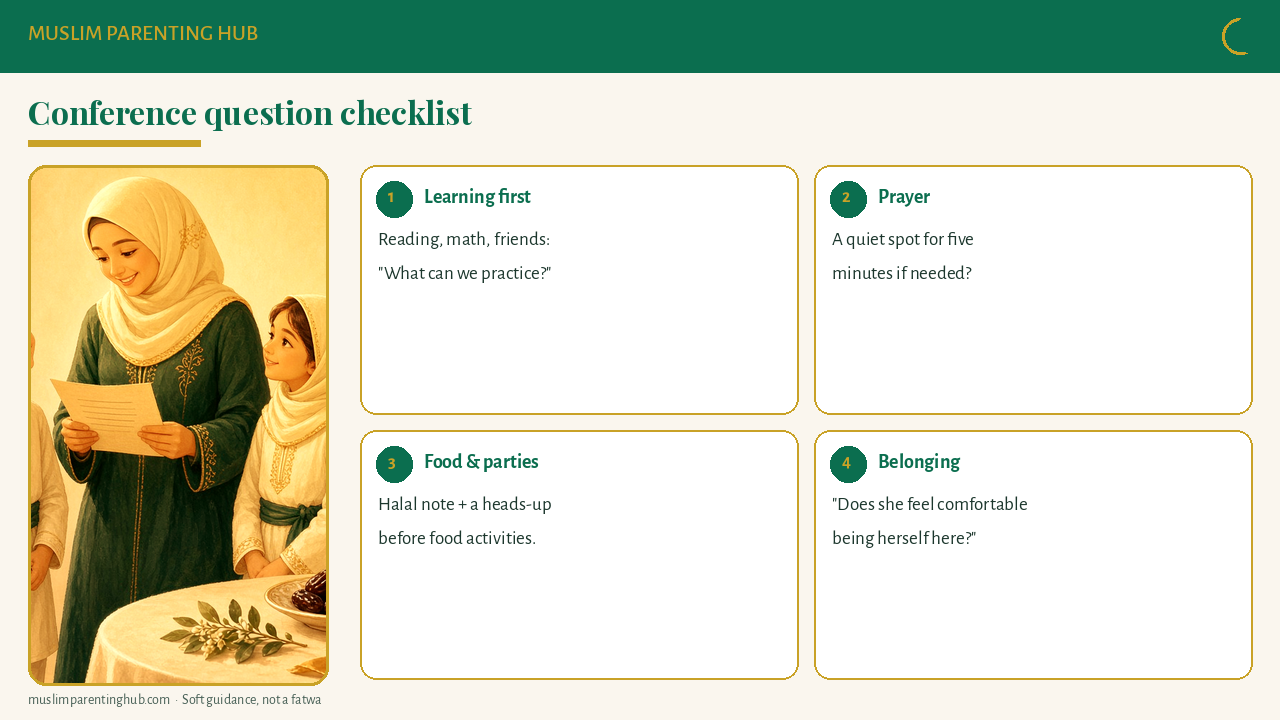
You don’t need a binder. You need three things.
1. Ask your child two questions
At dinner or in the car, try:
“What’s one thing you love about your class? And is there anything at school that feels confusing or uncomfortable because we’re Muslim?”
Listen without fixing. Kids often mention things you didn’t know—like a classmate’s joke about their lunch, or that they hold their bathroom need all day because they’re unsure about the restrooms. (If that last one comes up, our kid-friendly guide to Islamic bathroom manners at school helps you prepare them gently.)
2. Pick your top three topics
A fifteen-minute slot is mostly about academics. Choose no more than three faith-related items. The rest can go in a follow-up email.
3. Write a one-line “about our family” note
Something like:
“We’re a Muslim family. Our son prays a few times a day, eats halal (no pork or gelatin), and celebrates Eid al-Fitr and Eid al-Adha. We’re happy to answer any questions.”
Hand it over or read it. It sets a warm tone in ten seconds.
The Questions Worth Asking
You won’t ask all of these. Choose what fits your child’s age and your school.
Learning and the whole child (always first)
Start where the teacher starts. Ask about reading, math, friendships, and focus before anything else. This shows you are partners in your child’s whole education—not only their religious needs.
- “How is she doing socially? Who does she sit with at lunch?”
- “Is there anything you’d like us to practice at home?”
Prayer during the school day
For younger kids, Dhuhr usually falls during lunch or early afternoon, and in fall and winter Asr can fall before dismissal. Families handle this differently; many younger children simply pray when they get home, while some older kids pray a quick Dhuhr at school.
- “Is there a quiet place—an empty classroom, the library corner, the counselor’s office—where my child could pray for about five minutes if needed?”
- “Would it be okay for him to step out during lunch or recess for that?”
If your child is still learning the steps, our step-by-step salah and wudu guide for kids helps them pray calmly and quickly anywhere.
Lunch, snacks, and class treats
- “We eat halal, so no pork, pepperoni, or gelatin. How are class treats and birthday snacks usually handled?”
- “Could you let us know before food-based activities so we can send an alternative?”
Many teachers already manage allergies, so a “food note” feels familiar to them.
Parties, holidays, and celebrations
This is often the most sensitive area. Keep it short and kind:
- “What celebrations do you usually do in class this year?”
- “On days that don’t fit our family’s practice, could my child have an alternate role—helping set up, reading, or a library task—so she isn’t just sitting alone?”
For October specifically, our gentle Halloween plan for US public schools includes options and a teacher email you can adapt.
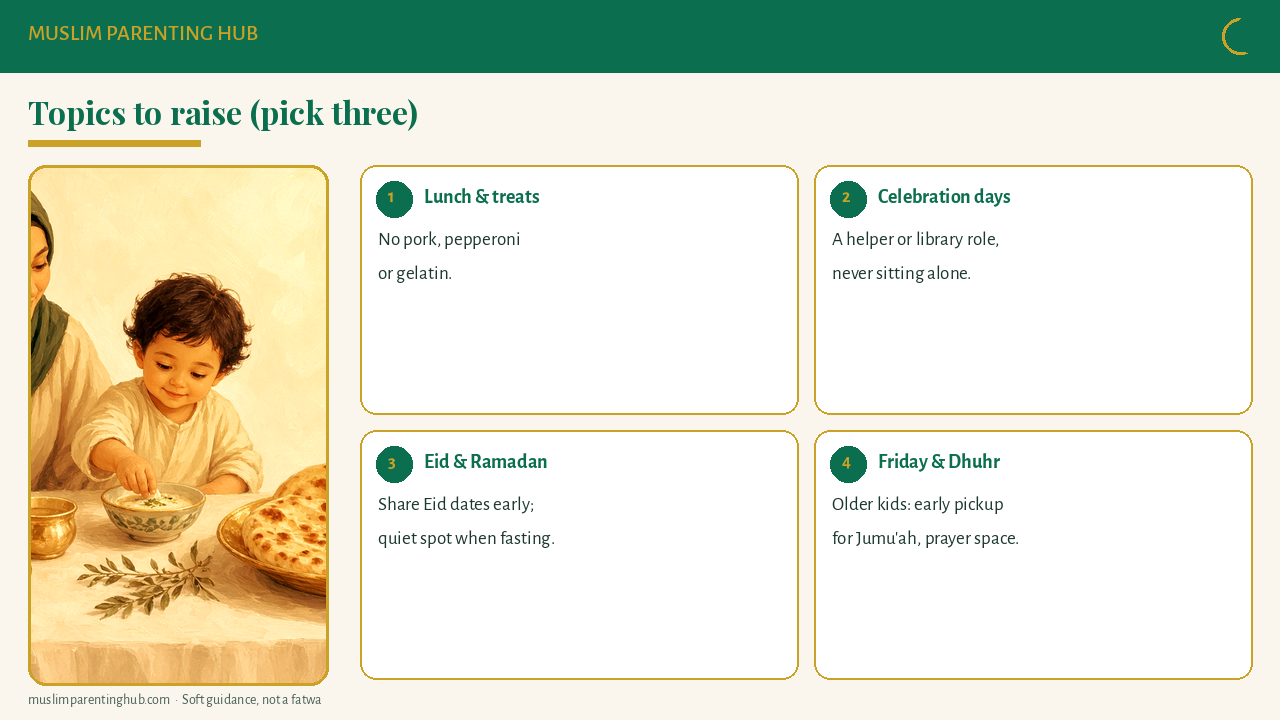
Eid, Ramadan, and Friday prayer
- “We celebrate two Eids. Could you note the dates? We usually keep our kids home on Eid day.”
- “If Ramadan falls during the school year, my older child may fast. Is there a quieter place than the cafeteria at lunch?”
- For older kids or teens: “On some Fridays we may pick him up early for Jumu’ah. What’s the best way to arrange that?”
Many districts now recognize Eid on their calendars; others mark it as an excused religious absence. Ask the front office how your district handles it.
Belonging and kindness
This is the question parents most often forget—and the one that matters most:
- “Does she seem comfortable being herself here? Have you noticed any teasing or questions about her faith?”
- “How do you usually handle it when kids ask each other about religion or culture?”
If the teacher mentions classmates’ questions, our guide to kind answers when classmates ask about Islam gives your child short, friendly lines to practice at home.
Scripts That Sound Warm, Not Demanding
Tone is everything. You are opening a door, not filing a complaint.
Opening:
“Thank you for everything you’re doing for Yusuf. Before we start—he really loves your read-aloud time.”
Raising faith needs:
“There are a couple of small things that would help him feel comfortable as a Muslim student. Is now a good time, or should I email you?”
When something already went wrong:
“Last month at the class party, Amina came home sad because she sat alone. I know it wasn’t intentional. Could we think together about what she could do next time?”
Offering help:
“If it’s ever useful, I’d be happy to bring dates and a picture book around Eid to share with the class.”
Closing:
“We really appreciate you. Please reach out anytime—my email is on the note.”
Notice what’s missing: no lectures, no legal language, no “you have to.” Most teachers respond best when they feel trusted.
What If the Answer Is “I’m Not Sure”?
Sometimes the teacher genuinely doesn’t know whether a prayer space exists or how the district handles Eid absences. That’s fine.
- Say thank you and ask who would know. “Would the principal or counselor be the right person?”
- Follow up in writing within two days. A short email keeps things friendly and creates a gentle record.
- Escalate slowly. Teacher → counselor → principal. Most issues resolve at step one or two.
- Keep your child out of the middle. They shouldn’t carry adult negotiations in their backpack.
If something feels unfair or keeps happening—exclusion, repeated teasing, or a teacher dismissing your child’s faith—document it calmly with dates and ask for a meeting with the principal. Stay courteous; adab is part of how we advocate.
Age-by-Age: What to Focus On
Pre-K to 1st grade
Focus on food, parties, and bathroom routines. Little ones aren’t required to pray yet, so prayer space rarely matters. Mention Eid so the teacher can celebrate with your child when they return.
2nd to 4th grade
Add belonging and classmates’ questions. This is the age kids notice differences most and start asking, “Why can’t I?” A teacher who knows the basics can quietly support them.
5th grade and up
Add prayer at school, Ramadan fasting, and Friday prayer. Let your child join part of the conference if your school allows student-led conferences. It builds confidence to speak for themselves.
Bring Your Child Into It (Gently)
After the conference, share one good thing the teacher said—specifically. “Ms. Lopez said you’re the kindest reader in your group.” Children who feel seen at school feel safer being openly Muslim there.
Then tell them what you discussed in kid language:
“I told Ms. Lopez that we pray and eat halal, and that we celebrate Eid. She said you can always tell her if something feels uncomfortable.”
This tells your child: my parents and my teacher are on the same team.
If your child has been feeling excluded from class celebrations or birthday events, our scripts for when your Muslim child is left out of birthday parties help you protect their heart at home while the school side gets sorted out.
The Follow-Up Email (Copy and Adapt)
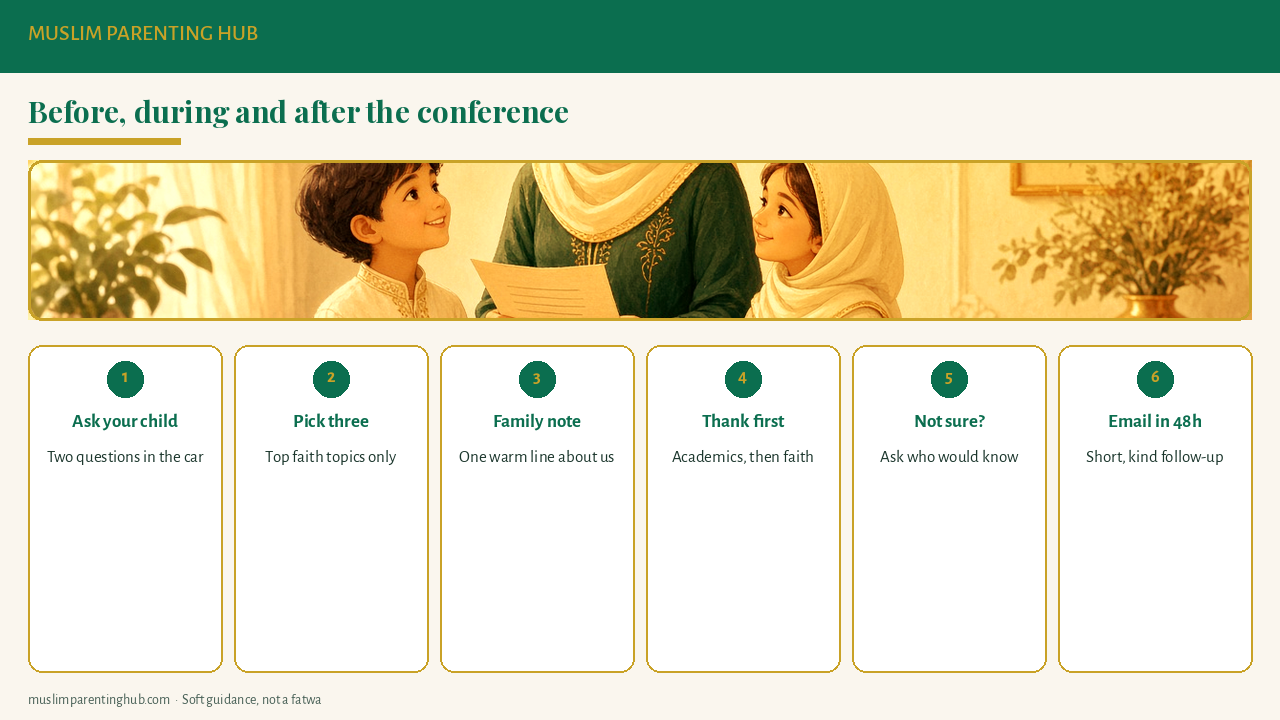
Send within 48 hours. Keep it under 150 words.
Subject: Thank you — and a few notes about Yusuf
Dear Ms. Lopez,
Thank you for meeting with us on Thursday. We loved hearing how much Yusuf enjoys your read-aloud.
As we mentioned, a few things help him feel comfortable as a Muslim student: - He eats halal (no pork, pepperoni, or gelatin). A heads-up before food activities would be wonderful. - On celebration days that don’t fit our practice, a helper role or library task works well. - We’ll keep him home on Eid (dates: ___).
Please reach out anytime with questions. We’re grateful for you!
Warmly,
Islamic Adab for Parent Advocacy
Advocating for your child is good parenting. Doing it with adab is good Islam.
- Begin with thanks. The Prophet ﷺ taught that whoever does not thank people has not thanked Allah (Abu Dawud, Tirmidhi).
- Assume good intentions. Most “mistakes” at school come from not knowing, not malice.
- Speak gently. “Allah is gentle and loves gentleness in all matters” (Bukhari, Muslim). A soft tone usually wins more than a hard one.
- Be consistent. Show up, say thank you, follow up. Teachers remember the parents who were kind.
Your child is watching how you talk about their teacher at dinner. When they hear respect, they learn that being Muslim and being a good neighbor at school go together.
FAQ
What should Muslim parents ask at a parent-teacher conference?
Start with academics and friendships, then pick up to three faith items: food and class treats, celebration days and alternate roles, Eid absences, and, for older kids, a quiet place to pray. End by asking whether your child seems comfortable being themselves at school.
Is it okay to ask a public school for a place to pray?
Yes, you can ask politely. Many schools can offer an empty classroom, library corner, or counselor’s office for a few minutes. If the teacher isn’t sure, ask who would know and follow up in writing.
How do I explain halal food to my child’s teacher?
Keep it simple: “We eat halal—no pork, pepperoni, or gelatin.” Ask for a heads-up before food activities so you can send an alternative. Teachers already handle allergies, so this usually feels familiar.
Should I keep my child home on Eid?
Many Muslim families do, and many US districts now list Eid or treat it as an excused religious absence. Tell the teacher the dates early and check your district’s attendance policy with the front office.
What if my child is being teased about being Muslim?
Tell the teacher calmly with specific examples, ask how they handle it, and follow up by email. If it continues, request a meeting with the counselor or principal. At home, validate your child’s feelings and practice short, confident answers.
Should my child come to the conference?
For younger kids, usually not. From about 5th grade, a few minutes of a student-led conference can build confidence. Prepare them first so they know what will be discussed.
Related guides
- Kind answers when classmates ask about Islam
- Halloween at a US public school: a gentle plan
- When your Muslim child is left out of birthday parties
- Islamic bathroom manners at school
Closing: Fifteen Minutes That Shape a Year
A parent-teacher conference is short. But fifteen kind, prepared minutes in October can mean your child doesn’t sit alone at the class party in December, doesn’t skip lunch because they’re unsure what’s in it, and knows there’s an adult at school who understands them. Write your one-line note tonight, ask your child their two questions, and walk in with a smile and a thank-you. You’re not just advocating—you’re showing your child what a confident, kind Muslim looks like.
Related articles
"Why Don't You Eat Pepperoni?" Kind Answers Muslim Kids Can Give When Classmates Ask About Islam
Hijab, halal lunch, prayer, Ramadan, holidays: short, kind answers Muslim kids can give when US classmates ask "Why do you…?"—plus a role-play plan for home.
Read guide →
Halloween at a US Public School: A Gentle Plan for Muslim Families
A calm US public-school Halloween plan for Muslim families—parades, costumes, candy, teacher email scripts, and options that don't shame friends.
Read guide →
When Your Muslim Child Is Left Out of Birthday Parties: Scripts That Protect Their Heart
Soft scripts when Muslim kids are left out of birthday parties—validate feelings, protect identity without shaming others, and build warm family alternatives.
Read guide →
Islamic Bathroom Manners at School: A Kid-Friendly Guide to Public Restrooms
Help your child keep Islamic toilet manners at school and in public restrooms: duas, privacy, istinja without a lota, and calm scripts for teachers.
Read guide →