Where Is Allah? 6 Hands-On Activities to Help Kids Understand (Ages 4–8)
You gave the short answer. You said, gently, “Allah is above everything He made, and He is always with us by His knowledge and care.” Your five-year-old nodded… and asked again the next night. And the next.
That is completely normal. Young children understand big ideas with their hands and bodies first, and with words second. A child who does something with the answer, like stacking paper skies, whispering a secret dua, or raising their hands to make dua, remembers it far longer than one who only hears it.
This guide gives US Muslim parents six short, hands-on activities (about 10 minutes each) to turn the answer to “Where is Allah?” into something kids can feel and keep. Each one is tied to a Quran verse or hadith, keeps the focus on Allah’s love and closeness, and avoids anything that could make a child imagine or draw Allah. It is gentle home guidance, not a fatwa. If your child’s teacher or imam uses specific wording, follow that trusted wording.
If you need the short scripts first, start with our main guide: where is Allah answers for kids. Then come back here for the activities.
The Two Ideas Every Activity Teaches
Keep every activity anchored to two simple truths that Muslims have taught children for centuries:
- Allah is above everything He created. The Quran says, “The Most Merciful rose over the Throne” (Quran 20:5), in a way that fits His greatness. He is not inside the house, the car, or the sky like we are inside a room.
- Allah is with us by His knowledge, hearing, seeing and care. “He is with you wherever you are” (Quran 57:4). He hears the softest whisper and knows every leaf.
For kids, that becomes one sentence you can repeat at every activity:
“Allah is above everything, and He is never far from us.”
Say it the same way every time. Repetition is how small children build a safe, steady picture.
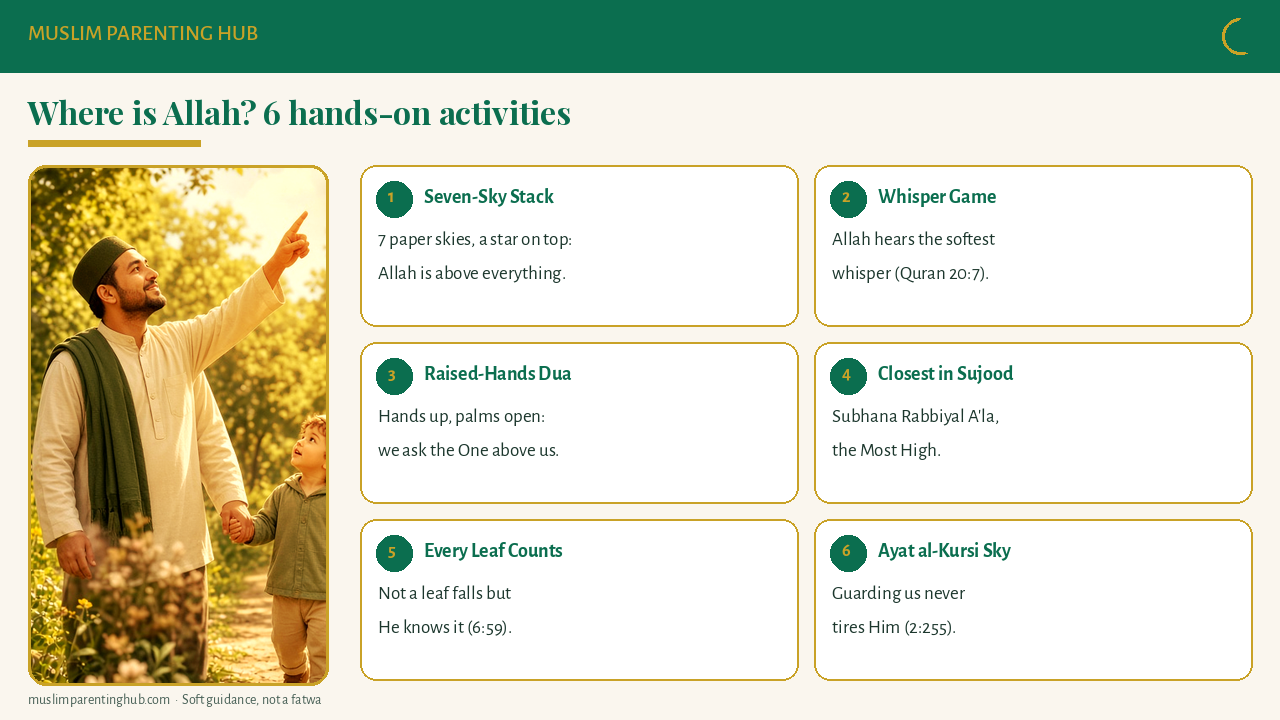
Activity 1: The Seven-Sky Stack (Ages 4–8)
You need: seven sheets of blue or colored paper, glue or tape, a sticker star.
- Lay the sheets in a stack. Tell your child, “Allah tells us He made seven heavens, one above the other” (Quran 67:3).
- Let them decorate the bottom sheet with clouds, birds and an airplane. “This is the sky we can see.”
- Stick a star on the top sheet. “Allah’s Throne is above all of this, and Allah is above His Throne. It is bigger and greater than anything we can picture.”
- Close with the sentence: “Allah is above everything, and He is never far from us.”
Important boundary: we never draw Allah or put a face, light, or shape at the top for Him. If your child wants to, gently redirect: “We don’t draw Allah, because nothing is like Him. Let’s write Allahu Akbar at the top instead.”
Activity 2: The Whisper Game (Ages 4–7)
This one answers the follow-up worry: “If Allah is above the sky, can He hear me down here?”
- Stand across the room and whisper something. Can your child hear it? Not really.
- Now whisper right in their ear. “I had to come close for you to hear.”
- Then say: “Allah doesn’t need to come close to hear. He hears the quietest whisper, even the words you only say in your heart.” The Quran says Allah “knows the secret and what is even more hidden” (Quran 20:7).
- Let your child whisper a tiny dua with their eyes closed. “Allah heard that. Every word.”
Kids often light up at this one. It quietly replaces the idea of a far-away Allah with a near, listening Allah.
Activity 3: The Raised-Hands Dua (Ages 4–8)
Ask: “When we make dua, where do our hands go?” Let them show you: up, palms open.
Then explain: “We raise our hands because Allah is above us, and He loves when we ask Him.” The Prophet ﷺ said that Allah is shy to send back empty the hands His servant raises to Him (Abu Dawud, Tirmidhi).
Make it a family routine for one week. After Maghrib or at bedtime, everyone raises their hands for one short dua in their own words. For a gentle way to grow this habit, see our guide to teaching kids dua from the heart.
Activity 4: Closest in Sujood (Ages 5–8)
This activity links the question to salah.
- Ask your child to stand tall and stretch. “Is this the closest we can be to Allah?”
- Then show them sujood, forehead on the prayer rug. “The Prophet ﷺ taught us that the closest we are to Allah is when we are in sujood” (Muslim).
- Let them try one sujood and whisper “Subhana Rabbiyal A’la” (Glory be to my Lord, the Most High).
Notice the meaning: the Most High. Even the words of sujood answer “Where is Allah?” Your child is low on the ground, praising the One who is above everything, and in that moment they are closest to Him. If your child is just starting salah, our learn salah for kids 30-day plan builds this step by step.
Activity 5: Every Leaf Counts (Ages 4–8, Perfect for Fall)
Go outside with a paper bag. Collect leaves for five minutes.
Back inside, count them together. Then ask: “How many leaves fell in our whole street today? In the whole country?” Nobody knows.
Then share the verse: “Not a leaf falls but He knows it” (Quran 6:59). Allah is above everything, and He still knows every single leaf. And every single child.
This pairs beautifully with the leaf walks and shukr tree in our fall activities for Muslim kids.
Activity 6: The Ayat al-Kursi Bedtime Sky (Ages 6–8)
At bedtime, turn off the lights and look out the window (or use a star nightlight). Read one line from Ayat al-Kursi in English:
“His Kursi extends over the heavens and the earth, and guarding them does not tire Him. He is the Most High, the Most Great.” (Quran 2:255)
Ask: “What does ‘does not tire Him’ mean?” (He never gets sleepy. He never stops looking after us.) Then recite Ayat al-Kursi together, or listen to it. Our Ayatul Kursi for kids guide breaks it into easy lines.
Children who are anxious at night often find this one the most comforting: Allah is above everything, never tired, and guarding them all night.
A Simple One-Week Rhythm
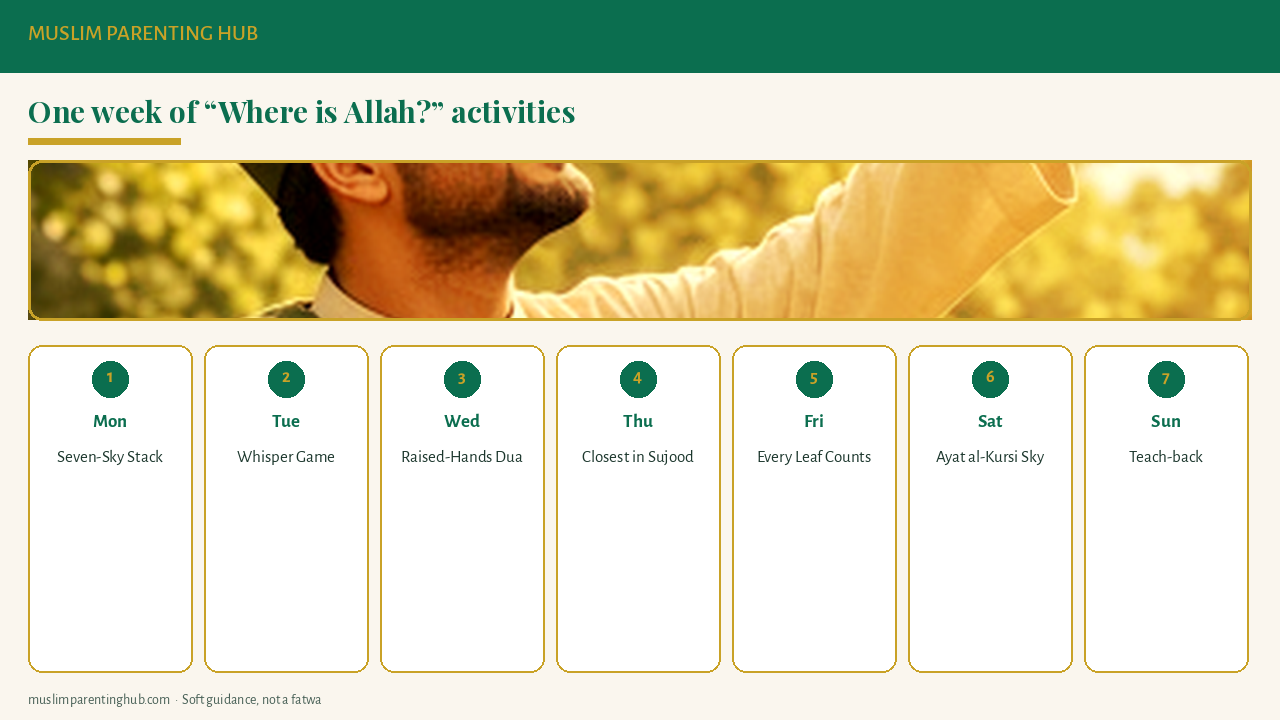
You don’t need to do all six in one weekend. Try one a day:
- Monday: Seven-Sky Stack
- Tuesday: Whisper Game
- Wednesday: Raised-Hands Dua (and keep it all week)
- Thursday: Closest in Sujood
- Friday: Every Leaf Counts
- Saturday: Ayat al-Kursi Bedtime Sky
- Sunday: Teach-back. Your child explains “Where is Allah?” to a sibling, grandparent or stuffed animal using the sentence.
What to Avoid
- “Allah is everywhere, inside everything.” Many parents grew up hearing this, but it can make kids picture Allah inside the trash can or the bathroom. Say instead: “Allah is above everything, and His knowledge is everywhere.”
- “Allah lives in the sky like a house.” Allah does not live in anything He made. He is above it all.
- Fear first. “Allah is watching to catch you” turns closeness into surveillance. Our guide Does Allah see me everywhere? has kinder scripts.
- Drawing or describing a shape. Keep art about creation: sky, stars, leaves and the words Allahu Akbar.
- Overloading. One activity, one sentence, one smile. Stop while it’s still fun.
FAQ
What is a simple answer to “Where is Allah?” for kids?
Say: “Allah is above everything He made, and He is never far from us. He hears us and knows us all the time.” Repeat the same sentence often, and let activities do the rest.
Is it correct to tell kids “Allah is everywhere”?
Many scholars advise saying “Allah is above everything, and His knowledge is everywhere” instead, so children don’t imagine Allah inside places or objects. Quran 20:5 and 57:4 together give the balanced picture.
What activities help kids understand where Allah is?
Short, hands-on ones work best: stacking seven paper skies, a whisper game about Allah hearing everything, raising hands in dua, trying one sujood, counting fall leaves (Quran 6:59), and reading a line of Ayat al-Kursi at bedtime.
Can kids draw Allah in these activities?
No. Gently explain that nothing is like Allah, so we don’t draw Him. Offer to draw the sky, stars or leaves and write “Allahu Akbar” or “Alhamdulillah” instead.
Why do Muslims raise their hands when making dua?
Raising hands shows humility and that we are asking the One above us. The Prophet ﷺ said Allah is too generous to return empty the hands raised to Him (Abu Dawud, Tirmidhi).
What age are these activities for?
Most work for ages 4–8. Toddlers can join the whisper game and raised-hands dua; older kids enjoy the sujood and Ayat al-Kursi activities because they connect the answer to salah and the Quran.
Related guides
- Where is Allah? Answers for kids’ questions
- Is Allah real? Honest answers for kids
- Who made Allah? Calm answers for kids
- How to talk about Allah with toddlers
Closing
“Where is Allah?” is a question kids ask with their whole body. So answer it with their whole body too: hands raised in dua, a forehead on the rug, a bag full of leaves, a stack of paper skies. One steady sentence and a few happy afternoons can give your child a picture of Allah that is true, big and close, all at once.
Quick steps
One-week plan of hands-on activities to teach kids where Allah is. Do one short activity a day, each tied to a Quran verse or hadith, and repeat one steady sentence: Allah is above everything, and He is never far from us.
- Monday — Seven-Sky Stack — Stack seven paper skies, decorate the bottom one and put a star on top while explaining that Allah is above everything He made.
- Tuesday — Whisper Game — Whisper from across the room, then explain that Allah hears even the quietest whisper and the words in our hearts.
- Wednesday — Raised-Hands Dua — Raise hands for one short dua in your own words, and keep it as a daily habit all week.
- Thursday — Closest in Sujood — Try one sujood together and say Subhana Rabbiyal A’la, the Most High.
- Friday — Every Leaf Counts — Collect and count fall leaves, then share Quran 6:59: not a leaf falls but He knows it.
- Saturday — Ayat al-Kursi Bedtime Sky — Read one line of Ayat al-Kursi in English by the window, then recite or listen to it together.
- Sunday — Teach-back — Your child explains where Allah is to a sibling, grandparent or stuffed animal using the family sentence.
Related articles
Where Is Allah? Gentle Answers Kids Ages 4–8 Can Understand
Where is Allah? Simple, love-based answers for ages 4–8—scripts for “Can He see me?” and “Who made Allah?”, what to avoid, and when you don’t know.
Read guide →
Does Allah See Me Everywhere? Gentle Answers for Curious Kids
When kids ask “Does Allah see me?”, answer with care—not fear. Soft scripts for bathroom, school, and bedtime, plus a 5-day habit US Muslim families can start tonight.
Read guide →
Is Allah Real? How to Answer Your Child’s Honest Question (Ages 4–12)
Your child asked, “Is Allah real? How do we know?” Calm, age-fit answers, signs-in-nature activities, Quran lines, and scripts for school doubts.
Read guide →
Ayatul Kursi for Kids: Meaning, Easy Transliteration and a Line-by-Line Way to Learn It
Teach your child Ayatul Kursi with simple kid meanings, easy transliteration in 9 short lines, a bedtime habit and a line-by-line plan for ages 3–10.
Read guide →