

A 5-Minute Morning Protection Dua Routine Muslim Kids Can Grow Into
Eyes open. Room still dim. Someone wants milk; someone wants cartoons; someone wants to argue about socks.
Before the day pulls everyone apart, you can plant five calm minutes of morning protection dua—wake-up words, short phrases of trust in Allah, and a soft family ameen. This is about adhkar and dua, not screen rules. For screen timing, see our deen-before-screen morning sunnah routine. For night fears, see scary dreams comfort scripts. Here we focus on morning protection and presence.
Soft guidance for home practice. Use the exact Arabic and translations your family and teachers prefer.
Why a Morning Protection Pocket Matters
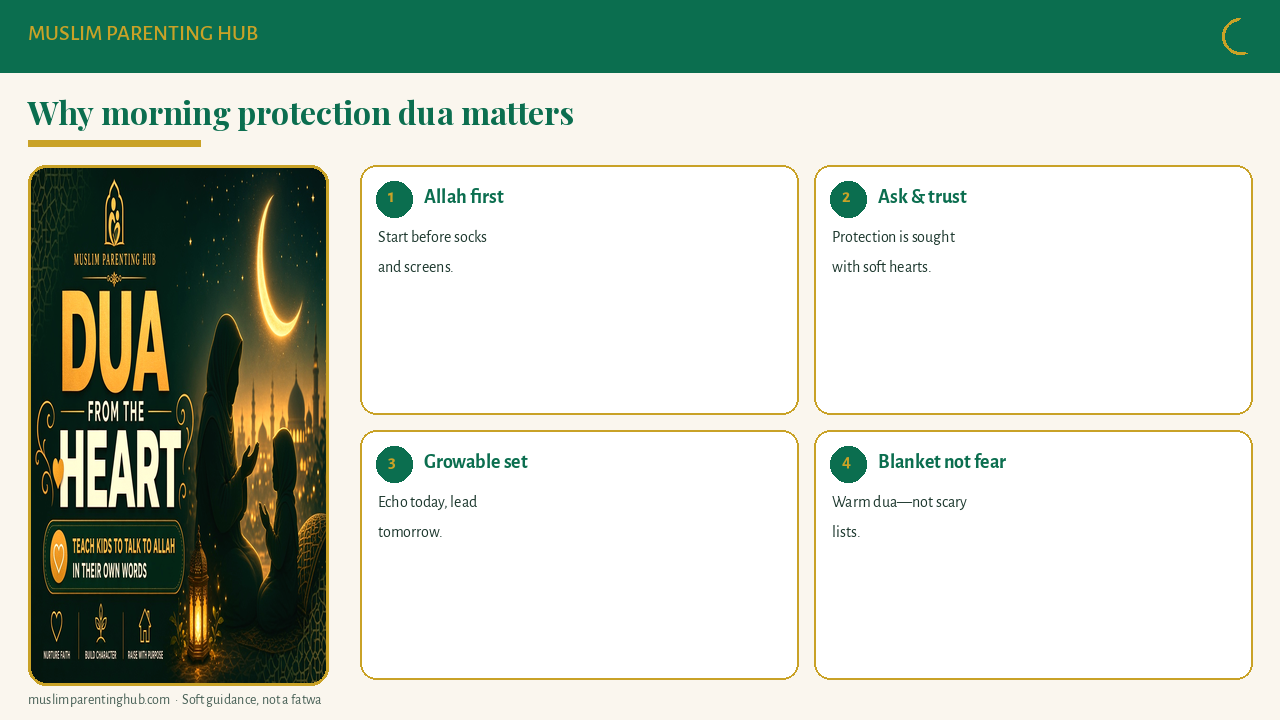
Kids wake into a world of noise. A tiny dua pocket teaches:
- We start with Allah, not with urgency
- Protection is asked for, not only assumed
- Bodies can be snuggly while hearts remember
This grows beside dua from the heart—kids learn that dua is conversation, not only memorization drills.
The 5-Minute Morning Frame
| Minute | What happens |
|---|---|
| 0–1 | Wake gently + Alhamdulillah we’re awake |
| 1–3 | Short wake-up / protection phrases (age band) |
| 3–4 | One personal dua line from parent or child |
| 4–5 | Ameen + stretch / bathroom / breakfast path |
Timer optional. Warmth required.
Script to start:
“Good morning, habibi. Before socks and snacks—Allah first for a minute.”
Wake-Up Words Kids Can Grow Into
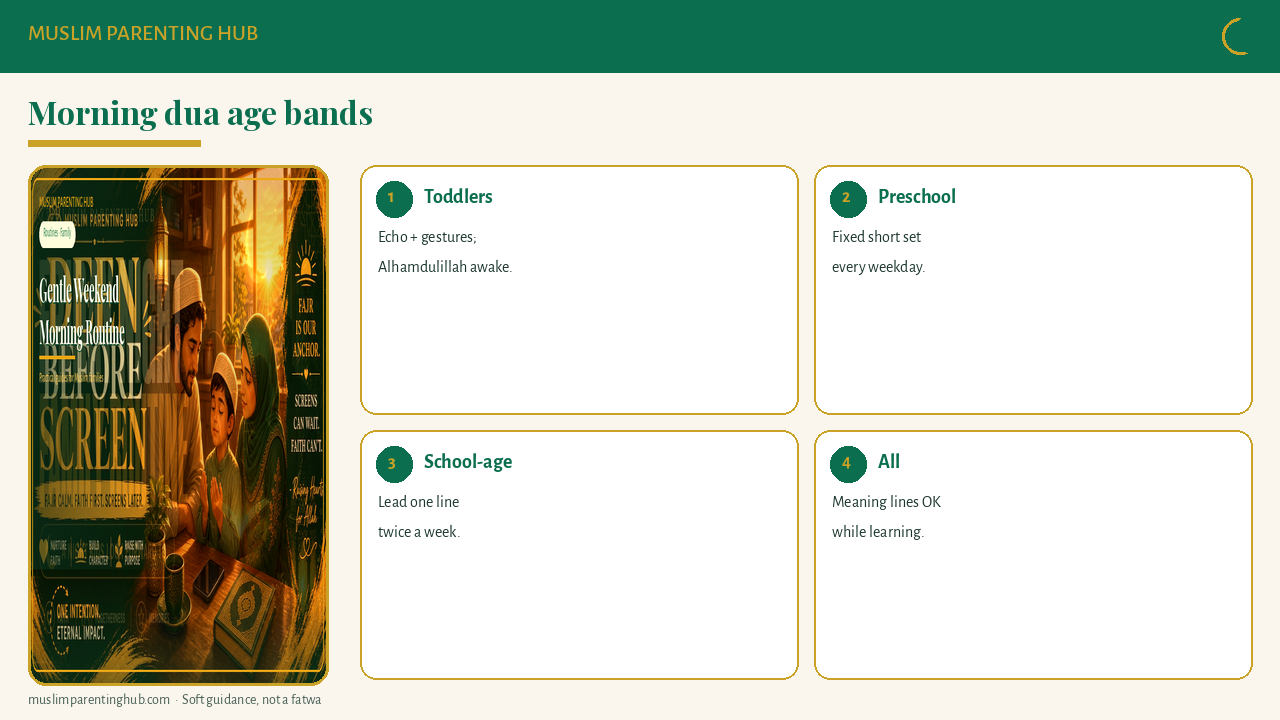
Level A — Toddlers (echo + gesture)
Parent says; child echoes last word or does the motion.
- “Alhamdulillah—we’re awake.” (stretch arms)
- “Bismillah—for our day.” (hands on heart)
- “Allah, keep us safe.” (hug)
Level B — Preschool (short set)
Use a tiny fixed set every weekday so muscle memory forms:
- Praise for waking
- Bismillah for the day
- One protection line your family uses (Arabic or meaning)
- Ameen together
Level C — School-age (lead sometimes)
Child leads one line twice a week. Parent fills gaps without grading pronunciation in the first month.
Connect to travel habits later with car travel dua routines so “we ask Allah before we move” feels consistent.
Sample Meaning Lines (Customize to Your Household)
Keep meaning lines if Arabic is still new:
- “All praise is for Allah who gave us life after sleep.”
- “In Allah’s name we start our morning.”
- “Ya Allah, protect our bodies, our home, and our hearts today.”
- “Ya Allah, help us be kind and brave.”
- “We trust You with this day. Ameen.”
When you add authentic morning adhkar, introduce one new phrase per week—not five at once.
Quick Steps (HowTo Sequence)
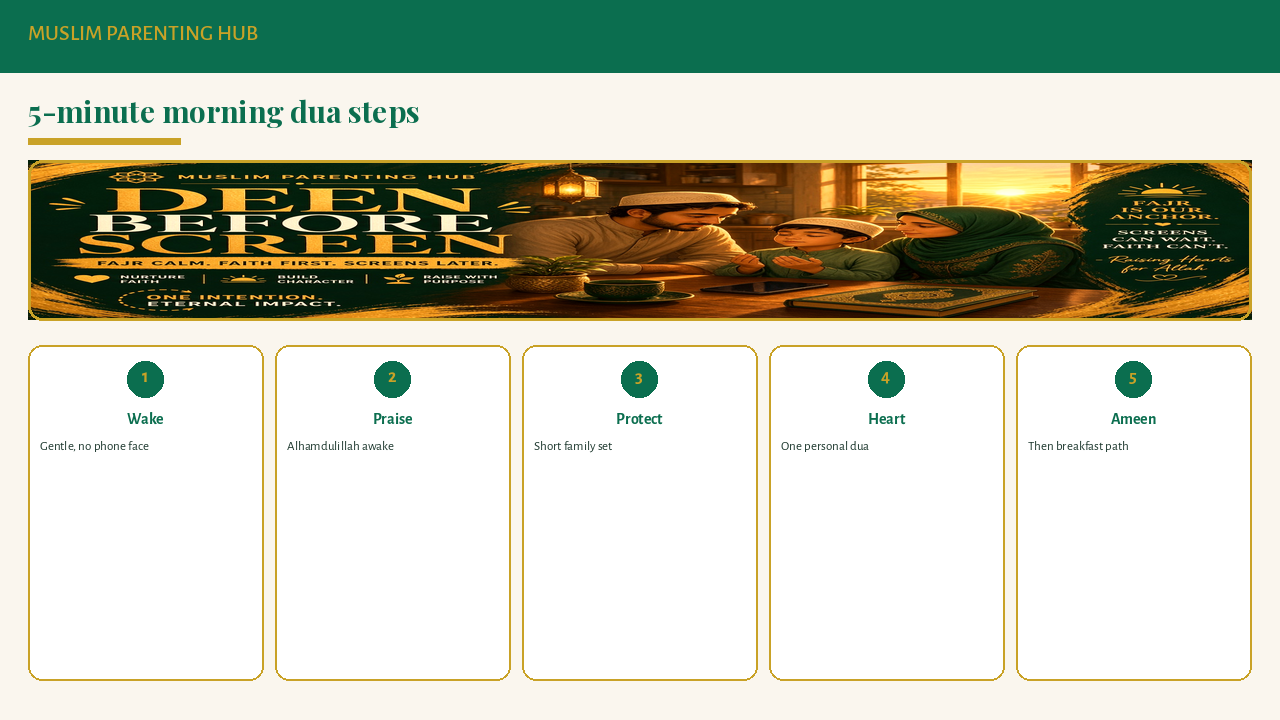
- Wake gently without a phone in the child’s face
- Sit or snuggle; lower voices
- Say wake-up praise (Alhamdulillah we’re awake)
- Recite your short morning/protection set
- Invite one heart dua (school test, sick grandma, kindness)
- Ameen + move to bathroom/breakfast
A 7-Morning Starter Week
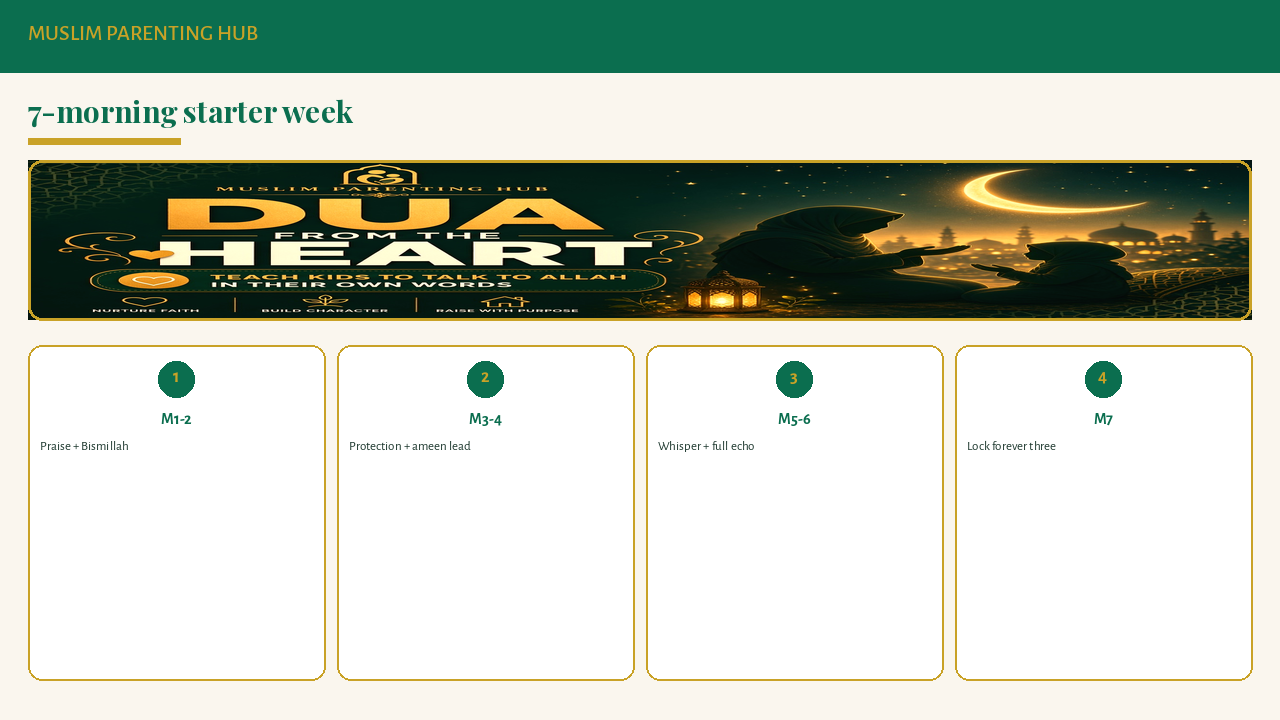
Morning 1 — Only Alhamdulillah + hug
No pressure to memorize.
Morning 2 — Add Bismillah for the day
Morning 3 — Add one protection meaning line
Morning 4 — Child chooses who says ameen first
Morning 5 — Whisper version (for early risers / babies sleeping)
Morning 6 — Child echoes a full short line
Morning 7 — Lock your “forever three” lines for weekdays
Weekend mornings can be longer and softer—see weekend morning routine for Muslim families.
Scripts for Real Parent Chaos
When they cry for milk first
“Milk is coming. Ten soft seconds for Allah—then milk. I’m not ignoring your tummy.”
When a sibling mocks the dua
“We don’t laugh at dua. You can listen quietly or step out softly.”
When you overslept
“Short version today—Allah hears short and sincere.” Do thirty seconds, not zero.
When Arabic feels intimidating
“Meaning words are real dua too while we learn. Allah understands our hearts.”
When they ask “Will dua stop every bad thing?”
Honest, age-wise:
“We ask Allah because we trust Him. He always hears. He chooses what is best—even when days are hard. We still ask.”
Protection Without Fear-Based Parenting
Morning protection dua should feel like a blanket, not a horror briefing.
Avoid:
- Listing every danger of the day
- Scary jinn talk at breakfast
- “If you skip dua, something bad will happen”
Prefer:
- Safety as Allah’s care
- Courage + kindness intentions
- Calm body language
Nighttime scary dreams get their own toolkit; mornings stay bright.
Pairing With Fajr (Without Forcing Toddlers)
If adults pray Fajr:
- Kids can hear soft Quran in another room
- Older kids may sit on a prayer mat edge for one minute
- Toddlers can do the 5-minute pocket after sunrise wakeups
Do not shame a child who is not ready for full salah. The dua pocket can stand alone.
Making It Stick for 30 Days
- Same spot (bed edge / prayer mat corner)
- Same opener line
- Same three core phrases on weekdays
- Friday upgrade: one extra gratitude line
- Chart with stickers optional—never punish missed days
Missed three days? Restart without a speech. Mercy teaches more than guilt.
Room Setup That Makes Dua Easier
You do not need a studio. Try:
- Prayer mat corner visible from bed
- Soft lamp (not phone flashlight in eyes)
- Water bottle ready so “I’m thirsty” doesn’t derail the pocket
- Tissues / socks nearby so the body feels cared for
If two siblings wake hostile, separate pockets: one child with Mom, one with Dad for three minutes each—then meet at breakfast with a shared ameen.
Sample Weekday vs Weekend Scripts
Weekday (5 minutes)
Parent: “Alhamdulillah we’re awake.”
Kids: echo.
Parent: short set (3 lines).
Child: one sentence—”Help me be kind at school.”
All: Ameen. Stretch.
Weekend (8–10 minutes)
Add one longer gratitude list, a short story of a prophet’s trust in Allah (no scary details), or a family dua for relatives. Keep bodies cozy. This can sit inside a wider weekend morning routine without replacing outdoor play.
Teaching the Feeling of Protection (Not Superstition)
Kids sometimes treat dua like a magic shield sticker. Clarify gently:
“Dua is asking the One who cares for us. We still look both ways, wear seatbelts, and tell a trusted adult if something feels wrong. Allah asks us to tie our camel and trust Him.”
That balance protects aqidah and practical safety together.
When One Parent Is Not On Board
Do not turn dua into a marital battlefield. Keep your pocket calm and inviting. Offer a role: “Could you do the ameen hug?” Small inclusion beats debates at 6:30 a.m.
Thirty-Day Tracker Ideas
- Smiley faces for completed pockets
- Star only for “started before screens” if you use that pair
- No public shaming chart on the fridge if it stresses your child—use a private notebook instead
Review every Friday: which line feels natural now? Which line still needs echo support?
Common Mistakes to Avoid
- Starting with a ten-dua list on day one
- Yelling “Say it properly!”
- Skipping whenever life is busy (teaches optional = unimportant)
- Using protection dua to frighten compliance
- Comparing siblings’ memorization speed
Choose mercy + consistency.
Travel Mornings and Hotel Pockets
Vacation mornings shatter routines. Pack a mini version:
- Same opener line even on a hotel bed
- One protection phrase before leaving the room
- Car dua after the morning pocket if you drive
Kids learn that Allah is not only at home. Keep expectations kinder when time zones make everyone fragile—short and soft still counts.
Linking Morning Dua to Character Goals
After ameen, add one character intention twice a week:
“Today I will share once without being asked.”
“Today I will use a soft voice with my sister.”
This ties protection of the heart to behavior without turning dua into a behavior chart. Rotate goals so it stays fresh.
If Your Child Has Nightmares and Morning Anxiety
Use scary-dream tools at night. In the morning, keep phrases bright: safety, kindness, courage. If anxiety is clinical-level (panic, school refusal), pair spiritual routines with professional support—dua and care can walk together.
One-Page Cheat Sheet (Save to Phone)
- Wake gently
- Alhamdulillah we’re awake
- Bismillah for our day
- One protection line
- One heart request
- Ameen + move on
If you remember only the cheat sheet on hard mornings, you still won. Build from there.
FAQ
What is a simple morning protection dua for kids?
Start with praise for waking, Bismillah for the day, and one short protection line your family trusts—then ameen together. Grow Arabic gradually.
How long should a morning dua routine take?
About five minutes is enough for most families. On rushed days, thirty sincere seconds beats skipping entirely.
Can toddlers do morning adhkar?
Yes—through echo, gestures, and listening. Toddlers learn tone and rhythm before perfect words.
Is this the same as a no-screens morning routine?
No. This guide focuses on dua and adhkar. Screen timing is a separate habit you can pair with it if you want.
What if my child only wants cartoons after waking?
Offer the dua pocket before screens as a calm default. Keep it short so it feels doable. Repair gently when you forget.
Which Arabic morning adhkar should we use?
Follow what your local teachers and family tradition recommend. Consistency and understanding matter more than collecting many phrases quickly.
How do we include kids who wake at different times?
Do a core set with early risers; offer a whisper version for late risers. Weekend catch-up can be cozier and longer.
What if mornings are too chaotic for any routine?
Anchor to one cue only—Alhamdulillah + ameen while putting on shoes. Expand later. Tiny roots still grow.
Related guides
- Teach kids dua from the heart
- Deen before screen morning routine
- Weekend morning routine Muslim family
- Car travel dua routine
Quick steps
5-minute morning protection dua routine for kids. A short wake-up sequence of praise, protection phrases, one heart dua, and ameen that grows by age.
- Wake gently — Wake without a phone in the child’s face and lower voices.
- Sit or snuggle — Create a calm pocket on the bed edge or prayer mat corner.
- Wake-up praise — Say Alhamdulillah we’re awake and invite a simple echo.
- Short protection set — Recite your family’s short morning or protection phrases.
- Heart dua — Invite one personal request from parent or child.
- Ameen and move — Say ameen together, then continue to bathroom or breakfast.
Related articles

The Car Dua Routine Muslim Kids Actually Remember (School Run to Road Trip)
Build a car travel dua routine Muslim kids remember—ignition trigger, call-and-response, school-run vs road-trip versions, and printable card placement tips. Soft and practical.
Read guide →
Duas for Kids to Learn: 10 Easy Duas + How to Make Dua From the Heart
10 easy duas for kids to learn, with meanings, plus a simple way to help children make dua from the heart in their own words. Scripts for tonight.
Read guide →
Gentle Weekend Morning Routine for Muslim Families (No-Rush Saturdays & Sundays)
A gentle Muslim family weekend morning routine—Fajr-friendly pace, breakfast adab, play, and light deen—without weekday rush. Soft Saturday & Sunday plan.
Read guide →
Deen Before Screen: A Realistic Morning Sunnah Routine for Kids
A realistic “deen before screen” morning Sunnah routine for Muslim kids—wake dua, Fajr, short dhikr, breakfast, then screens. Age tips & scripts that stick.
Read guide →