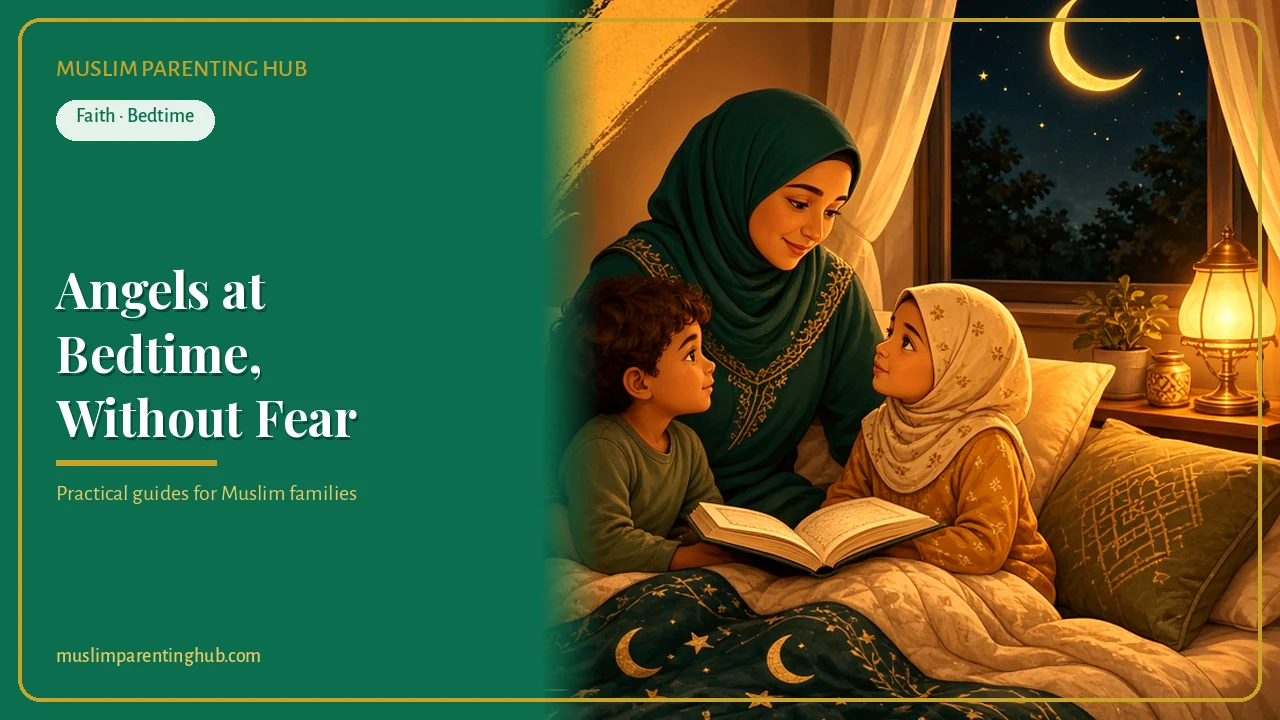
Angels at Bedtime: How to Talk to Muslim Kids About Angels Without Fear
The lights are off. The hallway is quiet. And then a small voice from the top bunk: “Mama… are the angels in my room right now? Can they see me? Are they watching me?”
It’s a sweet question, but it can go either way. Answered one way, your child falls asleep feeling held and safe. Answered another way, they lie awake picturing someone standing in the corner taking notes.
Bedtime is when children think about the unseen most. The house is dark, the day’s noise is gone, and Halloween decorations down the street may have already filled their heads with ghosts and “spooky” things. That’s exactly why bedtime is the best time to teach angels the right way: as a source of comfort, not fear.
If you’re looking for the full foundations (who angels are, their names, age bands), start with our guide to teaching children about angels in Islam without scaring them. This article zooms in on one moment: the last ten minutes before sleep.
Are Angels Scary in Islam? The Short Answer for Parents
No. In Islam, angels are noble, obedient servants of Allah. The Prophet ﷺ told us they were created from light (Muslim). They worship Allah, they never disobey Him, and many of their jobs are about caring for and protecting human beings.
The Quran describes angels who guard each person “before and behind him… by the command of Allah” (Quran 13:11). Angels make dua for believers and ask forgiveness for them (Quran 40:7). They attend gatherings where Allah is remembered. They bring mercy.
So when a child asks “Are angels scary?”, the honest answer is: angels are friends of the believers, sent by a Loving Allah. Some of the things angels do are serious, and some descriptions of them are majestic and huge. But “majestic” is different from “scary,” and small children only need the gentle parts first.
Why Bedtime Is the Right Time (and Why Tone Matters)
At bedtime, kids are:
- Tired, so their imaginations run faster than their reasoning.
- In the dark, where “unseen” feels very literal.
- Alone, often for the first time all day.
That means every word about angels lands heavier at night. A line that’s fine at the breakfast table (“Angels write down everything you do”) can feel like surveillance at 8:30 p.m.
The fix isn’t to avoid the topic. It’s to lead with the angels’ kindness and protection and keep anything heavier for daytime conversations.
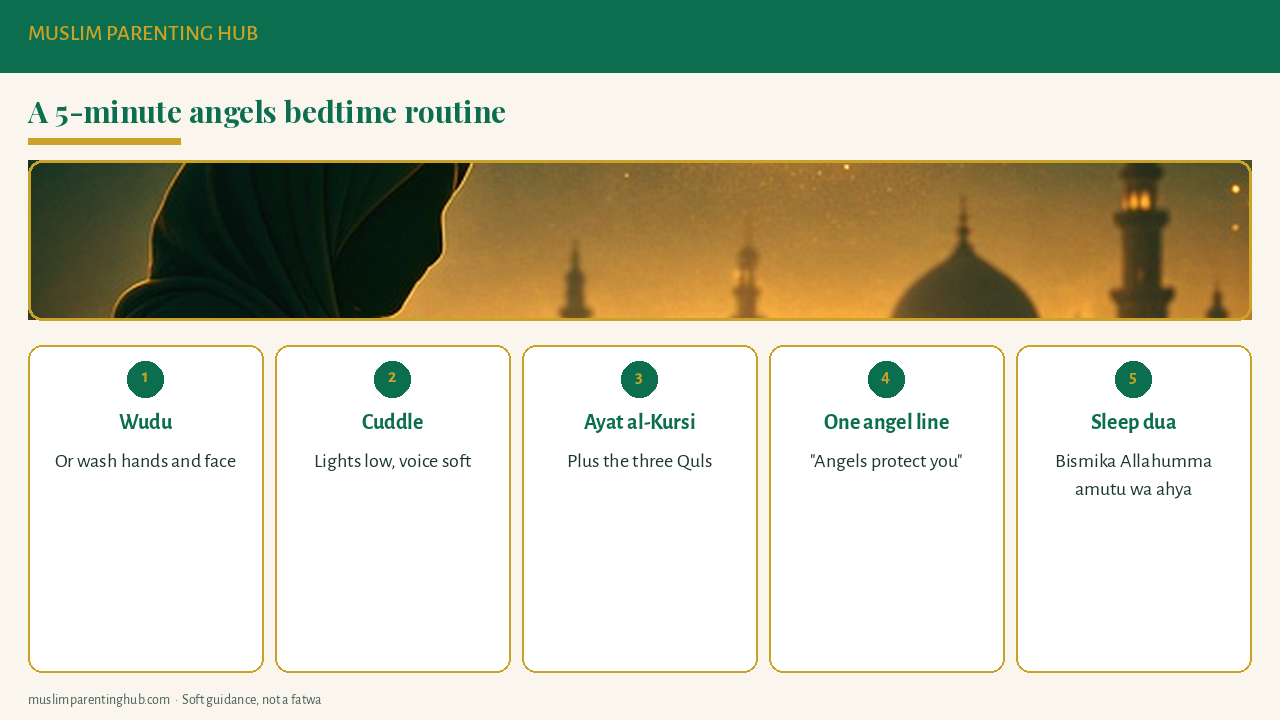
A 5-Minute Angels Bedtime Routine
You don’t need a new lesson every night. You need a short, predictable routine that ends in comfort. Here’s one that many families can fit into their existing bedtime duas routine.
1. Wudu or a quick wash (1 minute). Sleeping in a state of wudu is a Sunnah the Prophet ﷺ taught (Bukhari). For little ones, washing hands and face is plenty. You can say, “We go to sleep clean, like we’re going to meet something special.”
2. Light off, cuddle on (30 seconds). Sit on the bed, lower your voice.
3. Ayat al-Kursi and the three Quls (2 minutes). Recite them for your child or with them. The Prophet ﷺ taught that whoever recites Ayat al-Kursi when going to bed will have a guardian from Allah with them, and no devil will come near them until morning (Bukhari). The Prophet ﷺ also used to blow lightly into his cupped hands after reciting the last three surahs and wipe over his body (Bukhari).
4. One angel line (30 seconds). Just one. “Allah has angels who protect you while you sleep.” Or, “Angels make dua for kind people.” Then stop.
5. The sleep dua (30 seconds). “Bismika Allahumma amutu wa ahya” — “In Your name, O Allah, I die and I live” (Bukhari). For small children, the shorter meaning works best: “With Your name, Allah, I go to sleep and wake up.”
That’s it. Same steps every night. The repetition itself is calming.
Gentle Answers to the Questions Kids Ask at Night
Children ask the hardest questions in the dark. Keep your answers short, warm, and true. If you don’t know something, it’s fine to say, “Allah knows best. Let’s look it up together tomorrow.”
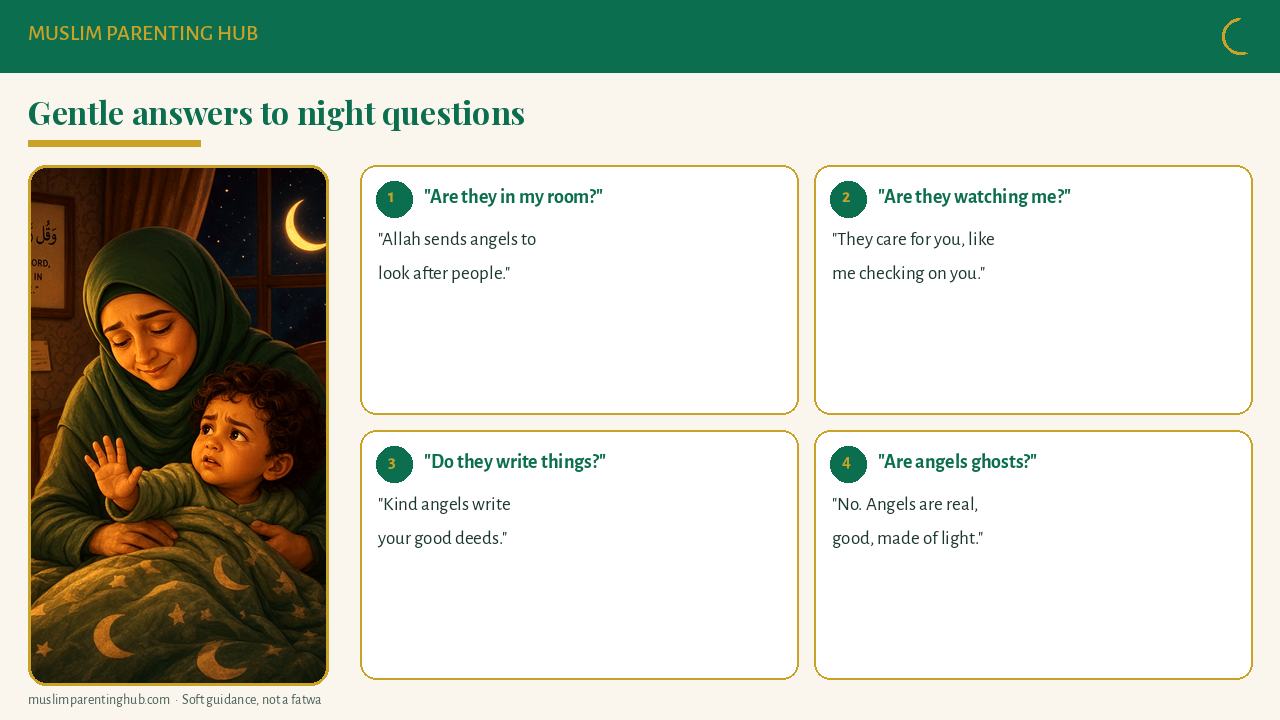
“Are there angels in my room right now?”
“Allah sends angels to look after people, by His permission. You can’t see them, and you don’t need to. Allah sees you and He’s taking care of you.”
“Are they watching me?”
Avoid “watching.” Use “caring.”
“Allah made angels to help and protect. It’s like when I check on you at night. I’m not watching to catch you; I’m checking because I love you.”
“Do angels write down everything I do?”
This is the Kiraman Katibin, the honorable recording angels (Quran 82:10–12). For bedtime, focus on the good side.
“Allah has kind angels who write your good deeds. Today you shared your crayons and helped Dad with groceries. Those are written! And if we make mistakes, we say sorry to Allah and He forgives.”
You can save the details of the recording of bad deeds for daytime and older ages.
“What do angels look like?”
“Angels are made of light. Some have wings. Allah made them beautiful and strong. We’ll see the wonderful things Allah made in Jannah, insha’Allah.”
“Will an angel come take me when I die?”
This one often comes up after a grandparent dies or a pet passes. Stay calm and short at bedtime.
“Everyone goes back to Allah one day, usually when they’re very, very old. Allah sends gentle angels for good people. Right now, your job is to sleep and grow. Tomorrow I’ll tell you more if you want.”
Then follow up in the daytime. Our guide on explaining death to a child in Islam has age-appropriate words.
“Are angels like ghosts?”
In October, this question shows up a lot.
“No. Ghosts in Halloween decorations are pretend. Angels are real and they’re good. They’re made of light and they obey Allah.”
“What about jinn? Are they in my room?”
Jinn are a separate topic, and bedtime is not the moment for a long jinn conversation. Keep it short:
“Jinn are real, but Allah is stronger than everything. When we say Ayat al-Kursi, Allah protects us. You’re safe.”
For a fuller daytime discussion, see how to talk to kids about jinn and the unseen without fear.
What Not to Say at Bedtime
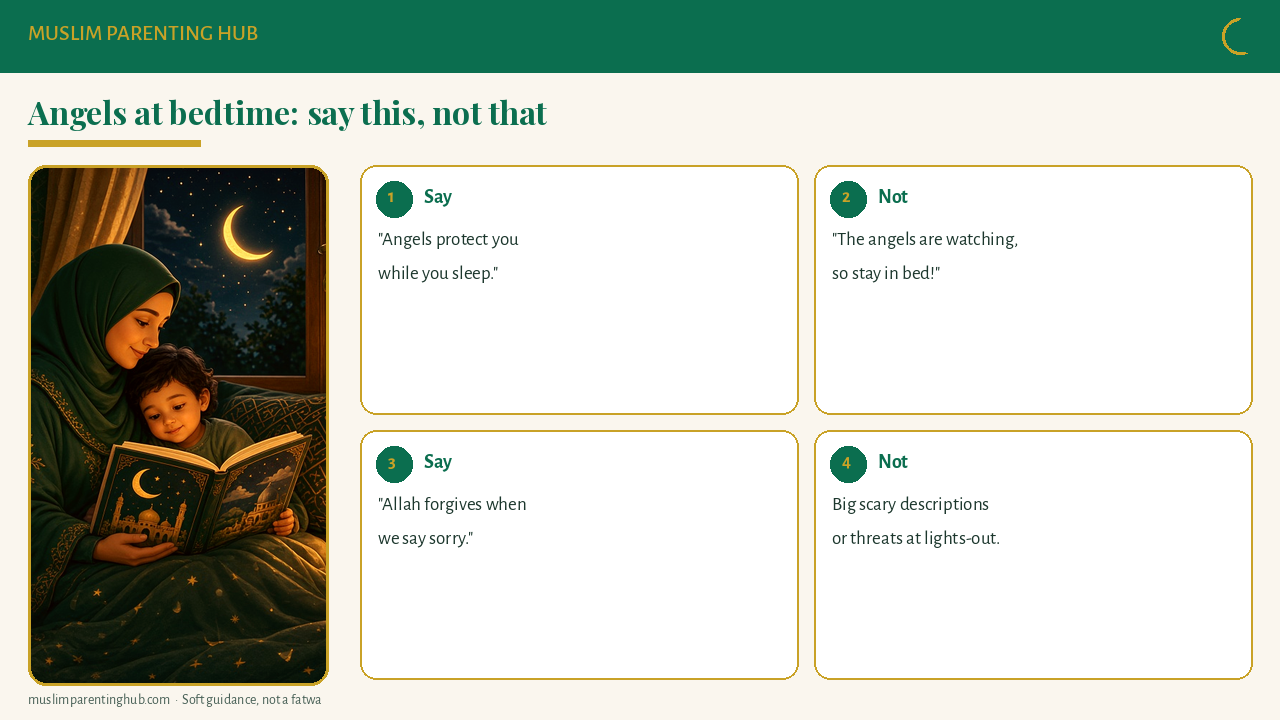
Most accidental fears come from tired parents trying to get kids to behave. A few lines to avoid:
- “The angels are watching, so you’d better stay in bed.” Using angels as bedtime police turns protection into surveillance.
- “If you lie, the angel will write it and you’ll be punished.” True consequences of sin are for calm, older-age teaching, never a threat at lights-out.
- “The Angel of Death could come any time.” Even if technically true, this is not a bedtime sentence for a child.
- Big, dramatic descriptions (huge size, many wings filling the horizon) for children under about eight. These are awe-inspiring for older kids in daylight, but overwhelming at night.
- “Angels leave if you’re bad.” Avoid inventing rules. Stick to what’s in the Quran and authentic Sunnah.
If you’ve already said one of these, it’s okay. Just come back to it the next day: “Remember when I said the angels are watching? I said it wrong. Angels are there to help and protect, and Allah loves you.”
By Age: How Much to Share at Night
Ages 2–4
One sentence, repeated nightly. “Allah takes care of you, and His angels protect you.” Toddlers don’t need names or jobs yet. Pair it with your usual bedtime prophet stories if your child loves stories.
Ages 5–7
Add simple jobs: angels who protect, angels who write good deeds, angels who make dua for us. Name Jibreel as “the angel who brought the Quran to the Prophet ﷺ.” Keep the tone cozy.
Ages 8–10
Older kids can handle the full picture of Kiraman Katibin, Mika’il, Israfil, and the Angel of Death, but teach the heavier parts in daylight. At bedtime, return to protection and mercy. Kids this age also love the idea that angels say “Ameen” and make dua for those who make dua for others (Muslim).
When Your Child Is Already Scared
Sometimes the fear is already there, from a cousin’s story, a YouTube video, a Halloween hallway display, or a nightmare. What helps:
- Listen first. “Tell me what you’re thinking about.” Don’t rush to correct.
- Name the feeling. “You felt scared. That makes sense when it’s dark.”
- Replace the picture. Swap the scary image with a true, gentle one. “Angels are made of light. Light is what makes the dark not scary.”
- Give them something to do. Kids feel braver with an action. “Let’s say Ayat al-Kursi together. Allah protects us.”
- Leave a light on. There’s nothing un-Islamic about a nightlight.
If fears turn into nightmares or trouble sleeping most nights, see our comfort scripts for scary dreams, and talk to your pediatrician if it lasts several weeks.
Making Angels Part of a Warm Day, Not Just the Night
Bedtime goes better when angels aren’t only a nighttime topic. A few easy daytime habits:
- On the drive to school: “The angels are making dua for you while you learn.”
- When your child shares: “That’s a good deed. Maybe the angels just wrote it with a smile.”
- After Jumu’ah: Mention that angels stand at the masjid doors writing who comes (Bukhari).
- Read together: A picture book about angels during the day removes the mystery at night.
When angels are linked to happy moments all day, a bedtime mention brings back those warm feelings instead of fear.
A Final Thought for Parents
Kids borrow our feelings about the unseen. If you speak about angels with love, awe, and calm, your child will, too. On the nights you’re exhausted and can’t manage the whole routine, one line is enough: “Allah is taking care of you, and His angels are protecting you. Goodnight, I love you.”
That sentence, repeated for years, can become one of the safest feelings in your child’s heart.
FAQ
Are angels scary in Islam?
No. Angels are noble servants of Allah created from light. Many of their roles involve protecting people, making dua for believers, and bringing mercy. Introduce them to kids as a source of comfort.
What should I recite with my child at bedtime for protection?
Ayat al-Kursi and the last three surahs (Al-Ikhlas, Al-Falaq, An-Nas) are the core Sunnah recitations, followed by the sleep dua “Bismika Allahumma amutu wa ahya.”
How do I explain recording angels without scaring my child?
Lead with good deeds: “Kind angels write your good deeds.” Explain that Allah forgives when we say sorry, and save detailed talk about bad deeds for daytime and older ages.
My child asked if angels are watching them sleep. What do I say?
Use “caring,” not “watching.” Say that Allah sends angels to protect people by His permission, like a parent checking on a sleeping child out of love.
At what age can kids learn about the Angel of Death?
Most children can handle a gentle explanation from about six or seven, especially after a family loss. Teach it calmly in the daytime, not as a bedtime topic.
Related guides
Related articles

How to Teach Children About Angels in Islam Without Scaring Them
Age-appropriate ways to teach children about angels in Islam—Kiraman Katibin, bedtime protection, gentle scripts, and activities for ages 4–8. Soft, calm faith.
Read guide →
Are Jinn Real? How to Talk to Muslim Kids About Jinn and the Unseen (Without Fear)
Your child heard about jinn at school or from a cousin. Calm, age-by-age answers, scripts, and protection habits that build trust in Allah—not nightmares.
Read guide →
Bedtime Duas for Kids: What to Recite Before Sleep (With a 7-Night Plan)
Bedtime duas for kids made simple: the sleeping dua, the 3 Quls, Ayat al-Kursi and a calm Sunnah sequence, with meanings, age bands and a 7-night plan.
Read guide →
Scary Dreams and Nighttime Fear: Islamic Comfort Scripts for Muslim Kids
Comfort Muslim kids after scary dreams with soft Islamic scripts, short dua, night lights, and parent calm—without fear-based stories. Practical tonight.
Read guide →