"Where Is Allah?" How to Answer Kids' Big Questions About Allah (Ages 4-8)
Around ages 4–8, the questions get bigger. Toddlers asked “Who made the moon?” School-age hearts ask “Where is Allah?” “Can Allah see me in the bathroom?” “Who made Allah?” They are not trying to trap you. They are building a map of reality—and they need love more than a debate club.
If you already practice warm everyday talk from talking about Allah with toddlers, this guide steps up for preschool and early elementary: short honest answers, what to avoid (fear-first theology), a 99 Names mini activity, and permission to say “I don’t know—let’s ask a teacher together.”
Soft guidance for homes—not a fatwa. Aqidah details belong with qualified teachers; parents plant love, clarity, and humility.
Why Kids Ask “Where Is Allah?”
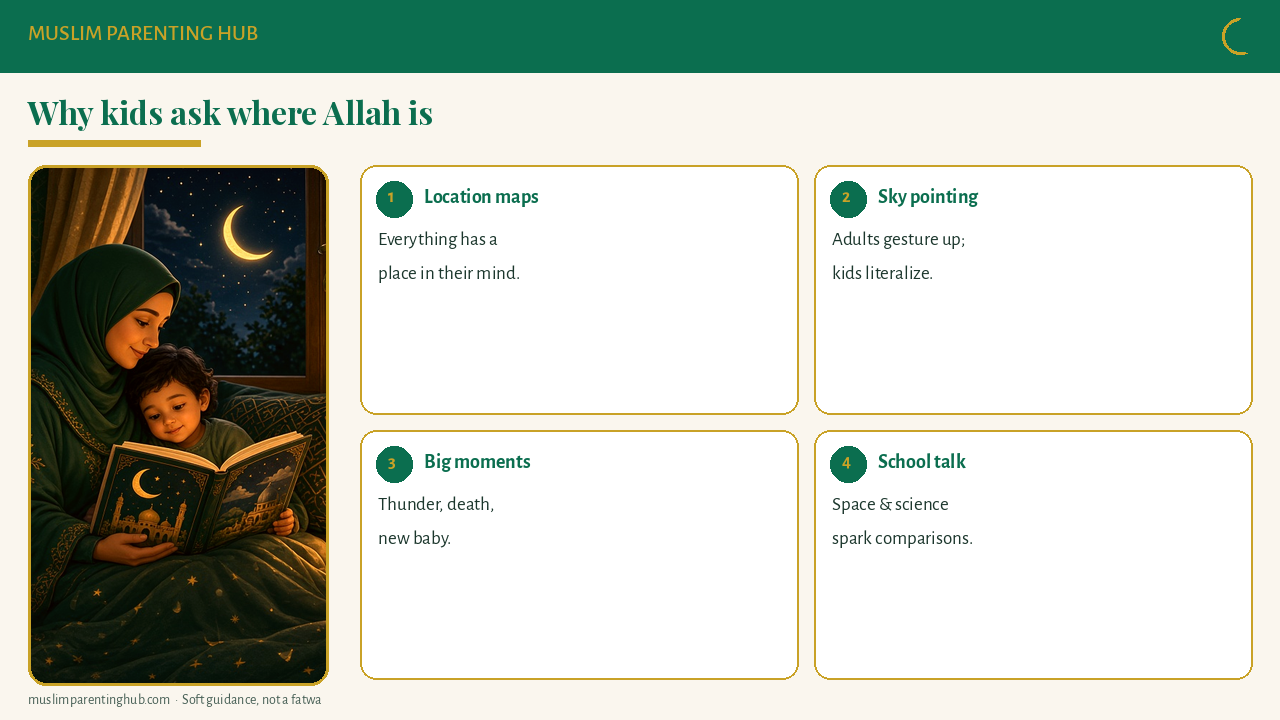
- They locate everything—school, masjid, Grandma’s house—so Allah must “be somewhere” in their mind.
- Adults point up when they say “Allah,” so kids picture the sky only.
- Death, thunder, or a new baby can trigger big cosmology questions overnight.
- Classroom talk about science and space invites comparison questions.
Your job is not to deliver a university lecture. Your job is to keep Allah near, loving, and greater than creation without painting a scary policeman in the sky.
Short Honest Answers to Common Questions
1) “Where is Allah?”
“Allah is not sitting in one chair like we do. Allah is above His creation in a way that fits His greatness—we don’t squeeze Allah into a room. He is always near us with His knowledge and care. When we pray, we face the qiblah, but Allah is not trapped inside the Ka’bah.”
Keep it shorter for a 4-year-old:
“Allah is greater than the whole world. He knows us and hears us wherever we are. We don’t put Allah in a box.”
If your child’s madhhab/teacher uses specific phrasing about istiwa’ or “above the throne,” follow that trusted wording—stay soft and age-fit.
2) “Can Allah see me?”
“Yes. Allah sees you with care—not to scare you. He sees you when you’re kind and when you need help. That is why we try to choose good even alone.”
Avoid: “Allah is watching so He can punish you if you mess up” as the first frame.
3) “Who made Allah?”
“Nobody made Allah. Everything we see was created. Allah is the Creator—He was not born and does not need a maker. That is part of what makes Allah unique.”
For kids who keep looping “but who made Him?”:
“Creatures need makers. Allah is not a creature. It’s okay if your brain feels wobbly—this is one of Allah’s special truths. We can ask Imam/teacher with you.”
4) “Why can’t I see Allah?”
“Our eyes are made for this world—trees, faces, rainbows. Allah is greater than what our eyes can hold. We know Allah through His signs, His words, and how He guides us. One day in the akhirah, believers hope for the greatest joy of being able to see Allah—teachers can explain more when you’re older.”
5) “Does Allah sleep?”
“No. Allah does not sleep or get tired. People sleep. Allah always hears dua—even at 2 a.m. when you whisper.”
6) “Is Allah in my heart?”
Kids hear metaphorical language. Clarify gently:
“We say Allah is ‘in our hearts’ to mean love and remembrance—not that Allah is a little person living inside your chest. Allah is not part of our bodies.”
7) “Does Allah love me when I’m bad?”
“Allah’s mercy is vast. When we mess up, we say sorry to Allah and try to repair. Feeling sad about a wrong can be a gift—it means your heart cares. Allah loves that you turn back.”
Pair with dua from the heart so repentance feels like a conversation, not a courtroom.
8) “Who are the angels? Will they hurt me?”
Redirect fear with your angels for kids approach: angels obey Allah; we do not use angels as Halloween-style scare tools.
Answers by Age Band (4–5 vs 6–8)
Ages 4–5: One or two sentences. Lots of analogy limits (“Allah is not like…”). Heavy warmth. Repeat weekly; they will ask again—that is normal, not failure.
Ages 6–8: Add a little more precision. Invite their question back: “What made you wonder?” Read a short ayah meaning in English. Visit the masjid library or ask the weekend school teacher together.
Story time: Prophet bedtime stories still help—seerah shows trust in Allah without abstract philosophy.
What to Avoid (Fear-Based Answers)
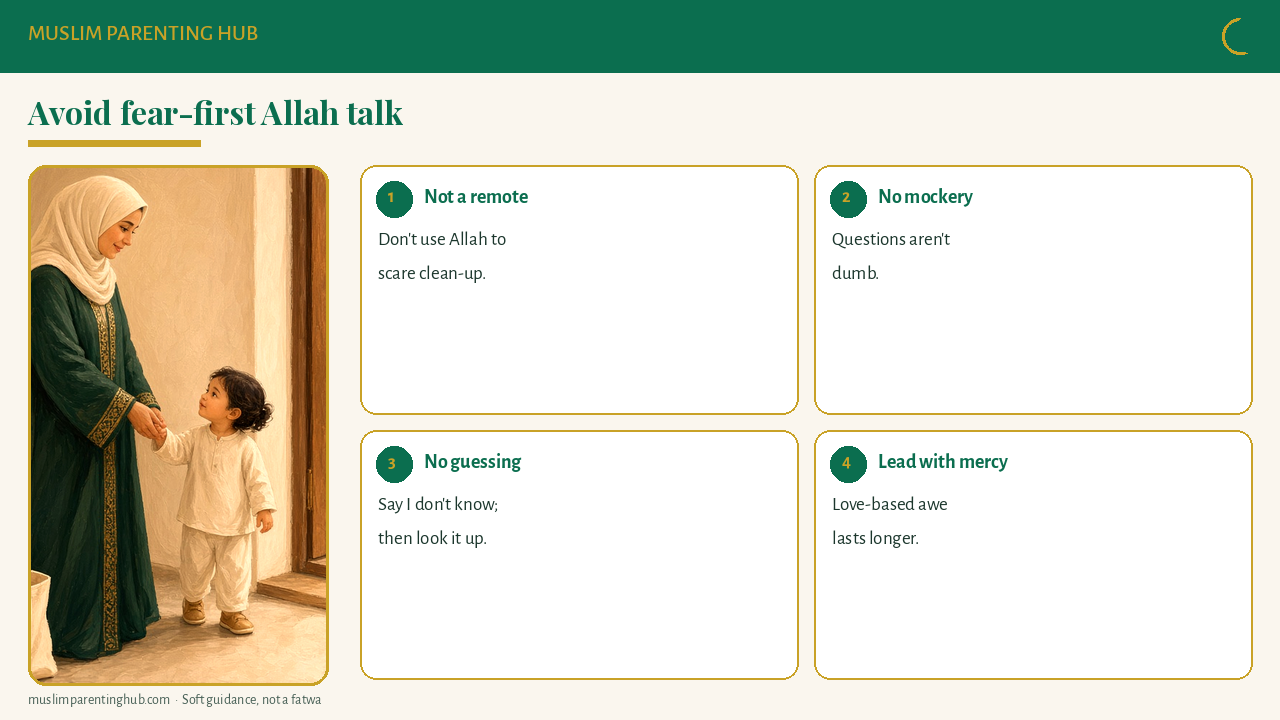
- Using Allah as a behavior remote (“Allah will get you if you don’t clean up”)
- Graphic punishment talk for young kids as the main image of Allah
- Laughing off questions (“That’s a dumb question”)
- Inventing details you do not know to sound smart
- Forcing a child to stop asking because you feel insecure
Fear may produce short-term obedience and long-term distance. Love-based awe lasts longer.
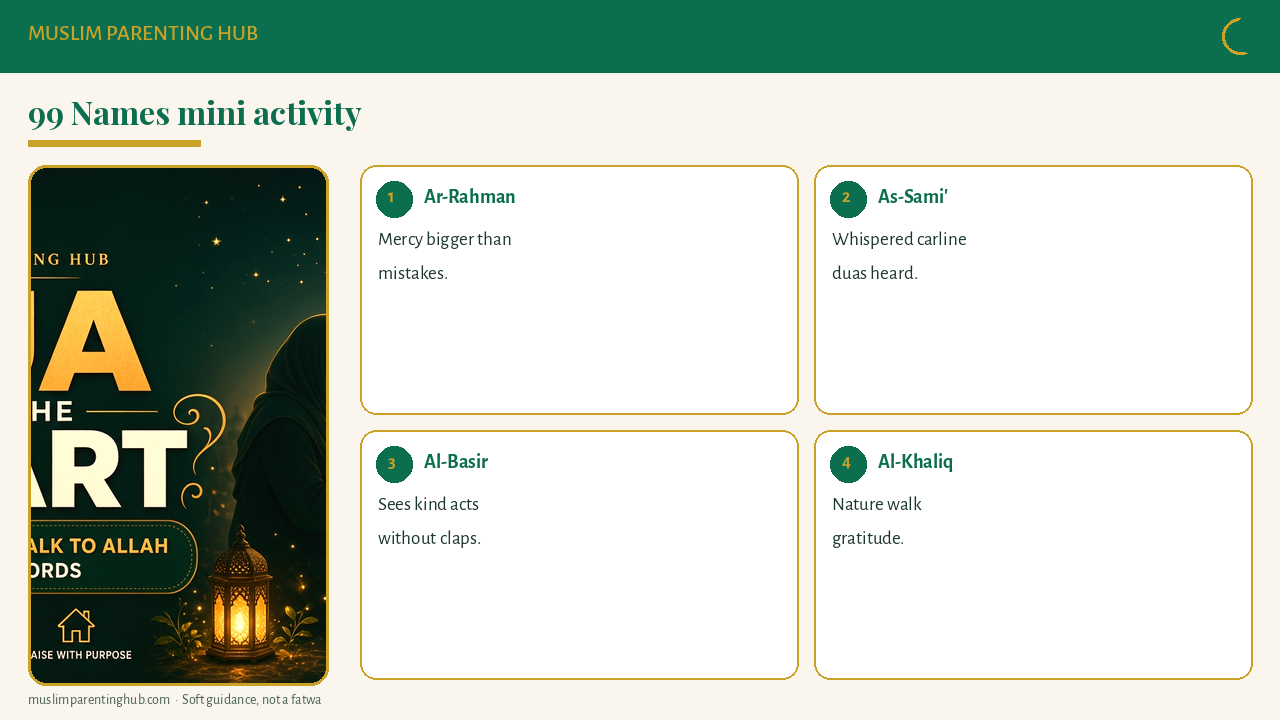
99 Names Mini Activity (Ages 5–8)
Once a week, pick one Name with a kid-friendly meaning:
- Ar-Rahman — The Most Merciful → “Allah’s mercy is bigger than our mistakes.”
- As-Sami’ — The All-Hearing → “Whisper dua in the car; He hears.”
- Al-Basir — The All-Seeing → “Allah sees kind acts nobody clapped for.”
- Al-Khaliq — The Creator → nature walk gratitude.
Make a paper chain or jar of Names. No pop quiz. The goal is affection, not memorizing ninety-nine under pressure.
When You Don’t Know the Answer
This may be the most important script in the article:
“That is a deep question. I don’t want to guess. Let’s write it down and ask Teacher/Imam this weekend—and we can read a trusted kids’ book together.”
Modeling humility teaches sunnah more than a fake confident answer. Kids respect adults who learn beside them.
Bring convert parents and mixed-knowledge homes into the light: you are allowed to grow. Weekend school, a reliable local scholar, and carefully chosen children’s aqidah books help—avoid random viral clips as your theology source.
Scripts for Real US Moments
In the school carline:
“Allah hears your worried feeling about the quiz. Want to make a one-line dua together?”
During thunder:
“Thunder is a creation. Allah is the Creator who knows every storm. You’re safe with us; we can say SubhanAllah.”
After a funeral mention:
“Allah gave life and Allah takes life back. We ask Allah to be kind to them. It’s okay to feel sad and ask questions.”
When a classmate says “God is imaginary”:
“People believe different things. We believe Allah is real. We stay respectful, and we can talk more at home.”
Home Edge Cases
- Autistic / concrete thinkers: Avoid metaphors that sound physical (“Allah lives upstairs”). Prefer: “Allah is not like people. He knows everything and cares for us.”
- Night fears: Separate “Allah sees you” (comfort) from “monsters.” Use night duas and night-lights practically.
- Over-questioning loops at bedtime: Answer once warmly, then: “We’ll talk more tomorrow after breakfast. Right now we rest with Allah’s name.”
Using Nature as a Soft Classroom
On a weekend walk, collect three “signs”: a leaf’s veins, a bird’s nest, a cloud shape. Say: “These point us to the Creator—we don’t worship the leaf; we thank Allah for it.” Keep walks shorter than lectures. Wonder first, labels second.
If your child loves space videos, clarify: planets are created; Allah is the Creator. Amazement at galaxies can feed iman when guided.
Books, Videos, and Quality Control
Choose children’s books from publishers or teachers you trust. Preview YouTube aqidah content before kids watch—viral simplicity sometimes includes errors or fear hooks. One excellent picture book repeated monthly beats twelve random clips.
Convert parents: bilingual books that explain Allah in clear English can be more useful than Arabic-only materials at ages 4–5.
Masjid Q&A Practice
Role-play asking the imam: stand, say salam, ask one question, say thank you. Kids who practice are less likely to freeze or blurt something mid-khutbah. Bring the written question from your “I don’t know” list.
When Questions Come From Non-Muslim Classmates
Coach tone: calm, short, kind. “We believe in one God—Allah. Happy to talk more at lunch if you want.” Then debrief at home. You are raising ambassadors, not debaters who need to win the cafeteria.
Drawing Allah? Keep Boundaries Kind
If a child draws a face and labels it “Allah,” redirect without shame: “We don’t draw Allah—Allah is not like people. Want to draw a mosque or a starry sky and write Alhamdulillah instead?” Offer an alternative creative outlet immediately so art stays joyful.
FAQ
Is it okay to say “I don’t know”?
Yes—and then look it up with a trusted teacher. Honesty protects aqidah better than guessing.
How do I answer “Who made Allah?” without a fight?
State that Allah is the uncreated Creator; creatures need makers. If the loop continues, pause and ask a teacher together.
How do I keep answers about love, not fear?
Lead with mercy, care, and guidance. Mention accountability gently and age-appropriately—not as a first scare tool for spilled juice.
My child mixes Allah with superhero powers. What now?
Smile, then clarify: “Allah is not a comic hero. Allah is the real Creator. Heroes are stories.”
Should I use Arabic terms like istiwa’ with an 8-year-old?
Only if your teacher recommends simple phrasing. Otherwise keep English clear and defer details upstairs in knowledge.
What if grandparents use fear-based Allah talk?
Protect your child’s heart politely: “We’re teaching Allah’s mercy first. Please don’t use scare lines about Allah when correcting them.”
Related guides
- Talk about Allah with toddlers
- Teach kids about angels without scaring
- Dua from the heart
- Bedtime prophet stories
Closing
“Where is Allah?” is a door, not a threat. Walk through it with short truths, warm eyes, and the courage to learn beside your child. Ages 4–8 do not need a full creed manual—they need a relationship with a Lord who hears whispered carline duas and sees kind acts on the playground.
Tonight, if the question comes, breathe. Answer with love. Write down what you do not know. Tomorrow, ask someone trustworthy together. That is parenting as worship.
Related articles

How to Talk About Allah With Toddlers: Simple Words That Stick
Age-0–3 scripts to talk about Allah with toddlers—creation walks, Alhamdulillah reflexes, bedtime lines. Soft, practical, no abstract lectures.
Read guide →
How to Teach Children About Angels in Islam Without Scaring Them
Age-appropriate ways to teach children about angels in Islam—Kiraman Katibin, bedtime protection, gentle scripts, and activities for ages 4–8. Soft, calm faith.
Read guide →
Duas for Kids to Learn: 10 Easy Duas + How to Make Dua From the Heart
10 easy duas for kids to learn, with meanings, plus a simple way to help children make dua from the heart in their own words. Scripts for tonight.
Read guide →
Bedtime Prophet Stories for Toddlers: A 5-Minute Storytelling Method
Tell bedtime Prophet stories for ages 2–4 with a 5-minute method—story frame, weekly rotation, empathy questions, scripts, and calm tips. Soft Sunnah storytelling for tired parents.
Read guide →