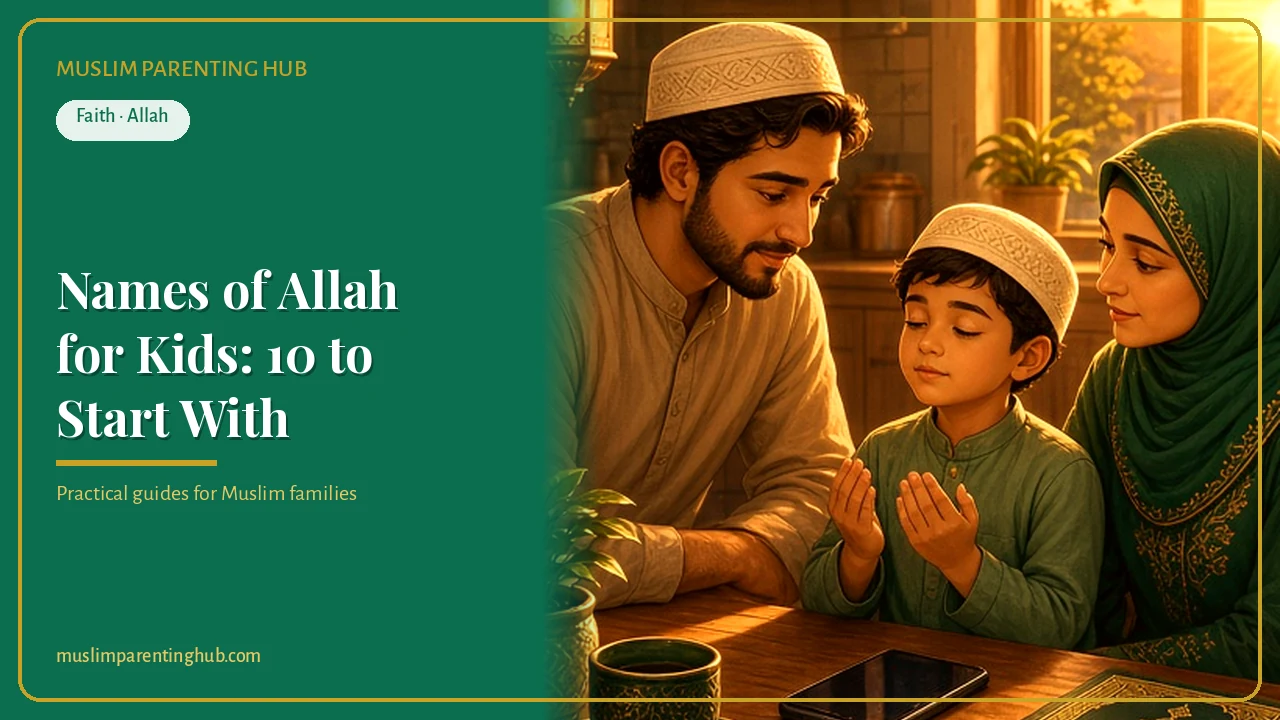
Names of Allah for Kids: 10 Beautiful Names to Start With (and How to Teach Them)
Your five-year-old comes home from weekend school singing a song with a long list of Arabic names. Your three-year-old points at the sunset and says, “Allah made that!” Your eight-year-old asks, “Why does Allah have so many names?”
Those little moments are an invitation. The Names of Allah—al-Asma’ al-Husna, “the most beautiful names”—are one of the gentlest ways to help children know who Allah is. Allah says: “And to Allah belong the most beautiful names, so call upon Him by them” (Quran 7:180). The Prophet ﷺ said that Allah has ninety-nine names, and whoever learns and preserves them will enter Paradise (Bukhari, Muslim).
You don’t have to start with all ninety-nine. In fact, for young children it’s better not to. This guide gives you 10 starter names with kid-sized meanings, the everyday moments where each name fits, a simple name-of-the-week plan, activities by age, and the mistakes to avoid so your child grows up loving Allah, not just reciting a list.
Why Start With a Few Names, Not Ninety-Nine
Memorizing the full list is a beautiful goal, and many children do it with a song. But knowing a name is more than saying it. Scholars explain that “preserving” the names includes understanding them, believing in them, and calling on Allah by them—living with them.
For a child, that means:
- Hearing a name in a real moment (“Alhamdulillah, Allah is Ar-Razzaq—He gave us this food”).
- Using it in their own dua (“Ya Rahman, help my grandma feel better”).
- Seeing it in how you act (gentle when they mess up, because Allah is Al-Ghafur, the Forgiving).
Ten names that a child truly knows are worth more than ninety-nine sung without meaning. Once those ten feel like home, add more.
If your child is still very young, start even smaller. Our guide to talking about Allah with toddlers uses just a few short phrases—“Allah made this,” “Alhamdulillah,” “Ya Allah, help us”—that lay the foundation for the names later.
10 Beautiful Names of Allah to Start With
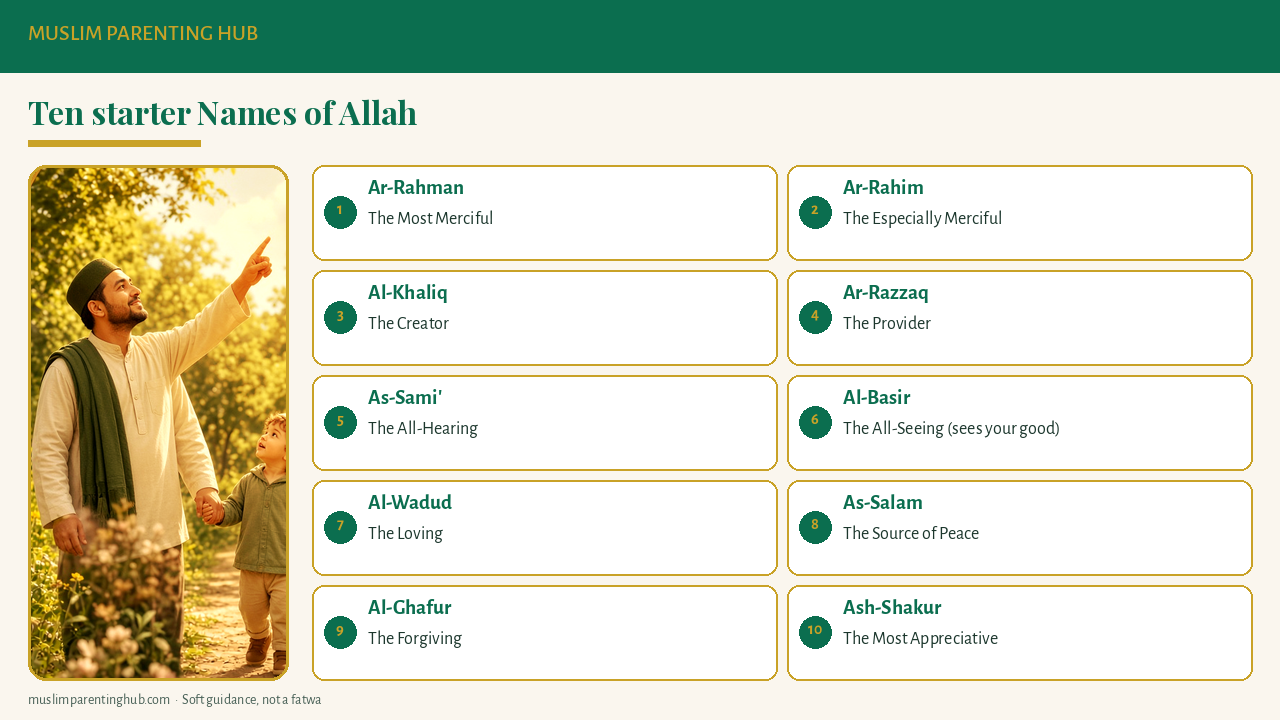
Each name below has a simple meaning, a moment to use it, and a sentence you can say. Translations are approximate; each name carries more meaning than one English word can hold.
1. Ar-Rahman — The Most Merciful
Kid meaning: Allah’s mercy is so big it covers everyone and everything.
Use it when: You see a parent animal caring for babies, or someone is kind.
Say: “Every bit of kindness in the world comes from Ar-Rahman. He is even more merciful than Mama.”
The Prophet ﷺ once pointed to a mother holding her baby close and said Allah is more merciful to His servants than this mother is to her child (Bukhari, Muslim). Children love this.
2. Ar-Rahim — The Especially Merciful
Kid meaning: Allah is kind and caring to the believers again and again.
Use it when: Saying Bismillah—point out the two mercy names in “Bismillahir-Rahmanir-Rahim.”
Say: “Every time we say Bismillah, we remember Allah is Rahman and Rahim. Mercy, mercy!”
3. Al-Khaliq — The Creator
Kid meaning: Allah made everything from nothing.
Use it when: Nature walks, fall leaves, bugs, the moon, a new baby cousin.
Say: “Who made the red leaves? Al-Khaliq. Who made your fingers? Al-Khaliq.”
4. Ar-Razzaq — The Provider
Kid meaning: Allah gives us everything we need—food, water, homes, family.
Use it when: Grocery trips, unpacking lunch, before meals.
Say: “Daddy works and we shop, but it’s Ar-Razzaq who sends us the food. Alhamdulillah.”
5. As-Sami’ — The All-Hearing
Kid meaning: Allah hears every dua, even a whisper, even a dua inside your heart.
Use it when: Bedtime dua, a worried moment, a quiet thank-you.
Say: “You can talk to Allah anytime. As-Sami’ hears you, even when you whisper.”
6. Al-Basir — The All-Seeing
Kid meaning: Allah sees everything—including all the good things you do that nobody notices.
Use it when: Your child helps secretly or keeps trying at something hard.
Say: “Nobody saw you put your brother’s shoes away. But Al-Basir saw. He loves that.”
(Notice the framing: Allah sees your good, not just “Allah is watching, so you’d better behave.” More on that below.)
7. Al-Wadud — The Loving
Kid meaning: Allah loves those who do good, and He wants us to love Him.
Use it when: Cuddles, bedtime, after a kind act.
Say: “I love you so much. And Al-Wadud’s love is even bigger.”
8. As-Salam — The Source of Peace
Kid meaning: Peace comes from Allah. That’s why our greeting is “Assalamu alaikum.”
Use it when: Practicing salam, calming down after a hard moment.
Say: “When we say salam, we’re wishing each other peace from As-Salam.”
This one pairs beautifully with greeting practice—see our 7-day plan to teach toddlers to say salam.
9. Al-Ghafur — The Forgiving
Kid meaning: When we make a mistake and say sorry to Allah, He forgives us.
Use it when: After a mistake has been repaired, at bedtime reflection.
Say: “Everyone makes mistakes. We say Astaghfirullah, and Al-Ghafur forgives. Then we try again.”
10. Ash-Shakur — The Most Appreciative
Kid meaning: Allah notices and rewards even tiny good deeds.
Use it when: A small good deed—picking up trash, sharing a snack, a smile.
Say: “That was small, but Ash-Shakur appreciates every good thing. Nothing is too little.”
Ready for more? Good next names include Al-Karim (The Generous), Al-Latif (The Gentle, The Subtly Kind), Al-Hafiz (The Protector), Al-‘Alim (The All-Knowing), and Al-Qarib (The Near).
The Name-of-the-Week Plan
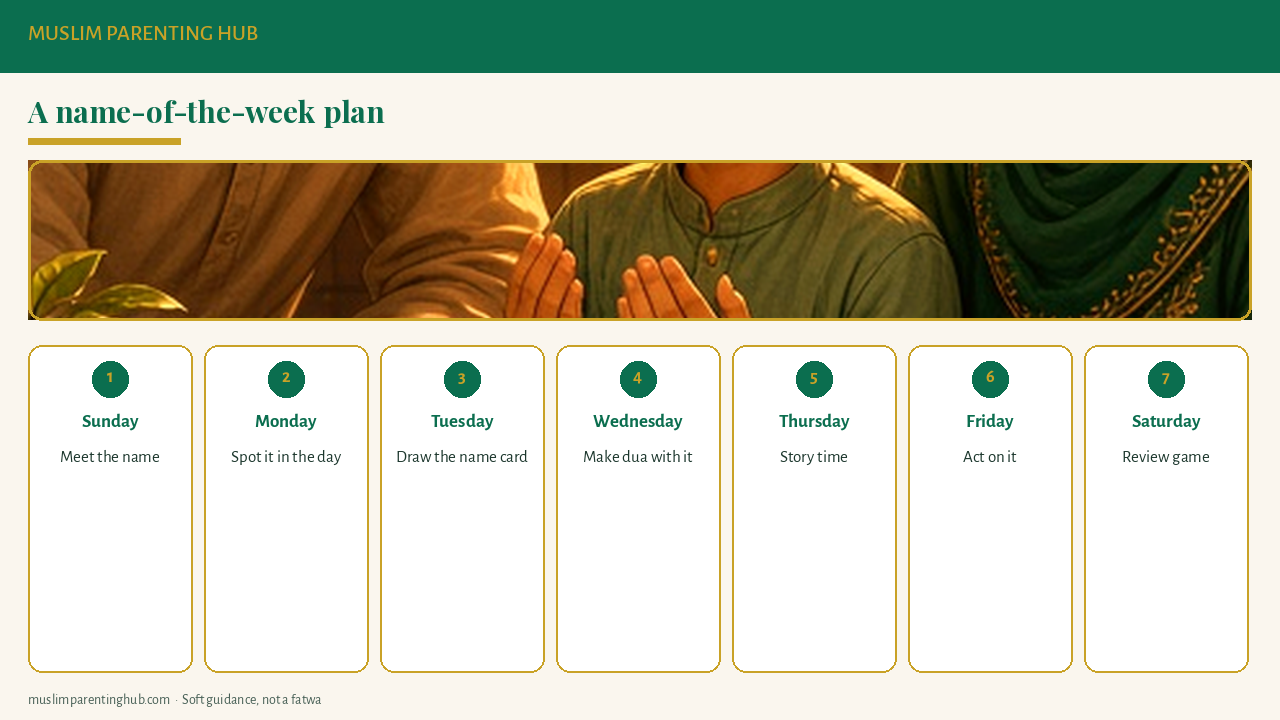
One name a week is slow enough to stick and fast enough to keep it fresh. Ten names take about ten weeks—roughly mid-October to Christmas break.
- Sunday — Meet the name. At dinner or after Maghrib, introduce the name, its kid meaning, and your “say” sentence. Write it on a card for the fridge.
- Monday — Spot it. Everyone looks for the name in the day. “I saw Al-Khaliq in the clouds at recess!”
- Tuesday — Draw it. Kids draw or color the name card (Arabic for older kids, English plus a picture for little ones).
- Wednesday — Dua with it. Each person makes one short dua using the name: “Ya Razzaq, please give food to hungry children.”
- Thursday — Story time. Share a short Quran story or hadith that shows the name.
- Friday — Act on it. Do one deed that reflects the name: Ar-Rahman week, be merciful to an animal; Ar-Razzaq week, give to a food drive.
- Saturday — Rest and review. Add the card to a “names wall” and review the earlier names in a quick game.
You don’t need to do every day. Even “meet it on Sunday, use it at bedtime” works.
Turning the Names Into Dua
The Quran tells us to call on Allah by His names, so the names and dua belong together. Teach children to match the name to what they’re asking for:
- Sick or sad? → “Ya Rahman, Ya Rahim…”
- Scared at night? → “Ya Hafiz, protect us…”
- Made a mistake? → “Ya Ghafur, forgive me…”
- Want something good? → “Ya Karim, You are so generous…”
- Feeling thankful? → “Ya Shakur, thank You…”
This is a lovely bridge to asking Allah in their own words. Our guide to teaching kids to make dua from the heart shows how to move from memorized lines to real, personal conversations with Allah—exactly where the names shine.
Activities by Age
Ages 3–5
- Name cards with pictures: Al-Khaliq with a leaf, Ar-Razzaq with an apple, As-Sami’ with an ear.
- Nature hunt: On a fall walk, find five things Al-Khaliq made.
- Song time: Short songs of the names are fine—just pair each with one picture.
- Bedtime name: Say one name and its kid meaning as the last line before sleep.
Ages 6–8
- Names wall or tree: Add a paper leaf for each name you learn.
- Match game: Match names to situations (“I’m scared of the dark” → Al-Hafiz).
- Journal: One line per week: “This week I saw Ar-Razzaq when…”
- Calligraphy tracing: Trace the Arabic name, then color it.
Ages 9–12
- Name hunt in the Quran: Find where a name appears at the end of a verse, like “wa huwal Ghafurur-Rahim.”
- Mini-presentations: Each child teaches the family one name on a Friday night.
- Pair names: Notice how names come in pairs—As-Sami’ Al-Basir, Al-Ghafur Ar-Rahim—and talk about why.
- Start memorizing the full list with a recitation they enjoy, now that they understand several meanings.
Mistakes to Avoid
1. Using Allah’s names as a threat
“Al-Basir is watching, so stop it!” may stop misbehavior today, but it teaches children that Allah is a security camera. Children who fear Allah only as a watcher can grow anxious or resentful. Hold boundaries with your own calm authority, and keep Allah’s names connected to love, help, and hope. When children ask big questions—“Can Allah see me in the bathroom?” “Where is Allah right now?”—our guide on answering “Where is Allah?” has calm, accurate answers.
2. Overloading meaning
You don’t need to explain every nuance. “Al-Latif means Allah is gentle and kind in ways we don’t always notice” is enough for a seven-year-old.
3. Comparing Allah to people too closely
Comparisons like “more merciful than Mama” help, but add: “Allah is not like anything He made.” That one sentence (from Quran 42:11) protects children from imagining Allah as a giant person.
4. Making it a competition
Sibling memorization contests can motivate some children and crush others. Celebrate each child’s progress against their own last week.
5. Doing it only in “Islam time”
The names belong in the car, at the grocery store, during soccer practice, and at bedtime—not only in weekend school.
Answers to Kids’ Questions
“Why does Allah have so many names?”
“Because Allah is so great that one name can’t tell us everything about Him. Each name teaches us something new.”
“Is Allah’s name Rahman, or is it Allah?”
“Allah is His name. Ar-Rahman, Al-Khaliq and the others are beautiful names that describe Him.”
“Can I call Allah by any name?”
“We call Allah by the names He taught us in the Quran and through the Prophet ﷺ. There are so many beautiful ones to choose!”
“Do angels have names too?”
“Some do! Allah told us about Jibril, who brought the Quran to the Prophet ﷺ. Angels were made by Al-Khaliq, and they love to obey Him.”
Children often connect the names to the unseen world. For calm, age-appropriate answers, see our gentle guide to teaching kids about angels without scaring them.
For details where scholars discuss differences—such as exactly which names make up “the ninety-nine”—ask a teacher or scholar you trust. For young children, the starter names above are widely agreed upon and appear in the Quran.
FAQ
At what age should kids start learning the Names of Allah?
You can start around age 2–3 with one or two names in everyday moments, like “Allah is Al-Khaliq, He made the moon.” Add a name a week from about age 4–5, and begin memorizing the full list when your child understands several meanings.
Which Names of Allah should kids learn first?
Start with names children can connect to daily life: Ar-Rahman, Ar-Rahim, Al-Khaliq, Ar-Razzaq, As-Sami’, Al-Basir, Al-Wadud, As-Salam, Al-Ghafur, and Ash-Shakur.
Should my child memorize all 99 Names of Allah?
It’s a beautiful goal, and many children do it with a song. Pair memorizing with meaning and use—understanding and calling on Allah by His names is part of preserving them.
How do I teach the Names of Allah without scaring my child?
Connect each name to love, care, and help. Avoid using names like Al-Basir (The All-Seeing) as a threat for misbehavior; instead say Allah sees all the good your child does.
How can kids use the Names of Allah in dua?
Match a name to the need: “Ya Rahman” for mercy, “Ya Ghafur” for forgiveness, “Ya Razzaq” for provision, “Ya Hafiz” for protection, then ask in their own words.
Related guides
- How to talk about Allah with toddlers
- “Where is Allah?” Answering kids’ big questions
- Duas for kids to learn and dua from the heart
- 25 short duas for kids to learn by age
Closing: One Name, One Moment
Tonight, pick one name. Maybe Al-Khaliq as the sun sets early this October, or Ar-Razzaq as you serve dinner. Say it in one sentence, connect it to one real thing your child can see or feel, and use it in one short dua at bedtime. Do it again tomorrow. Over the months, your child won’t just know a list of names—they’ll know the One those names describe, and they’ll love Him.
Related articles
"Where Is Allah?" How to Answer Kids' Big Questions About Allah (Ages 4-8)
Gentle, love-based answers for ages 4–8: Where is Allah? Can He see me? Who made Allah?—plus scripts, what to avoid, and when you don't know.
Read guide →
How to Talk About Allah With Toddlers: Simple Words and a 7-Day Plan
What to say when your toddler asks “Who made the moon?” Loving phrases about Allah for ages 0–3, bedtime lines and a 7-day plan—no fear, no lectures.
Read guide →
Duas for Kids to Learn: 10 Easy Duas + How to Make Dua From the Heart
10 easy duas for kids to learn, with meanings, plus a simple way to help children make dua from the heart in their own words. Scripts for tonight.
Read guide →
25 Short Duas for Kids to Learn (By Age, With Meaning and Transliteration)
Short, easy duas for kids by age (2–4, 5–7, 8–10) with transliteration and meaning—plus a gentle 10-minute daily practice for US Muslim families.
Read guide →