Are Jinn Real? How to Talk to Muslim Kids About Jinn and the Unseen (Without Fear)
It usually starts with a whisper. A cousin tells a “true story” at a family dinner. An older kid on the school bus says jinn live in empty bathrooms. A YouTube short autoplays something creepy. And now your seven-year-old won’t walk down the hallway alone after Maghrib.
October makes it louder. Between Halloween decorations at Target, ghost stories at recess, and spooky read-alouds in class, US Muslim kids get a steady drip of “scary unseen things”—and some of them quietly mix all of it up with what they hear about jinn at the masjid.
This guide helps you answer the jinn question honestly (yes, jinn are real in Islam) while keeping your child’s heart anchored in Allah’s power, mercy, and protection. If you’ve already used our approach to teaching kids about angels without scaring them, this is the companion conversation: the rest of the unseen world, told with calm instead of creepiness.
Soft guidance for homes—not a fatwa. For detailed aqidah questions, bring your child to a trusted local teacher or imam.
Why the Unseen Matters (and Why Tone Matters More)
Belief in the unseen—al-ghayb—is part of iman. Allah describes the believers as “those who believe in the unseen” (Qur’an 2:3). Angels, jinn, the Day of Judgment, Jannah: kids will meet all of these ideas eventually.
The problem is rarely the information. It’s the delivery:
- A story told at bedtime with spooky voices
- An adult saying “a jinn will get you if you don’t listen”
- Graphic “possession” videos shown to children for entertainment
- Cousins competing for the scariest tale
Children don’t remember the theology. They remember the feeling. If the feeling is dread, the unseen becomes something to hide from instead of something Allah is in charge of.
Our goal is simple: Allah is the biggest; Allah is in charge; Allah protects us; we have simple daily habits; and we don’t need to be afraid.
The Big Idea: Allah First, Jinn Second
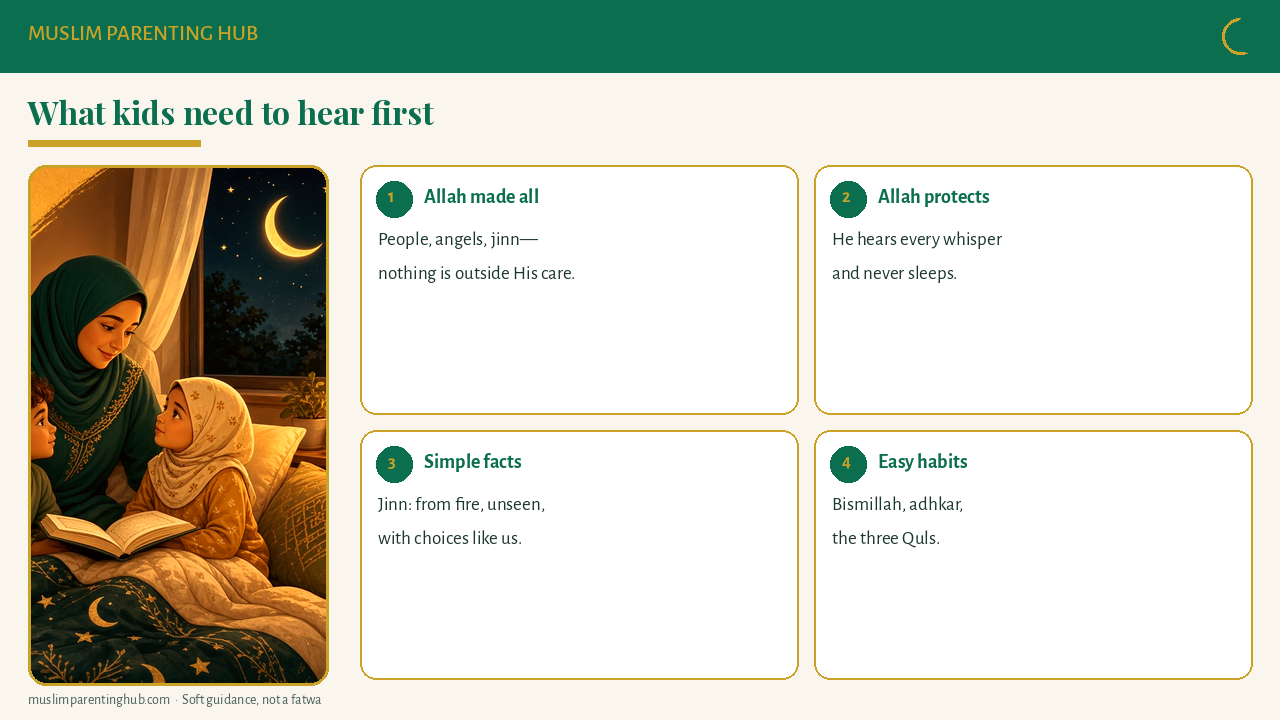
Before you say a single sentence about jinn, make sure your child already knows these three things:
- Allah created everything—people, animals, angels, and jinn. Nothing is outside His control.
- Allah loves and protects us. We ask Him for help and He hears every whisper.
- We have easy protection habits like Bismillah, morning and evening adhkar, and the last three surahs.
If those foundations are wobbly, start there. Our guide on answering “Where is Allah?” is a good warm-up for kids ages 4–8 who need Allah to feel near and loving first.
Only then add the jinn piece—short, factual, and calm.
What to Tell Kids About Jinn (Simple, True Facts)
Keep it to a handful of facts drawn from the Qur’an and authentic Sunnah, and resist the urge to add folklore.
- Jinn are a creation of Allah, like people and angels. Allah tells us He created jinn from smokeless fire (Qur’an 55:15).
- We usually can’t see them. That’s normal—there are lots of things Allah made that we can’t see, like air and radio signals.
- Jinn have choices, like people. Some are Muslim and good; some are not. There is a whole surah named after them—Surah Al-Jinn—where some jinn hear the Qur’an and believe.
- Jinn are not more powerful than Allah. Nothing is. They can’t do anything Allah doesn’t allow.
- Shaytan (Iblis) was from the jinn, and he tries to whisper bad ideas. Our job is to say “A’udhu billah” and choose good.
- Allah gave us protection. Bismillah, adhkar, Ayat al-Kursi, and the three Quls are like a shield Allah gave us.
That’s it for most children under ten. You don’t need names, stories of haunted houses, or detailed descriptions.
A script for ages 4–6
“Allah made lots of creations. People like us. Animals. Angels made of light. And jinn, made of fire—but we can’t see them. Some jinn are good Muslims! And Allah is bigger than all of them. When we say Bismillah, we’re asking Allah to take care of us. And He does.”
A script for ages 7–10
“Jinn are real, and Allah tells us about them in the Qur’an so we’re not confused by scary movies. They’re created beings with choices, like us. Shaytan is from the jinn, and he tries to whisper bad ideas—that’s why we say A’udhu billah. But here’s the most important part: jinn can’t do anything without Allah’s permission, and Allah gave us simple duas that protect us. We’re not supposed to live scared. We’re supposed to live connected to Allah.”
Jinn vs Ghosts vs Halloween Monsters
US kids hear a lot of words that sound similar but mean different things. Sorting them out lowers fear.
| What kids hear | What Islam teaches |
|---|---|
| Ghosts (dead people wandering) | People’s souls don’t roam haunted houses; after death, souls are in Allah’s care until the Day of Judgment. |
| Monsters under the bed | Made-up stories. Allah didn’t create “bed monsters.” |
| Zombies, vampires | Pretend characters for movies and costumes. |
| Jinn | Real creation of Allah, usually unseen, with free will—and under Allah’s control. |
| Angels | Real creation of Allah made of light, who always obey Him. |
If your child is anxious this month, the Halloween at a US public school plan covers how to handle spooky classroom themes, parades, and read-alouds without shaming friends.
Turning Fear Into Calm: A 4-Step Response
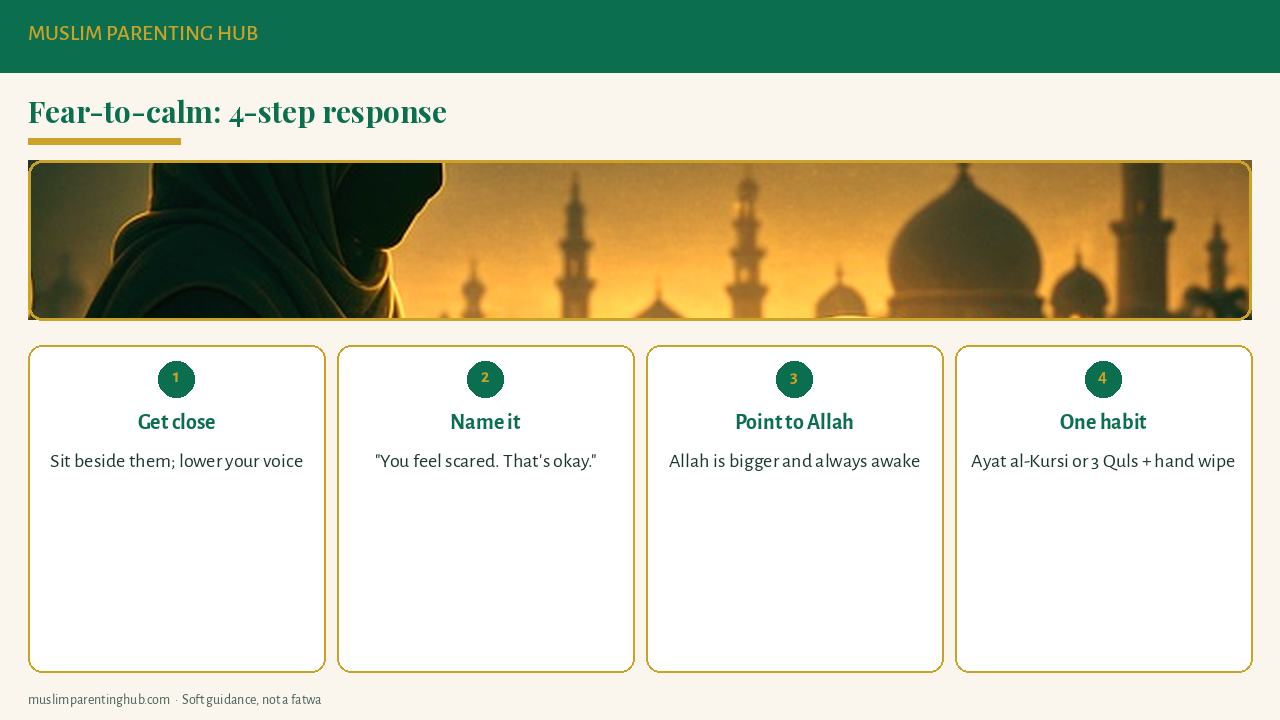
When your child comes to you scared—“Is there a jinn in my room?”—use this four-step response. It works at 3 p.m. and at 2 a.m.
Step 1 — Get close. Sit beside them. Lower your voice. Touch matters more than words at first.
Step 2 — Name the feeling. “You feel scared. That’s okay. Lots of kids feel that way when they hear stories.”
Step 3 — Point to Allah. “Allah is bigger than anything. Allah is awake when we sleep. Allah protects this house.”
Step 4 — Do one habit together. Recite Ayat al-Kursi or the three Quls, blow gently into your hands, and wipe over their body the way the Prophet ﷺ did before sleep. Then say, “Now we trust Allah and rest.”
For repeated nightmares, our scary dreams comfort scripts walk through the full nighttime routine, including what not to say at 2 a.m.
Daily Protection Habits (Small, Not Spooky)
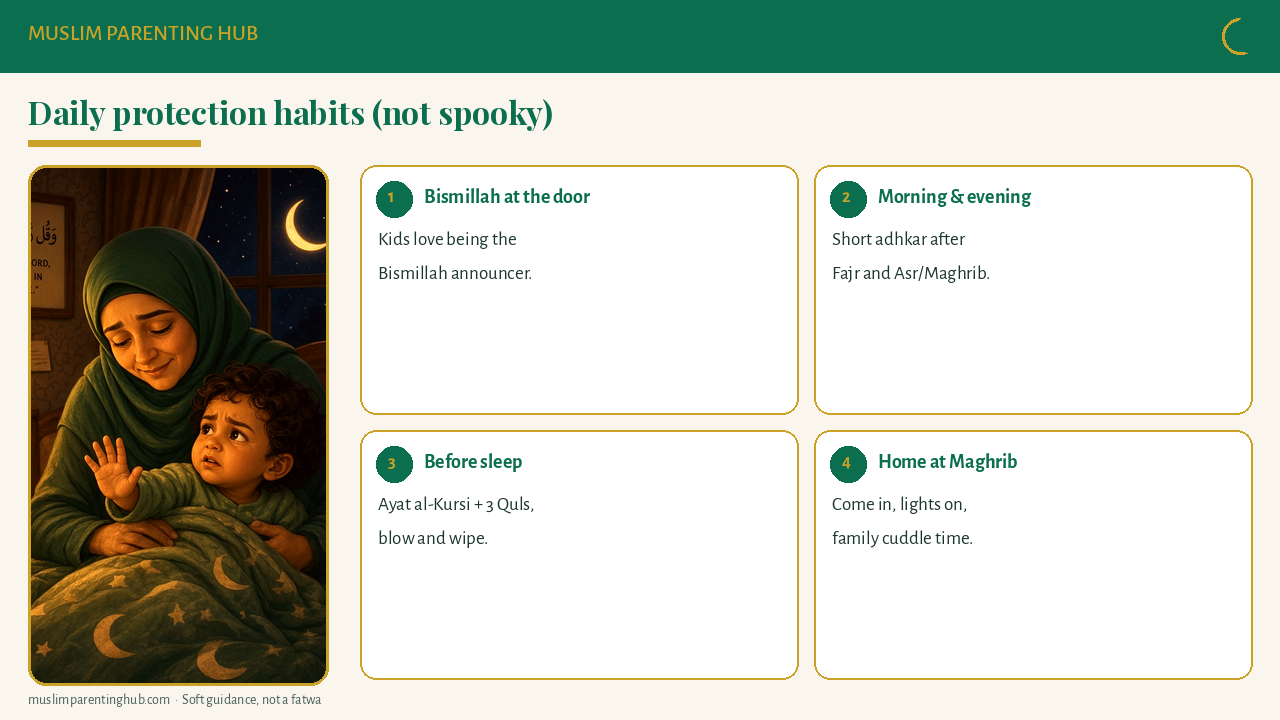
The Sunnah offers protection habits that are ordinary, gentle, and family-friendly. Present them as “Allah’s care routines,” not anti-monster weapons.
- Bismillah at the door. Saying Bismillah when entering the house and when eating. Kids love being the “Bismillah announcer” at the front door.
- Morning and evening adhkar. A short set after Fajr and after Asr or Maghrib. Our 5-minute morning protection dua routine is designed for busy school mornings.
- The three Quls before sleep. Surah Al-Ikhlas, Al-Falaq, and An-Nas, blowing into the hands and wiping over the body.
- Ayat al-Kursi at bedtime. Children can learn it in small chunks over weeks.
- Bathroom dua. “Allahumma inni a’udhu bika minal khubuthi wal khaba’ith” before entering. Teach it as manners, not as fear.
- Coming inside at Maghrib. The Prophet ﷺ advised families to keep young children close at the start of nightfall (reported in Bukhari and Muslim). Frame it warmly: “Maghrib is our come-home-and-cuddle time.”
That last one fits neatly into an after-school Maghrib routine: snack, wudu, pray together, lights on, doors closed, and family time.
Age Bands: How Much Is Enough?
Toddlers (ages 2–3)
Don’t introduce jinn at all unless they ask. Focus on “Allah made everything” and “Allah takes care of us.” Bismillah and simple bedtime duas are plenty.
Preschool (ages 4–5)
If they ask, give one or two sentences: “Jinn are something Allah made that we can’t see. Allah is in charge of them.” Then move on cheerfully. Avoid follow-up details.
Early elementary (ages 6–8)
This is when school and cousins bring stories. Give the simple facts list, the jinn vs ghosts table, and the protection habits. Answer only what they ask.
Upper elementary (ages 9–11)
They can handle Surah Al-Jinn’s story, the idea of Shaytan’s whispers, and why Muslims don’t use fortune-tellers or “ghost hunting” apps. Talk about media choices and how fear sells content.
What Not to Say (Common Accidental Scares)
- “If you don’t clean your room, a jinn will come.” (Threat + fear = confusion about Allah.)
- “Don’t go in the bathroom alone, the jinn live there.” (Creates bathroom anxiety—hard for school.)
- “Your aunt got possessed because she didn’t pray.” (Graphic and blaming.)
- “Look at this video of a real jinn.” (Entertainment fear is not education.)
- Doing spooky voices or jump scares “for fun.”
If a relative uses these lines, gently redirect in private: “We’re trying to teach about jinn calmly so the kids feel safe with Allah. Can we keep the scary stories out of the kids’ room?”
When Cousins, Classmates, or Videos Bring Scary Stories
You can’t control every sleepover or carpool. You can give your child a reset phrase and a plan.
Reset phrase: “Allah is bigger. I say A’udhu billah and I don’t need to keep listening.”
Plan:
- Your child is allowed to walk away from a scary story—no explaining needed.
- They tell you afterward without getting in trouble.
- You sit together, sort the facts from fiction, and do one protection habit.
Practice it at home with role-play: you play the cousin telling a spooky tale, your child practices saying, “I don’t like scary stories. Want to play something else?”
Jinn, Screens, and October Content
Short-form video apps love “real jinn caught on camera” clips. They are built to keep kids scared and scrolling.
- Turn off autoplay on shared devices and YouTube Kids.
- Search history check: if you find spooky jinn content, don’t panic or punish—talk.
- Choose calm Islamic stories that mention the unseen in context (Surah Al-Jinn, the story of Prophet Sulayman) rather than horror-style channels.
A 10-Minute Family Talk (Daytime, Not Bedtime)
Pick a sunny afternoon—never right before bed.
- Open (1 minute): “Someone asked me about jinn. Want to learn what Allah actually says?”
- Facts (3 minutes): Share the simple facts list.
- Sort it (3 minutes): Play “Real or pretend?” with ghosts, zombies, angels, jinn, dragons, Shaytan’s whispers.
- Habit (2 minutes): Practice the three Quls with the hand-wipe.
- Close (1 minute): “Who’s the biggest? Allah! Who protects us? Allah!” High five.
Repeat parts of it as questions come, not as a weekly lesson.
FAQ
Are jinn real in Islam?
Yes. The Qur’an teaches that Allah created jinn from smokeless fire, that they are usually unseen, and that they have free will like people. Explain this calmly and always alongside the truth that Allah is in full control.
At what age should I teach my child about jinn?
There’s no need to introduce jinn to toddlers. Answer briefly when a preschooler asks, and give simple facts around ages 6–8 when school and cousins bring stories. Detailed discussion fits ages 9 and up.
My child is scared of jinn at night. What should I do?
Sit close, name the feeling, remind them Allah is bigger and awake, then recite Ayat al-Kursi or the three Quls together and wipe over them. Keep jinn conversations to daytime and keep the bedtime routine calm and predictable.
What’s the difference between jinn and ghosts?
Islam doesn’t teach that dead people wander as ghosts. Jinn are a separate creation of Allah. Monsters, zombies, and vampires are pretend characters. Sorting these out often reduces fear quickly.
Should I let my child watch videos about jinn?
Avoid “real jinn caught on camera” and horror-style channels. They’re designed to frighten. Choose calm, age-appropriate Islamic stories that mention the unseen in context, and watch together.
How do I stop relatives from telling scary jinn stories?
Talk privately and kindly. Explain you’re teaching about the unseen calmly so the kids feel safe with Allah, and ask them to save serious topics for adults. Give your child a reset phrase and permission to walk away.
Related guides
- Teach kids about angels without scaring them
- Scary dreams and nighttime fear: Islamic comfort scripts
- Bedtime duas for kids (7-night plan)
- “Where is Allah?” answers for kids
Closing: The Unseen Is Allah’s, Too
Children don’t need every detail about jinn. They need to know that everything seen and unseen belongs to Allah, that He hears them, and that the habits you practice together are a gift of protection. Say it calmly, say it in daylight, and say it again when they ask. Over time, “Are jinn real?” becomes a question your child can answer with confidence: “Yes—and Allah is bigger.”
Related articles
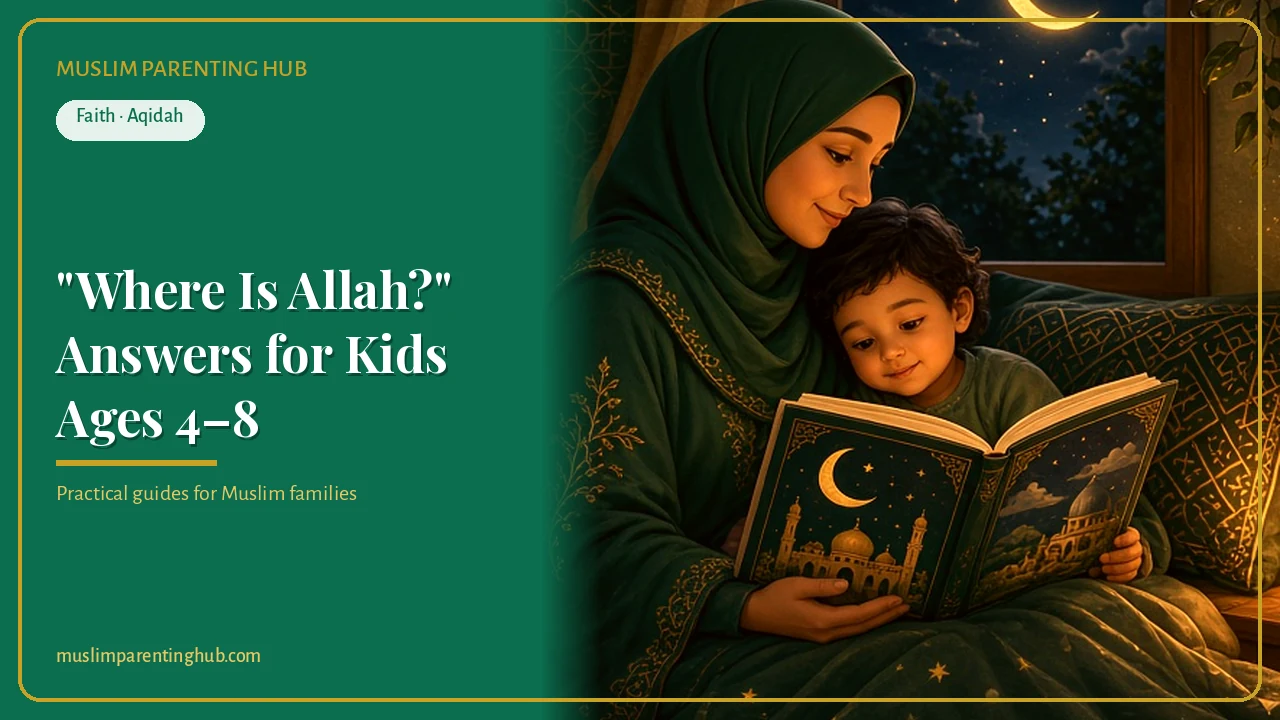
"Where Is Allah?" How to Answer Kids' Big Questions About Allah (Ages 4-8)
Gentle, love-based answers for ages 4–8: Where is Allah? Can He see me? Who made Allah?—plus scripts, what to avoid, and when you don't know.
Read guide →
How to Teach Children About Angels in Islam Without Scaring Them
Age-appropriate ways to teach children about angels in Islam—Kiraman Katibin, bedtime protection, gentle scripts, and activities for ages 4–8. Soft, calm faith.
Read guide →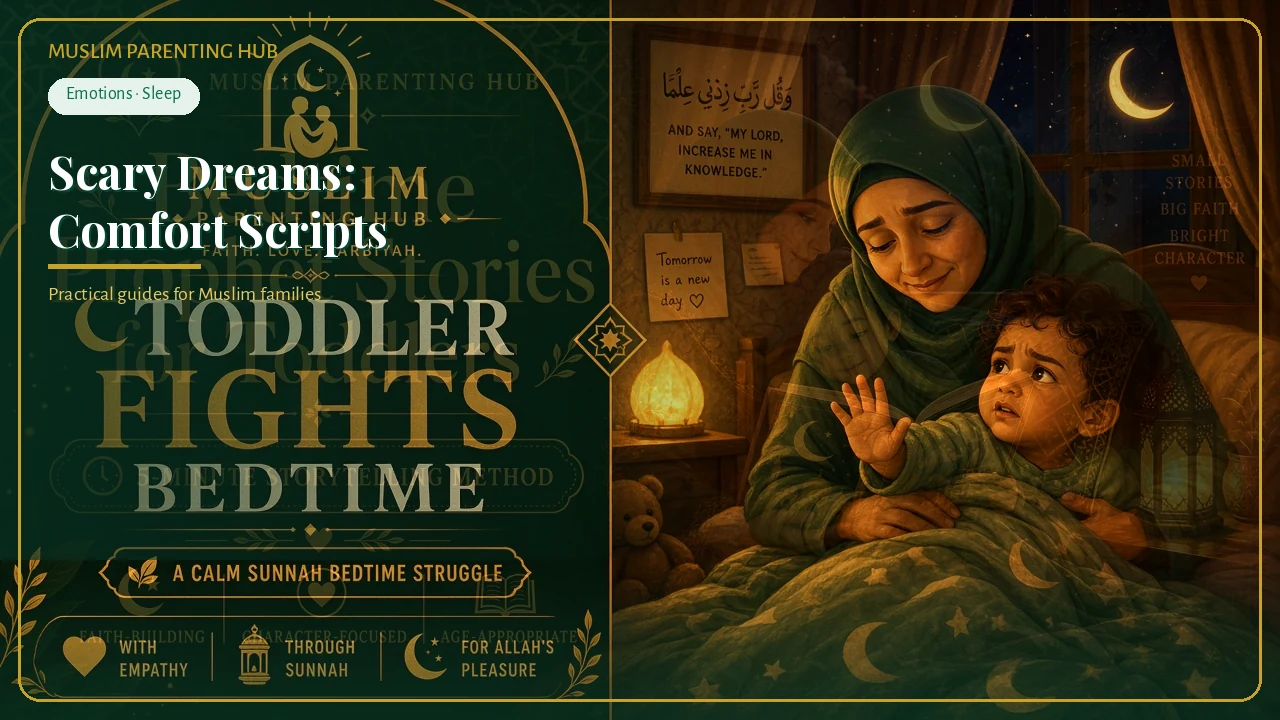
Scary Dreams and Nighttime Fear: Islamic Comfort Scripts for Muslim Kids
Comfort Muslim kids after scary dreams with soft Islamic scripts, short dua, night lights, and parent calm—without fear-based stories. Practical tonight.
Read guide →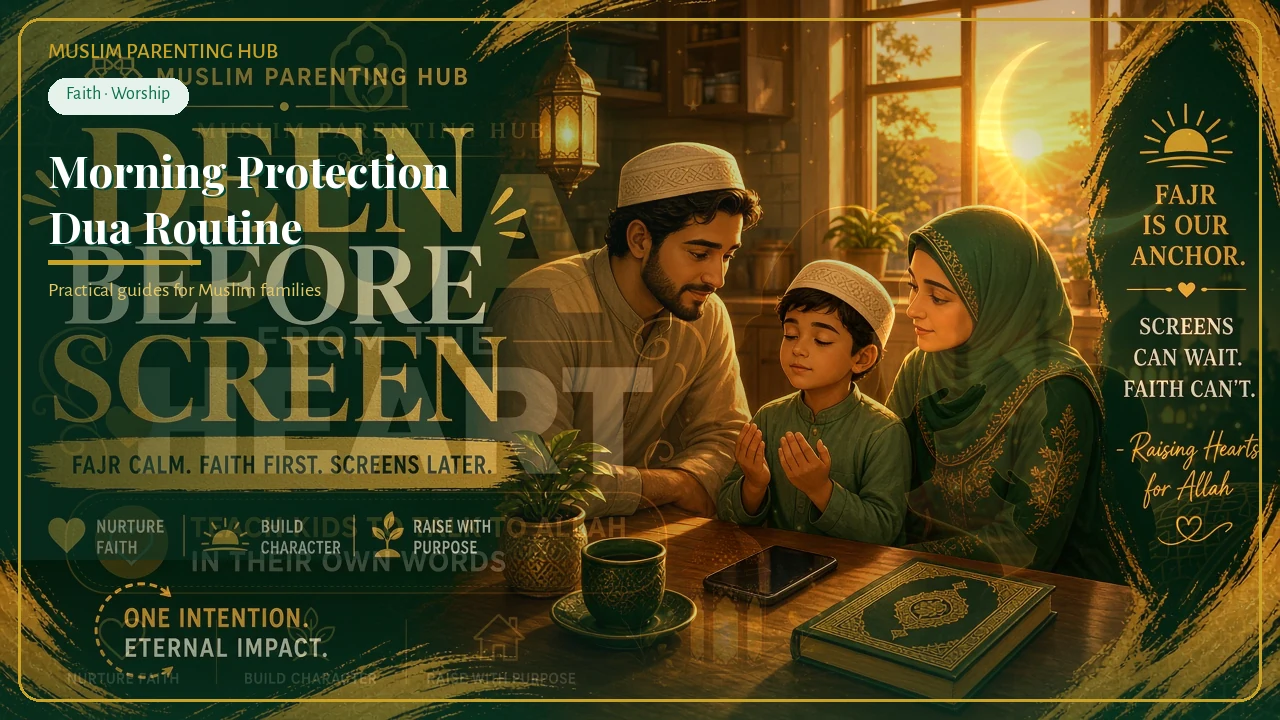
A 5-Minute Morning Protection Dua Routine Muslim Kids Can Grow Into
A gentle 5-minute morning protection dua routine for Muslim kids—wake-up words, short adhkar by age, and scripts that grow with toddlers to school-age.
Read guide →